

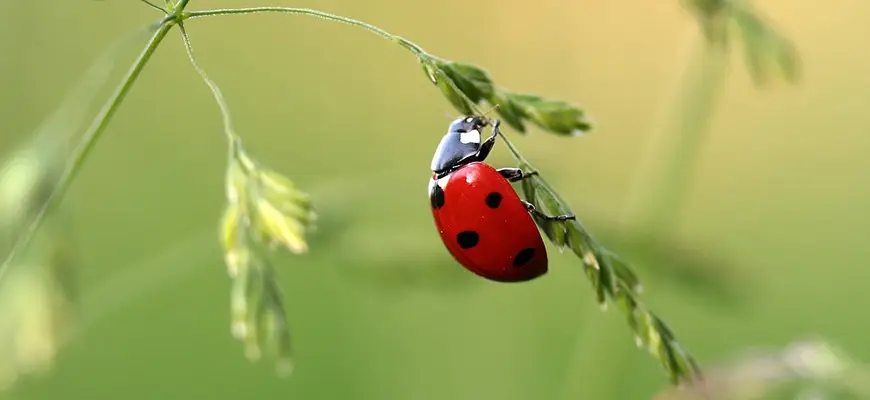
Beneficial insects for plants are predatory or parasitic species that hunt and eliminate common garden pests — naturally, without spraying a thing. Whether you’re managing a backyard garden, a grow tent, or a commercial cultivation facility, these biological control agents can be the difference between a manageable pest situation and a full-scale infestation.
The idea sounds counterintuitive: add more bugs to get rid of bugs. But this is pest management as old as agriculture itself, and modern horticulture has turned it into a science. Today you can order precisely the right species for your specific pest, sized to your square footage, and have them ready to deploy within days.
This guide covers the most effective beneficial insects and predatory organisms for controlled-environment growing — what they eat, what conditions they need, how to release them, and how they fit into a broader integrated pest management program.
Growing at commercial scale? See the For Commercial Operations section for guidance on programmatic releases, stacking strategies, and integrating beneficials with spray programs across multiple rooms.
What Are Beneficial Insects and How Do They Work?
Beneficial insects are organisms — predators, parasitoids, or parasites — that reduce pest populations by feeding on them or interrupting their reproductive cycle. They operate in two main modes:
Predators (ladybugs, lacewings, predatory mites) physically consume pest insects at the egg, larval, or adult stage. They’re most effective when deployed early, while pest populations are still low.
Parasitoids (Aphidius wasps, Trichogramma wasps) lay eggs inside or on a host pest. The hatching larvae consume the host from within, killing it and disrupting reproduction. These are often invisible in action but devastating to pest colonies over time.
One important note: predatory mites — covered below — are technically arachnids, not insects. But they belong in any honest guide to biological control because they’re among the most effective tools available for spider mite and thrips management in indoor grows.
The main advantage over chemical sprays: no pesticide residues on plants, reduced risk of resistance development compared with repeated chemical applications, and strong compatibility with many organic certification programs when organisms are sourced and used according to program rules. The main limitation: most beneficial colonies are short-lived (typically 2–4 weeks for many species), which means they work best as part of a regular IPM program rather than a one-time emergency treatment. For a look at the most common grow room pests and diseases you’ll be deploying them against, start there.
The Most Effective Beneficial Insects for Indoor and Outdoor Growing
Ladybugs (Hippodamia convergens)*
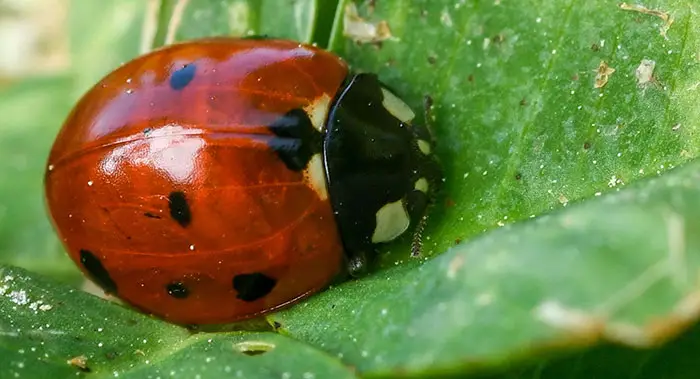
Ladybugs are the most recognizable beneficial insect, and their reputation is well-earned. A single adult can consume up to 60 aphids per day and up to 5,000 over its lifetime — making them one of the few beneficial organisms that can substantially outpace aphid population growth when conditions are favorable. Beyond aphids, ladybugs will consume whiteflies, mites, weevil larvae, adelgids, and various soft-bodied pest eggs.
Target pests: Aphids (primary), whiteflies, mites, weevil larvae, adelgids
Conditions needed: Moist, moderately humid conditions (around 60–70% RH). Keep growing medium damp and avoid deploying into rooms immediately after any broad-spectrum spray.
Release rate: 2–4 per square foot preventatively; increase for active infestations and repeat releases every 1–2 weeks.
Important limitation: Ladybugs released indoors may attempt to leave through light sources or exhaust fans. Evening or low-light releases reduce this behavior.
Lifespan: Several months up to about a year under favorable conditions, with the full life cycle from egg to adult typically completed in a few weeks.
Green Lacewings (Chrysoperla rufilabris)*
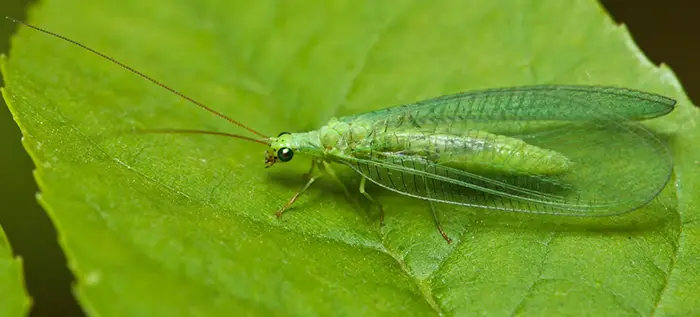
Lacewing larvae — called “aphid lions” — consume up to 200 pests per week across aphids, thrips, whiteflies, mealybugs, and small caterpillars. The adult lacewing feeds only on pollen and nectar; the larval stage does all the pest control work. Purchase larvae or eggs, not adults — larvae begin feeding immediately upon release and can be distributed directly onto canopy near pest hot spots.
Target pests: Mealybugs (primary), aphids, thrips, whiteflies, scale insects, small caterpillars
Conditions needed: 65–80°F, moderate humidity. Adapts well to typical indoor grow room conditions.
Release rate: Distribute larvae near pest concentration points, placed off ground level to avoid predation by soil-dwelling organisms.
Lifespan: Larvae feed actively for 2–3 weeks; adult lacewings live 4–6 weeks.
Shop: Tip Top Bio-Control Green Lacewing Larvae | ARBICO Organics Green Lacewing Eggs (250,000)
For more on mealybug management, see our complete guide on how to get rid of mealybugs.
Orius insidiosus (Minute Pirate Bug)
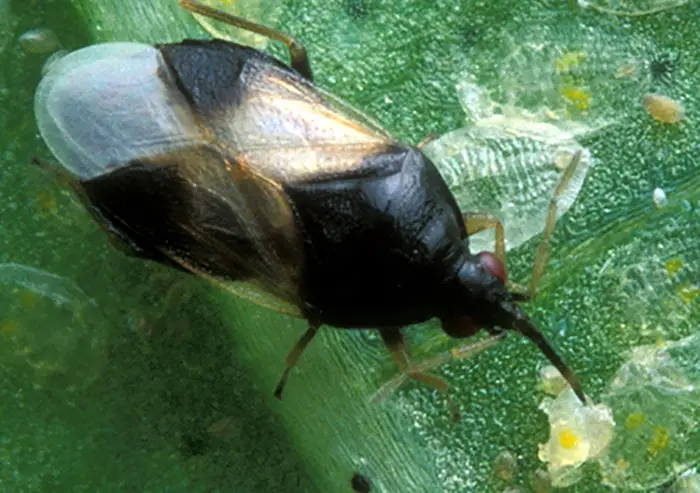
Orius insidiosus is one of the most effective biological controls for thrips available in greenhouse and indoor cropping systems. Extraordinarily aggressive, it pursues thrips adults, larvae, and eggs with equal efficiency — under good conditions one Orius can destroy around a dozen thrips per day, often killing more than it consumes. It also consumes mites, aphids, and moth eggs when thrips pressure is low, giving it staying power across crop cycles.
Target pests: Thrips (primary), spider mites, aphids, moth eggs
Critical condition: Orius is sensitive to daylength and performs best under long-day conditions, with many suppliers recommending around 14 hours or more of light to prevent diapause. It can become less effective in late flower cycles under 12/12 indoor lighting, so it is usually best deployed during veg or in greenhouse operations with longer photoperiods.
Lifespan: 3–4 weeks post-hatch.
Shop: Tip Top Bio-Control Orius Pirate Bug | ARBICO Organics Orius insidiosus
Dealing with a thrips outbreak? See our full guide on how to identify and eliminate thrips.


Delphastus catalinae (Whitefly Predator)
Delphastus catalinae is a small, specialized predatory beetle that has evolved almost entirely around consuming whiteflies. Females may consume on the order of 100–150 whitefly eggs per day to sustain their own reproduction — making them highly motivated predators once whitefly pressure is confirmed. They don’t just graze eggs; they also pierce and kill adult whiteflies directly, attacking multiple life stages at once.
Target pests: Whiteflies (exclusively)
Conditions needed: 70–85°F, moderate humidity. Deploy after confirming active whitefly pressure — these beetles are too specialized to sustain a colony without it.
Lifespan: Approximately 21–25 days.
Shop: Tip Top Bio-Control Delphastus Catalinae | ARBICO Organics Delphastus Catalinae
See our complete guide to getting rid of whiteflies for a full treatment protocol.
Aphidius ervi (Aphid Parasitic Wasp)
Aphidius ervi is a parasitic wasp roughly the size of an aphid. The female detects aphids through their honeydew, then injects an egg directly into the aphid’s body. The larva feeds from within, killing the aphid and leaving a hardened brown “aphid mummy” behind. Once you start spotting those papery husks on your leaves, you know it’s working. Because the parasite interrupts the reproductive cycle before it completes, even a small Aphidius population can collapse a large infestation.
Target pests: Aphids, particularly larger species like foxglove and potato aphid
Conditions needed: 64–75°F, 70–80% RH. Sensitive to wide temperature swings and direct pesticide exposure — wait 3–5 days after any spray application before introducing.
Lifespan: About a 4-week total cycle (approximately 2 weeks immature, 2 weeks adult) under typical greenhouse conditions.
Shop: Tip Top Bio-Control Aphidius Ervi | ARBICO Organics Aphidius ervi
For a complete aphid treatment plan, see our guide on how to get rid of aphids on plants.
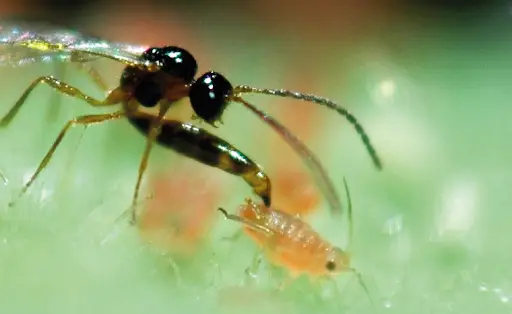
Aphidoletes aphidimyza (Aphid Predatory Midge)
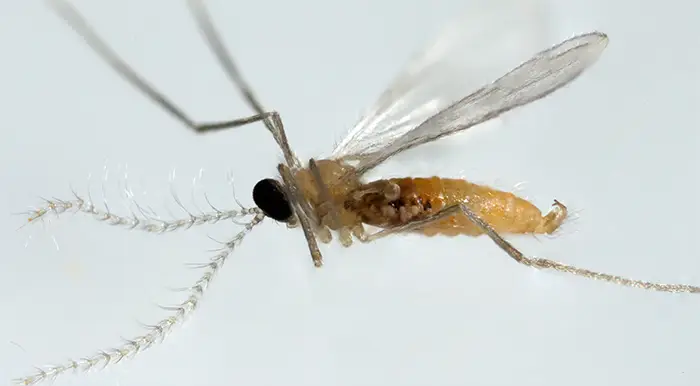
Aphidoletes aphidimyza resembles a large mosquito but is one of the most voracious aphid predators available. Larvae inject a paralyzing toxin into aphids before consuming them — a single larva can eliminate up to 80 aphids before pupating. Paired alongside Aphidius wasps, Aphidoletes provides brute-force aphid knockdown while the wasps interrupt reproduction. Together they’re more effective than either deployed alone.
Target pests: Aphids (primary), other soft-bodied insects
Conditions needed: 12+ hours light, warm temperatures, moist growing medium (larvae pupate at the soil surface). Adults are highly susceptible to pesticide residue.
Lifespan: Adults 1–2 weeks; full egg-to-adult cycle 3–6 weeks.
Shop: Tip Top Bio-Control Aphidoletes Aphidimyza | ARBICO Organics Aphidoletes Aphidimyza
Dalotia coriaria (Rove Beetle)
Dalotia coriaria (formerly Atheta coriaria) is a fast-moving, soil-dwelling rove beetle that hunts fungus gnat larvae right in the root zone — where sticky traps and foliar sprays never reach. It thrives in the same moist, dark conditions fungus gnats prefer, and once local populations are controlled, adults can fly to seek new food sources, self-distributing across the grow space.
Target pests: Fungus gnat larvae and pupae (primary), shore flies, other soil-dwelling pests
Conditions needed: Moist growing media, 65–80°F. Dry or excessively hot conditions drive them out of the root zone.
Lifespan: Approximately a 21-day complete cycle; eggs hatch in 3–4 days, producing continuous fresh larvae when food is present.
Shop: Tip Top Bio-Control Rove Beetle — Dalotia coriaria | ARBICO Organics Rove Beetle — Dalotia coriaria
For the full fungus gnat treatment approach, see our guide on how to prevent and eliminate fungus gnats.
Trichogramma (Caterpillar & Moth Egg Parasite)
Trichogramma wasps attack the eggs of caterpillars and moths before they ever hatch. The female inserts her eggs directly into the pest’s eggs; hatching Trichogramma larvae consume the host from within, turning them visibly black. Because they work at the egg stage, they prevent caterpillar populations from ever establishing — making them uniquely preventative compared to most other beneficials.
Target pests: Caterpillars, armyworms, corn borers, loopers, moths (egg stage)
Conditions needed: Adults need pollen, nectar, or honeydew as food sources. Most effective near flowering plants or companion plantings.
Lifespan: Adults up to 14 days; release cards hatch continuously over 1–2 weeks.
Shop: Tip Top Bio-Control Trichogramma (Caterpillar & Moth Control)
See our guide on how to get rid of caterpillars for a broader treatment protocol.
Predatory Mites: The Invisible IPM Workhorses
Predatory mites aren’t insects — they’re arachnids — but they’re among the most effective biological controls for indoor growers, particularly against spider mites and thrips.
Phytoseiulus persimilis — Spider Mite Specialist
Phytoseiulus persimilis looks nearly identical to a spider mite — same tiny pear-shaped body, same leaf-surface habitat. The difference: bright orange-red color, significantly more active movement, and an exclusive carnivore diet. Under suitable environmental conditions, it can consume on the order of 5–20 spider mites or eggs per day, including eggs and juvenile stages, and will continue hunting as long as prey is present. Once it clears an area, it migrates to find new populations — a self-directed predator that covers your canopy without manual repositioning.
Target pests: Spider mites (two-spotted spider mite primary target)
Conditions needed: Moderate to high humidity (typically above about 60% RH) and temperatures in the range of about 68–86°F. At these temperatures and humidities, P. persimilis can complete its life cycle quickly and build populations faster than two-spotted spider mites.
Lifespan: Eggs can hatch in a few days and adults may live several weeks under favorable greenhouse conditions.
Shop: Tip Top Bio-Control Phytoseiulus Persimilis | ARBICO Organics Phytoseiulus persimilis
For the full spider mite treatment approach, see our guide on how to identify and get rid of spider mites.
Amblyseius cucumeris — Thrips Larvae Predator
Amblyseius cucumeris targets first-instar thrips larvae — the stage causing the most direct plant damage — in flower buds and leaf tissue where they feed. It’s the ideal companion to Orius insidiosus: while Orius hunts adult thrips above the canopy, cucumeris targets larvae in the plant tissue. It also consumes spider mite eggs and broad mite nymphs, giving it broader coverage in mixed-pest situations.
Target pests: Thrips larvae (primary), spider mite eggs, broad mites
Conditions needed: 68–86°F, 60–70% RH. Works across veg and flower cycles including under 12/12 lighting — more versatile than Orius for late-stage indoor grows.
Lifespan: 3–4 week cycle; sachets provide slow continuous release over several weeks.
Stratiolaelaps scimitus — Soil-Stage Pest Predator
Stratiolaelaps scimitus (formerly Hypoaspis miles) operates entirely in the growing medium, hunting fungus gnat larvae, thrips pupae, and root aphids in the root zone. While canopy-level beneficials handle above-soil populations, Stratiolaelaps closes the loop by eliminating soil-stage larvae before they emerge as adults.
Target pests: Fungus gnat larvae, thrips pupae (soil stage), root aphids, springtails
Conditions needed: Moist growing media, 50–85°F. Works well in coco, rockwool, and amended soils. Feeds on algae and organic matter between pest cycles, helping keep the population alive when pest pressure is low.
Lifespan: Up to 2 months when food is present.
Beneficial Nematodes: Soil-Stage Pest Elimination
Beneficial nematodes are microscopic roundworms that parasitize soil-dwelling insects — locating hosts through heat and CO₂, entering through body openings, and releasing symbiotic bacteria that often kill the pest within about 24–48 hours under favorable conditions. They work best as a preventative or early-stage treatment, most effective against larval stages.
Target pests: Fungus gnat larvae, root aphids, thrips pupae, weevil larvae, armyworms, leafminers, cutworms
Conditions needed: Cannot tolerate UV light or extreme temperatures. Apply to moist growing media with lights off, and keep substrate moist for 2–3 days post-application to support nematode movement.
Two key species for indoor use:
Steinernema feltiae — best for fungus gnats and thrips larvae; tolerates cooler soil (50–65°F); the standard choice for coco and rockwool environments.
Heterorhabditis bacteriophora — more effective against root aphids and soil-stage weevils; prefers warmer soil (70–80°F).


How to Release Beneficial Insects: Deployment Best Practices
Release timing: Early morning or evening. Lower light levels and cooler temperatures reduce stress and discourage flight activity in ladybugs and wasps.
Pre-release spray window: Wait a minimum of 3–5 days after any pesticide application before introducing beneficials — most predatory organisms are more sensitive to residue than the pests you’re targeting.
Temperature acclimation: Most beneficial organisms ship in cold storage. Allow packages to acclimate to room temperature for 15–30 minutes before opening to avoid shock.
Preventative vs. active infestation: Preventative releases need lower density but won’t establish as persistently without prey. For active infestations, increase density and stack multiple species to attack different life stages simultaneously.
Monitor with traps: HBX Yellow Sticky Traps at one per 10–25 sq ft provide early warning on flying pest pressure and help gauge whether beneficial populations are working. This monitoring layer is essential in any IPM program.
Combining Beneficial Insects with Spray Programs
Biological control and targeted spray programs work best together. When pest pressure gets ahead of what beneficials alone can handle, a knockdown spray reduces the population while beneficials manage what remains.
BioSafe AzaGuard (azadirachtin-based) is a good biologically compatible option: it disrupts insect growth regulators and works primarily on immature pest stages, with shorter residual activity than many synthetic chemistries. Apply as a targeted knockdown, then reintroduce beneficials after the residual window passes (typically 5–7 days; always follow the product label).
For fungal pressure that often accompanies pest stress, BioSafe ZeroTol 2.0 provides broad-spectrum bactericidal and fungicidal coverage without long residual impact on predatory organisms when used according to label directions. Use it as part of facility sanitation between releases rather than concurrent with live deployments.
Our guide to the best pesticides and fungicides covers compatible spray options in more detail.


Quick Reference: Beneficial Insects by Target Pest
| Pest | Best Biological Controls |
|---|---|
| Aphids | Ladybugs, Aphidius ervi, Aphidoletes aphidimyza |
| Spider Mites | Phytoseiulus persimilis |
| Thrips (adults/veg) | Orius insidiosus |
| Thrips (larvae/flower) | Amblyseius cucumeris |
| Thrips (soil stage) | Stratiolaelaps scimitus |
| Whiteflies | Delphastus catalinae, Green Lacewings |
| Fungus Gnats | Dalotia coriaria, Stratiolaelaps scimitus, S. feltiae nematodes |
| Mealybugs | Green Lacewings (larvae), Ladybugs |
| Caterpillars / Moths | Trichogramma wasps |
| Root Aphids / Weevils | H. bacteriophora nematodes |
For Commercial Operations: Scaling Biological Controls
Commercial cultivation facilities face different constraints than hobby growers: larger canopy footprints, multiple rooms in staggered cycles, and zero tolerance for pest spread between zones.
Preventative programs over reactive deployments. Biological controls are most cost-effective when released on a weekly or bi-weekly calendar before pest populations establish. Reactive releases against heavy infestations are expensive and rarely fast enough to prevent crop damage.
Zone-based programs. Assign each room its own deployment calendar. Veg rooms benefit from root-zone organisms (Stratiolaelaps, nematodes) and canopy scouts (Orius, lacewings). Flowering rooms require species that perform under 12/12 — Phytoseiulus persimilis, Amblyseius cucumeris, and Dalotia coriaria are more reliable at this stage than Orius, which often declines under short days.
Stacking complementary species. No single beneficial covers every life stage of every pest. A well-designed stack for a cannabis facility might run: persimilis (spider mites), Stratiolaelaps (soil-stage gnats and thrips), Aphidius ervi (aphid prevention), Orius (thrips adults in veg), cucumeris (thrips larvae through flower), and Dalotia (fungus gnat larvae) — deployed concurrently.
Integration with facility sanitation. Reduce baseline pest load between crop cycles before beneficials are introduced. This gives new releases a manageable starting point rather than an overwhelming one.
For commercial IPM support, contact the Hydrobuilder Commercial team.
Why Shop Beneficial Insects at Hydrobuilder?
We carry both Tip Top Bio-Control and ARBICO Organics — two of the most trusted biological control suppliers in North American horticulture — alongside insecticidal soaps, targeted sprays, and IPM monitoring tools that complement your beneficial program rather than undermining it. You can find all of it in one place, and our team knows the difference between a spider mite and a predatory mite.
- 100% Secure Shopping
- Largest Selection of IPM Products
- Expert Grower Support: 888-815-9763
Beneficial Insects for Plants: FAQs
What are beneficial insects, and how do they help control garden pests?
Beneficial insects are predatory or parasitic species — ladybugs, lacewing larvae, predatory wasps, and others — that feed on common pest insects like aphids, spider mites, thrips, and fungus gnats. They provide chemical-free pest suppression and are the foundation of biological IPM programs in both home gardens and commercial cultivation. In controlled environments, they’re particularly valuable because they target pests without leaving pesticide residues on plants or requiring harvest intervals.
Are beneficial insects safe for my plants?
Yes — beneficial insects do not damage plant tissue. They target pest organisms, and many species also consume plant debris or pollen incidentally with no negative effect. The main risk is deploying them immediately after a pesticide application, which can kill beneficials before they establish; always observe a spray-free window of 3–5 days before introducing any beneficial colony.
How long do beneficial insects live in a grow room?
It depends on species and food availability. Ladybugs, for example, can complete multiple generations per year and adults may live for several months under favorable conditions, while many other beneficials have 2–6 week lifespans. Colony duration in a grow room is generally tied to pest population: when the target pest is eliminated, most beneficials decline within 1–3 weeks without an alternative food source. For persistent protection, plan repeat releases at 2–4 week intervals.
Can I use beneficial insects preventatively before I see pests?
Yes, and it’s the recommended approach for serious growers. Preventative releases require lower densities because there’s less food pressure. The tradeoff is populations won’t establish as durably without prey. Pair preventative releases with HBX Yellow Sticky Traps to catch early pest indicators, which signals when to increase beneficial density or add targeted species.
Which beneficial insects are best for indoor grow rooms?
The most reliably effective organisms for controlled indoor environments are: Phytoseiulus persimilis (spider mites), Orius insidiosus (thrips under long-day lighting), Amblyseius cucumeris (thrips larvae through flower), Dalotia coriaria (fungus gnat larvae in root zone), Aphidius ervi (aphids), and Steinernema feltiae nematodes (fungus gnats and soil-stage thrips). These species adapt well to the temperature and humidity ranges typical of indoor grows when deployed according to supplier recommendations.
Do beneficial insects work in hydroponic systems?
Yes, with some adjustments. Predatory mites and canopy-dwelling beneficials function similarly in hydroponic and media-based environments. Soil-dwelling organisms (Dalotia, Stratiolaelaps, nematodes) adapt well to rockwool, coco, and clay pebble systems as long as moisture levels are maintained. Nematodes specifically need consistently moist substrate to move through the root zone — ensure your media isn’t drying out between irrigations
What is the best beneficial insect for spider mites?
Phytoseiulus persimilis is the gold standard — a dedicated spider mite predator that can outpace spider mite reproduction when temperatures are in the moderate–warm range and relative humidity stays above about 60%. For environments running lower humidity, Neoseiulus californicus (also available from Tip Top Bio-Control and ARBICO Organics) tolerates drier conditions while still consuming spider mites effectively.
Are there beneficial insects for fungus gnats specifically?
Two of the most effective: Dalotia coriaria (rove beetles) hunt fungus gnat larvae actively in the growing medium and can consume many larvae per day, and Steinernema feltiae nematodes parasitize larvae in the root zone and work particularly well as a preventative. Using both together — rove beetles for active predation and nematodes for larval parasitism — provides thorough coverage of fungus gnats at the soil stage, where crop damage actually occurs.
Can I use pesticides and beneficial insects at the same time?
Not simultaneously. Most pesticides — including many OMRI-listed organic options like insecticidal soaps, spinosad, and neem products — are harmful to beneficial organisms. The standard protocol: apply a targeted knockdown spray to reduce pest density, wait 3–7 days (check the specific product’s residual window), then introduce beneficials to manage remaining populations. This combination approach is more cost-effective and faster than either strategy alone.
How do I release beneficial insects for best results?
Release in early morning or evening when temperatures are lower and light stress is reduced. Allow packaged beneficials to acclimate to room temperature for 15–30 minutes before opening. Distribute releases evenly across the canopy — concentrate eggs and larvae near pest hot spots. Avoid water or spray applications for 24 hours post-release. For flying species (wasps, adult lacewings), keep sticky traps in place so you can gauge whether populations are establishing and whether pest pressure is declining.