

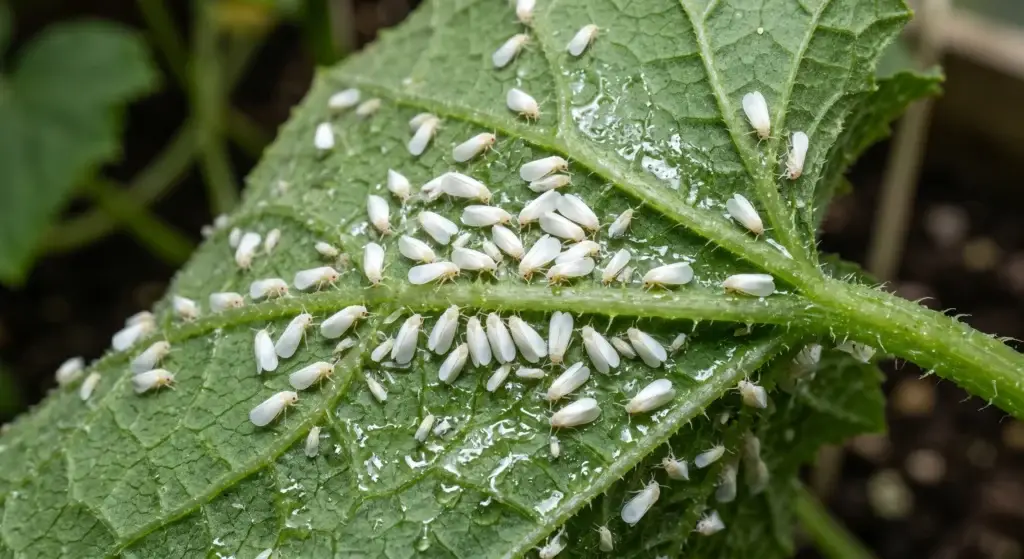
Whiteflies are one of the most disruptive pests in both indoor and outdoor growing environments. A small population can explode into a full infestation within weeks, and because these insects feed on plant sap and excrete honeydew that promotes fungal disease, getting rid of whiteflies quickly requires a systematic approach — not just a single spray.
This guide covers everything: how to identify whiteflies and their damage, step-by-step control methods from physical removal through bioinsecticides, and how to prevent reinfestation using an integrated pest management (IPM) framework that works at any scale.
Growing at a commercial scale? See the For Commercial Operations section at the end for facility-level protocols.
What Are Whiteflies?
Whiteflies (family Aleyrodidae) are small, winged, soft-bodied insects closely related to aphids and mealybugs — and they’re frequently misidentified as one or the other. Adults typically measure 1/16″ to 1/12″ and are covered in a white powdery wax that gives them their name.
Two species are most common in controlled growing environments:
- Trialeurodes vaporariorum (greenhouse whitefly) — the primary indoor pest; thrives in warm, humid conditions between 70–80°F
- Bemisia tabaci (sweetpotato/silverleaf whitefly) — more resistant to many pesticides; increasingly common in both greenhouse and outdoor crops
Both species cluster on the undersides of leaves, where they pierce plant tissue and extract phloem sap. They’re most active during daylight hours, and even a brief disturbance of affected foliage will send a cloud of adults into the air — one of the easiest ways to confirm an infestation.
Signs of a Whitefly Infestation
The earlier you catch whiteflies, the less intervention you’ll need. Here’s what to look for:
Visual signs on leaves:
- White, powdery clusters on leaf undersides (adults and nymphs)
- Tiny oval eggs, laid in circular patterns on the leaf underside
- Flat, scale-like nymphs — easily mistaken for mealybugs in early instars
- Sticky honeydew residue on upper leaf surfaces
Plant damage indicators:
- Yellowing, wilting, or pale leaves that don’t respond to watering or nutrients
- Stunted growth or reduced vigor in otherwise healthy plants
- Sooty mold (black fungal growth) developing on honeydew deposits
- Ant activity on plants — ants are drawn to honeydew and may be your first alert
Early detection tip:
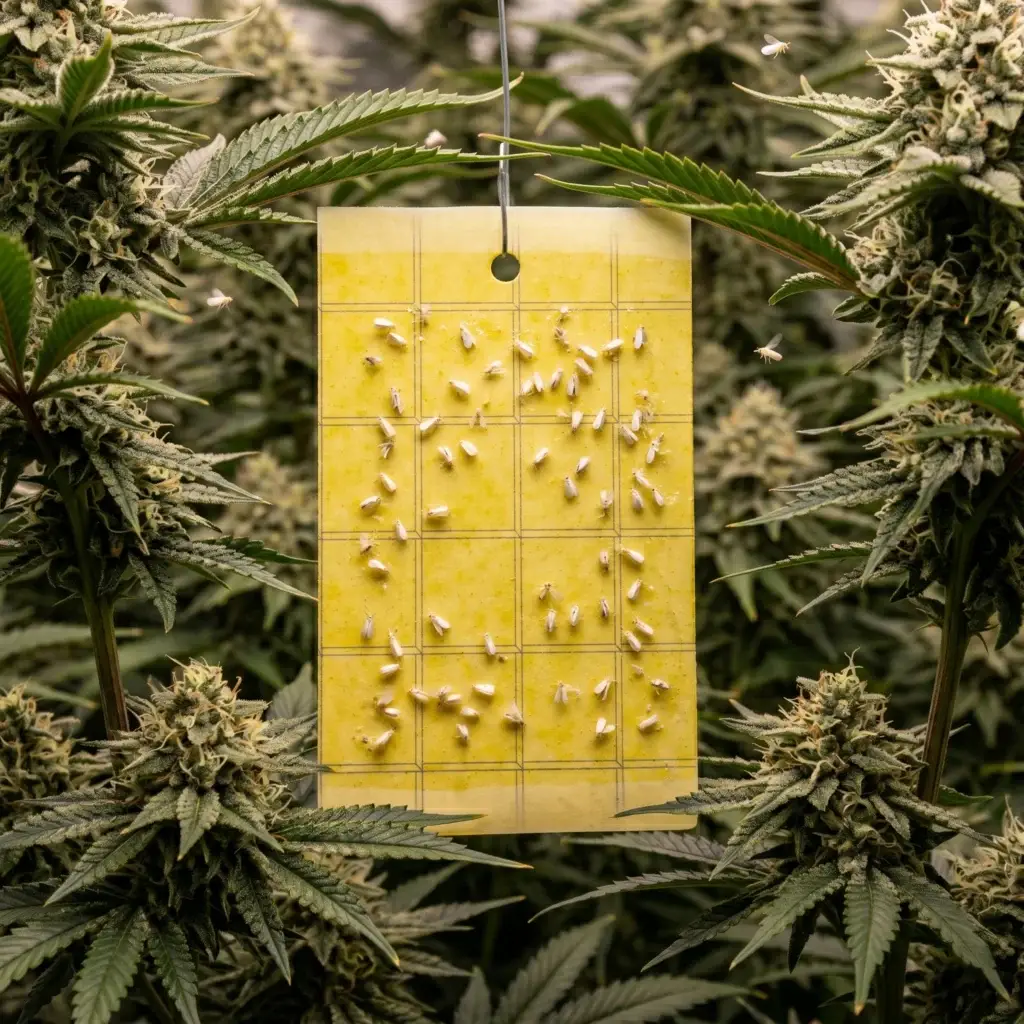
HBX Yellow Sticky Traps positioned at canopy level will catch adult whiteflies before populations establish. Use one trap per 10–25 sq ft and check weekly — a single trap with 5+ adults in a week signals a developing population that needs immediate attention.
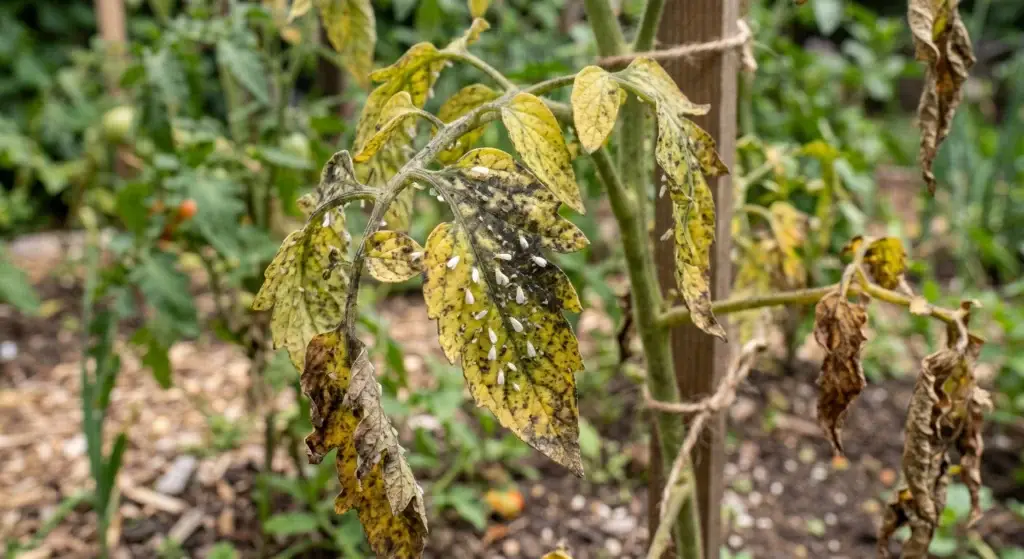
Understanding the Whitefly Life Cycle (Why This Matters for Control)
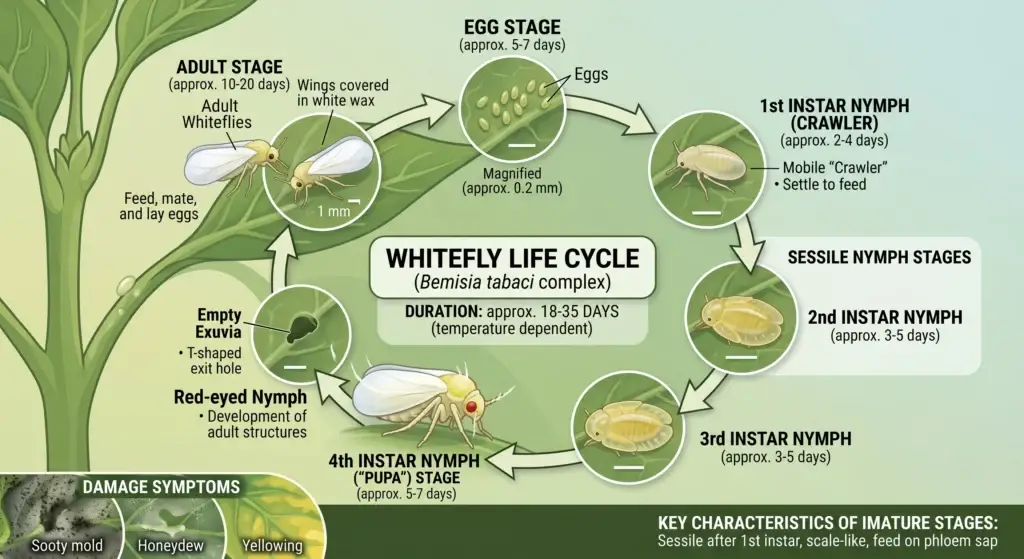
Getting rid of whiteflies permanently requires treating multiple life stages simultaneously. Adults are highly mobile and will evade sprays. Eggs and early-instar nymphs are immobile but resistant to many contact pesticides. Only the crawling first-instar (the “crawler”) is truly vulnerable to oil-based and soap treatments.
The full cycle from egg to adult takes 25–30 days at 75°F, faster at higher temperatures. This is why a single spray never resolves an infestation — you must plan for multiple treatment applications timed to the life cycle.
Life stages:
- Eggs — laid in circular arcs on leaf undersides; hatch in 5–12 days
- 1st instar (crawler) — only mobile nymph stage; most vulnerable to contact pesticides
- 2nd–3rd instar (nymphs) — flat, scale-like; immobile; covered in waxy coating
- 4th instar (“pupa”) — immobile; more resistant
- Adult — winged; mobile; ready to reproduce within days of emergence
Apply treatments on a 5–7 day rotation to interrupt the cycle at multiple points.
How to Get Rid of Whiteflies: Step-by-Step Control Methods
Work through these methods progressively. Start with physical controls, then layer in biological and chemical controls as needed.
Step 1: Physical Removal — Water Spray
For early-stage infestations, a direct water spray to the underside of leaves is your immediate first action. It’s chemical-free, costs nothing, and disrupts both eggs and early nymphs before they can develop further.
Use a steady, moderate-pressure stream. Avoid high pressure that bruises foliage. Spray early in the day so foliage dries completely before lights-off or nightfall — wet leaves overnight create conditions for mold and mildew. Repeat every 2–3 days for the first week while you’re building a fuller treatment plan.
Step 2: Yellow Sticky Traps — Monitoring and Mass Trapping
HBX Yellow Sticky Traps serve two functions: they monitor population levels and actively reduce adult counts. Position traps just above canopy level (adults fly upward when disturbed). In an active infestation, increase density to one trap per 5–10 sq ft.
Traps will not eliminate an established population on their own, but they’re an essential part of any IPM protocol — they tell you when populations are declining (fewer adults per trap per week) and whether your treatments are working.
Step 3: Insecticidal Soap Spray
Insecticidal soap works by disrupting the cell membranes of soft-bodied insects on contact. It’s effective against crawlers and nymphs when applied to leaf undersides, and it breaks down quickly without leaving harmful residues — making it ideal for edible crops and repeat applications.
You can use diluted castile or dish soap (about 1–2 teaspoons per quart of water), but commercial formulations offer more consistent results and are less likely to cause phytotoxicity on sensitive foliage. Learn more about formulating and applying insecticidal soap effectively in our complete guide to insecticidal soap.
Apply with an HBX Pump Sprayer — coat leaf undersides thoroughly, as contact is required for efficacy. Apply in the morning or during lights-on periods at temperatures below 90°F to minimize plant stress. Reapply every 5–7 days.
Step 4: Neem Oil / Horticultural Oil
Neem oil (containing azadirachtin) is a botanical insecticide that works through multiple mechanisms: it acts as a contact killer on nymphs and crawlers, disrupts molting via azadirachtin’s insect growth regulator (IGR) activity, and deters feeding and egg-laying by adults.
Neem oil is OMRI-listed and suitable for organic production when used per label directions. Avoid application during high heat or bright light, and ensure good coverage to leaf undersides.
Important: Neem oil can have a phytotoxicity risk in HID-lit environments at high concentrations or under high-intensity LED without a dark period before application. Always test on a small area first, and apply during lights-off.
Step 5: Bioinsecticides — Targeted and Residue-Free
For moderate to heavy infestations — especially in controlled environments where you want to avoid harsh residues — bioinsecticides are the most effective and sophisticated option.
BioSafe AzaGuard is a dual-mode insecticide and nematicide containing azadirachtin at 3% concentration — one of the highest available. It disrupts whitefly molting (kills nymphs as they move between instars), deters egg-laying, and reduces adult feeding. It’s OMRI-listed and labeled for use on a wide range of food and ornamental crops. Apply as a foliar spray on a 7-day rotation or per label.
BioSafe BioCeres WP is a wettable powder bioinsecticide based on Beauveria bassiana, an entomopathogenic fungus that kills whitefly nymphs and adults through infection. It’s particularly effective against populations that have developed resistance to conventional pesticides. Apply in the morning and maintain relative humidity above 80% RH (ideally 90%+) post-application for at least several hours to support conidial germination and infection. Note: avoid applying in the same week as fungicides, which can reduce efficacy.
Athena IPM is a concentrate formulated for indoor cultivation environments — effective against whiteflies, spider mites, and fungal pathogens simultaneously. It’s well-suited to facilities where multiple pest pressure and disease prevention overlap.


Step 6: Beneficial Insects — Biological Control
Introducing beneficial insects is one of the most effective long-term whitefly control strategies, especially in enclosed controlled environments where predator populations can establish without escaping.
The best beneficials for whitefly control:
- Encarsia formosa (parasitic wasp) — the most widely used commercial whitefly biocontrol; parasitizes nymphs, especially effective against greenhouse whitefly
- Eretmocerus eremicus — more effective against Bemisia (sweetpotato whitefly) than Encarsia; use when species identification confirms Bemisia
- Amblyseius swirskii (predatory mite) — feeds on whitefly eggs and first-instar crawlers; also controls thrips; excellent compatibility for IPM programs
- Delphastus catalinae (predatory beetle) — a voracious consumer of whitefly eggs and nymphs; effective at high population levels
Beneficial insects work best when introduced at the first sign of infestation rather than as a rescue strategy. Learn more in our guide to beneficial bugs for grow rooms.
How to Prevent Whiteflies
The most cost-effective pest management is prevention. In controlled environments, consistent IPM habits eliminate most infestations before they start.
Monitoring: Deploy HBX Yellow Sticky Traps at canopy level in every room — one per 10–25 sq ft — and inspect weekly. Catching one or two adults per week on a trap is a signal to increase monitoring intensity, not a crisis. Catching 10+ adults per week is a signal to start treatment immediately.
New plant quarantine: Any plant or clone entering your grow space should be isolated and inspected for 7–14 days before being introduced. Whitefly eggs on leaf undersides are nearly invisible; a quarantine period lets eggs hatch and become identifiable before spreading.
Environmental management: Whiteflies thrive at temperatures between 70–80°F; keeping your environment at the lower end of this range (70–75°F) with moderate relative humidity (50–60% RH during veg, 40–50% RH during flower) reduces conditions favorable for rapid reproduction.
Sanitation: Remove dead plant material from the grow space promptly. Honeydew accumulation on surfaces breeds sooty mold and creates attractive conditions for reinfestation. For facility-level surface sanitation, Prokure V is a chlorine dioxide–based liquid that eliminates mold, biofilm, and microbial contamination on grow room surfaces between cycles — without harmful residues.
Reflective mulch (outdoor and greenhouse): Silver or aluminum reflective mulch confuses whitefly navigation and reduces their ability to find host plants. Most effective around solanaceous crops (tomatoes, peppers, eggplant) that are primary whitefly targets.
Crop rotation: Avoid planting the same crops in the same location across consecutive seasons in greenhouse and outdoor settings. Whiteflies can overwinter in warm climates, and returning to the same location gives overwintered populations an immediate food source.
See our complete integrated pest management guide for a full prevention framework that works across all common grow room pests.
Whiteflies vs. Related Pests: Quick Identification Guide
Whiteflies are commonly confused with aphids, mealybugs, and fungus gnats. Here’s how to tell them apart:
| Feature | Whiteflies | Aphids | Mealybugs | Fungus Gnats |
|---|---|---|---|---|
| Wings | Yes (adults) | Sometimes | No | Yes (adults) |
| Color | White/pale yellow | Green, black, white | White/waxy | Dark gray/black |
| Location | Leaf undersides | Stems, shoot tips | Leaf joints, roots | Soil surface/roots |
| Movement | Flies when disturbed | Slow | Slow | Jumps/flies near soil |
| Honeydew | Yes | Yes | Yes | No |
For more on differentiating between pest species, see our guide to common grow room pests and diseases.
Resistance Management: Rotating Chemistries
Whiteflies — particularly Bemisia tabaci — are notorious for developing resistance to pesticides. Rotating between product chemistries is critical to maintaining efficacy.
A practical rotation for indoor grows using available bioinsecticides:
- Week 1: Water spray + BioSafe AzaGuard (azadirachtin)
- Week 2: Insecticidal soap + sticky trap check
- Week 3: BioSafe BioCeres WP (Beauveria bassiana)
- Week 4: Athena IPM or neem oil
- Week 5: Repeat cycle as needed
Never apply the same product more than 2–3 consecutive applications without rotating to a different mode of action. Log every application with date, rate, and target pest to track efficacy over time.
For Commercial Operations: Facility-Scale Whitefly Management
Commercial cultivation facilities face unique challenges with whiteflies: higher plant density means faster spread, and regulatory compliance may restrict which products can be used at harvest proximity.
Monitoring density: Scale sticky trap deployment to one trap per 5–10 sq ft in high-value rooms. Assign a dedicated staff member to weekly IPM scouting. Document trap counts by room and date to identify outbreaks early and track intervention efficacy.
Preventive sanitation: Use Prokure V during room turnover to sanitize surfaces, trays, and equipment. Chlorine dioxide penetrates biofilm and eliminates the organic matter that supports pest population establishment between cycles.
Application equipment: At commercial scale, foliar applications require consistent coverage across a full canopy. The HBX Pump Sprayer (8 liter capacity) delivers reliable pressure for thorough leaf-underside coverage. For larger rooms, powered backpack sprayers or boom systems deliver more uniform coverage at pace.
Beneficial insect programs: Commercial facilities with enclosed environments are ideal candidates for predatory wasp release programs (Encarsia formosa, Eretmocerus spp.). Work with a biological control supplier to establish release schedules appropriate to your room size and plant density. Beneficials are most cost-effective when population pressure is low — introduce them preventively, not reactively.
IPM recordkeeping: METRC-licensed facilities and those pursuing compliance certifications (e.g., Certified Kind, Clean Green) should maintain detailed IPM logs for every application. Document product names, EPA registration numbers, application rates, target pests, and pre-harvest intervals.
Why Shop at Hydrobuilder for Pest Control
Hydrobuilder carries the full spectrum of professional-grade IPM products used in licensed cultivation facilities and home grows alike — from BioSafe’s complete bioinsecticide lineup to application hardware and monitoring tools. Our team of experienced growers is available at 888-815-9763 or by email to help you build the right treatment protocol for your specific situation, crop, and growing environment.
Browse our complete pest control and garden care collection to find the right products for your IPM program.
FAQs for How To Get Rid Of Whiteflies
Q: How do you get rid of whiteflies permanently?
A: Permanent whitefly elimination requires eliminating all life stages — eggs, nymphs, and adults — through a 4–6 week integrated treatment rotation combining physical removal, insecticidal soap or neem oil, and bioinsecticides like azadirachtin or Beauveria bassiana.
Expanded: No single application eliminates whiteflies because the egg and early nymph stages are resistant to most contact pesticides. A structured rotation — treating every 5–7 days, rotating chemistries every 2–3 applications, and maintaining sticky trap monitoring throughout — is the only approach that prevents re-establishment from eggs already on the plant.
Commercial application: Facilities should maintain a written IPM log with product rotations, application dates, and trap counts per room to document efficacy and support compliance documentation.
Q: What kills whiteflies instantly?
A: Contact bioinsecticides like insecticidal soap, neem oil, and azadirachtin-based products (such as BioSafe AzaGuard) kill soft-bodied nymphs and crawlers on contact when applied with thorough coverage to leaf undersides.
Expanded: “Instantly” is relative — adult whiteflies often escape a spray application by flying off. Products containing pyrethrin provide rapid knockdown of adults, but residual populations from eggs and nymphs will continue to develop. For fast visual results, combine a water spray to dislodge adults with a follow-up soap or oil application within 24 hours.
Commercial application: Athena IPM is a fast-acting option for commercial facilities because it targets both insects and fungal pathogens simultaneously, reducing the total number of spray applications needed during a rotation.
Q: What is the best natural pesticide for whiteflies?
A: BioSafe AzaGuard (azadirachtin at 3%) is the most effective OMRI-listed botanical insecticide for whiteflies — it disrupts molting, deters egg-laying, and works across multiple life stages in a single product.
Expanded: For growers who prefer a mycoinsecticide (fungal-based) approach, BioSafe BioCeres WP (Beauveria bassiana) offers a complementary mode of action with no chemical residue risk. Rotate between azadirachtin and Beauveria bassiana every 7 days for broad-spectrum pressure across life stages while minimizing resistance development. When applying BioCeres WP, maintain relative humidity above 80% RH (ideally 90%+) post-application to support conidial germination and infection.
Commercial application: Both products are compatible with most state regulatory frameworks for licensed production. Confirm label registration in your state before application at commercial scale.
Q: How do I get rid of whiteflies on my plants fast?
A: The fastest effective approach is: (1) water spray to dislodge eggs and nymphs immediately, (2) apply insecticidal soap or BioSafe AzaGuard to leaf undersides within 24 hours, and (3) set HBX Yellow Sticky Traps at canopy level to capture adults. Expect visible results within 3–5 days.
Expanded: “Fast” control of whiteflies doesn’t mean a single application — it means starting the right actions immediately and being consistent. A grower who begins water sprays, sticky traps, and an azadirachtin application on day one will see dramatically less damage than one waiting to find the “perfect” product. Speed of response matters more than product choice.
Commercial application: At facility scale, apply BioSafe AzaGuard with an 8-liter pump sprayer across your entire affected zone on the same day you identify the infestation — don’t wait to confirm the scale of the problem before treating.
Q: What are tiny white bugs flying around my plants?
A: Tiny white flying insects around your plants are almost certainly adult whiteflies (family Aleyrodidae). They’re typically 1/16″–1/12″ in size and fly in clouds when foliage is disturbed. Check the underside of leaves for eggs and nymphs to confirm.
Expanded: White flying insects are occasionally confused with fungus gnat adults, which are darker in color and typically found near the soil surface rather than on foliage. If you see white insects flying off when you brush leaves, and find sticky honeydew residue plus clusters on leaf undersides, it’s whiteflies. If you see dark gray insects emerging from the soil or potting medium, it’s fungus gnats — a separate pest requiring a different treatment protocol. See our guide to common grow room pests to confirm identification.
Commercial application: Visual confirmation of species matters for commercial operations because Bemisia tabaci has developed resistance to multiple pesticide classes. If you’re experiencing treatment failures with standard azadirachtin or soap protocols, species confirmation (via university extension or licensed pest management professional) can guide more targeted biocontrol selection.
Q: What is the best spray to kill whiteflies?
A: For organic-compliant indoor growing, BioSafe AzaGuard is the top recommendation — it targets multiple life stages via azadirachtin’s insect growth regulator mechanism and has a favorable residue profile for production grows.
Expanded: The “best” spray depends on your constraints. For fast knockdown of adults: insecticidal soap (contact action, degrades quickly). For systemic life-cycle disruption: azadirachtin-based products like AzaGuard. For resistance management and biological control: Beauveria bassiana (BioSafe BioCeres WP). For facilities managing both pests and disease simultaneously: Athena IPM. Most growers benefit from rotating through all three modes of action across a 4-week protocol.
Commercial application: Athena IPM is widely used in licensed cannabis facilities because of its combined insect and fungal pathogen efficacy and its compatibility with most compliance frameworks.
Q: Can whiteflies survive indoors year-round?
A: Yes. In indoor controlled environments with stable temperatures above 65°F, whiteflies reproduce year-round with no diapause (dormant) period. This is why whitefly management in grow rooms requires ongoing vigilance, not seasonal treatment.
Expanded: Unlike outdoor whitefly populations that die back in cold winters, indoor infestations cycle continuously. A population that appears to be “gone” after treatment often rebounds from surviving eggs or nymphs within 3–4 weeks. Monitoring with sticky traps year-round is the only way to catch a rebounding population before it re-establishes.
Commercial application: Facilities that don’t maintain continuous IPM monitoring between harvest and planting are especially vulnerable to reinfestation from eggs on surfaces, in growing media, or on equipment.
Q: Do yellow sticky traps work for whiteflies?
A: Yes. Yellow sticky traps are highly effective for whitefly monitoring and adult population reduction. Whiteflies are strongly attracted to the color yellow. Deploy HBX Yellow Sticky Traps at one per 10–25 sq ft for monitoring, or increase density during active infestations.
Expanded: Sticky traps won’t eliminate an established infestation on their own — their primary value is detection and population tracking. A baseline trap count of 1–3 adults per trap per week typically indicates a manageable population. More than 10 adults per trap per week indicates an established infestation requiring immediate treatment. Traps are also valuable for confirming when a treatment rotation has worked: declining weekly counts over 3–4 weeks signal successful control.
Commercial application: Use one sticky trap per 5–10 sq ft in commercial facilities with high plant density. Assign weekly scouting to a dedicated staff member and track trap counts by zone in your IPM log.
Q: Are whiteflies harmful to humans?
A: No. Whiteflies do not bite, sting, or transmit diseases to humans. They are harmful to plants only — feeding on plant sap, excreting honeydew that leads to sooty mold, and transmitting certain plant viruses in some agricultural contexts.
Expanded: The main concern with whiteflies for growers is plant health and yield loss, not personal safety. However, the pesticides used to treat whiteflies may require PPE during application. Always wear nitrile gloves and eye protection when applying any bioinsecticide or horticultural oil. HBX Heavy Duty Nitrile Gloves are rated for chemical handling and suitable for foliar spray applications.
Commercial application: Commercial facilities should maintain PPE protocols and application logs for all pest control products regardless of their organic/OMRI classification.
Q: How do I know if my plants have whiteflies?
A: Gently shake or touch a leaf. If a cloud of tiny white insects flies off the undersides, your plants have whiteflies. Other signs include sticky residue (honeydew) on leaf surfaces, yellowing or wilting leaves, and small white clusters of eggs on leaf undersides.
Expanded: The shake test is the fastest diagnostic. Whiteflies hide on leaf undersides during the day but fly immediately when disturbed. If you see them flying, check the undersides of several leaves across different parts of the plant for eggs (tiny oval specks in arcs or rings), flat nymphs, and adult clusters. Early identification before a full infestation develops dramatically improves your control options.
Commercial application: Train cultivation staff to perform the shake test during weekly IPM walks as a standard scouting protocol. It’s faster than inspecting individual leaves and will catch populations before they reach outbreak levels.