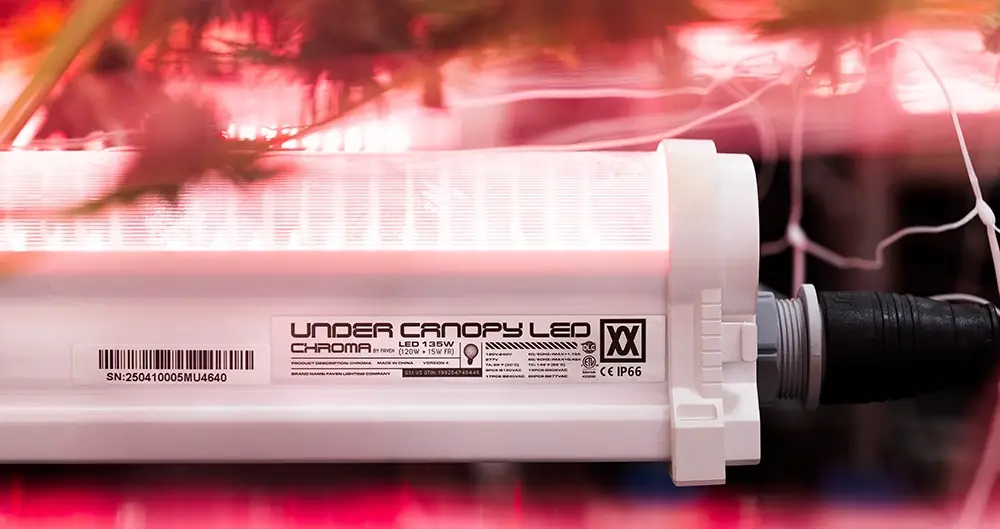
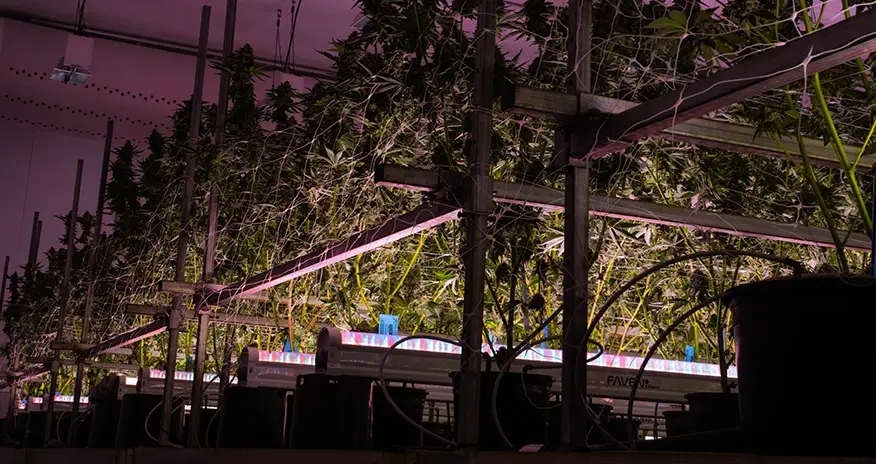
Under-canopy lighting (UCL) — placing supplemental LED bars below the plant canopy to deliver light upward into the lower bud zone — is one of the most reliable yield upgrades available to indoor growers. When properly implemented under optimized conditions, growers consistently report yield increases of 20–35%, improved lower bud structure, and more uniform color from top to bottom. Whether you’re running a 4×4 tent or a 10,000 sq ft licensed facility, the principle is the same: top lighting alone leaves the bottom third of your plant in the dark, and under-canopy lighting solves that.
New: Use our Under-Canopy Lighting Calculator to size your Faven bars, project your yield boost, and calculate ROI — all in one tool.
This guide covers the fundamentals of UCL for growers at every scale. Home and craft growers: start with the basics and the Faven R6/R8 bars. Commercial operators: the implementation protocols and commercial workflow section at the bottom are built specifically for you.
What Is Under-Canopy Lighting?
Under-canopy lighting positions low-wattage LED bar fixtures on stands at substrate level, pointing upward — delivering photosynthetically active radiation (PAR) directly to lower bud sites that overhead lighting cannot reach effectively.
In a typical top-lighting setup, overhead fixtures deliver the majority of their PPFD to the upper canopy. By the time that light penetrates through the leaves and structure of a full-canopy plant, the bottom third of the plant may be receiving 5–10% of what the tops receive. The result: underdeveloped “popcorn” buds, inconsistent color, and a substantial portion of the plant contributing far less than it’s capable of.
Under-canopy lighting fills that deficit directly. A 120W LED bar positioned at or just above substrate level activates the lower ⅓ to ½ of the plant — turning what would have been light losers into productive, flowering biomass.
The Science: Why Lower Bud Sites Underperform Without UCL
The physics of light penetration explains the yield gap. Photosynthetically active radiation (PAR) — the 400–700nm spectrum plants use for photosynthesis — follows the inverse square law. Light intensity drops dramatically with distance and obstruction. Dense upper canopy growth acts as a barrier, intercepting PAR before it reaches lower nodes.
Sub-canopy lighting compensates by delivering targeted PAR from below, bypassing the canopy barrier entirely. This improves:
- Photosynthetic efficiency across the full plant, not just the upper third
- Essential oil, flavonoid, and terpene production in lower buds — these compounds respond directly to light intensity and spectrum
- Biomass distribution — more sites producing high-density, marketable flower
- Daily Light Integral (DLI) uniformity — the ability to hit consistent DLI targets across all canopy depths, not just the tops
This isn’t a marginal improvement. Under optimized conditions (adequate CO₂, dialed-in VPD, calibrated nutrients), the bottom of your plant can develop structure and potency that matches your tops. The sorting and grading step at harvest reflects this directly.
Key Benefits of Under-Canopy Lighting
Yield Increases of 20–35% Under Optimized Conditions
The most consistently reported result of UCL adoption is a yield increase of 20–35%, measured under controlled conditions with adequate CO₂, VPD in the 1.0–1.6 kPa flowering range (early flower: 0.8–1.2 kPa; mid/late flower: 1.2–1.6 kPa), and a calibrated nutrient program. New UCL adopters typically see gains starting around 20%, with experienced operators reaching 35%+ as they dial in light intensity and stand positioning relative to genetic stretch habits.
Returns are most dramatic in high-planting-density rooms where the lower canopy is deepest and most light-deprived. A one-run ROI may be achievable for commercial operators, depending on room size, product price per gram, and current overhead lighting configuration — use the calculator above to model your specific scenario.
Improved Lower Bud Structure and Shape
Lower bud sites that receive adequate PAR develop the same dense structure as top colas. The even level of bud maturity means more usable A/B tier product per plant — less “larf” requiring sorting or discarding. For operations selling by grade, this directly affects margin per run.
Consistent Color Throughout the Full Plant
Plants grown with UCL show consistent color — including expression of anthocyanins and other pigment compounds — from the top of the plant to the very bottom. Strains known for purple and dark color phenotypes express those traits on lower branches as well as tops when those branches receive adequate light. This is a significant quality differentiator in premium flower markets.
Less Undergrowth Clearing — Different Pruning Protocol Required
UCL activates the lower ⅓ to ½ of the plant, which means the traditional approach of heavily clearing undergrowth before or during flower changes. Instead of removing everything below a certain node height, you focus on strategic de-leafing to allow upward light penetration rather than wholesale removal.
Recommended pruning protocol with UCL:
- Initial thinning — remove large fan leaves that would block upward light mobility, after plants stop stretching and begin bulking
- Heavy strip — a more aggressive de-leaf pass to uniformize color, maturity, and bud structure from top to bottom, performed early in the ripening phase
Net result: less time clearing larf and more time managing quality. Labor per plant decreases in skilled hands.
Post-Harvest Time Savings: No Grade Sorting Required
With even bud development across the entire plant, the flower is visually uniform enough to largely eliminate grade-sorting at harvest. When all sites are top-tier, the downstream work is simpler. At scale, this time savings compounds significantly.
Improved Lower Bud Structure and Shape
A properly sized UCL system adds 120W per bar — a modest energy addition relative to the yield return. LED bars run cool enough to position at substrate level without heat stress risk, and the supplemental DLI they add to the lower canopy would require a much larger overhead fixture (with significant heat and energy penalties) to achieve any other way.
Proper Implementation: How to Set Up Under-Canopy Lighting
Step 1 — Choose the Right Fixture for Your Top Lighting
Not all UCL bars are the same spectrum, and matching your UCL spectrum to your top lighting type is one of the most important setup decisions you’ll make. Faven’s “Spectrum Balancing” approach addresses this directly.
Faven Chroma with Far Red — Best for: Full-spectrum LED top lights
The Chroma is the flagship Faven bar — a 120W LED bar featuring an independent Far Red channel that growers can dial in separately from the main spectrum. Far red drives the Emerson Effect (enhanced photosynthetic efficiency triggered by the simultaneous delivery of deep red (~660–680 nm) and far red (700–740 nm) wavelengths), promotes cell elongation at lower nodes, and supports earlier, more uniform ripening. The Chroma is the bar to choose when your overhead fixtures are modern full-spectrum LEDs (Gavita, Growers Choice, Iluminar, etc.).
Available at 120V, 240V, and 277V. Sold as a pack of 4 bars.
Faven R6 / R8 Under-Canopy LED Bars — Matched to your top lighting type
For operations choosing bars individually rather than packs of 4:
- R6 (60% red) — designed to complement HID/HPS top lighting, which is already high in red-orange wavelengths (ROY). The R6 fills in the blue and supplemental red to balance the spectrum across the full plant.
- R8 (80% red) — designed to complement full-spectrum LED top lights. More red-dominant to boost the lower canopy’s far-red response where overhead full-spectrum LEDs may already be delivering blue and green.
Both variants are available in single bars, packs of 2, packs of 4, and packs of 8 — in 120V, 240V, and 277V. Single bars start at $149.
Step 2 — Set Stand Height Correctly
The lowest recommended stand height is flush with the top of the substrate. This maximizes the depth of canopy the bar activates without directing heat at the growing medium.
Stand height guidelines based on grow format:
- Multi-tier vertical grows: Stands typically set to 8 inches — compact placement between tiers
- Single-tier rooms: Stands can be positioned higher off the bench (12+ inches) to push light deeper into taller plants
- Match height to genetic stretch: Adjust after each cultivar’s stretch phase stabilizes — don’t set it and forget it through week 3
The Faven Adjustable Stands are purpose-built for this, with 8″, 10″, and 12″ settings. They enable repeatable SOPs across rooms without custom rigging.
Step 3 — Ramp Up Intensity Gradually — Do Not Introduce at Full Power
Start at 45–50% intensity on Day 1 of flower. Increase gradually over 18–21 days to 100%. This is not optional for stress management — introducing full-intensity UCL immediately stresses plants that have no adaptation to upward light from below.
The Faven Dimming Mini-Controller makes this manual ramping process straightforward for smaller setups. For larger rooms with multiple zones, the Faven CX2 Smart Controller enables programmatic dimming schedules and multi-zone control.
Step 4 — Monitor and Adjust Intensity to DLI Targets
Use a PAR meter to verify that you’re achieving your target DLI at the bottom of the canopy, not just at the top. The goal is to match µmol intensity across the top, middle, and bottom of the plant — eliminating the light gradient that drives uneven development.
The 120W dimmable design of Faven bars makes this achievable: dial the bars up or down to hit your targets as canopy density and height change through the run.
Under-Canopy Lighting and VPD: What Changes in Your Room
Under-canopy lighting interacts with your VPD environment in ways that require active management — and ignoring this is one of the most common mistakes growers make when adding UCL for the first time.
Vapor Pressure Deficit (VPD) measures the difference between current air moisture and the maximum moisture the air could hold. VPD governs transpiration rate, water and nutrient uptake, and stomatal function. Optimal VPD during flowering typically ranges from 0.8–1.2 kPa in early flower to 1.2–1.6 kPa in mid/late flower for cannabis.
How UCL Affects VPD
Temperature stratification — the primary effect. In a top-lit room without UCL, temperature is highest at canopy level and cooler toward the floor. This creates VPD stratification: the top of the plant operates under different conditions than the bottom. UCL introduces a secondary heat source at substrate level, warming the lower microclimate and evening out this stratification. This is a net positive — it means the lower buds are operating in a VPD environment closer to your room set point, rather than the cooler, higher-humidity conditions near the floor.
Increased transpiration. Better-lit lower leaves transpire more. This adds moisture to the lower microclimate and can elevate humidity near the substrate. Manage planting density to prevent stagnant low airflow zones. Circulation fans (floor-level or benching-height) are more important in a UCL room than a top-light-only room.
Practical adjustment: When adding UCL, monitor VPD at three canopy levels — top, middle, and substrate. Expect to see the gradient narrow. If humidity spikes near the floor, increase low-level air movement before adjusting dehumidification.
For real-time environmental monitoring and automated responses, the TrolMaster Hydro-X Environmental Control System enables multi-point sensor arrays with automated HVAC and dehumidifier response — essential for maintaining precise VPD at scale. For a deeper dive on VPD management, see our guide to Vapor Pressure Deficit (VPD).
Under-Canopy vs. Inter-Canopy Lighting: Why Placement Matters More Than Wattage
Growers researching UCL will frequently encounter the term “inter-canopy lighting” (ICL). These are not the same thing, and the distinction matters significantly for yield outcomes and operational efficiency.
Definitions
Intercanopy Lighting (ICL) — A light source suspended between two plant canopies, illuminating sideways in both directions. ICL was originally developed for vine crops like tomatoes and peppers, which have longer fruiting cycles and sparser canopy structure than most specialty indoor crops.
Intracanopy Lighting — Similar to ICL but positioned within a single canopy rather than between two. The fixture sits inside the plant’s branch structure.
Under-Canopy Lighting (UCL) — A light source placed beneath the canopy on floor stands, illuminating upward. No part of the fixture is inside the canopy.
The Honest Case Against ICL
Hydrobuilder’s position: For the vast majority of indoor operations — tent growers, multi-light rooms, and commercial facilities alike — under-canopy lighting delivers meaningfully better yield, quality, and labor outcomes than inter-canopy configurations. ICL has a specific use case in tall vine crops with sparse branching; it was not designed for dense-canopy flowering plants.
For Commercial Operations: UCL at Scale
This section addresses licensed facilities, multi-room operations, and commercial cultivators. Home and craft growers: the implementation protocols above apply equally at smaller scale.
Sizing Your UCL System
Start with the Under-Canopy Lighting Calculator above to determine bar count, coverage percentage, and estimated ROI for your room dimensions. For a manual calculation:
- Standard single-tier room: 1–2 bars per plant row, depending on row depth and plant density
- 2×4 ft tent (1 row): 1 bar; 2 bars for 75%+ coverage
- 4×8 ft room (2 rows): 2–4 bars total
- 10×10 commercial room (5–6 rows): 10–12 bars — use packs of 4 or 8 for efficiency
Coverage goal: Aim for 50–75% canopy coverage for balanced return. Above 75% yields diminishing marginal gains and higher heat management requirements.
Spectrum Selection for Commercial Rooms
SOPs for Consistent Results
- Document stand height by cultivar — record the final stand position for each genetic based on post-stretch height. Build this into your cultivar SOPs so it’s repeatable.
- DLI mapping — use a PAR meter (Apogee MQ-500 or equivalent) to map intensity at substrate level at 100% Faven output. Dial in from there.
- Two-touch pruning protocol: Touch 1 — initial fan leaf thinning after stretch; Touch 2 — heavy strip early in ripening phase for color and structure uniformity.
- Harvest workflow: Mark Faven bar removal on the harvest prep day, the day before chop. Bars can also remain in room until plants are removed if bench space allows.
IPM note: UCL bars do not interfere with spray penetration. After foliar applications, wipe lens with a damp cloth to remove residue.
ROI Context
With one-run ROI potentially achievable for commercial operators and yield gains compounding across multiple rooms, Faven bars are among the highest-return equipment investments available in a mature operation. The calculator above models your specific room dimensions and target yield improvement.
Why Shop Under-Canopy Lighting at HydroBuilder
HydroBuilder is the exclusive or primary online distributor for Faven Lighting in North America. Our commercial team has hands-on familiarity with Faven installations across a range of room types, from single-tier 1,000W HPS rooms to multi-tier 630W CMH and LED facilities. When you call us at 888-815-9763, you’re talking to a team that has seen these products work (and seen them set up incorrectly) — not a general call center reading product cards.
Our cultivation staff is available to help you determine bar count, spectrum selection, and stand height protocol before you order. Use the calculator above for an initial sizing, then call us if you want a second set of eyes on the layout.
Final Thoughts on Under-Canopy Lighting
Under-canopy lighting is no longer experimental. It is an established, operationally proven technique with consistent yield data behind it. The question for most growers is not whether to implement UCL — it’s which spectrum to choose, how many bars their room needs, and how to integrate the setup into their existing pruning and IPM workflow.
If you’re still running overhead-only lighting, you are leaving yield, quality, and margin on the table every run. The calculator above takes less than two minutes to complete. If the ROI math works for your room — and for most operations it does — the decision is straightforward.
For additional help on optimizing your complete lighting system, see our guides to choosing LED grow lights and grow light coverage calculations. For UV supplemental lighting as a harvest quality enhancer, see our UV light for plants guide.
Need help before you order? Call us at 888-815-9763 or reach out through the Contact Us page. Our grow team is here.