

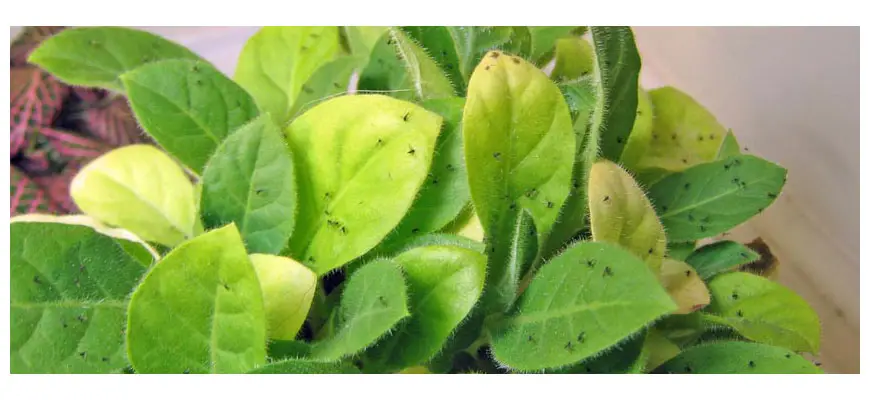
Fungus gnats are one of the most common indoor growing pests — and one of the most underestimated. These small, dark flies look like minor nuisances, but it’s their larvae that cause real damage: tunneling through roots, spreading plant pathogens, and opening the door to root rot. If you’re seeing tiny black flies hovering near your soil or medium, act quickly. A small fungus gnat population can explode within a single week.
Whether you’re growing in soil, coco, or a soilless mix — in a tent, a greenhouse, or a commercial facility — this guide covers everything you need to identify, eliminate, and prevent fungus gnats for good.
Bridge: The prevention and treatment strategies below apply across all growing scales, from a 4×4 hobby tent to a multi-room commercial facility. Commercial operators should also review the For Commercial Operations section at the end of this article.
What Are Fungus Gnats?
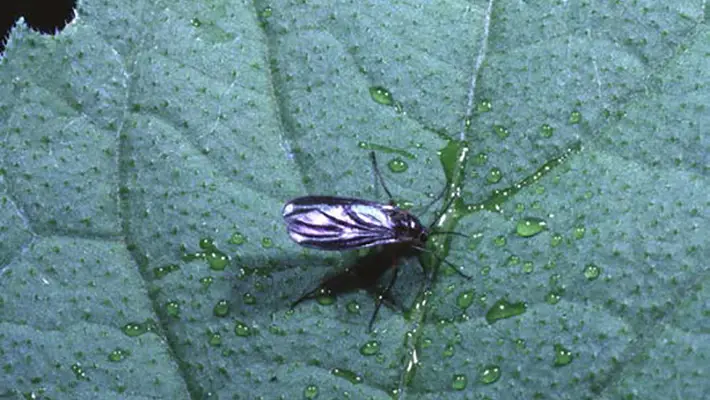
Fungus gnats (Bradysia spp.) are small, dark flies that look similar to mosquitoes or fruit flies but are smaller — typically 1/16 to 1/8 inch long. Adults are weak fliers and are most often spotted hovering near the soil surface or crawling across growing media, and winged adults are easy to confuse with fruit flies; a close look under a jeweler’s loupe or hand lens will show the Y-shaped wing vein that distinguishes fungus gnats.
The adults are annoying but largely harmless to plants on their own; the primary problem is their larvae. Female fungus gnats lay eggs in the top layer of moist growing media — often up to around 200 eggs over their lifetime — and those eggs can hatch within about 4–6 days under typical grow room conditions (around 72–78°F). Larvae are white, legless, and semi-transparent with a distinctive black head capsule, feeding on fungi and organic material in the root zone and, at higher populations or in stressed root systems, directly on root tissue, which creates entry points for Pythium and other root pathogens. The total life cycle from egg to adult can take roughly 3–4 weeks at about 72°F, meaning populations can complete multiple generations in a single crop.
How to Identify a Fungus Gnat Infestation
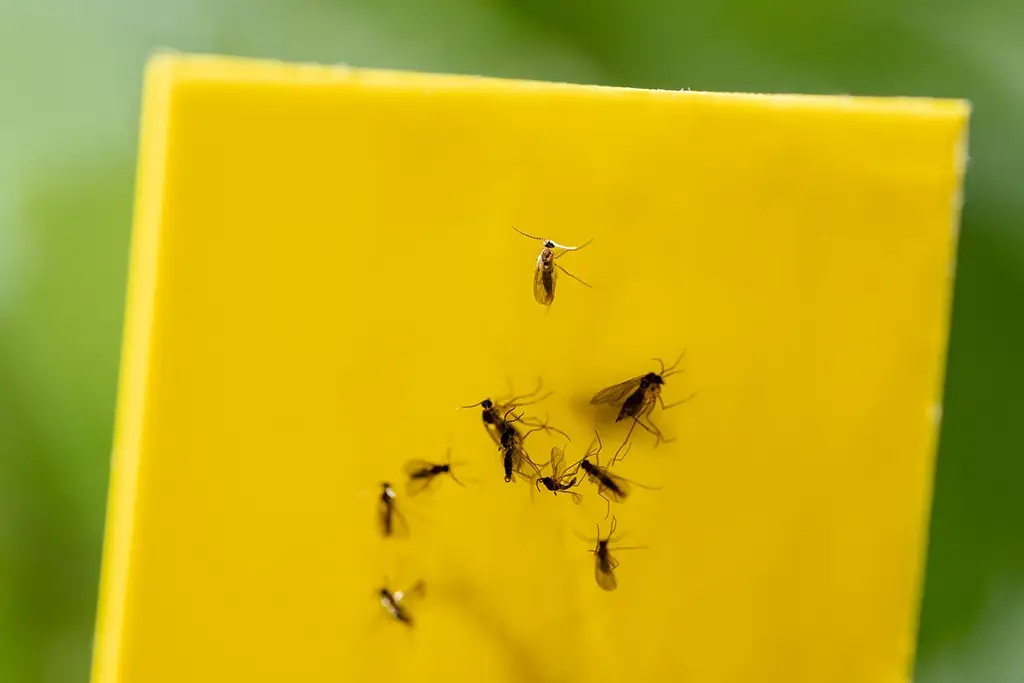
The earliest and most reliable detection method is sticky trap monitoring. Place HBX Yellow Sticky Traps horizontally at soil level — one trap per 10–25 sq ft of canopy — and check them every 3–5 days; even a few adults on traps before you see any flying is an early-warning signal worth acting on.
Other signs of a fungus gnat infestation include:
- Flying adults hovering near the soil surface, especially after watering
- Yellowing leaves or stunted growth that doesn’t respond to feeding adjustments — likely root damage from larvae
- Wilting in otherwise healthy-looking plants, particularly in seedlings and clones
- Visible larvae — white, worm-like, about 1/4 inch long — found in the top 2–3 inches of media when you pull a plant or dig gently into the root zone
The sticky trap count is useful as a severity guide: 0–5 adults per trap per week = low pressure; 6–20 = moderate; 20+ = heavy infestation requiring immediate multi-method treatment.


What Attracts Fungus Gnats — and How to Remove Those Conditions
Fungus gnats are opportunistic; they do not seek out your plants specifically, but instead seek out the environmental conditions your grow room can accidentally create for them, especially moist substrates rich in organic matter.
Overwatering and Wet Media
The single biggest contributing factor to fungus gnat infestations is persistently moist growing media. Wet, oxygen-depleted soil is an ideal egg-laying environment, and if the top 1–2 inches of your media are consistently damp between waterings, you are essentially running a fungus gnat nursery. Review our guide on how to properly water your plants if you’re new to dialing in your schedule. In soil, allow the top 1–2 inches to dry out thoroughly (but not to the point of stressing the plant) before the next watering, and in coco, run to near-dry with prompt same-day recovery while monitoring carefully — larvae can establish quickly in compacted coco that retains surface moisture.
Media Type
Peat, coco, and compost-heavy soilless mixes are more prone to fungus gnat colonization because they support the fungal organisms larvae feed on, as well as holding moisture near the surface. This doesn’t mean you should avoid these media — just that you need to be more vigilant with moisture management and monitoring. A top-dressing of coarse perlite, washed sand, or diatomaceous earth over the surface of your pots creates a physical barrier that discourages egg-laying and can help desiccate larvae as they move through the upper layer of media.
High CO2 Environments
Rooms running elevated CO2 often also run dense canopies and higher irrigation frequency, which can leave media surfaces wetter for longer and can make existing fungus gnat populations more comfortable if airflow and moisture management are not dialed in. If you’re running CO2 supplementation and dealing with an active infestation, consider tightening up irrigation practices and airflow and, if necessary, temporarily reducing enrichment while you bring the infestation under control. You can learn more about using grow room CO2 properly to keep your environment within optimal ranges without inadvertently creating pest-friendly conditions.
Suboptimal Ventilation and Air Circulation
Stagnant air, high humidity, and poor air circulation all favor fungus gnat reproduction by keeping the media surface damp and reducing evaporation. A properly sized ventilation system typically keeps humidity in an approximate 45–65% RH range during veg and around 40–50% during flower for many crops, though exact targets should be tuned to your crop, strain, and VPD strategy. Check out our indoor grow room ventilation setup guide if your environment isn’t dialed in, and monitor conditions continuously with a HBX Thermo-Hygrometer — its Min/Max memory function is particularly useful for catching overnight humidity spikes that create favorable gnat conditions.
Contaminated Inputs
Fungus gnats can hitchhike in on bags of soil and compost, on new plants, on used equipment, and even on your clothing after visiting other gardens. Always quarantine new plants for 1–2 weeks before introducing them to your established grow space, inspect new media for signs of larvae before use, and clean and sanitize all equipment that moves between grows to avoid importing pests.
Intake Air
If your ventilation intake is unfiltered, fungus gnats can enter directly through your ducting. Sealing your intake with a HEPA intake filter helps stop adult gnats and other airborne contaminants at the source. Our tips on setting up your ventilation system cover the specifics of proper intake filtration and airflow management.
How to Get Rid of Fungus Gnats: A Multi-Method IPM Approach
The fastest and most durable fungus gnat control comes from combining chemical, biological, and cultural methods simultaneously. Targeting only adults (what you see flying) while ignoring larvae (what’s eating your roots) is the most common mistake growers make, whereas effective IPM hits every life stage at once.
For a deeper dive on building a full pest management program, see our complete guide to integrated pest management (IPM).
Primary Solution #1: BioSafe AzaGuard — Soil Drench and Foliar Treatment
BioSafe AzaGuard is an EPA-registered azadirachtin-based insecticide and nematicide derived from neem seed extract, and is a highly effective broad-spectrum botanical option widely used for fungus gnat control when used as part of an IPM program. AzaGuard works via two mechanisms: as an insect growth regulator (IGR) that disrupts larval molting and development, and as a contact and ingestion treatment that helps repel and suppress adults.
For fungus gnat control, apply as a soil drench or chemigated soil application to target larvae directly in the root zone, mixing and applying strictly according to the product label for your crop, system type, and application method (rates are typically specified in fl oz per area rather than fixed per-gallon recipes). Repeat applications at label-directed intervals during an active infestation, or on a longer interval as part of a preventative rotation, and always avoid leaching by applying just enough solution to thoroughly moisten the root zone. AzaGuard can also be applied as a foliar spray directed at adult populations at label-listed rates, with applications made under lower light and temperature conditions to reduce phytotoxicity risk and protect the active ingredient from UV degradation.
Note: AzaGuard has a relatively short residual window under grow room conditions, so for sustained control it should be paired with compatible rotation partners (for example, pyrethrin- or essential-oil-based products) to manage resistance and bridge treatment cycles, always in accordance with the product label and any applicable regulations.
Primary Solution #2: ARBICO Organics Triple Threat Beneficial Nematodes — Soil Application
ARBICO Organics Triple Threat Beneficial Nematodes combine three nematode species — Steinernema feltiae (Sf), Steinernema carpocapsae (Sc), and Heterorhabditis bacteriophora (Hb) — into a single application. S. feltiae is the most commonly used species for targeting fungus gnat larvae specifically: it actively seeks out gnat larvae in the soil, enters through natural openings, and releases symbiotic bacteria that kill the host within roughly 24–48 hours.
Beneficial nematodes work best in soil and soilless media with adequate moisture to support their movement and survival, and are not effective in fully sterile hydroponic systems (e.g., DWC with no media), but perform well in rockwool, coco, and peat-based mixes when applied correctly. Apply to moist media at rates consistent with product guidance — for example, some S. feltiae products recommend around 5 million nematodes per 300 sq ft for preventative use and higher rates (such as 5 million per 50 sq ft) under heavier pressure — and always follow the specific rate and dilution instructions on your chosen nematode product. Mix in cool, chlorine-free water, apply immediately after preparation without letting the solution sit, and keep media evenly moist (not saturated) for about 2 weeks post-application to support nematode survival; they will not persist in media that is allowed to dry out completely.
Beneficial nematodes are generally most effective as a preventative or early-intervention tool, so once a larval population is high, they should be combined with compatible soil drenches or surface treatments for faster knockdown while the biological population establishes.
Primary Solution #3: PyGanic Gardening — Adult Contact Kill
PyGanic Gardening is a pyrethrin-based, OMRI-listed contact insecticide that provides quick knockdown on adult flying insects when applied correctly. Pyrethrins degrade rapidly (often within hours under grow room light), making PyGanic an effective, low-residue option for adult population suppression when applied at lights-off to minimize UV breakdown and potential plant stress.
Use PyGanic at label-specified rates — for example, many greenhouse and nursery uses call for approximately 0.25–0.5 fl oz per gallon of water applied at a specified volume per 1,000 sq ft, but you must follow the exact application directions for your formulation and use site. Apply in rotation with AzaGuard or other compatible products to help prevent resistance development, as pyrethrins and azadirachtin have different modes of action that complement each other in an IPM program.
Primary Solution #4: Athena IPM
Athena IPM is a concentrated peppermint and rosemary oil-based IPM product that serves dual duty as both an insecticide and a fungicide when used according to label directions. Applied as a foliar spray or soil surface treatment, it disrupts insect respiration on contact and creates a repellent environment that discourages egg-laying on treated surfaces.
Athena IPM is designed for use in active canopies and is formulated with minimal re-entry and pre-harvest restrictions for labeled use sites, but growers must always follow the product label and any applicable local regulations when integrating it into an IPM program. Apply at the label-recommended dilution (commonly around 2 mL per liter for preventative maintenance in many applications) on a 7–14 day schedule, and rotate with other compatible products to avoid over-reliance on a single mode of action.
Primary Solution #5: Tip Top Bio-Control Stratiolaelaps Scimitus (Hypoaspis Miles)
Tip Top Bio-Control Stratiolaelaps Scimitus are predatory soil mites that feed on fungus gnat larvae, eggs, and pupae in the top layer of growing media. Unlike nematodes, Stratiolaelaps are generalist predators that can feed on a variety of soil-dwelling organisms, meaning they don’t require a high-density target population and can persist in the soil between crop cycles as long as organic food sources are present.
For commercial or dense container setups, Stratiolaelaps are often applied based on a per-square-foot or per-container rate (for example, some beneficial mite programs use around 0.25 mites per square foot preventatively, with higher rates under pressure), but you should follow the specific rate and release instructions provided with the product you purchase. Apply at transplant or at the first sign of gnat pressure, and use in combination with S. feltiae nematodes for comprehensive soil-level biological control across different microhabitats in the media.


Supporting Tools and Sanitation
Environmental Monitoring: A HBX Thermo-Hygrometer provides continuous temperature and humidity readings with Min/Max memory — essential for catching overnight RH spikes that promote fungus gnat habitat, especially near the media surface. Place one unit at canopy level and one at soil level in larger rooms to capture both plant and substrate conditions.
Application Equipment: For soil drench applications of AzaGuard or nematode solutions, the HBX Pump Sprayer 8 Liter delivers consistent, even coverage across large canopies and root zones when calibrated and used correctly. For targeted spot treatments in smaller areas or propagation trays, use the HBX Handheld Pump Sprayer 2 Liter for precision without waste.
Facility Sanitation Between Cycles: BioSafe SaniDate 5.0 is an EPA-registered broad-spectrum sanitizer/disinfectant that eliminates bacteria, fungi, and pathogens on hard surfaces, benches, trays, tools, and floors when used according to label directions. Used as part of an end-of-cycle sanitation protocol, it helps remove residual fungal food sources that can sustain gnat populations between crops; apply per label to all appropriate surfaces that contact growing media, with no rinse required on designated non-food-contact surfaces. For active root zones, BioSafe ZeroTol 2.0 provides bactericidal and fungicidal activity in the root zone and on foliage at label rates, offering pathogen suppression without significantly harming beneficial biology when used correctly.
Prevention Protocol: Stopping Fungus Gnats Before They Start
Prevention is significantly more effective than treatment. A few consistent cultural practices will dramatically reduce your risk of infestation:
- Dial in your watering cadence. Allow the top 1–2 inches of media to dry between waterings in soil, and run to near-dry in coco with same-day recovery, avoiding prolonged saturation. Overwatering is one of the primary drivers of fungus gnat problems because it creates ideal conditions for egg-laying and larval development.
- Monitor consistently. Deploy HBX Yellow Sticky Traps from day one — one per 10–25 sq ft — and replace weekly so you can spot increasing pressure early and respond at low population levels rather than to full-blown infestations.
- Top-dress with a physical barrier. A 1/2 inch layer of coarse perlite, washed sand, or diatomaceous earth on the surface of your pots creates a desiccating barrier that deters egg-laying and can desiccate hatching larvae as they move through the upper layer of media.
- Maintain proper RH and airflow. Keep grow room RH generally within a 45–65% range during veg and 40–50% during flower for many crops, adjusting for your specific strain and VPD targets, and use your ventilation system and fans to prevent dead air pockets near the soil surface.
- Quarantine all incoming plants and media. Inspect new soil or coco for larvae before use, quarantine incoming plants for 1–2 weeks, and consider a preventative AzaGuard drench or biological application — always following label directions — before introducing new plants to your established room.
- Rotate your IPM products. Never rely on the same product continuously. Rotate between AzaGuard (azadirachtin/IGR), PyGanic (pyrethrins/contact), and Athena IPM (essential oils/repellent) or other compatible tools on an appropriate interval to help prevent resistance development and manage different life stages, staying within all label limits.
- Sanitize between cycles. Apply BioSafe SaniDate 5.0 to all appropriate surfaces before bringing in new media and plants; thorough sanitation removes fungal residue and organic buildup that can sustain low-level larval populations between crops.
- Filter your intake. Install a HEPA intake filter on your ventilation intake to help prevent adult gnats and other small flying pests from entering through your ducting and spreading between rooms.
| Condition | Action |
|---|---|
| 0 adults/trap/week | Maintain monitoring only; no treatment needed beyond standard preventive cultural practices |
| 1–5 adults/trap/week | Initiate preventative AzaGuard soil application per label and introduce beneficial nematodes as a baseline biological control |
| 6–20 adults/trap/week | Full IPM: label-rate AzaGuard soil application + PyGanic foliar for adults + Stratiolaelaps mites + nematodes to target larvae and pupae |
| 20+ adults/trap/week | Maximum pressure response: tighten rotation between AzaGuard and PyGanic within label limits; increase biological releases; review watering and media; consider media replacement and root-zone remediation if roots are severely compromised |
For Commercial Operations
Commercial Workflow: Fungus Gnat Management at Scale
Commercial facilities — particularly multi-room operations running perpetual cycles — face a unique challenge with fungus gnats: a population that escapes control in one room can quickly spread via shared air handling, foot traffic, and contaminated equipment. The following protocol is designed for facility managers and head growers.
Weekly Monitoring Protocol: Deploy HBX Yellow Sticky Traps at a density of about one trap per 10 sq ft on the floor or at soil level, monitored and replaced on a 7-day rotation. Assign trap counts to a crop log by room and week, and establish action thresholds such as: 0–2 adults/trap/week = monitor only; 3–10 = preventative biological release; 11+ = chemical IPM intervention required, adjusted to your risk tolerance and crop value.
Preventative Biological Program:
Release Steinernema feltiae nematodes and Stratiolaelaps scimitus mites at transplant rather than waiting for first detection. This is often the most cost-effective strategy at commercial scale, because establishing biological populations preventatively is far less expensive than treating an active infestation in a full canopy room, and reapply on regular intervals consistent with product labels — for example, every 4–6 weeks per container crop or at each transplant for continuous crop systems.
Chemical Rotation Program:
Operate on a strict rotation using chemistries with different modes of action, for example:
- Week 1–2: BioSafe AzaGuard (azadirachtin/IGR) — soil application plus canopy spray per label
- Week 3–4: PyGanic Gardening (pyrethrin/contact kill) — target adults at lights-off under label constraints
- Week 5–6: Athena IPM (essential oils/repellent) — preventative maintenance on labeled crops and sites
Document all applications in your IPM logbook with product, rate, room, and applicator. This supports compliance with state pesticide application record requirements and helps identify if resistance patterns or application issues are developing over time.
End-of-Cycle Facility Sanitation:
Apply BioSafe SaniDate 5.0 to all benches, walls, floors, trays, and tools between cycles, following label directions for contact time and dilution. Allow surfaces to dry fully before introducing new media; this helps eliminate the residual fungal load and organic debris that allow low-level gnat populations to persist through crop transitions. Use HBX Nitrile Gloves (6-mil, latex-free, case of 1,000) or equivalent PPE for all chemical handling throughout the facility in line with label and safety requirements.
Root Zone Sampling:
Monthly, pull 3–5 random containers per room and inspect the top 2 inches of media for larvae. A count of more than about 5 larvae per sample is a practical threshold that warrants immediate soil-level intervention regardless of sticky trap counts, since larvae can be present at damaging levels before adult flights become obvious. Incorporate findings into your IPM log to refine thresholds and treatment timing.
Why Shop at HydroBuilder for Pest Control
HydroBuilder stocks a complete IPM supply chain — from monitoring (HBX Yellow Sticky Traps) to treatment (BioSafe AzaGuard, PyGanic Gardening, beneficial insects) to application (HBX Pump Sprayer 8 Liter) to sanitation (BioSafe SaniDate 5.0) — all in one place, with expert support available at 888-815-9763.
Our team includes experienced growers who can help you select the right product rotation for your specific crop, media, and grow system. Whether you need a single treatment or a commercial facility-wide IPM program, we’re equipped to help you build a compliant, label-driven plan that protects yields and root-zone health.


Related Resources
Fungus Gnats: FAQs
Q: What are fungus gnats and why are they harmful to my plants?
Direct answer: Fungus gnats are small, dark flies whose larvae feed in the root zone of your plants — damaging roots, spreading pathogens, and opening the door to root rot; adults are mostly harmless, while larvae cause the real damage.
Expanded context: The adult flies are often mistaken for fruit flies or small mosquitoes and do not chew on leaves; instead, they lay eggs in moist growing media. The larvae that hatch are the destructive stage: in high populations or stressed root zones, they chew through root hairs and tap roots, dramatically reducing water and nutrient uptake and carrying fungal pathogens like Pythium and Fusarium as they move through the root zone.
Commercial application: At commercial scale, fungus gnat-damaged roots are a significant source of late-stage crop loss — particularly in perpetual cycle facilities where root zone health and pathogen load can carry over between chambers. Implement preventative biological controls at transplant rather than relying on reactive treatments after infestations are visible.
Q: How do I get rid of fungus gnats in soil?
Direct answer: Eliminate fungus gnats in soil by using a label-directed soil application of BioSafe AzaGuard to disrupt larvae, introducing Steinernema feltiae nematodes into the root zone, and allowing the top 1–2 inches of soil to dry between waterings so the surface is not constantly wet.
Expanded context: Soil applications with AzaGuard target larvae directly where they live, while beneficial nematodes (S. feltiae) actively hunt larvae through the soil profile and provide sustained biological control when moisture is adequate. At the same time, deploy sticky traps to monitor and catch adults to reduce the egg-laying population, and modify your irrigation so that the upper media layer can dry down between events, removing the habitat fungus gnat females prefer for laying eggs.
Commercial application: Commercial soil-grown operations should implement monthly root zone sampling alongside sticky trap monitoring. A count of roughly 5 or more larvae per sample is a practical threshold that warrants immediate intervention regardless of adult fly counts, as larval damage can precede visible adult pressure.
Q: Can fungus gnats live in hydroponic systems?
Direct answer: Adult fungus gnats can live near any moist environment, but larvae cannot survive in truly sterile, media-free hydroponic systems such as DWC or NFT; they can and do establish in hydroponic media including rockwool, coco, and clay pebbles if conditions are favorable.
Expanded context: In media-free systems (DWC, aeroponics), there is no organic substrate for larvae to colonize, so fungus gnats rarely cause root zone damage there, assuming reservoirs and surfaces are kept clean. However, any system with a growing medium — even inert media like coco or rockwool — can harbor larvae if moisture management is poor, and in rockwool systems larvae can establish in the surface of cubes if kept persistently wet. Beneficial nematodes can work well in coco and rockwool, but are not effective in pure water systems.
Commercial application: In mixed-system facilities (e.g., mother rooms in soil, production in coco or rockwool), manage each room’s IPM program separately and prevent cross-contamination between rooms through strict footwear, tool, and cart protocols so pests are not moved from soil areas into otherwise clean hydroponic zones.
Q: What kills fungus gnat larvae in soil?
Direct answer: Steinernema feltiae nematodes, predatory Stratiolaelaps scimitus soil mites, AzaGuard soil applications, and carefully managed hydrogen-peroxide-based drenches (used according to product directions) can all reduce fungus gnat larvae in soil.
Expanded context: Each method has a different mode of action and appropriate use case. Nematodes and Stratiolaelaps provide ongoing biological suppression without harming plant roots when applied correctly, while AzaGuard (azadirachtin) disrupts larval molting so larvae cannot develop into adults and eventually die. Hydrogen-peroxide-based drenches can provide immediate contact reduction of larvae and some pathogens but have no residual activity and must be used cautiously according to product instructions to avoid root damage, so they are best used as a quick knockdown measure while biological programs establish, not as a standalone, repeated treatment.
Commercial application: Commercial IPM programs should layer biological control (nematodes plus Stratiolaelaps) as a continuous baseline, with label-driven chemical drenches (such as AzaGuard) and other compatible tools deployed on threshold-triggered schedules based on sticky trap counts and root zone sampling.
Q: How fast do fungus gnats multiply?
Direct answer: At typical grow room temperatures of around 72–78°F, a single female fungus gnat can lay up to roughly 200 eggs over her lifetime, which can hatch in 4–6 days, and the full life cycle from egg to adult can complete in approximately 3–4 weeks, allowing multiple generations to cycle within a single crop.
Expanded context: The rapid generation time means a small, undetected population can become a severe infestation within 3–4 weeks of establishment, especially in warm, moist propagation or veg environments. This is why sticky trap monitoring from day one is critical — catching the first generation early allows you to intervene at low pressure with preventative biologicals and targeted soil applications rather than responding to a full outbreak.
Q: What plants are most susceptible to fungus gnats?
Direct answer: Seedlings and clones are the most vulnerable because their root systems are small and undeveloped, so a larval feeding event that a mature plant would tolerate can kill a seedling; cannabis, tomatoes, herbs, and leafy greens in peat or coco-based media are all commonly affected.
Expanded context: In propagation areas especially, maintain strict watering discipline and deploy preventative nematode applications and sticky traps before signs of infestation appear, as the moist, warm conditions of propagation trays are highly attractive to egg-laying adults. Avoid leaving standing water in trays or domes, and ensure adequate airflow just above the media surface.
Commercial application: Propagation rooms should be treated as the highest-risk area in a commercial facility for fungus gnat establishment, with a dedicated IPM protocol that includes preventative biologicals, high-density sticky traps, and tight moisture control, separate from the programs used in production rooms.
Q: Do yellow sticky traps get rid of fungus gnats?
Direct answer: Sticky traps alone will not eliminate a fungus gnat infestation — they only capture adults and are primarily a monitoring tool — but they are essential for early detection and should be used as the foundation of any fungus gnat IPM program.
Expanded context: HBX Yellow Sticky Traps placed horizontally at soil level catch adult flies before they complete their egg-laying cycle, giving you a real-time view of pressure and trend. At light pressure, high-density trap deployment (for example, around one per 10 sq ft) can meaningfully reduce adult populations and slow infestation progression, but at moderate to heavy pressure sticky traps must be combined with soil-level larval treatments and cultural changes to be effective.
Q: Are fungus gnats harmful to humans?
Direct answer: No. Fungus gnats do not bite humans or pets, do not transmit human diseases, and are not considered physically harmful; they are primarily a plant health and quality concern.
Q: What's the best organic treatment for fungus gnats?
Direct answer: One of the most effective organic fungus gnat strategies combines BioSafe AzaGuard soil applications (OMRI-listed azadirachtin) with Steinernema feltiae beneficial nematodes — AzaGuard helps knock down larval populations chemically while nematodes provide ongoing biological suppression, all within a broader IPM rotation.
Expanded context: Both products are OMRI-listed for organic use, and this combination is widely used by commercial organic growers because it leverages two different modes of action — chemical IGR disruption and active biological predation — while supporting living soil biology when applied as directed. PyGanic (pyrethrin) can be added to the rotation as an organic-compliant adult contact kill for flying stages, again following label directions and local regulations.
Q: How do I prevent fungus gnats from coming back after treatment?
Direct answer: Prevent recurrence by maintaining a consistent monitoring program with sticky traps, allowing the top 1–2 inches of media to dry between waterings, top-dressing pots with coarse perlite or diatomaceous earth, and keeping biological controls (nematodes, Stratiolaelaps) active in the soil as part of your ongoing IPM.
Expanded context: The most common reason fungus gnats return after treatment is that growers reduce or stop treatments but revert to overwatering and poor surface moisture management. Treatments reduce populations, while changed habits and ongoing biological and physical barriers prevent reinfestation; combining a physical surface barrier (perlite or DE) with ongoing biological control and a conservative preventative AzaGuard or essential-oil-based rotation helps maintain suppression pressure through subsequent crop cycles, all within the constraints of each product’s label.