

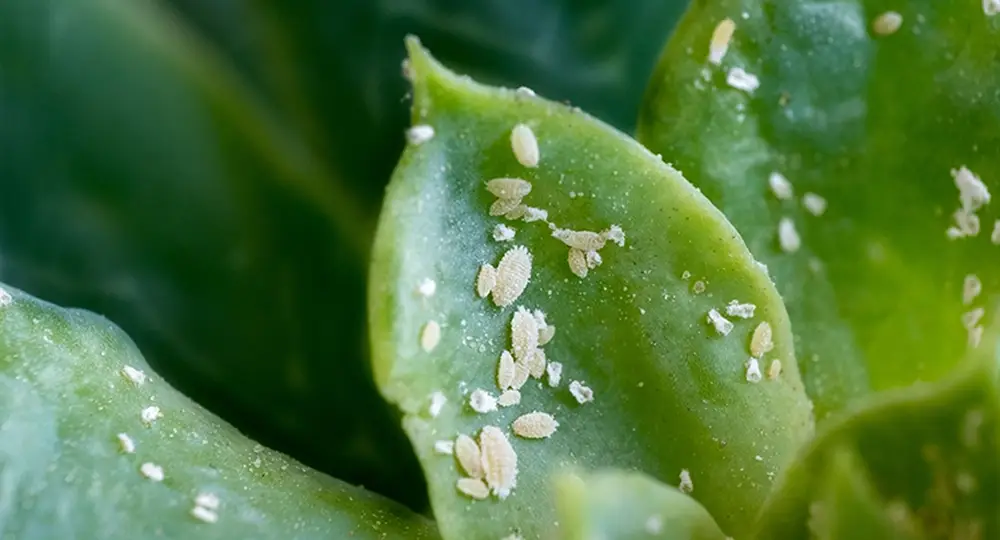
Scale insects are among the most deceptive pests a grower will encounter — they look like harmless bumps or waxy deposits until the damage is already done. Whether you’re managing a four-plant home grow tent or a multi-room commercial facility, knowing how to get rid of scale insects quickly and correctly can mean the difference between a crop setback and a full recovery.
This guide covers everything: what scale insects are, how to tell them apart from similar pests, when to treat for maximum effectiveness, and which products actually work — organic and conventional — across all grow environments.
These strategies apply at any scale, from houseplants and hobby tents to commercial greenhouse operations. We’ve included a section at the end specifically for facility-scale IPM workflows.
What Are Scale Insects?
Scale insects are small sap-sucking pests that attach themselves to leaves, stems, twigs, branches, and fruit tissue, feeding on plant fluids through piercing-sucking mouthparts. They are notoriously difficult to spot because they don’t look like typical insects — they resemble bumps, shell deposits, or waxy growths rather than anything with legs or obvious movement.
There are two primary categories, and the distinction matters because it directly affects which treatments will work on your infestation.
Hard (Armored) Scale Insects — Less than ⅛ inch in diameter, these pests secrete a tough waxy or shell-like protective covering directly over their bodies. That covering is not attached to the insect itself; it functions as a separate physical shield. Because of this armor, hard scales are significantly more resistant to contact insecticides and oils than soft scales. They do not produce honeydew.
Soft Scale Insects — Slightly larger (up to ½ inch), soft scales do not build a hard shell. They produce a waxy coating that is fused to the body and do secrete honeydew, a sticky substance that creates secondary problems (more on that below). Soft scales are more susceptible to sprays than armored types, but infestations tend to be stickier and messier to manage.
Common Scale Species You'll Encounter
With approximately 8,000 described scale species worldwide, you may not always be able to identify exactly what you’re dealing with — and that’s okay. Treatment approaches are similar across most species. The most common families found in indoor and greenhouse cultivation include:
Diaspididae (Armored Scales) — The hardest to treat due to their external armor. Species include San Jose scale, oyster shell scale, and California red scale. These are the “hard” scales that resist oil sprays unless caught early.
Coccidae (Soft Scales) — Includes brown soft scale and wax scales. They produce honeydew and are somewhat easier to treat with contact sprays because of their softer protective covering.
Pseudococcidae (Mealybugs) — Technically mealybugs, these are often classified with scale insects. They have visible legs, move occasionally, and leave a characteristic cottony white residue. Our guide to mealybugs covers this species in more detail.
Eriococcidae (Felt Scales) — These look like small felt-covered bumps on plant tissue and can be mistaken for a disease symptom rather than an insect.
Margarodidae (Ground Pearls/Giant Scales) — Larger, sometimes fluffy-appearing scales that can be found in soil around root zones as well as on above-ground tissue.
What Damage Do Scale Insects Cause?
Scale insect infestations can build from a handful of crawlers to a colony of hundreds before visible damage becomes obvious. By the time you notice the classic signs, you may already be dealing with a substantial population.
Direct damage: Continuous sap removal weakens plants, causing yellowed leaves, reduced growth rate, early leaf drop, and in severe or prolonged infestations, branch dieback or full plant death. Cannabis and high-value crops are particularly vulnerable during stretch and flowering, when plants have less metabolic reserve to compensate for the nutrient loss.
Honeydew and sooty mold: Soft scale species excrete honeydew as a metabolic byproduct. This sticky substance coats leaf surfaces and attracts ants, wasps, and other insects that farm scales for honeydew. More critically, honeydew is a substrate for sooty mold fungus, which forms black powdery coatings on foliage. Sooty mold itself doesn’t directly penetrate plant tissue, but it reduces light absorption and photosynthetic efficiency — and it’s a clear visual signal that a pest population has been active for some time.
Don’t over-rely on honeydew as your diagnostic anchor. Aphids and whiteflies also produce honeydew. Confirm the actual pest before treating. Check our guides on aphids and whiteflies if you’re not certain you’re dealing with scale.
How to Identify Scale Insects vs. Other Pests
Correct identification before treatment prevents wasted applications. Here’s how to distinguish scale from lookalikes:
Scale insects vs. mealybugs: Mealybugs are mobile, leave a cottony white waxy residue, and have visible segmented bodies. Scale insects appear as fixed bumps or shells without visible appendages. Pseudococcidae (mealybug-type scales) blur this line, but the lack of movement and shell-like appearance are your key tells.
Scale insects vs. pest eggs: Spider mite eggs are much smaller and typically found on leaf undersides in clusters. Scale insects have a slightly three-dimensional raised profile and are found on stems and branches as often as on leaves.
Scale insects vs. disease bumps: If you’re unsure whether you’re looking at an insect or a plant growth anomaly, use a 10x hand lens or magnifier. Scale insects will reveal a defined edge or shell margin. Plant galls and cankers don’t have this edge.
Sticky residue test: If you see ants trailing up your stems, or notice a shiny sticky film on leaves below a grouping of bumps — that is honeydew from soft scale. This almost always confirms a soft scale population is present.

Can You Prevent Scale Insects?
Prevention is part of any good IPM program, but scale insects are harder to prevent than many common pests because they arrive as nearly invisible crawlers or through infested plant material — and the crawler stage is extremely brief.
What actually reduces your risk:
- Inspect all incoming plant material and clones before introducing them to your grow space. Scale insects are commonly introduced this way.
- Maintain healthy plants. Stressed, over-fertilized (high-nitrogen), or drought-stressed plants are more susceptible to scale colonization than well-balanced, vigorous ones.
- Keep your grow space clean. Remove dead leaves and debris from growing areas promptly. Scale crawlers can hide in plant litter and re-infest.
- Use HBX Yellow Sticky Traps as part of ongoing scouting. While scale insects are not strongly attracted to yellow (unlike aphids or whiteflies), sticky cards help you detect other pest pressure that often arrives alongside scale infestations, giving you an early warning system overall.
What won’t work: There’s no reliable pre-emptive chemical barrier that will prevent scale specifically. IPM-based scouting and clean cultural practices are your best prevention tools.
When to Treat: The Crawler Stage Is Your Window
Scale insects are uniquely protected by their shells and waxy coatings during most of their life cycle, which makes treatment timing critical. The most effective time to treat is during the crawler (nymph) stage, when newly hatched scale are soft-bodied, mobile, and completely exposed.
Crawlers are tiny — often barely visible without magnification — but they are the one stage when contact insecticides and horticultural oils work most efficiently. Once they settle, molt, and begin building their shell or waxy covering, treatment efficacy drops significantly, especially for armored species.
How to catch the crawler stage:
- Monitor your plants weekly. If you know you’ve had scale activity, step that up to every 3-4 days during warm periods (above 70°F / 21°C) when the reproduction cycle accelerates.
- Use a double-sided tape “crawler trap” wrapped around infested stems — if you start catching tiny mobile crawlers, that’s your treatment window.
- The crawler flush typically follows egg hatch, which in most species peaks in late spring outdoors, but in controlled indoor environments can occur year-round.
How to Get Rid of Scale Insects: Treatment Approaches
Step 1: Manual Removal and Pruning
For small or localized infestations — a few infested stems or a single branch — start with mechanical removal before reaching for sprays.
Remove infested branches, twigs, and leaves entirely and dispose of them in sealed bags. Do not compost infested plant material; this spreads crawlers. For isolated scale on a stem you want to keep, use a stiff toothbrush, soft cotton cloth, or fine cotton swab dipped in rubbing alcohol to dislodge and kill individual scale insects on contact.
After removal, monitor the same plant for 7-10 days to confirm the population is not rebounding from crawlers you missed.
Step 2: Horticultural Oil and Soap-Based Treatments
Oil-based and soap-based insecticides are the first line of treatment for most scale infestations — OMRI-listed, low residue, and safe to use in most grow environments including organic programs.
How they work: Horticultural oils suffocate scale insects by coating their spiracles (breathing pores), disrupting the waxy protective layer and penetrating to the insect body. Insecticidal soaps disrupt the cell membrane of soft-bodied insects on direct contact.
BioWorks SuffOil-X is a highly refined paraffinic oil that works against all life stages of soft scale and against crawlers of armored scale species. It’s OMRI-listed, with a favorable plant safety profile when applied at recommended rates (typically 1–2% dilution). Apply at lights-off or in low-temperature conditions (below 85°F / 29°C) to reduce the risk of phytotoxicity, particularly on soft-stemmed or heat-stressed plants.
Lost Coast Plant Therapy combines peppermint oil, rosemary oil, and sodium lauryl sulfate into a contact insecticide and fungicide that works well on soft scale and crawlers. It’s approved for use up to harvest and leaves no harsh chemical residue, making it a solid choice for organic cultivators with mid-to-late-cycle infestations.
Certis Biologicals Des-X Insecticidal Soap Concentrate is a potassium salt of fatty acid formulation — effective on soft-bodied crawlers and soft scale. As with all contact insecticides, coverage is critical: you must reach the insects directly for the application to work. Thorough stem and undersurface coverage is essential.
Application tip: Multiple applications 5-7 days apart are typically needed. A single spray rarely achieves control; the goal is to catch successive crawler flushes as they emerge.
Use a HBX Pump Sprayer for consistent, even coverage across canopy and stem surfaces. The 8-liter configuration handles full-room applications in larger grow spaces, while the 2-liter provides better maneuverability for spot treatments and tighter canopy environments.


Step 3: Azadirachtin-Based Treatments
For infestations that haven’t responded to oil and soap alone, or as a proactive rotation partner in your IPM program, azadirachtin-based products provide systemic and contact activity against scale insects.
BioSafe AzaGuard is HydroBuilder’s preferred azadirachtin formulation — derived from neem seed extract, OMRI-listed, and effective as both a contact spray and a soil drench that can provide systemic activity when taken up through roots. As a contact spray, it disrupts the molting cycle of crawlers, preventing them from maturing into their protected adult form. This makes it especially valuable when used proactively or early in an infestation cycle. Rotate AzaGuard with oil or soap treatments to prevent any buildup of tolerance. Do not apply within 2 weeks of harvest; follow label rates precisely.
Step 4: Conventional Insecticides for Heavy Infestations
When biological and OMRI-listed treatments have been deployed and the infestation persists — or when a commercial operation cannot afford extended treatment cycles — conventional insecticides provide faster knockdown.
Athena IPM is a broad-spectrum pesticide and fungicide formulated for professional cultivation environments. It combines pyrethrin and plant-based oils for fast contact activity, with a favorable PHI (pre-harvest interval) profile. It’s effective against scale crawlers and soft scale adults. Apply during lights-off, maintain thorough coverage, and confirm label compliance for your crop type before application.
Step 5: Beneficial Insects as a Biological Control
Beneficial predatory insects are most effective against scale populations when deployed before an infestation becomes heavy — they are a prevention and suppression tool, not a rescue treatment for severe outbreaks.
ARBICO Organics Green Lacewing Eggs are among the most versatile beneficial insects available. Lacewing larvae are aggressive predators of scale crawlers, as well as aphids, thrips, and other soft-bodied pests. Release rates of 1,000-2,000 eggs per 500 sq ft are standard for established pest pressure; higher for heavy infestations.
An important note on biological vs. armored scale: Once scale insects have developed their hard protective shell or waxy covering, most beneficial insects cannot penetrate that defense. Lacewings and ladybugs are most effective against crawlers and young nymphs. For established armored scale colonies, mechanical removal and chemical controls must do the heavy lifting. See our full beneficial bugs guide for more on integrating biocontrols into your IPM rotation.


How to Get Rid of Scale Insects on Indoor Plants and Grow Rooms
Grow rooms and enclosed indoor spaces change the scale insect management equation in several important ways. Without natural predator pressure, scale populations can build faster. The controlled environment also means you can time treatments with more precision — but it also means you’re responsible for every pest that gets in.
Quarantine incoming plants. This is the single most important practice. Any clone, mother plant, or vegetative transplant coming from an outside source should spend a minimum of 5-7 days in a separate quarantine zone before entering your main grow space. Inspect closely with a hand lens before clearing them.
Treatment modifications for enclosed spaces:
- Apply oil and soap sprays at lights-off or during dark periods to prevent heat-related phytotoxicity. Temperatures above 85°F / 29°C during or shortly after oil application increase burn risk significantly.
- Seal ducting ports and intake areas during treatment if possible to prevent treated pest material from being drawn out and potentially recirculating.
- For houseplants, the cotton swab and rubbing alcohol technique remains highly effective for small, accessible infestations: dip the swab in 70% isopropyl alcohol and press directly onto individual scale insects. Allow treated areas to dry before returning plant to its normal position.
- Remove dead scale insects after treatment so you can monitor for new crawler activity accurately.
Post-treatment sanitation: After a scale infestation in a grow room, clean growing surfaces, trays, and wall areas with a broad-spectrum sanitizer before starting your next cycle.
BioSafe ZeroTol 2.0 applied as a surface wipe-down kills any residual pathogens, including the sooty mold fungal spores that can persist after a scale infestation is resolved. This is standard IPM hygiene between cycles and costs relatively little in time and product compared to re-infestation risk.
For Commercial Operations: Scale IPM at Facility Scale
Scale insects in commercial cannabis or greenhouse facilities are a containment problem as much as a treatment problem. The goal shifts from “how do I fix this plant” to “how do I prevent this room from spreading to the next room.”
Integrated scouting protocol: Scout every room on a weekly minimum schedule. Use a standardized scouting form with a grid-mapped layout of your canopy. Mark findings by location so you can track whether a population is contracting (treatment working) or spreading (treatment failing or re-introduction occurring). Deploy HBX Yellow Sticky Traps at one card per 100-200 sq ft as part of general pest pressure monitoring.
Rotation spray programs: In commercial settings, resistance management is critical. Rotate between mode-of-action classes with each spray cycle: oil/soap (physical contact) → azadirachtin (growth disruptor) → pyrethrin-based (nerve agent) → back to physical. This prevents any single-mechanism resistance from building in a persistent population. Maintain a spray log per room, per application.
Room-level containment: If scale is identified in one room, treat that room as a contained unit. Restrict staff movement between rooms without PPE changes and tool sanitization. Scale crawlers can travel on clothing, tools, and even air currents from high-velocity fans.
Preventive air and surface sanitation:
Prokure G chlorine dioxide gas treatment between crop cycles kills surface-residing pest eggs and sooty mold fungal spores simultaneously — a significant IPM advantage for facilities running back-to-back cycles without extended downtime. Integrate into your room turnover SOP.
Beneficial insects at scale: Green lacewings can be scaled up cost-effectively to large canopy areas. At commercial scale, preventive weekly or bi-weekly releases of lacewing eggs are more economical than reactive spray programs once infestations are established.
Want to build a full integrated pest management framework for your facility? Review our complete IPM guide and our resource on the most common grow room pests and diseases.
Treatment Rotation Summary
| Treatment Type | Best Against | Timing | Notes |
|---|---|---|---|
| Horticultural oil (SuffOil-X) | Crawlers, soft scale adults | Crawler flush, repeat 5–7d | Apply below 85°F |
| Insecticidal soap (Des-X) | Crawlers, soft-bodied stages | Crawler flush, repeat 5–7d | Direct contact required |
| Lost Coast Plant Therapy | Crawlers, soft scale | Any active infestation | Safe to near harvest |
| BioSafe AzaGuard | Crawlers, all soft stages | Preventive + early treatment | Rotate with oils/soaps |
| Athena IPM | All stages, fast knockdown | Heavy infestations | Follow label PHI |
| Green Lacewing (ARBICO) | Crawlers and young nymphs | Preventive, before heavy infestation | Not effective on armored adults |
Why Shop at HydroBuilder for IPM Supplies
HydroBuilder carries the professional-grade pest control products used by commercial growers — the same formulations available to licensed applicators, without the institutional minimums. From OMRI-listed biologicals to conventional insecticides with tight pre-harvest intervals, you’ll find what you need backed by a team that actually grows.
Our pest and disease control collection includes the full BioSafe lineup, bioinsecticides, beneficial insects, and application equipment from brands our commercial partners trust.
Scale Insects: FAQs
How do I identify scale insects on my plants?
Scale insects look like small bumps, shells, or waxy deposits on stems, branches, and leaf undersides — not like typical insects. Hard (armored) scales create a separate shell over their bodies and don’t move once settled. Soft scales have a waxy coating fused to their body and produce a sticky honeydew. The key diagnostic: use a 10x hand lens and look for a defined margin or edge on the bump. Plant galls won’t have this. A sticky film on leaves below a cluster of bumps confirms soft scale with honeydew.
Expanded context: Color and size vary by species — some are white, some brown, some reddish or black. Don’t rely on color alone. The raised, shield-like profile on a stem or branch is more reliable. If you’re unsure, the crawler stage (tiny mobile nymphs) is unmistakable under magnification.
Commercial application: In commercial facilities, scale identification should be part of standardized weekly scouting. Record species and location on a canopy grid map so you can track population movement between scout cycles.
What kills scale insects on plants?
The most effective treatments depend on the life stage you’re targeting. During the crawler stage, horticultural oils, insecticidal soaps, azadirachtin-based sprays, and pyrethrin-based insecticides all work well. On established adult armored scale, treatment effectiveness drops sharply — oil applications penetrate better than soaps, and mechanical removal is often required alongside chemical treatment.
Expanded context: No single product is a one-and-done solution. Effective control requires two to three applications spaced 5-7 days apart to catch successive crawler flushes. OMRI-listed options like BioWorks SuffOil-X and BioSafe AzaGuard cover most organic program needs. For fast knockdown in commercial settings, Athena IPM provides stronger contact activity.
Commercial application: Rotation between mode-of-action classes (oil → azadirachtin → pyrethrin → back to oil) is critical in commercial settings to prevent resistance development in persistent scale populations.
When is the best time to treat scale insects?
The best time is during the crawler (nymph) stage — when newly hatched scale insects are soft-bodied, mobile, and completely exposed to contact treatments. Once they settle and build their protective shell or waxy covering, treatment efficacy drops substantially, especially for armored species.
Expanded context: The crawler flush typically follows egg hatch, which in outdoor environments peaks in late spring. In controlled indoor environments with stable temperatures, egg hatch can occur year-round. A crawler monitoring trap — double-sided tape wrapped around an infested stem — will catch mobile nymphs and tell you exactly when the treatment window is open.
Commercial application: Track crawler flush timing room-by-room on a scouting log. Treat within 48-72 hours of confirmed crawler activity for maximum spray efficacy before nymphs settle.
Can scale insects spread from plant to plant?
Yes — scale insects spread primarily during the crawler stage, when newly hatched nymphs are mobile and can walk to adjacent plants, ride air currents from fans, or be mechanically transferred via tools, clothing, and hands. Adult scale are essentially immobile once settled, but crawlers can travel surprisingly quickly and are nearly invisible to the naked eye.
Expanded context: In enclosed indoor environments, high-velocity fans accelerate crawler dispersal significantly. An infestation on one plant in a canopy can spread across a room within one generation cycle (2-3 weeks under warm conditions) if not caught and treated early.
Commercial application: Treat an infested room as a contained zone. Restrict tool and staff movement between rooms without sanitization. Crawler dispersal via shared equipment is a common re-introduction vector.
Do scale insects live in soil?
Most common scale species feed on above-ground plant tissue and do not establish in growing media. However, Margarodidae (ground pearls) are a notable exception — these scales feed on root tissue and can be found in soil around the root zone. Symptoms include unexplained plant decline without visible above-ground pest damage.
Expanded context: Root-zone scale is rare in controlled indoor environments but can occur in outdoor soil beds and occasionally in deep organic media. A soil flush and root zone inspection can confirm or rule out their presence if you’re seeing unexplained decline that doesn’t match above-ground pest activity.
Commercial application: In rockwool and coco grows, root-zone scale are extremely uncommon. Soil-based commercial operations should include root zone inspections as part of quarterly IPM audits. Beneficial nematodes may have limited efficacy against ground pearl species — consult the label before application.
What's the difference between hard and soft scale insects?
Hard (armored) scale insects build a separate protective shell over their bodies made of secreted wax and shed skin. This shield is not attached to the insect and provides significant protection against contact insecticides. Soft scale insects have a waxy coating that is fused to their body — it’s protective but more permeable, making them somewhat more susceptible to oil and soap treatments. Only soft scales produce honeydew.
Expanded context: This distinction drives treatment choice. For soft scale, insecticidal soaps and light oil treatments are usually sufficient with proper timing and coverage. For armored scale, heavier oil applications (SuffOil-X at the higher end of the label rate range), mechanical removal, and azadirachtin rotation are often necessary to achieve control.
Commercial application: Document whether you’re dealing with hard or soft scale in your scouting log. This determines your spray program and realistic timeframe for control — armored scale typically requires more treatment cycles and longer management timelines than soft scale.
Is neem oil effective against scale insects?
Neem oil and neem-derived products (particularly those containing azadirachtin as the active ingredient, like BioSafe AzaGuard) are effective against scale crawlers and nymphs, primarily by disrupting the molting cycle and providing some contact activity. Pure neem oil applied as a horticultural oil also provides physical suffocation against soft-bodied stages.
Expanded context: The raw neem oil products (like Dyna-Gro Pure Neem Oil) function primarily as oils — contact suffocation with minimal systemic effect. Refined azadirachtin extracts (AzaGuard, AzaMax) provide more consistent and targeted IGR (insect growth regulator) activity against scale. For best results, use the azadirachtin product as one rotation component alongside a purpose-formulated horticultural oil like SuffOil-X rather than relying on either alone.
Commercial application: In commercial organic programs, AzaGuard as a soil drench (4–8 oz/gallon per label, every 14-21 days) in addition to foliar rotation provides systemic protection that helps manage re-infestation from crawlers that settle before your spray cycle catches them.
How long does it take to get rid of a scale infestation?
A light infestation caught early and treated during the crawler stage can be controlled within 2-3 weeks with 2-3 spray applications under consistent treatment conditions. A heavy infestation with established armored scale colonies may require 4-8 weeks of consistent treatment — mechanical removal, multiple oil/soap spray cycles, and possibly a conventional insecticide rotation — before the population is fully suppressed.
Expanded context: “Getting rid of scale” is a population reduction process, not a single event. After each treatment, allow 5-7 days and then scout the affected area again. If you still see crawlers, apply another round. A confirmed 2+ scout cycles with zero live crawlers detected is your signal that the infestation is resolved.
Commercial application: Track infestation status on a room-level basis with a treatment log including application date, product used, rate, and next scout date. For room-level clearance criteria in commercial operations, zero live crawlers on two consecutive weekly scout cycles is a common benchmark before resuming normal IPM cadence.
How do I prevent scale from returning after treatment?
Post-treatment prevention centers on two things: eliminating reintroduction vectors and maintaining the environmental conditions that favor plant health over pest establishment. Inspect all incoming clones and plants before they enter your grow space. Clean growing surfaces with a sanitizer like BioSafe ZeroTol 2.0 between cycles. Maintain plant nutrition balance — overfed, nitrogen-heavy plants are more susceptible to scale colonization.
Expanded context: Scale crawlers are extremely small and nearly invisible, which is why reintroduction is so common. A quarantine space for new plant material is the single most effective structural prevention in any grow operation. For ongoing suppression in facilities with a history of scale pressure, weekly low-rate oil spray applications as a preventive treatment are more economical than waiting for visible infestations and treating reactively.
Commercial application: For facilities with recurring scale pressure, implement a structured beneficials program — weekly green lacewing egg releases across all canopy areas — as a background biological control layer running in parallel with your reactive spray rotation.