Choosing the best hydroponic system starts with one honest question: what does your grow actually need? The right system for a single tent looks nothing like the right system for a licensed facility, and picking the wrong one sets you up for unnecessary headaches. This guide walks you through how each hydroponic system type works, what it’s actually good for, and which specific systems are worth buying — from a first DWC bucket all the way up to commercial RDWC and slide bench configurations.
Whether you’re dialing in your first recirculating setup or building out a production-scale facility, we have options that match your space, budget, and crop goals.
What Makes a Hydroponic System "Hydroponic"?
Hydroponics replaces soil with direct nutrient delivery to the root zone. Instead of roots searching through growing media for nutrients, you bring the nutrients directly to the roots — dissolved in water, dripped onto media, or misted through the air.
This is the core reason hydroponic plants grow faster and produce heavier yields than their soil-grown counterparts: nutrient uptake is more immediate, oxygen availability at the root zone is higher, and the grower has precise control over every variable that drives growth.
Common grow media used in hydroponic systems include clay pebbles, rockwool, coco coir, perlite, and grow stones — or in DWC-style systems, no media at all. Most systems use net pots or net cups that allow roots to extend into the nutrient solution while supporting the plant above.
For a deeper look at how each media type performs in different system types, see our guide to hydroponic grow media.
The 5 Main Hydroponic System Types
Understanding the mechanics of each system type is the first step to making a smart buying decision. Each type has a distinct approach to delivering water and oxygen to the root zone — and those differences matter at scale.
Ebb & Flow (Flood & Drain)
In an ebb and flow system, the grow tray or individual grow buckets periodically flood with nutrient solution, then drain back into a reservoir. The flood-drain cycle is controlled by a timer, and the rhythm of wet-dry cycles both delivers nutrients and pulls fresh oxygen into the root zone between floods.
These systems can run drain-to-waste (fresh solution each cycle) or recirculating (same solution reused until it degrades). Recirculating configurations conserve significantly more water and nutrients over a full grow cycle.
Best for: Growers who want versatility in crop type, moderate maintenance overhead, and the ability to scale up without switching system designs. Works well with most grow media — clay pebbles and rockwool are the most common pairings.
Watch out for: Timer failures or power outages that leave plants flooded or dry-locked for extended periods.
DWC (Deep Water Culture)
In a deep water culture system, plant roots are suspended directly in an aerated nutrient solution. There are no flood-drain cycles — roots stay submerged continuously, with dissolved oxygen supplied by an air pump and diffuser or air stone.
DWC is often cited as the most forgiving hydroponic system for new growers because it has fewer moving parts than ebb and flow. The tradeoff is that system hygiene matters enormously — stagnant, under-oxygenated solution is the fastest path to root rot. For more on oxygen delivery, see our article on air diffusion vs. air stones in hydroponics.
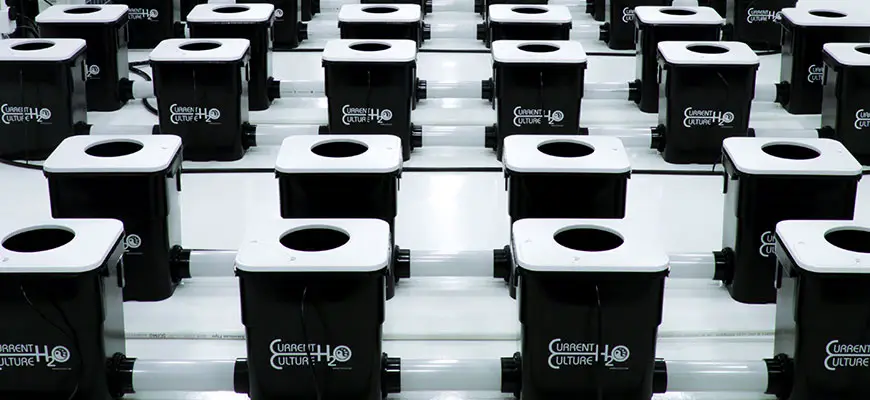
Recirculating DWC (RDWC) connects multiple buckets through a central reservoir and circulating pump, solving the pH and EC pocket problem that plagues standalone bucket systems. This is the architecture used by premium systems like the Current Culture Under Current line.
Best for: Growers prioritizing fast vegetative growth and large root development. Single-bucket DWC is an excellent first hydroponic system; RDWC scales well into serious hobby and commercial settings.
Hydroponic Drip Systems
Drip systems deliver nutrient solution through emitters directly onto the grow media at a controlled rate. This is the dominant system type in large-scale commercial cultivation — when you see a commercial greenhouse running rockwool blocks or coco slabs, you’re almost certainly looking at a drip system.
Drip systems can run drain-to-waste or recirculating. Commercial operations typically use drain-to-waste for consistency and pathogen control. The combination of precision emitter sizing, pressure-compensated stakes, and inline fertigation dosers gives commercial growers tighter control over nutrient delivery than any other system type.
Best for: High plant counts, commercial production environments, and anyone integrating automated fertigation. Scales from a single tent using basic drip stakes all the way to a facility running hundreds of plants across multiple zones.
Aeroponics
In an aeroponic system, roots are suspended in air and periodically misted with a fine nutrient spray. The high oxygen exposure at the root zone drives accelerated growth — this is why aeroponics is the preferred system for propagation and cloning at serious scale.
Aeroponic systems also use substantially less water than other system types. The tradeoff is complexity: mister heads can clog, spray intervals are critical, and system failures can stress plants quickly.
Best for: High-frequency propagation and cloning operations, growers comfortable with more demanding maintenance, or operations where water efficiency is a priority.
Autopot / Passive Gravity-Fed Systems
Autopot systems use a gravity-fed reservoir and a passive valve (the AQUAvalve) to deliver nutrient solution to each pot without any pumps, timers, or electricity. Plants draw solution as needed through capillary action.
This passive architecture makes Autopot systems uniquely hands-off — no power required, no timers to set, and minimal active maintenance. They’re popular with greenhouse operators and any grower who needs to step away from the facility for extended periods.
Which Hydroponic System Is Easiest to Use?
For first-time hydroponic growers, DWC bucket systems require the fewest components and the least infrastructure. There’s no flood timer to configure, no emitter network to plumb — just a reservoir, an air pump, and a net pot.
If you want something even more passive, Autopot systems remove the active maintenance entirely. The main learning curve is reading the plants and managing the reservoir correctly — the system itself handles the rest.
Best Ebb & Flow Hydroponic System
Active Aqua Grow Flow 12 Site Ebb & Flow System
The Active Aqua Grow Flow 12 Site is a top-selling ebb and flow system at Hydrobuilder for good reason: it balances usable plant count, manageable footprint, and proven reliability at a price that fits a serious hobby or small production budget.
Each of the 12 growth modules sits in a 5-gallon square pot, and the system ships with everything needed to run a flood-drain cycle — controller, pump, and all fittings. The system is also expandable via the Active Aqua Grow Flow 2.0 Expansion Kit, so you’re not locked into 12 sites if your grow evolves.
Pair this system with HGV Condition – Clear for periodic reservoir flushing and line maintenance between cycles.
Best DWC Hydroponic Systems
For New Growers: Active Aqua Root Spa 5 Gallon Bucket
The Active Aqua Root Spa is the classic entry point for DWC growing. Single bucket, single plant, minimal components — the system includes an air pump, 6″ net pot, air hose, and all fittings. Add grow media (clay pebbles work well) and nutrients and you’re growing.
The simplicity here is a feature. When you’re learning how pH swings affect plants, how often to top off, and how root health looks in real time, fewer variables means faster learning.
For Serious Hobby and Commercial Grows: Current Culture Under Current RDWC
When DWC growers are ready to stop fighting pH pockets and want a production-grade system, the Current Culture Under Current is the upgrade. The UC system uses patented sub-current circulation technology to create negative water pressure that continuously recirculates and aerates the nutrient solution across all sites. pH and EC stay consistent throughout the system — a critical advantage as plant count increases.
The Under Current UCXL13 RDWC System is available in both 6-site and 12-site configurations, with a 2-row layout that fits efficiently in grow tents or rooms. For a single large plant or small-format production, the Current Culture Under Current Solo Commercial DWC System (35 gallons) delivers commercial-grade construction in a standalone format.
Media tip: Rockwool blocks are the preferred media for RDWC systems at commercial scale. VidaWool Rockwool Blocks provide excellent water-to-air ratio and root support in net pot applications. Maintain solution temperature between 65–72°F to prevent root disease — see our guide on why hydroponic water temperature matters.
Best Hydroponic Drip System
Netafim Drip Stakes + Dosatron Integration
For any grow running media-filled containers — coco bags, rockwool slabs, or clay pebble pots — precision drip irrigation is the most efficient and controllable delivery method available.
The Netafim Drip Stake Assembly (0.5 GPH, Pack of 25) is the top-selling irrigation product at Hydrobuilder. Pressure-compensated stakes deliver consistent flow rate across every plant regardless of line pressure variation — this consistency is what separates professional drip installations from DIY emitter setups.
For production-scale operations, pair Netafim stakes with a Dosatron water-powered nutrient doser inline to automate fertigation without electricity. The D14MZ2 handles flows up to 14 GPM and is the standard choice for multi-zone drip rooms. For a full walkthrough on sizing and setup, see our Dosatron selection guide.
Best Vertical Hydroponic System
ExoTower Hydroponic Garden Tower
For growers with minimal floor space but adequate vertical clearance, the ExoTower delivers a high plant count in under 2 square feet of footprint. The system uses a top-fed recirculating design that cycles nutrient solution through all growing sites before returning to the reservoir. Available in 12, 16, 20, and 24 plant configurations.
The ExoTower 24 Plant System is the top configuration for maximizing vertical space. The ExoTower 16 Plant is the most popular size for spare rooms and garages.
Best Aeroponic System
SuperCloset Super Flow System
The SuperCloset Super Flow combines aeroponic bottom-feeding with top-feed drip and NFT elements — a hybrid design that maximizes both root oxygenation and nutrient saturation. Available in 20, 26, and 32 site configurations, it’s built for growers who want genuine aeroponic performance without the maintenance complexity of a pure misting system.
Organic-compatible components mean you’re not locked into synthetic nutrient programs, and the clog-resistant mist heads tolerate heavier organic nutrient solutions better than most aeroponic systems.
For propagation-focused aeroponic use: The SuperCloset SuperPonics line offers compact configurations optimized for closer plant spacing and faster clone throughput.
For Commercial Operations
Commercial hydroponic facility design requires different thinking than hobby grows. Space efficiency, labor reduction, system reliability under continuous operation, and integration with automated fertigation are the key variables — not just plant count.
Botanicare Trays and Benching Components
The foundation of an efficiently designed hydroponic grow room is the benching system. While the Botanicare Slide Bench and Track Bench systems are currently unavailable to order directly, Botanicare trays and components — including Gutter Tray Conversion Kits and TriLock Trellis Mounts — are in stock and compatible with custom benching configurations. You can read our full review of the Botanicare Slide Bench System to understand the full capability of the platform.
Contact our commercial team for facility-scale benching consultation and component sourcing.
Autopot for Greenhouse and Multi-Site Facilities
For greenhouse operators and facilities where power reliability or infrastructure constraints favor passive systems, Autopot’s lineup scales from 2-pot hobby configurations up to large production settings. The AutoPot 4 Pot Watering System is an accessible entry point; the AutoPot 1Pot XXL Module supports large-format crops in production settings.
Autopot systems pair well with rockwool or coco and integrate cleanly with inline fertigation. See our guide on crop steering in coco and rockwool for how system choice intersects with environmental control strategy.
System Maintenance at Commercial Scale
Commercial systems require systematic line flushing between cycles to prevent mineral buildup and pathogen accumulation.
HGV Condition – Clear is formulated specifically for hydroponic system cleaning and works across DWC, drip, and ebb and flow setups. For a deeper look at dissolved oxygen management in recirculating systems, see our article on dissolved oxygen in hydroponics.
Why Shop at Hydrobuilder
Hydrobuilder carries the full spectrum of hydroponic systems — from entry-level DWC buckets to commercial RDWC configurations — alongside everything you need to run them: grow media, nutrients, irrigation hardware, and environmental control. Our commercial accounts team works directly with facilities on system design and component sourcing through our partnerships with brands including Botanicare, Netafim, and Dosatron.