

Most avoidable plant health problems in controlled environments trace back to nutrient balance, irrigation management, or pH drifting outside the target range for your crop and system. Understanding how plant nutrients work — what they are, how they change across growth stages, where they come from, and why pH controls whether your plants can even access them — is one of the most valuable skills you can develop as a grower. This guide covers the complete picture, from NPK basics through organic vs. synthetic decisions, nutrient source science, supplement timing, and pH management across soil and hydroponic systems.
Whether you’re growing in a backyard raised bed or managing a commercial facility, the fundamentals here apply. The scale changes; the underlying plant nutrition and pH principles do not.
What Are Plant Nutrients? The Three-Tier Framework
Plants require 17 essential elements to complete their life cycle. These are organized into three tiers based on the quantities needed: macronutrients, secondary nutrients, and micronutrients.
Primary Macronutrients (NPK)
The three numbers on every fertilizer label — nitrogen (N), phosphorus (P), and potassium (K) — represent the percentage of each macronutrient by weight in the product. A label reading 3-6-22 contains 3% nitrogen, 6% phosphorus (as P₂O₅ equivalent), and 22% potassium (as K₂O equivalent).
Nitrogen (N) drives vegetative growth. It is essential for chlorophyll production, photosynthesis, and the development of shoots and leaves. During the vegetative stage, plants consume nitrogen at relatively high rates. A common early sign of nitrogen deficiency is yellowing of older, lower leaves as the plant remobilizes nitrogen from mature tissue to feed new growth. Nitrogen demand typically drops when plants transition to flower, especially in crops grown for floral yield rather than biomass.
Phosphorus (P) is involved in energy transfer (ATP), photosynthesis, root development, and seed and flower formation, and it contributes to secondary metabolite production in many crops. Conventional wisdom says to push phosphorus hard during bloom, but controlled-environment research tells a more nuanced story: many crops, including cannabis, achieve optimal yield at relatively moderate phosphorus concentrations, and additional P above an adequate level does not reliably increase yield or potency. Under continuous feeding, plants can meet most of their phosphorus requirement by late veg and early bloom as long as solution concentrations remain in the adequate range, and excessive phosphorus later in flower can contribute to nutrient imbalance and antagonism with elements like zinc and iron.
Potassium (K) functions across all growth stages. It regulates stomatal function and water relations, supports root development, increases disease and stress resistance, and contributes to sturdy structural growth and quality parameters like firmness. Potassium needs remain significant from veg through flower, and K is often maintained or increased relative to N in bloom formulas compared to vegetative mixes.
Secondary Nutrients (Ca-Mg-S)
Secondary nutrients are required in lower quantities than NPK but are no less essential. They become deficient more often than many growers expect, especially in hydroponic and coco coir systems where base water and media chemistry can strip or bind them.
Calcium (Ca) is a key structural nutrient that supports strong cell walls and roots. Tissue analysis of many crops shows calcium can represent a major share of total mineral content in mature tissues, particularly in fruiting and leafy crops, which explains why calcium deficiency causes widespread structural failure (weak stems, blossom end rot, tip burn). Calcium is also critical for intracellular signaling and membrane stability.
Magnesium (Mg) is the central atom in the chlorophyll molecule, making it essential for photosynthesis. It also aids the uptake and utilization of other nutrients and supports carbohydrate production, which becomes especially important during flowering and fruiting. Calcium and magnesium deficiencies often appear together because they interact at uptake sites and in the root zone, and imbalanced Ca:Mg ratios can promote antagonism. A combined cal-mag supplement is a standard correction and preventive measure, particularly for coco coir growers where these deficiencies are structurally more likely due to the cation exchange properties of the media.
Sulfur (S) is necessary for chlorophyll synthesis and plays a key role in both vegetative growth and root development. It is a component of certain amino acids and many secondary metabolites, including sulfur-containing compounds and some terpenes that influence aroma and flavor in cannabis and specialty flower crops.
Micronutrients
Micronutrients — zinc (Zn), manganese (Mn), iron (Fe), boron (B), chlorine (Cl), copper (Cu), molybdenum (Mo), and silicon (Si) — are needed in only trace amounts, but their absence causes significant problems. Most complete nutrient packages include a micronutrient profile. In soil, many of these can be supplied and buffered by the growing medium; in hydroponic systems, you are responsible for supplying all of them in the correct ratios.
Silicon (Si) deserves special mention — it is sometimes described as a “beneficial element” because it builds stronger cell walls, thickens stems, can improve pathogen and abiotic stress resistance, and supports overall metabolic function. It can be one of the more impactful additions to a hydroponic supplement stack for structural strength and stress tolerance, particularly under high-intensity lighting and in crops like cannabis that respond well to improved stem rigidity.
For a deeper look at what each micronutrient does and how to identify deficiencies, see our complete guide on micronutrients.
NPK Ratios Across Growth Stages
The ideal nutrient balance is not static — it shifts as your plants move through their life cycle. Understanding why those shifts happen helps you feed with precision instead of just following a chart.
Propagation and Early Rooting
Young plants and fresh clones have minimal nutrient needs, and their priority at this stage is root development, not rapid top growth. High nitrogen at this point can push soft, weak tissue and may inhibit strong rooting in some crops. Feed lightly with a gentle base nutrient, emphasize phosphorus and calcium for root structure, and consider adding beneficial bacteria or mycorrhizae to extend effective root surface area and improve transplant success rates.
Vegetative Stage
Once roots are established, nitrogen demand typically increases rapidly as plants build leaves and branches. During veg, the goal is robust branching, appropriate internode spacing for your light intensity and training style, and a canopy structure that supports maximum bud or fruit sites. Many commercial programs use a nitrogen-to-potassium ratio around 5:4 during this stage, which can produce consistent results when EC, light, and environment are dialed in.
Phosphorus needs during veg are moderate — P is used, but not at the peak levels seen in early reproductive stages. A veg formula structured around higher nitrogen, moderate potassium, and modest phosphorus reflects what many crops actually need in this phase.
For calcium and magnesium, a calcium-to-magnesium ratio of roughly 3–5:1 in solution often supports good uptake and charge balance across the root zone, but exact ratios depend on source water and media chemistry. This ratio is important to verify when selecting a cal-mag supplement or adjusting your base nutrient ratios.
This is also when silica supplementation pays dividends — thicker stems and stronger tissues built during veg are better able to support heavier flowers or fruit at harvest.
Flowering Stage
The transition to flower or reproductive growth triggers a cascade of nutritional shifts. Nitrogen demand generally declines relative to veg as the plant redirects resources toward reproductive development, while potassium remains important for water relations, enzyme activity, and overall plant function. Phosphorus demand increases into early bloom and then levels off once adequate P is present in the tissues and solution.
During early bloom, phosphorus uptake is often near its peak, especially in crops like cannabis that accumulate P in floral tissues. By mid-to-late flower, what your plants need most is stability and overall balance in the solution, not continuously escalating phosphorus inputs. A nitrogen-to-potassium ratio around 2:3 is a reasonable starting target for many flowering programs, with fine-tuning based on cultivar response, EC, and yield goals.
Growers who push phosphorus aggressively through late flower often see diminishing returns: research shows that raising P above adequate levels does not reliably increase yield, and excessive P can contribute to micronutrient antagonism and runoff P loading. Trust your balanced bloom formula, monitor your runoff or solution EC, and resist the urge to “fix” an apparently healthy crop with unnecessary bloom boosters.
Pre-Harvest Flushing
Two to three weeks before harvest, many growers transition to a flush or reduced EC feed to limit additional salt accumulation and allow plants to utilize stored nutrients. Whether you run plain water (where appropriate) or a dedicated flushing agent, the goal is similar — reduce excess mineral buildup in the media and plant tissues. Many cultivators report that an appropriate flush or taper contributes to cleaner-burning product and better expression of terpene profile, but responses can vary by cultivar, medium, and fertilization strategy.
Understanding Nutrient Balance vs. Nutrient Deficiency
One of the most common and costly mistakes in growing is misidentifying a nutrient imbalance or lockout as a true nutrient deficiency — then overfeeding to “fix” it and making things worse.
Mulder’s Chart maps the interactions between plant nutrients. Nutrients do not operate independently — they affect each other’s availability through antagonistic and synergistic relationships. When one nutrient is present in excess, it can actively reduce the uptake of another; for example, high phosphate can depress zinc and iron availability, and high potassium can antagonize magnesium uptake. The calcium-magnesium relationship is another classic example: too much calcium relative to magnesium can suppress magnesium uptake, creating what looks like a magnesium deficiency even when Mg is present in the solution.
Before you add more product to your feed to chase a symptom, check these first:
- EC of your solution and runoff. A high runoff EC compared to your feed EC indicates excess mineral accumulation — your plant is leaving behind more salts than it is taking up, which points to imbalance or pH-related lockout rather than simple underfeeding.
- Media buildup. Visible salt crust at the base of stems or on the surface of your growing media is a sign of accumulation and potential lockout, not deficiency.
- pH. A major cause of apparent nutrient deficiency is pH drift that moves a nutrient outside its optimal availability window, especially in soilless and hydro systems with low buffering capacity.
Once you have ruled out obvious imbalance and pH issues, then consider whether targeted supplementation is warranted.
For a full breakdown of diagnosing specific deficiencies, see common nutrient mistakes growers make.
Organic vs. Synthetic Nutrients: What the Research Shows
The organic-vs-synthetic debate is one of the most persistent in growing, and the honest answer is that both have legitimate applications depending on your system, goals, and crop.
Organic Nutrients
Organic nutrients are derived from living or once-living sources — plant or animal matter. Common examples include bat guano, fish hydrolysate, kelp meal, bone meal, and seabird guano. They typically release nutrients more slowly than highly soluble synthetics, which makes them more forgiving in terms of overfeeding but also means deficiencies can take longer to identify and correct.
Organic nutrient sources also contribute carbon and organic matter to the rhizosphere, which can support microbial diversity and improved soil structure in living-soil systems. However, their exact nutrient content and release rates can be more variable from batch to batch compared to standardized synthetic formulations.
The case for plant-derived organic sources: Some researchers have investigated plant-based fertilizers — made from plant matter — and their effects on crop yield and quality relative to manure-based sources, with mixed results depending on the crop and system. In practice, both plant-based and animal-based organic fertilizers can support high-yield, high-quality production when the overall program is well designed, so the best organic nutrient source for your crop is typically the one you trial and validate under your actual conditions.
Practical limitation for hydro: Organic nutrients — particularly thick liquid fish or kelp formulations and suspensions containing particulate matter — can clog hydroponic system components, promote biofilm, and increase the risk of reservoir hygiene issues. For recirculating systems, growers usually stick to mineral synthetics or organic-leaning formulations specifically designed and filtered for hydroponic use.
Organic flower and produce are often prized for flavor, perceived market differentiation, and potential environmental benefits. Look for OMRI-listed products when certification or organic compliance matters to your operation.
Synthetic Nutrients
Synthetic nutrients are manufactured mineral compounds rather than directly biologically derived amendments. They are typically faster-acting, more precise, more consistent batch to batch, and generally more cost-effective at scale. Deficiencies can often be corrected faster because absorption of soluble ions from a clear solution is more immediate than from slow-release organic sources.
“Synthetic” does not mean low-quality or unsafe — all fertilizer products, organic and synthetic, are manufactured or processed to a specification and must meet regulatory standards. The primary differences are origin, solubility, and release curve, not inherent safety.
For hydroponic and soilless systems, synthetics are generally the practical choice. They mix cleanly, do not introduce undigested organic matter that can harbor pathogens in your reservoir, and allow for the tight EC and pH management that recirculating and drip systems require.
Liquid vs. Powder Nutrients
The liquid vs. dry decision comes down largely to scale, labor, and system type. Liquid concentrates are easier to dose accurately and mix immediately — they are often the right choice for hobby to mid-scale growers and for operations where staff training time is limited. Dry water-soluble formulas offer significant cost advantages at commercial scale: lower shipped weight means lower freight cost per unit of nutrition, and longer shelf life reduces waste on slow-moving SKUs.
Choosing a Nutrient System
For growers new to feeding, a complete nutrient package — one that includes base nutrients, supplements, and additives in a pre-designed stack — removes much of the guesswork of building ratios from scratch. Starting with a proven package and then observing how your specific plants and environment respond is how you develop the intuition to customize over time.
For hobby and intermediate growers, the General Hydroponics Flora Series has been an industry standard for decades — a three-part system (FloraMicro, FloraGro, FloraBloom) that provides full-spectrum nutrition with flexibility across growth stages.
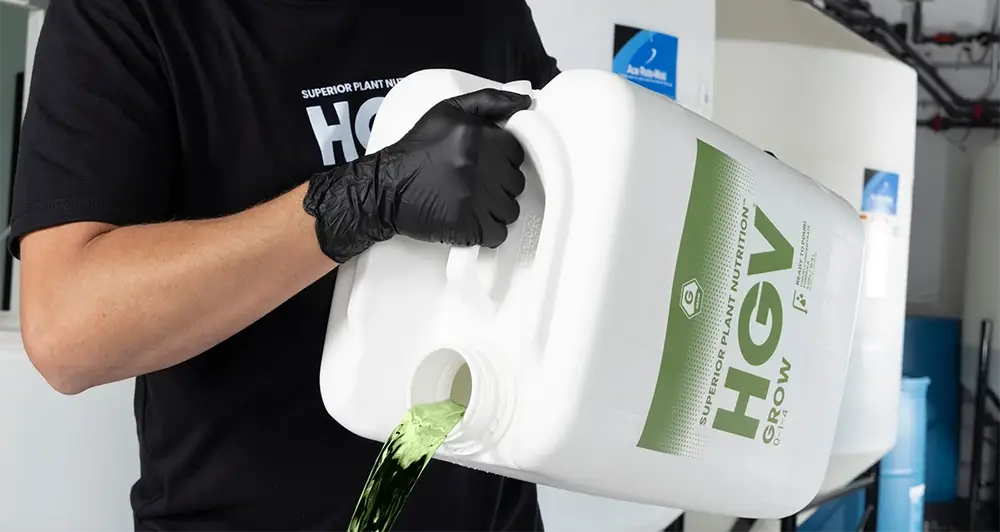
As you scale, the economics of dry water-soluble formulas become increasingly significant. HGV Nutrients is a high-purity, three-part dry nutrient system — Base (14.5-0-0), Grow (3-6-22), and Flower (0-10-26) — designed specifically for commercial and large-scale cultivation. The Base pairs with either Grow or Flower throughout the entire cycle, simplifying multi-bottle NPK math while still allowing precise control of concentration via EC. HGV’s batch-to-batch consistency is a key reason commercial operations rely on it when repeatable results across multiple crop cycles matter more than marginal gains in any single run.
pH: Why It Controls Everything Downstream
pH is not just another parameter to monitor — it is the gatekeeper for every nutrient you are feeding your plants. A perfectly balanced, well-dosed nutrient solution delivers little to a plant if the pH drifts outside the effective availability range for key nutrients.
What pH Is and How It Works
pH is a measure of hydrogen ion concentration in a solution, expressed on a logarithmic scale from 0 to 14. A pH of 7.0 is neutral; below 7.0 is acidic and above 7.0 is alkaline (basic). Because the scale is logarithmic, a solution at pH 5.0 is ten times more acidic than one at pH 6.0, and 100 times more acidic than one at pH 7.0, so small numerical adjustments can represent significant chemical changes.
Optimal pH Ranges by Growing System
| System | Target pH Range |
|---|---|
| Soil | 6.0–7.0 (sweet spot: 6.2–6.8 for many crops) |
| Coco coir | 5.8–6.3 |
| Rockwool | 5.5–6.2 |
| Deep water culture (DWC) | 5.5–6.0 (within a broader 5.5–6.5 band) |
| Nutrient film technique (NFT) | 5.5–6.0 (within a broader 5.5–6.5 band) |
These ranges are not arbitrary — each nutrient has a specific pH window where it is most soluble and available to roots, and the ranges above align with where most horticultural crops perform well in these systems. Availability of iron, manganese, and zinc declines as pH moves into the high 6s and above, especially once pH exceeds about 7.0 in many media. Calcium and magnesium management becomes more challenging in strongly acidic or strongly alkaline conditions, with increased leaching and solubility in very low pH soils and more precipitation at high pH. In hydroponic nutrient solutions, pH above roughly 6.5 can cause some nutrients, especially iron and other metals, to precipitate, sometimes visible as deposits on reservoir walls — those nutrients are then physically unavailable to your plants.
Low pH also causes its own problems: in strongly acidic mineral soils, typically below pH about 5.5, aluminum and manganese can become soluble at levels that stunt root growth and interfere with nutrient uptake. That is why most soil-based programs aim for a slightly acidic range rather than allowing pH to drift much lower.
Common diagnostic consideration: Interveinal chlorosis on young leaves often looks like iron deficiency. In many soilless and hydro systems, the underlying issue is more often pH-driven iron lockout than a true shortage of Fe in the solution, so checking and correcting pH is usually the first step before adding extra iron.
Testing pH
pH meters are the most accurate option for consistent grows when properly maintained. Electronic meters need regular calibration (typically with pH 4.0 and 7.0 calibration solutions) and proper electrode storage (most probes require storage solution, not dry storage). A dry or poorly maintained electrode gives erratic readings that are worse than no reading at all.
The Bluelab Combo Meter reads pH, EC, and temperature simultaneously — the three measurements that define your nutrient solution at any point in time. For commercial inline monitoring, the Bluelab Guardian Monitor and similar controllers integrate with irrigation systems for continuous logging and alarms.
Liquid test kits are more affordable than quality meters and generally easier to read accurately than paper strips, making them a practical backup or low-cost option.
Paper test strips are the least precise option but work in a pinch. The color changes can be subtle and lighting-dependent, so they are best used for approximate checks rather than fine adjustments.
For soil pH testing, the most accurate method is a lab soil test with samples taken from representative depths across the growing area. In-situ testing with a Bluelab Soil pH Pen provides faster, on-site results without sample submission, though it should be periodically validated against lab or standard solutions.
Adjusting pH
After mixing your nutrient solution, check and adjust pH before feeding. Small, gradual adjustments are better than large swings — overshooting in either direction compounds the problem and can shock sensitive crops.
To lower pH (make more acidic): Phosphoric acid is a common standard in horticulture — it is effective and generally safer to handle in typical concentrations than nitric or sulfuric acid alternatives.
HGV Condition pH Down is formulated for compatibility with HGV nutrients and most major nutrient lines, with no pre-dilution required before adding to reservoirs as directed. For organic systems, food-grade citric acid and other organic acids are sometimes used, though they can be less stable in large recirculating systems.
To raise pH (make more alkaline): Potassium hydroxide (KOH) is the most common active ingredient. HGV Condition pH Up uses 17% KOH — dilution into a smaller volume of water is recommended in practice to prevent localized high-pH zones and ensure smooth mixing.
How often to check: In a new system or new crop cycle, check daily until you understand the pH drift pattern of your specific setup. Once you have a stable, well-understood system, many operations can move to every 2–3 days for established crops while still checking each fresh batch of nutrient solution before use. Soil pH changes more slowly but should still be monitored across the crop cycle — fertilizer additions, irrigation water alkalinity, and liming materials all shift soil pH over time.
For step-by-step pH calibration procedures and equipment care, see our full guide on measuring and adjusting pH.


Building a Feeding Schedule
A complete feeding schedule combines your base nutrients with targeted supplements layered in at the right stages:
- Propagation: Minimal base nutrition, beneficial microbes and mycorrhizae, light phosphorus and calcium for root establishment
- Early veg: Ramp up base nutrients, add silica supplement, introduce cal-mag for coco or hydro growers
- Veg: Full base nutrition, silica, cal-mag, and optional growth enhancers as needed based on plant response
- Early bloom: Transition to bloom-ratio base (higher K relative to N), maintain cal-mag, and consider a balanced bloom booster if needed
- Mid-late bloom: Maintain stable feed, monitor EC and runoff closely, avoid unnecessary phosphorus escalation beyond proven adequate levels
- Final weeks: Flush or reduce EC to limit additional salt buildup and help prepare tissues for harvest
For detailed guidance on building and dialing in your schedule, see mixing plant nutrients.
For Commercial Operations
At production scale, nutrient management is a systems problem, not just a chemistry problem.
Dry water-soluble nutrients become the economically rational choice once you are going through significant volume per cycle. The freight savings on dry vs. liquid concentrates alone often justify the transition before even accounting for storage footprint, shelf life, and automated mixing options. HGV Dry is available in 25 lb bulk bags — HGV Dry Base, HGV Dry Grow, and HGV Dry Flower — and in large liquid concentrate formats for facilities running automated injection systems.
Automated pH and EC management reduces manual variability that can create crop-to-crop inconsistency at scale. Inline pH dosers and integrated controllers pair with continuous monitoring to maintain target solution parameters without constant manual adjustment. For fertigation automation, see our guide on fertigation and automated nutrient delivery.
Tissue and runoff testing provide objective data on what your plants are actually taking up vs. what you are feeding. At commercial scale, this data, combined with EC and pH logs, should drive feeding schedule adjustments far more than visual observation alone. Regular runoff EC and pH monitoring also catches developing lockout conditions before they significantly impact yield.
Crop steering with nutrients involves deliberately shifting EC, irrigation frequency, and nutrient ratios to guide plants between more vegetative and more generative responses. This is advanced territory that works best when you already have NPK and pH fundamentals dialed, which is a prerequisite for crop steering in coco and rockwool.


Plant Nutrients & pH: FAQs
What is the NPK ratio and why does it matter?
NPK stands for nitrogen, phosphorus, and potassium — the three primary macronutrients in any fertilizer. The three numbers on a fertilizer label show the percentage of each expressed as N, P₂O₅, and K₂O by weight. These ratios matter because plants need different proportions at different growth stages: higher relative nitrogen during veg for foliage, and adjusted nitrogen, phosphorus, and potassium during flower to support reproductive growth and quality.
What pH should I use for hydroponics?
For most hydroponic systems, a common target range is 5.5–6.0, within a broader acceptable band of about 5.5–6.5 for many crops. Within that range, specific nutrients hit their peak availability at slightly different points, so some growers deliberately allow pH to drift gently between about 5.6 and 6.2 across a reservoir cycle to ensure broad availability. Soil growers generally target 6.0–7.0, with a sweet spot around 6.2–6.8 depending on crop.
Why are my plants showing deficiencies even though I'm feeding them?
A frequent cause is pH drift — nutrients are present in your solution or media but less available because pH has moved outside the optimal window for that nutrient. Another common factor is nutrient antagonism: excess of one nutrient blocking uptake of another, which is why checking your runoff EC and watching for salt crust in your media is essential before assuming underfeeding.
What is the difference between organic and synthetic nutrients?
Organic nutrients are derived from plant or animal matter and usually release more slowly, while synthetic nutrients are manufactured mineral compounds that dissolve quickly and allow more precise dosing. For hydroponic systems, synthetics are generally recommended because they mix cleanly and avoid clogging components, whereas organic programs excel in soil and living media for growers prioritizing regenerative practices and certain market preferences. Neither is universally “better” — the right choice depends on your system, goals, and crop.
How often should I check pH in my hydroponic system?
Check daily during the first few weeks of a new cycle or when commissioning a new system, until you understand how your media, crop, and environment affect pH drift. As you learn your system’s behavior, you can often check every 2–3 days for established runs while still verifying each fresh batch of nutrient solution before use.
Should I use liquid or powder nutrients?
Liquid nutrients are easier to measure and mix accurately and work well for hobby through mid-scale grows or where labor simplicity is a priority. Powder (dry water-soluble) nutrients are typically more cost-effective at commercial scale — lower freight weight and longer shelf life reduce cost per unit of nutrition, especially when paired with automated mixing or injection equipment. Performance between well-formulated liquid and dry systems is comparable when recipes and management are matched.
What causes nutrient lockout?
Nutrient lockout happens when an element is present in your solution or soil but chemically or physically unavailable to roots. The most common causes are pH outside the effective range for that nutrient and nutrient antagonism — where excess of one element interferes with uptake of another — often compounded by salt accumulation in the root zone. The solution is usually to correct pH first, then flush or leach if EC is high, and only then consider adjusting nutrient concentrations.
Do plants need different nutrients in veg vs. flower?
Yes. During veg, most plants need higher nitrogen relative to phosphorus and potassium to support leaf and stem growth, along with adequate calcium, magnesium, and micronutrients. During flower, nitrogen typically decreases relative to potassium, while phosphorus demand peaks around early bloom and then stabilizes at adequate levels; continuing to push phosphorus far above sufficiency late in flower usually does not increase yield and may disturb overall nutrient balance.
What is the best pH range for coco coir growing?
Coco coir growers usually target 5.8–6.3, which supports good availability of both macro- and micronutrients in this medium. Coco is naturally slightly acidic and has unique cation exchange properties that make it structurally prone to calcium and magnesium issues, so cal-mag supplementation and monitoring should be a baseline part of any coco feeding program rather than an afterthought.
How do I know if my plants need more nutrients or have a nutrient imbalance?
Compare your runoff EC to your feed EC. A runoff EC significantly higher than feed EC indicates salt accumulation — your plant is leaving more behind than it takes in, which points to imbalance or pH-related lockout, not underfeeding. A runoff EC significantly lower than feed EC can indicate that the plant is feeding aggressively and may be able to handle a slight EC increase, provided environmental conditions (VPD, light) support higher uptake. Always pair visual symptoms with pH and EC data before making major nutrient changes.