
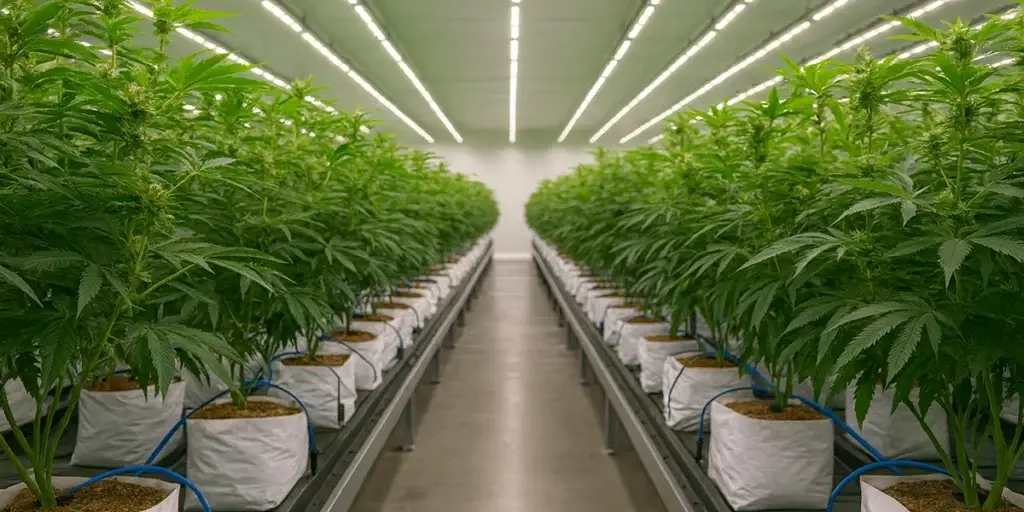
Crop steering is the practice of guiding plants toward either vegetative or generative growth by shaping root-zone moisture and salinity (EC) trends. When paired with a stable climate with balanced light, VPD, and temperature, this approach helps growers achieve repeatable results across different runs and rooms. The foundation of crop steering lies in understanding water content (VWC), dryback, and EC, and using these root-zone signals to intentionally influence how a plant allocates energy.
What Is Crop Steering?
Crop steering uses irrigation and climate management to create controlled root-zone trends that influence growth direction. By shaping water content (VWC), dryback, and EC, growers can push plants toward either vegetative growth (leaf and shoot development) or generative growth (flowers and fruit). This makes irrigation timing and climate control precision tools rather than guesswork. The approach transforms grower intuition into repeatable results, improves quality consistency, reduces wasted water and nutrients, and provides clean signals that can be automated and scaled.
The Daily “Day-Dynamic” (P1 / P2 / P3)
Each day in a crop steering strategy can be thought of as three distinct periods. In P1, the Ramp-Up phase, the substrate warms, transpiration rises, and the canopy becomes active. Irrigation should be timed so the first drain happens during this active window, not immediately at lights-on, otherwise EC signals become diluted by adding unnecessary variability.
P2, the Steering Window, runs from the first drain through late afternoon. This is where the majority of steering decisions take effect. Pulse size and frequency are adjusted here to maintain a steady WC slope and control drain EC, providing the main opportunity to influence plant growth.
P3, the Reset phase, spans late afternoon through the night. Overnight dryback signals growth direction. A stronger dryback pushes plants toward generative development, while gentler drybacks maintain vegetative growth.
The Four Feedback Signals
Crop steering relies on interpreting signals together, not in isolation:
- VWC & Dryback: Dryback is the drop in water content between irrigations and overnight. Smaller, steadier drybacks bias vegetative growth, while larger drybacks bias generative growth.
- Substrate EC (with Temperature): EC indicates whether salts are accumulating (rising) or flushing (falling). Since EC is temperature-dependent, comparisons should always account for substrate temperature.
- Input EC / pH: Feed consistency is essential. A stable input allows meaningful interpretation of EC trends in the root zone.
- Leachate EC & Drain %: Drain is the “report card.” If the drain EC is greater than the input EC and rising, salts are building up. In that case, adjust midday volume or frequency, or lower input EC slightly. If the drain EC is lower than the input EC, dilution may be occurring, so reduce pulse count or total volume. Drain percentage is a lever, not the goal; use it to balance drain EC.
Coco vs. Rockwool: Same Loop, Different Behavior
Rockwool is inert, predictable, and quick to respond to schedule changes. This makes it well-suited for frequent, smaller irrigation pulses and precise steering. Coco, on the other hand, has cation-exchange capacity (CEC), which temporarily holds ions such as calcium, magnesium, and potassium. This means root-zone EC in coco is slower to respond to recipe changes, especially early in a cycle. Coco should be buffered and rinsed before use, and once established, it benefits from fewer, sometimes larger irrigation events. In Coco, progress should be judged by long-term trends rather than single readings. Neither medium is inherently better; each requires a strategy tailored to its response speed.


Climate Sync: Light, VPD, and Timing
For crop steering to work, irrigation must be aligned with climate conditions. Irrigation should begin only once the crop is physiologically active, meaning light and VPD are at daytime levels. This ensures that the first drain is meaningful. Keeping VPD swings modest helps reduce noise in WC and EC data. Since EC is temperature dependent, runs should always be compared under similar substrate temperatures to keep data consistent.
A Simple Starter Plan (Beginner-Friendly)
Growers who are new to crop steering can begin with a simple framework. First, select a runoff window that matches the growth phase; earlier in the day for vegetative steering, and later in the day for generative steering. Choose an initial shot size that reaches the first drain without overshooting. From there, maintain steady pulses to manage WC slope throughout the day. Monitor drain percentage and drain EC against input EC, then make adjustments the following day based on observed trends. Before rewriting any schedule, confirm emitter uniformity to ensure consistency.
For example, a vegetative day typically begins with an early irrigation start, small and frequent pulses, and a light overnight dryback. A generative day, by contrast, begins later with fewer, larger irrigation events and a more significant overnight dryback.
Common Mistakes (and Fast Fixes)
- Mistake: Chasing a fixed drain % instead of drain EC.
Fix: Many growers get caught up aiming for a certain percentage of drain, but this can be misleading. The true indicator is the salt balance shown in drain EC. Use drain percentage only as a tool to adjust EC, not as the goal itself. - Mistake: Starting irrigation too early.
Fix: If the first drain happens before the crop is physiologically active, EC data will be diluted and less reliable. Wait until plants are transpiring and the canopy is active so that the first drain reflects meaningful conditions. - Mistake: Ignoring distribution uniformity.
Fix: Uneven irrigation caused by clogged filters, pressure issues, or mismatched drippers creates inconsistent plant responses. Always check and correct uniformity before making schedule changes; otherwise, data and outcomes will be skewed. - Mistake: Using oversized or infrequent pulses.
Fix: Large water content swings create stress and saw-tooth data patterns that are hard to interpret. Instead, shrink pulse sizes and tighten spacing to achieve smoother, more controllable trends. - Mistake: Reading one signal in isolation.
Fix: Steering decisions require context. WC, EC, drain %, and plant behavior must be considered together. Looking at one value alone can lead to incorrect conclusions and poor adjustments.
Glossary (Reader Basics)
- VWC: Volumetric water content; how much water is in the substrate.
- Dryback: The WC drops between irrigations overnight.
- EC: Electrical conductivity; a proxy for salt concentration.
- First Drain: The first measurable runoff of the day, used as a steering checkpoint.
- Drain %: The fraction of applied irrigation that drains, calculated as (Drain ÷ Applied) × 100.
Key Takeaways
Crop steering is about managing WC and EC trends to influence plant growth phases. A daily P1/P2/P3 framework provides structure, with most steering decisions made in the mid-day window. Rockwool responds quickly to changes, while coco reacts more slowly due to its ion exchange properties, so irrigation strategies must be adapted accordingly. Above all, drain EC is the most reliable guide for decision-making, and system uniformity ensures that data is accurate and trustworthy.
FAQs for Crop Steering
Q: How does VPD affect steering?
A: VPD influences how plants transpire and take up water and nutrients. Stable VPD conditions reduce fluctuations in WC and EC readings, making trends clearer and more reliable. Large VPD swings add noise and make steering decisions less precise, so consistent climate management is essential for success.
Q: What is crop steering?
A: Crop steering is a strategy to direct plant growth by shaping root-zone water content (WC), dryback, and EC. By carefully managing irrigation and climate, growers can influence whether a crop emphasizes vegetative growth (leaves and shoots) or generative growth (flowers and fruit). A stable climate with balanced VPD, light, and temperature makes these adjustments more predictable and consistent.
Q: What does “first drain” mean?
A: The first drain is the initial measurable runoff that occurs after irrigation begins for the day. It signals the point where the root zone is fully active, and it provides the first reliable data point for interpreting EC and WC trends. Timing this correctly ensures that the steering process is based on accurate, meaningful data rather than noise from early, inactive substrate conditions.
Q: How big should the dryback be?
A: The size of dryback depends on your growth phase and cultivar. During vegetative stages, smaller, steady drybacks help keep plants focused on leaf and shoot expansion. In generative stages, larger overnight drybacks create stronger signals for flowering and fruiting. Always monitor WC trends and plant response, adjusting incrementally rather than making drastic changes.
Q: Is drain % more important than drain EC?
A: Drain EC is the more critical indicator because it reflects the salt balance in the root zone. Drain percentage is useful but should be treated as a lever to control EC rather than a fixed target. For example, if drain EC is rising too high, a higher drain % can help wash salts out, while if it is too low, reducing drain % can prevent over-dilution.
Q: Why is coco slower to steer than rockwool?
A: Coco’s cation-exchange capacity (CEC) means it holds onto certain ions like calcium, magnesium, and potassium. This buffering effect slows the visible impact of recipe changes in the root-zone EC compared to rockwool, which is inert and more responsive. To manage this, coco should always be pre-buffered and rinsed before planting, and growers should judge success by overall trends rather than single readings.
Q: Do I need sensors?
A: While not mandatory, sensors make crop steering significantly easier. Manual methods can work for small grows, but sensors provide continuous readings of WC, EC, and temperature, giving clearer insight into trends. This makes scaling operations more efficient, reduces guesswork, and helps identify subtle issues before they impact the crop.
Q: Can I over-steer?
A: Yes. Over-steering happens when growers make drastic changes to irrigation or EC levels in a short period of time. This can stress plants, leading to reduced growth or quality issues. The best approach is to make gradual adjustments, monitor results daily, and look for steady trends instead of expecting immediate dramatic shifts.
Q: What’s a common beginner mistake?
A: Beginners often start irrigation too early, causing the first drain to happen before the crop is active. This dilutes EC readings and makes steering decisions less accurate. Another common mistake is chasing a fixed drain percentage instead of focusing on drain EC. Both lead to confusion and inconsistent results.
Q: Where should I place sensors?
A: Place sensors in pots or blocks that represent average conditions, not edge cases. Avoid spots directly next to emitters or container edges, as these areas do not reflect the root zone as a whole. Representative placement ensures the data you collect truly reflects what the bulk of your crop is experiencing.