

Plant training is one of the highest‑ROI skills a grower can develop once environment, genetics, and nutrition are reasonably dialed in. By physically manipulating how your plant grows — bending, tying, topping, and weaving — you can significantly increase yields compared to untrained plants running the same genetics under the same lights, often in the 30–70% range and sometimes more when training is combined with optimized climate, fertigation, and lighting, often without changing your feed schedule or upgrading your hardware.
This guide covers every major training method: what it is, when to use it, how to execute it, and — critically — which methods work together and which don’t. Whether you’re running a 4×4 tent or a multi-room commercial facility, the principles are the same, with canopy geometry and labor planning changing most at scale. We’ll cover the fundamentals first, then provide commercial-scale canopy management guidance for professional operations in a dedicated section.
Why Plant Training Works: The Science Behind Bigger Yields
Plant training works by breaking apical dominance — the tendency of cannabis and many other plants to concentrate growth energy into one dominant central cola.
Left alone, a plant often grows in a Christmas-tree shape: one large top cola that absorbs most of the available light, while lower bud sites receive diminished intensity and produce small, airy “larf” flowers. This is an efficient resource allocation strategy outdoors, where moving sunlight eventually lights different parts of the plant throughout the day, but it’s less efficient under fixed indoor lighting.
Indoors, your grow light is typically stationary and overhead, so light intensity drops off sharply with distance, leaving the single dominant top cola with dramatically better light than anything below it. Training solves this by flattening and opening the canopy so more bud sites occupy a similar optimal distance from the light source.
When you break apical dominance — by bending the main stem, cutting the growth tip, or weaving branches through a screen — growth hormones (auxins) redistribute from the single dominant tip to lateral branches, encouraging them to surge upward. The result is a wider, flatter canopy with multiple strong colas instead of just one.
What this means in practice:
- More bud sites receiving more uniform light intensity across the canopy.
- Larger, denser flowers across the plant rather than only at the top when environment and nutrition are adequate.
- Better airflow through the canopy, reducing microclimates that can favor mold, mildew, and pest pressure.
- More efficient use of your light footprint and grow space, supporting higher yield per square foot and per watt when executed correctly.
Training techniques fall into two categories based on how much stress they inflict on the plant:
- Low-Stress Training (LST): Bending and repositioning branches without cutting or heavily damaging tissue, so the plant keeps growing with minimal disruption and recovery time. This is generally safe for all plant types including autoflowers when done gently.
- High-Stress Training (HST): Cutting, pinching, or deliberately damaging plant tissue — topping, FIMing, supercropping, and mainlining all fall here and require recovery time under stable conditions. These are typically used on photoperiod plants and are generally not recommended for autoflowering plants in production runs unless you are an experienced grower testing specific cultivars.
Low-Stress Training (LST)
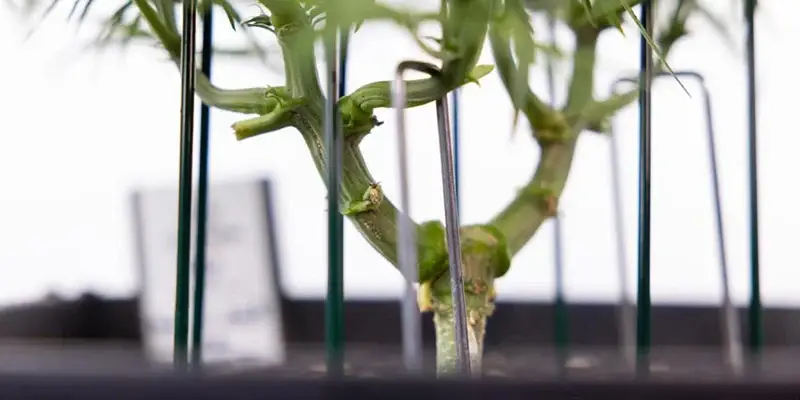
LST is the most forgiving and most universally applicable training method for both hobby and commercial growers. It’s also the foundation that makes many other techniques more effective — topping is most powerful when combined with LST afterward, and ScrOG is essentially LST at scale with a net doing much of the positional work.
The core mechanic is simple: bend the tallest stems downward and outward, and secure them in place so they are no longer the highest point on the plant. This prevents the plant from concentrating auxins in a single tip and encourages more uniform hormone distribution into lateral branches, which then race upward to become new canopy leaders.
When to Start LST
Start LST when the plant has about 4–6 nodes and stems are still young and flexible so they bend rather than snap. Young growth bends without cracking, while older, lignified stems are much more likely to break under pressure. Always work from the tips of branches, not the woody base, to reduce breakage risk.
Don’t rush into LST the day seedlings emerge; allow the plant to establish some structure first so there is meaningful growth to position. In commercial settings, this often coincides with early vegetative growth when plants are established but before internodes stretch excessively.
How to Do LST
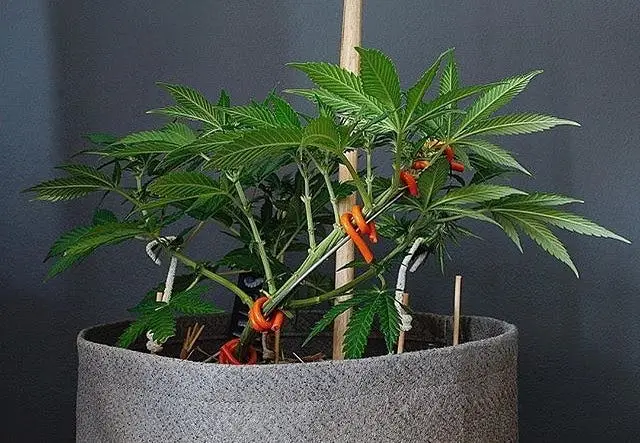
- Identify the tallest shoot of new growth that is easy to bend without cracking.
- Gently bend it downward and outward — away from the center of the plant and away from crossing other stems, to maintain airflow and prevent abrasion.
- Secure it in place using soft plant ties. Hydrofarm Garden Soft Tie works well here — it is flexible enough not to cut into stems as the plant grows, unlike bare wire or hard‑edged materials that can create wounds and infection points.
- Repeat regularly throughout the vegetative stage, working through all new tallest shoots to maintain a level canopy, instead of waiting for canopy height to get away from you.
- The goal is to keep canopy points at roughly equal height — think of opening the plant so light can penetrate through the middle and across multiple bud sites.
As you approach the flip to flower, your plant should have a wide, relatively flat canopy with multiple tops at similar height instead of a single peak. Once those tops enter flower and stems begin to lignify during the stretch, gradually taper off active LST, because forcing lignified stems can snap branches and damage developing buds.
LST Tips That Actually Matter
Tie firmly, not just snugly. A loose tie allows the branch to move and create friction points as it grows, which can cause abrasions and make training less effective; a firm but cushioned tie keeps the branch in the desired position without constricting it.
Bend at the tips. The further from the stem base, the more flexible the tissue and the lower the risk of a clean snap that requires repair or splinting.
Never rush. You can always come back and bend more once you see how the plant responds; you cannot un‑break a branch once it snaps, especially in late veg or early flower when recovery time is limited.
LST is ongoing work. One session rarely completes the job, particularly under high‑intensity lighting and strong vegetative growth; budget recurring short sessions throughout veg to maintain canopy uniformity.
For a deep-dive into LST technique, see our complete low-stress training guide.


Screen of Green (ScrOG)
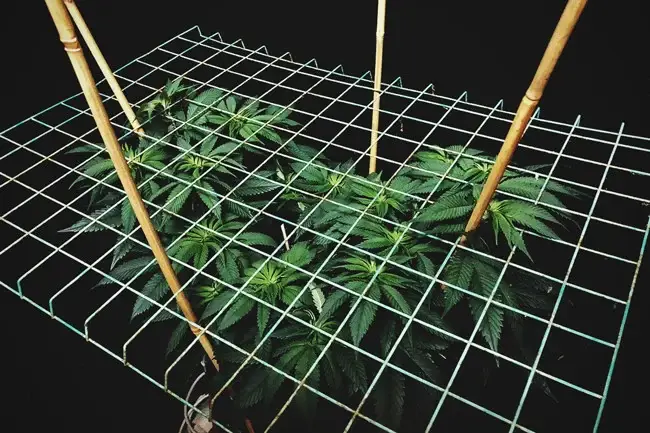
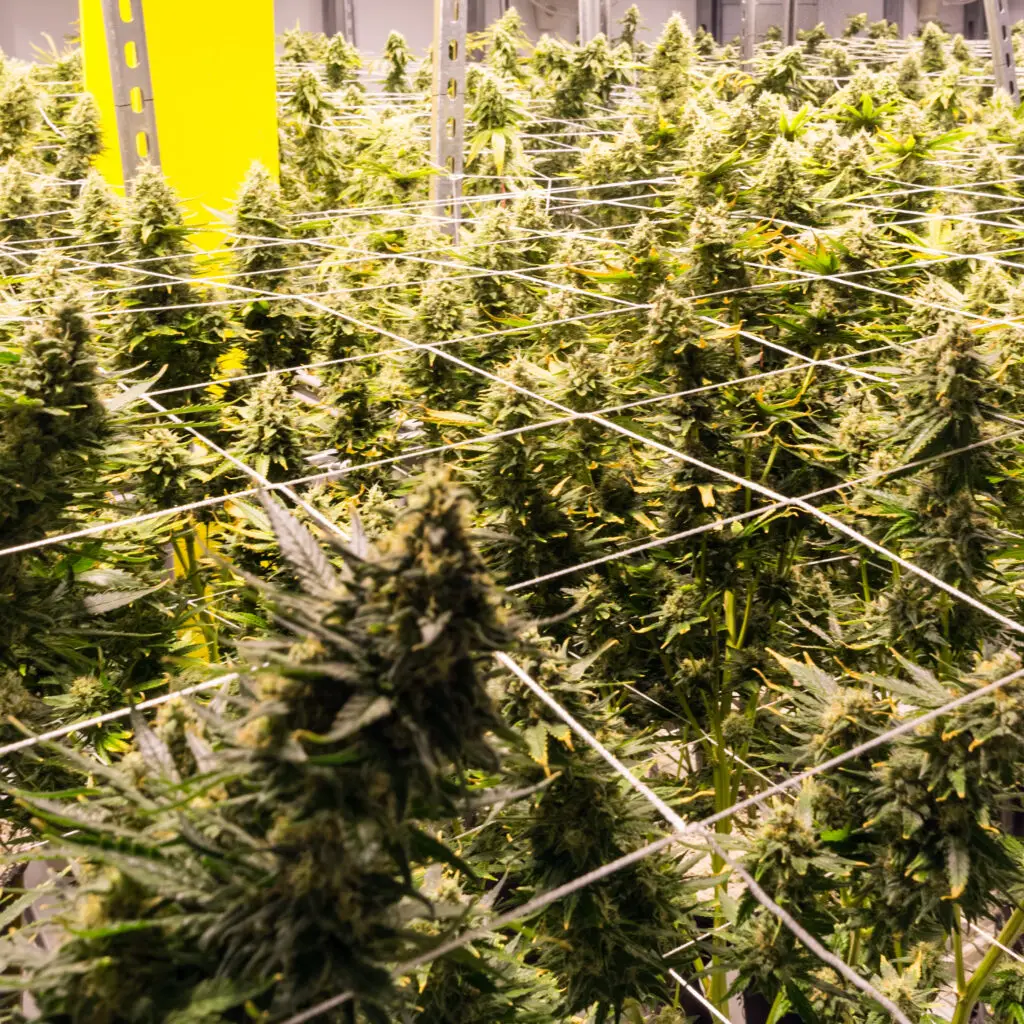
ScrOG is LST at scale — instead of using individual ties to position each branch, a horizontal trellis net does the work for you. Branches grow up through the net and are tucked horizontally as they emerge, filling the screen evenly from edge to edge.
The result is a uniformly flat canopy where every bud site sits at the same distance from the light. This is one of the most effective ways to maximize output from a fixed-wattage light over a fixed footprint.
Important: Simply placing a net over your plants and letting them grow through it is not ScrOG. That’s passive plant support. ScrOG requires active canopy management — tucking branches through net squares as they emerge to force lateral growth, not vertical.
How to ScrOG
- Set up your screen before plants reach it, typically 12–15 inches above the substrate surface, with sufficient clearance between the screen and your grow lights to maintain target PPFD and avoid bleaching.
- Top the main cola when it first grows through the screen to divert energy to lateral branches and help fill the screen faster than relying purely on natural branching.
- As branches grow through the net, tuck them horizontally into the next open square, working outward from the center toward the edges for even coverage.
- Continue tucking through the first 2–3 weeks of flower during the stretch, then stop once stems lignify and become less flexible, to avoid breakage.
- Switch to flowering when the screen is roughly 60–70% filled; the stretch typically fills the remaining space when plants are healthy and lighting is adequate.
Net selection matters. For tent setups, the AC Infinity Elastic Grow Tent Trellis Netting provides flexibility that accommodates varying branch diameters without cutting into stems and is easy to install and adjust. For commercial-scale fixed rooms, the HBX Heavy-Duty Plastic Garden Trellis Netting offers long-run options sized for facility buildouts.
Topping
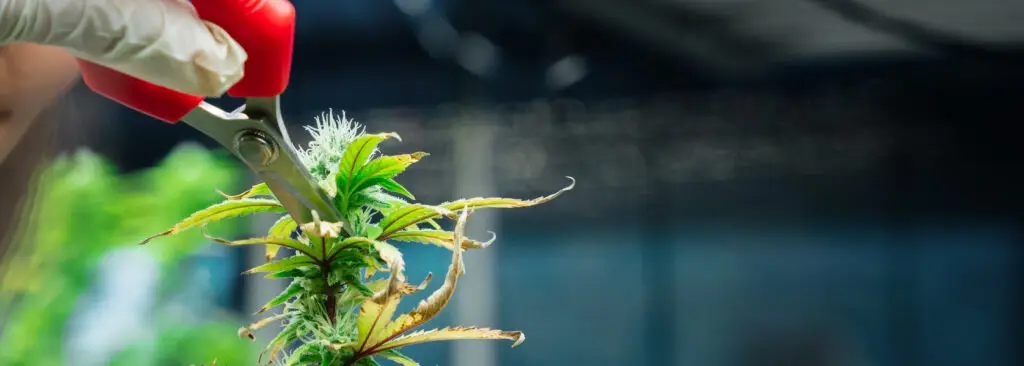
Topping is the most commonly used HST technique and a fast way to increase the number of main colas by interrupting apical dominance. It’s straightforward: cut the growing tip of the main stem so that growth energy is redistributed into multiple side shoots.
After a successful topping, the plant that was pushing one dominant cola now produces two dominant shoots at that node, and additional branching can be encouraged with further topping or LST. Each topping pass increases the number of primary colas, but the yield per cola typically decreases slightly, so there is a practical ceiling where additional topping provides diminishing returns.
How to Top
Top when the plant has about 4–6 nodes and is solidly in vegetative growth; doing it earlier increases the risk of stunting, while doing it much later wastes potential veg time and can be harder for the plant to recover from fully before flower. When making the cut, remove as little plant matter as possible and cut just above the node you plan to keep, because a small, clean wound heals faster and creates less stress.
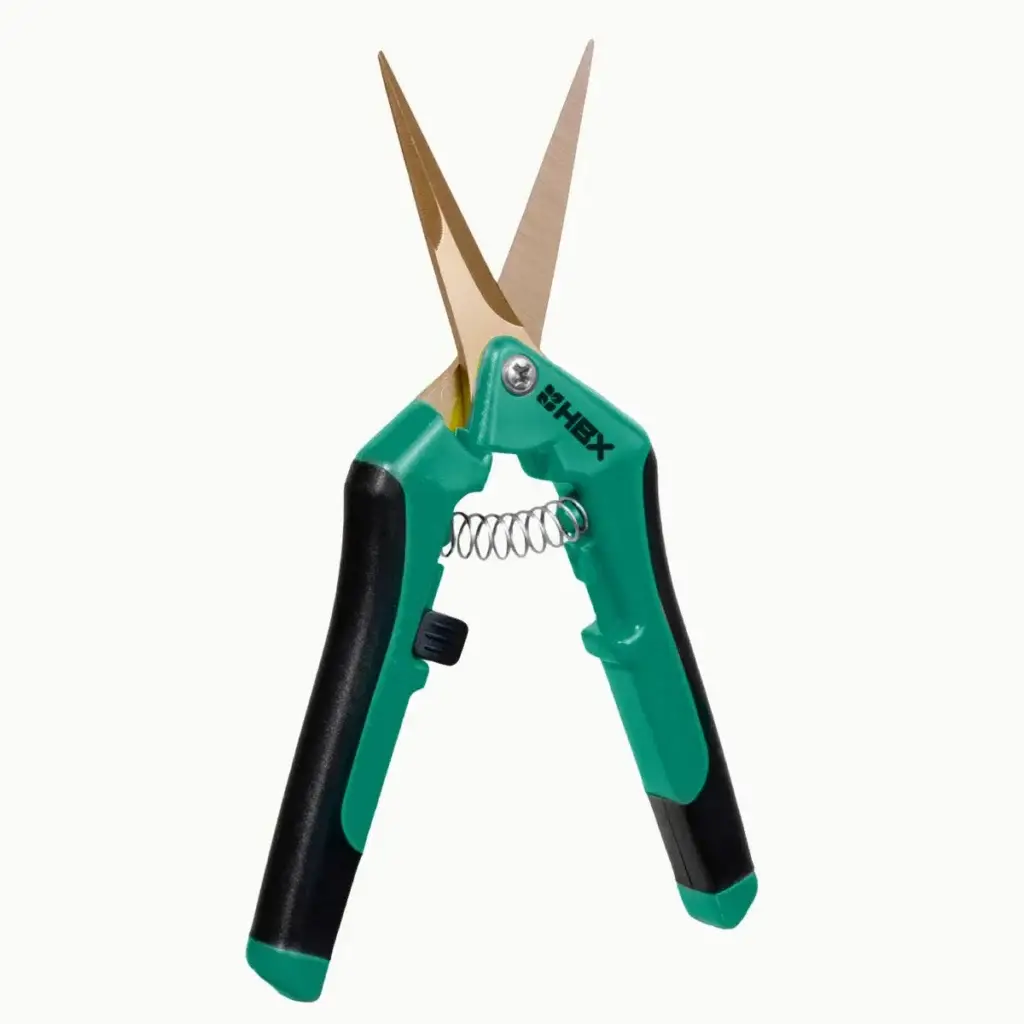
Use sharp, sterile scissors or pruners so the cut is clean and does not crush the stem. HBX Heavy Duty Bypass Pruners are built for this kind of work, with blades designed to minimize tissue damage and support repeated use in cultivation settings.
After topping, plan for roughly 5–10 days of slower growth while the plant recovers and redirects growth hormones to new tops, and in some cases up to about 14 days for full structural recovery, depending on environmental conditions and plant health. Avoid stacking other major stress events (heavy defoliation, transplanting) immediately after topping so the plant can recover efficiently.
Combine topping with LST for best results. Top first, then use LST to bend and spread the resulting new tops outward, creating a wider, flatter canopy that takes fuller advantage of your light footprint while keeping canopy height manageable. The complete low-stress training guide covers this combination in detail.
Can You Top a Plant Twice?
Yes — and many growers do, particularly with photoperiod plants and adequate veg time. A common approach is topping once at about the 4th–5th node (leaving several nodes below), then topping the new tops once they have grown out sufficiently, which yields four main tops, and in some cases a third topping pass is used to reach eight tops. Space toppings at least 7–10 days apart, and ensure plants have fully resumed vigorous growth before repeating the process.
Does Topping Slow Growth?
Topping temporarily slows visible vertical growth because the plant must heal the wound and redirect growth hormones. Expect roughly 5–10 days of reduced growth rate after each topping under stable conditions, and plan your veg schedule so the last cut occurs at least 1–2 weeks before your intended flip date to ensure full vigor entering the stretch.
FIMing vs. Topping
FIMing is a variant of topping where, instead of cutting cleanly below the growth tip, you cut or pinch through the middle of the developing tip itself to encourage 3–4 new tops from that site. The “FIM” acronym (“F*** I Missed”) reflects that the technique originated from an accidental partial topping.
In practice, FIMing tends to be less predictable than standard topping: when executed just right, it can be more efficient than multiple clean toppings, but when it misses the ideal tissue zone, the plant may retain a strong central leader and require topping anyway. For growers who prioritize consistency and repeatability, clean topping is generally more reliable; for those comfortable with experimentation, FIMing can be tested on a subset of plants rather than entire rooms.
Supercropping
Supercropping is an HST technique that bends a branch by crushing internal tissues while keeping the outer skin mostly intact, allowing you to reposition mature branches that would otherwise be too rigid to bend. When executed correctly on healthy plants, the damaged area heals and forms a visible “knuckle” that often becomes mechanically stronger than the original stem segment.
It is more aggressive than LST and is best reserved for vigorous plants under stable environmental conditions, where you have time for recovery before major developmental milestones like flowering.
When to Supercrop
Target branches that are mature but not fully woody — typically in early to mid veg or early stretch, when stems are still somewhat pliable but have enough structure to maintain a new orientation after bending. Avoid supercropping very young seedlings or weak plants, and generally avoid supercropping the main stalk in favor of lateral branches so you don’t risk catastrophic failure of the plant’s primary support.
How to Supercrop
- Identify the branch you want to bend based on canopy height and light distribution.
- Grip the stem between your thumb and forefinger and gently but firmly squeeze to crush the inner tissue, aiming to soften the core while keeping the outer “skin” as intact as possible.
- Wiggle the branch gently back and forth to further soften the crushed area.
- Once the tissue feels pliable, slowly bend the stem to your target position, usually just below the horizontal plane you want for the canopy.
- Secure the branch in place with soft ties or additional support if it tends to spring back, especially for heavier branches.
If the outer skin cracks and the branch partially breaks, you can often salvage it by quickly supporting and taping the break (using electrical tape, grafting tape, or plant tape) and stabilizing it until healed. Allow at least several days of recovery, and ideally 5–7 days or more before flipping to flower, so the plant can repair the damage and recommit resources to bud development.
For a deeper look at HST techniques, see our high-stress training guide.
Manifolding (Main-Lining)
Manifolding is a structured topping protocol that creates a symmetrical framework of multiple colas — often eight — originating from a central, evenly distributed manifold, so each cola has similar access to nutrients and light.
The advantage of manifolding is that once the framework is built, canopy management during the remainder of veg and early flower becomes more about maintenance than continuous heavy training, which can be an advantage for growers looking to standardize plant architecture.
When manifolding makes sense:
- Photoperiod plants with adequate veg time (often at least 6–8 weeks from seed or equivalent clone development).
- Healthy, vigorous plants that can tolerate multiple topping events and structural training.
- Growers who want a repeatable, set-and-maintain structure and are willing to invest early labor for simpler later maintenance.
When to skip manifolding:
- Autoflowering plants — the fixed lifecycle leaves less room for recovery from multiple toppings, so manifolding is rarely recommended in production runs.
- Plants already struggling with stress, pests, or deficiencies, where added stress could reduce vigor and yield.
- Very low-powered lighting setups where numerous colas might compete for limited light rather than each reaching full potential.
- Grows with very strict height or time limitations where extended veg to build the manifold is not feasible.
How to Manifold
- Grow the plant to around 6 nodes in veg.
- First topping: Cut the main stem down to the third node, leaving that node to form two primary branches and removing growth above.
- Clean up the base: Remove lower growth from the first and second nodes so energy is focused into the two primary branches at the third node.
- Allow the two primary branches to grow out to about 3 nodes each.
- Second topping: Top each of these branches to create four main tops (two per side).
- Remove lower growth below the top nodes on each branch, leaving the desired number of nodes that will form your colas.
- Use LST to keep the developing tops at the same height and spread them to form a flat, even manifold.
- Optional third topping: Where veg time allows, some growers top again from four to eight main colas, stopping once canopy density and plant vigor are appropriate for the lighting and space.
During the remainder of veg, focus on maintaining even height across all manifolded tops and preventing any single branch from dominating, using gentle LST to keep the structure flat and open.
Defoliation
Defoliation means selectively removing larger fan leaves to improve light penetration and airflow, not randomly stripping foliage. Done properly on healthy plants, it can increase light reaching lower bud sites, reduce humidity pockets around dense foliage, and support the plant in prioritizing energy toward productive sites.
Overdone or poorly timed defoliation — removing too much leaf mass, especially from stressed plants or late in flower — can reduce photosynthetic capacity and negatively impact yield and quality.
When and How to Defoliate
Late veg / pre-flip: Remove large fan leaves that are stacked or heavily shading lower bud sites, particularly in dense canopies or ScrOG setups where airflow can be restricted. Many commercial SOPs schedule a structured pre‑flip defoliation once plants have filled their footprint but before the stretch.
Early flower (around week 3): A targeted defoliation pass around days 14–21 of flower is commonly used to remove leaves that block light to developing bud sites and to thin lower growth unlikely to produce quality flowers. Focus on leaves that directly cover flower sites or hang in low‑light, low‑airflow zones.
The rule: Prioritize removing leaves that block light to bud sites or contribute to dense, stagnant pockets of air, and avoid removing healthy, well‑lit leaves that contribute meaningfully to photosynthesis and plant energy.
New growers often under‑defoliate out of concern, while some commercial teams initially over‑defoliate before dialing in SOPs; the best practice is to make moderate, staged passes and evaluate plant response before scaling the practice across rooms.
For a full guide to defoliation and strategic pruning, see our pruning to increase yield guide.


Sea of Green (SoG)
Sea of Green is primarily a canopy strategy rather than an individual plant training technique; instead of training a few large plants to fill the space, you run many smaller plants, flipping them to flower earlier so that combined canopy volume fills the footprint.
In a typical SoG, each plant carries fewer colas, but the collective canopy provides comparable or higher density across the space, often with shorter veg times per cycle when propagation is efficient.
The math behind SoG: A single large plant trained to fill a 4×4 area may require 8–10 weeks of veg, whereas multiple smaller plants can often reach comparable canopy coverage with 3–5 weeks of veg each, depending on genetics and environment. For growers who prioritize harvest frequency and total annual output over per‑plant yield, SoG can be effective when propagation and compliance logistics are handled well.
SoG tradeoffs:
- More plants mean more individual care early in veg and more propagation infrastructure for clones or seedlings.
- Works best with cultivars that stay compact and don’t stretch excessively at flip, to maintain even canopy height and prevent overcrowding.
- Plant count limits apply in many jurisdictions, so legal regulations often influence whether SoG is viable for cannabis operations.
Combining SoG with training: Individual SoG plants can still benefit from light training, such as a single topping to create two main colas or minimal LST to spread branches slightly, without significantly extending veg time, so long as recovery is quick and environment is stable.
For a detailed breakdown, see our Sea of Green guide.
12/12 From Seed
Running a 12/12 light schedule from seed is a technique aimed at maximizing harvest speed at the expense of plant size and yield per plant. Under typical indoor cultivation, photoperiod plants veg under extended light (e.g., 18/6 or 20/4) to build structure before flowering; switching to 12/12 immediately pushes them toward flowering as soon as they are developmentally able.
The result is a very fast harvest from very small plants with relatively low yield, which is rarely the best choice for maximizing grams per watt or per square foot in a production context. However, it can be useful in very limited spaces, rapid phenotype testing, or small experimental runs where cycle time is prioritized over yield.
A more practical alternative: A short vegetative period of roughly 3–4 weeks at 18/6 often gives plants enough structure to produce more meaningful yields while still delivering faster turnaround than a full 8–10-week veg, especially when combined with basic training like LST and topping. Many autoflower cultivars effectively deliver short-cycle performance with continuous light or 18/6 schedules without the need to manipulate photoperiod.
For the complete guide, see our 12/12 from seed article.
Which Training Techniques Work Together?
Training methods are often more powerful in combination than alone, as long as you manage total stress load and recovery windows. Here’s how they stack:
| Goal | Recommended Combination |
|---|---|
| Max yield, single plant in a tent | Topping + LST + ScrOG |
| Fast setup, minimal ongoing work | Manifolding + light LST maintenance |
| Aggressive HST for experienced growers | Topping + Supercropping + LST |
| Autoflowers only | LST only (no cutting) |
| Maximum plants per cycle (SoG) | Single topping + minimal LST |
| Space-limited vertical restriction | Supercropping + LST |
The sequence matters. For photoperiod plants, a typical workflow looks like this:
- Top around the 4th–5th node (often week 3–4 of veg, depending on growth rate).
- Apply LST to the new tops, bending them outward to widen and flatten the canopy.
- Optionally perform a second topping once plants have recovered and new tops are established.
- Continue LST throughout veg to maintain even canopy height and fill the footprint.
- Flip to flower once the canopy is well-filled but not overcrowded, leaving room for stretch.
- Continue light positional adjustments (tucking in ScrOG) during the first 2–3 weeks of stretch, then stop once stems lignify.
- Defoliate strategically in late veg and early flower based on your strain and environment.
Autoflowers: What Works and What Doesn't
Autoflowers run on an internal developmental clock rather than relying on daylength changes to trigger flowering, typically finishing in about 60–90 days from sprout depending on genetics and environment. This compressed lifecycle leaves less room for recovery from high-stress interventions.
Because HST techniques such as topping, manifolding, and supercropping can introduce recovery windows of a week or more, they may consume a substantial fraction of an autoflower’s overall vegetative window, especially if environmental conditions are not ideal. For this reason:
- ✅ LST-first approach — Bending and tying without cutting is the standard for autos; gentle LST can be started early (around 4–5 nodes) to flatten the canopy with minimal recovery overhead.
- ✅ Gentle ScrOG — Works when the screen is installed early and branches are tucked gently as they grow, avoiding sharp bends or breaks.
- ⚠️ Single topping (advanced only) — Some experienced growers successfully top autoflowers once at about the 4th–5th node on vigorous cultivars under dialed-in conditions, but the technique carries real risk of stunting or yield loss and is best tested on a small subset of plants, not entire production runs.
- ❌ Multiple toppings, manifolding, FIMing, aggressive supercropping — Generally not recommended for autoflowers, especially in commercial operations, because the time and stress load often outweigh potential gains.
The best auto workflows combine early gentle LST with selective defoliation on healthy plants, maintaining an open, uniform canopy while avoiding aggressive cuts that require long recovery periods.
For Commercial Operations: Canopy Management at Scale
For licensed cultivation facilities and commercial indoor grows, plant training becomes formalized canopy management with written SOPs, training schedules, and QA checks. The underlying techniques mirror home growing, but they are executed within structured workflows and documented for consistency and traceability.
Standard Commercial Training Approaches
ScrOG at facility scale: Commercial operations using ScrOG typically install fixed trellis infrastructure above rolling benches or tables at defined heights, aligning nets with lighting layout and irrigation access. The HBX Heavy-Duty Plastic Garden Trellis Netting offers long-run lengths suitable for spanning full tables or rooms.
Canopy uniformity and light utilization: In well-run facilities with fixed overhead lighting, operators aim to keep canopy height variation as tight as practical so PPFD remains within the desired range across the room. Regular canopy height audits — walking the room, measuring at multiple points, and logging areas that run significantly high or low — help guide targeted training and pruning.
Under-canopy lighting as a training supplement: In facilities where perfect canopy flatness is difficult to maintain, under-canopy lighting can complement training by delivering additional light to mid and lower canopy zones. Faven Under-Canopy LED Grow Lights are designed for this application, providing spectrum-tuned light from below or within the canopy to support more uniform bud development. This approach is most impactful during the first several weeks of flower when bud sites are setting and lower sites benefit most from improved light.
Pruning SOPs: Commercial defoliation and pruning are typically scheduled as crew tasks anchored to key phenological dates — for example, a pre-flip clean-up, a structured early-flower defoliation around days 14–21, and occasionally a mid-flower touch-up around days 35–42. Tools such as HBX Heavy Duty Bypass Pruners support repeated clean cuts at volume, and sanitation protocols (disinfecting tools between plants or tables) are essential to minimize disease spread.
Canopy training and vertical growing: In vertical systems with multi-tier racks, the same principles of canopy flattening, defoliation, and support apply, but clearances, ergonomics, and airflow patterns differ significantly. See our vertical growing guide for system-specific training considerations.
Tracking and documentation: Commercial operators should treat training and canopy management as data points, recording dates, rooms, crew, and observations about canopy response alongside fertigation and environmental logs. This recordkeeping enables meaningful A/B comparisons between rooms, cultivars, and training strategies over time.
Quick-Reference: Training Technique Comparison
| Goal | Recommended Combination |
|---|---|
| Max yield, single plant in a tent | Topping + LST + ScrOG |
| Fast setup, minimal ongoing work | Manifolding + light LST maintenance |
| Aggressive HST for experienced growers | Topping + Supercropping + LST |
| Autoflowers only | LST only (no cutting) |
| Maximum plants per cycle (SoG) | Single topping + minimal LST |
| Space-limited vertical restriction | Supercropping + LST |
This table is a general guide; always adapt stress level and technique choice to your specific genetics, environment, and operational goals.
Final Thoughts
You don’t need to deploy every technique in this guide to see strong results; most successful growers standardize on a small toolkit of 2–3 methods that fit their genetics and operational constraints. The core fundamentals — disrupting apical dominance where appropriate, flattening the canopy, and keeping productive bud sites at similar distances from the light — remain constant regardless of which specific combination you choose.
For many growers, starting with LST is the safest and most impactful first step, followed by topping on suitable photoperiod plants once you are comfortable reading plant responses. From there, techniques like ScrOG, supercropping, and manifolding become tools you can add selectively as your confidence and facility capabilities grow.
If you have questions about applying any of these techniques to your specific setup, reach out to our expert growers at 888-815-9763 or browse our training and canopy management supplies below.
Have questions about plant training for your specific setup? Our grower support team is available at 888-815-9763.
Example: FAQs
Q: What is the best plant training method for beginners?
A: LST (low-stress training) is usually the best starting point for beginners because it avoids cutting and major wounds while still providing clear canopy benefits. It involves gently bending the tallest new growth downward and outward, securing it with soft plant ties, and repeating periodically throughout veg so more sites receive uniform light; once you’re comfortable with LST and how your plants respond, topping becomes a logical next step on healthy photoperiod cultivars.
Q: Does topping really increase yield?
A: Topping can increase yield when done correctly on healthy photoperiod plants with sufficient vegetative time remaining because it redirects growth from a single dominant cola into multiple tops that share the canopy. Combined with LST, appropriate defoliation, and adequate recovery time (often around 7–10 days per topping), trained plants often outperform untrained plants under the same lighting and environmental conditions, although the exact percentage gain depends on genetics, environment, and execution.
Q: Can you train autoflowering plants?
A: Autoflowers can be trained, but the safest and most commonly recommended methods are low-stress techniques like LST and gentle ScrOG, which reshape the canopy without major cuts. While some experienced growers successfully perform a single well-timed topping on vigorous autos, many seedbanks and cultivation guides caution that topping autos is higher risk and better reserved for small trials, so most production auto runs rely on LST and selective defoliation instead.
Q: When should I start training my plants?
A: For most setups, you can begin gentle LST once your plants reach about 4–6 nodes and stems are still flexible, so bending is unlikely to cause snapping. Topping is generally recommended at a similar stage — often around the 4th–5th node during vegetative growth — and structured manifolding typically starts once the plant has about 6 nodes and is showing vigorous growth.
Q: How do I do a ScrOG?
A: To run a ScrOG, set up a horizontal trellis net roughly 12–15 inches above your substrate before plants reach it, then guide branches through the net and tuck them laterally into open squares as they grow. Top the main cola when it hits the net, continue tucking branches during veg and into the first 2–3 weeks of flower, and flip when the screen is about 60–70% filled so the stretch can complete the canopy.
Q: What's the difference between topping and FIMing?
A: Topping removes the main growth tip cleanly just above a node, reliably producing two new dominant tops and breaking apical dominance in a predictable way. FIMing removes only part of the developing tip to try to generate 3–4 tops from a single cut, but it tends to be less consistent; many growers prefer topping for its repeatability and reserve FIMing for controlled experimentation.
Q: Does defoliation stress plants?
A: Defoliation does create some stress because leaves are vital photosynthetic organs, but on healthy plants under good conditions, moderate, well-timed defoliation is widely used to improve light penetration and airflow. The key is to remove leaves blocking bud sites or contributing to dense, stagnant pockets of air in late veg and early flower, while avoiding aggressive stripping of healthy, light-exposed leaves, especially on stressed plants or late in flower.
Q: How do I train plants in a commercial facility?
A: Commercial canopy management typically standardizes techniques like ScrOG, topping, LST, and defoliation into written SOPs with specific timing (e.g., pre-flip, early flower) and clear labor expectations. Facilities often combine fixed trellis systems, scheduled defoliation passes, canopy height audits, and, in some cases, under-canopy lighting to keep the canopy uniform and maximize light utilization across large, multi-table rooms.
Q: Can I combine LST and topping?
A: Yes — combining LST with topping is one of the most common and effective ways to shape photoperiod plants. A typical sequence is to top once the plant reaches about the 4th–5th node, allow initial recovery, then use LST to bend the resulting tops outward and maintain a flat, well-lit canopy as new growth emerges.
Q: Is Sea of Green better than ScrOG?
A: Neither approach is universally “better”; they serve different operational goals. SoG relies on many smaller plants flipped earlier to prioritize harvest frequency and throughput, while ScrOG focuses on training fewer plants to fill the footprint with a flat canopy and maximize yield per cycle, and plant-count regulations, labor, and infrastructure often determine which approach is more appropriate for a given facility.