

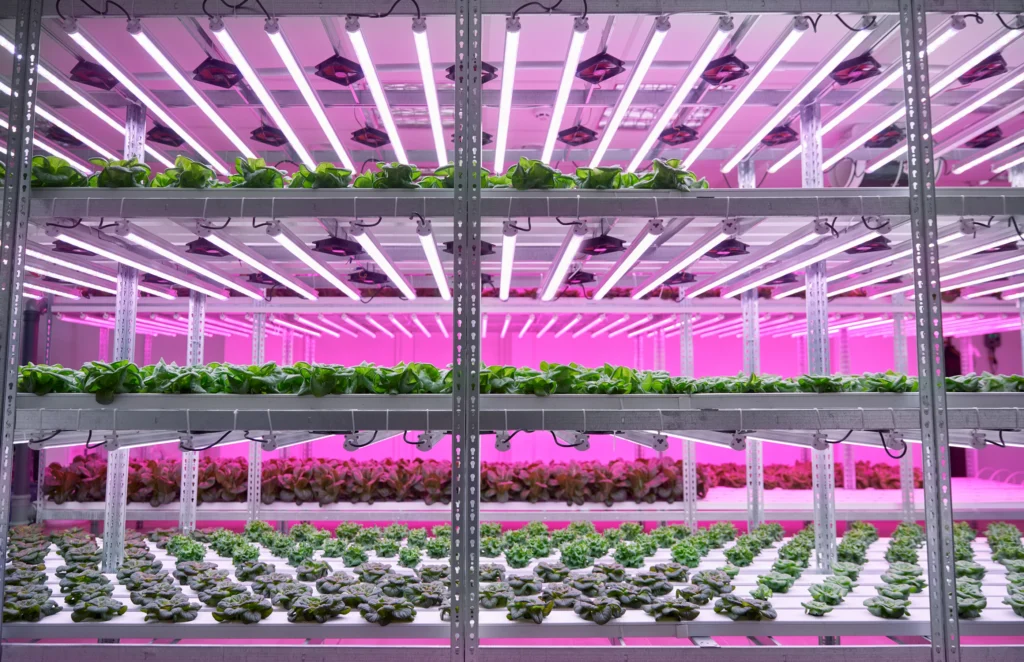
Vertical growing is one of the most efficient ways to expand your production without expanding your footprint. Whether you’re stacking two tiers of propagation trays in a 4×8 tent or designing a multi-tier cannabis facility with mobile racking and per-tier LED bars, the core principle is the same: grow up, not out.
This guide covers how vertical growing systems work, what equipment matters most at each scale, and the real tradeoffs growers run into once the racks go in.
Both home growers and commercial operators use vertical systems for the same reasons — maximize canopy per square foot, reduce overhead cost per pound, and keep environmental conditions tighter. The scale differs; the fundamentals don’t.
What Is Vertical Growing?
Vertical growing is the practice of cultivating plants in stacked or tiered layers rather than a single horizontal plane. Plants grow on shelves, racks, or columns, with light sources mounted per tier or positioned centrally between rows.
Systems range from a simple two-shelf propagation rack with a T5 bar to engineered mobile racking with per-tier LED strips, dedicated drip irrigation zones, and integrated environmental controls. The method works with soil, coco, rockwool, and most hydroponic approaches, including drip systems, ebb and flow, aeroponics, and NFT.
The concept was formally proposed as a large-scale agricultural solution in 1999, but growers have been stacking propagation and veg trays vertically for decades before commercial vertical farming became a defined industry term.
What Can You Grow Vertically?
The short answer: most things, with the right system design. But some crops are better suited than others, and knowing which before you build saves significant rework.
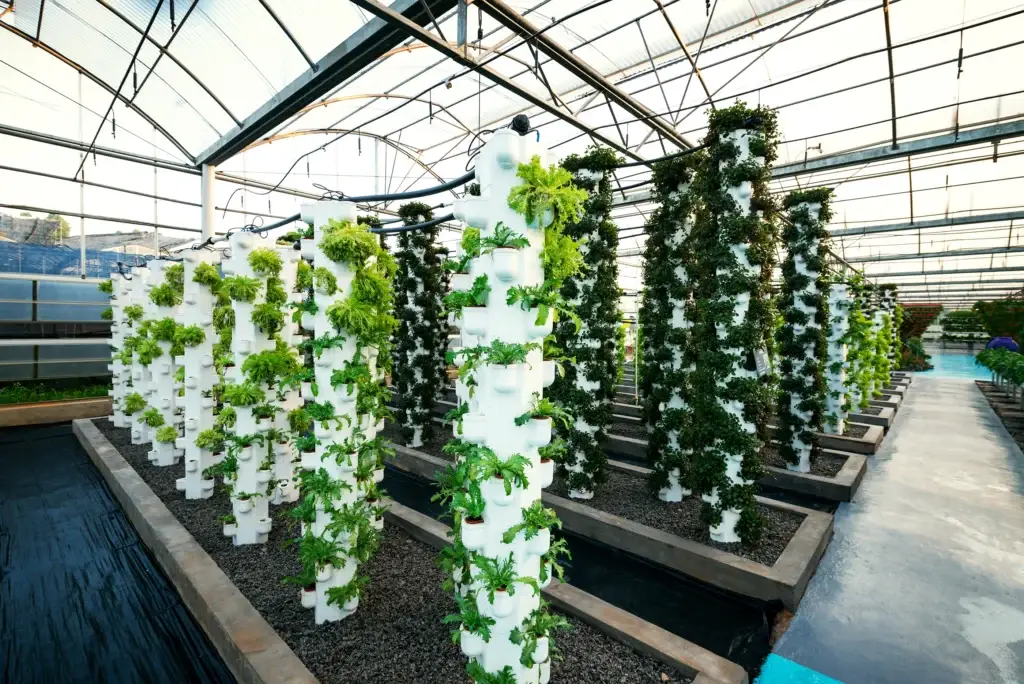
Best fits for vertical growing:
Fast-cycling crops with compact growth habits produce the most consistent results. Lettuce, spinach, kale, herbs, and microgreens are the most natural fit — short internode spacing, shallow root zones, and predictable canopy height make tier-to-tier spacing easy to standardize.
Hydroponic tomatoes can work in vertical systems when indeterminate varieties are trained to a single leader, though they require taller tier clearances and careful plant training to keep canopy manageable.
Vining crops like peas, cucumbers, and summer squash perform well vertically when given appropriate trellis support. Weight is the limiting factor with larger fruiting crops — melons and winter squash are typically too heavy for standard rack systems without structural reinforcement.
In cannabis cultivation, vertical growing most commonly refers to multi-tier vegetative and propagation workflows, with some operations running short-variety flowering crops on stadium-style racking systems. Genetics selection matters considerably here — naturally compact, short-internode cultivars with fewer leaves are the standard recommendation, reducing labor for defoliation and simplifying canopy management across tiers.
The Real Tradeoffs in Vertical Growing
Vertical systems offer real advantages, but they introduce specific challenges that competitors don’t always acknowledge. Know these before committing to a build.
Advantages
Space efficiency. A two-tier system roughly doubles usable canopy within the same floor footprint. Three-tier systems can triple it, assuming ceiling height and lighting allow.
Year-round production in a controlled environment. Indoor vertical grows are not subject to weather, pest pressure from the field, or seasonal light availability.
Workflow density. Commercial operations see labor efficiencies when irrigation, lighting, and environmental control are standardized per tier — every zone behaves the same, and staff can move through rows systematically.
Water efficiency. Closed-loop irrigation systems in vertical setups recirculate runoff, which can reduce overall water consumption relative to open-field or open-drain systems when properly monitored and maintained.
Challenges
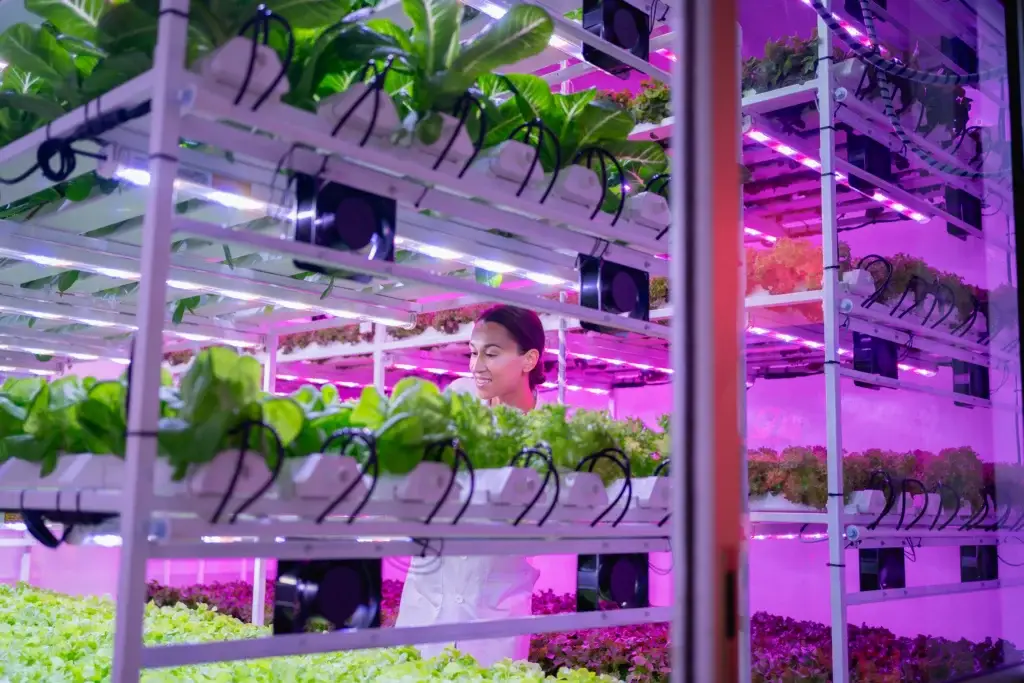
Lighting complexity. A single overhead fixture cannot serve multiple tiers adequately. Each tier needs its own light source — typically an LED bar mounted to the underside of the shelf above. This adds capital cost and electrical load, and it means managing multiple dimmer zones across the canopy.
Airflow. Stacked canopies create dead zones. Vertical setups require deliberate airflow design — directional fans positioned per tier, or vertical-flow fans designed specifically for stacked environments. Without it, VPD differentials between tiers cause inconsistent growth and increase pathogen pressure.
Heat management. Heat rises. Upper tiers run hotter than lower tiers in most vertical setups, which means lighting schedules, VPD targets, and irrigation timing may need to differ by tier height in a tightly packed system.
Access. In commercial multi-tier systems, reaching the top canopy safely requires platforms or mobile access systems. This is a genuine ergonomic and safety concern that affects workflow design.
Upfront cost. Compared to a single-level benching setup, a properly equipped multi-tier system with per-tier lighting and irrigation zones costs significantly more to build. The payback comes through higher canopy per square foot over time, but the capital outlay is real.
How to Set Up a Vertical Growing Operation
The right setup depends on what you’re growing, how much space you have, and what your production goals are. Here’s how to think through each layer of equipment.
Start with Racking
Your rack system is the structural foundation of the whole operation. For most growers, the first question is: stationary or mobile?
Stationary racks are simpler, less expensive, and well-suited for propagation areas, mother rooms, and veg zones where access to all plants is easy from a fixed aisle. Standard utility-style shelving in a 4×8 footprint with adjustable tier heights handles most small to mid-scale vertical setups. The key material considerations are moisture resistance and structural capacity — grow environments are humid and irrigation events add weight.
Mobile rolling systems open up the main efficiency advantage of commercial vertical growing by eliminating fixed aisles. Racks on tracked systems slide laterally, so a single aisle can serve multiple rack rows. In a flowering room, this can meaningfully increase canopy in the same square footage. Mobile systems cost more and require a flatter floor with properly anchored track systems.
For initial rack selection, check out Hydrobuilder’s full racks and shelving collection to find options at your scale.
Lighting — The Most Critical Variable in Multi-Tier Grows
Lighting is where most vertical setups succeed or fail. Each tier needs its own dedicated light source — a single overhead fixture delivers inadequate intensity to lower shelves and risks overlighting upper-tier canopy.
For propagation and vegetative tiers: T5/T8 fluorescent bars or purpose-built LED clone/veg bars mounted flush to the underside of the shelf above are the standard approach. Clearance between the light source and canopy typically runs 4–12 inches depending on fixture intensity, target PPFD, and crop.
For flowering tiers or high-light crops: Higher-output LED bars are required. Under-canopy LED bars built specifically for tight vertical installations deliver the PPFD needed for flowering without the heat or electrical draw of full-size overhead fixtures.
The Faven Lighting Chroma Under-Canopy LED Grow Lights are designed for exactly this type of application. Mounted to the shelf above, they deliver targeted full-spectrum output per tier with a low-profile, 46-inch, dimmable 120-watt form factor and IP66 rating that suits tight, humid environments. Faven’s adjustable stands let you dial in canopy distance as plants develop.
For overhead top-tier or single-tier setups where full-spectrum coverage is needed, the Growers Choice ROI-FF 650 Watt delivers high-output, GC-3K full-spectrum performance at approximately 1950 µmol/s and around 3.0 µmol/J efficacy. The Matrix M4 400 Watt LED is well-suited for narrower vertical aisles where footprint matters.
Browse the full LED grow lights collection and under-canopy lighting collection to match the right fixture to your tier configuration.


Nutrients and Feeding
Nutrients are essential in any vertical grow, and particularly important in soilless and hydroponic setups where the root zone has no soil buffer for pH swings or nutrient imbalances.
HGV Dry nutrients are well-matched to vertical systems at any scale. The three-part system — HGV Dry – Grow, HGV Dry – Flower, and HGV Dry – Base — covers both vegetative and generative stages in a high-purity, water-soluble formula that mixes cleanly for recirculating systems. The dry format makes concentrate management straightforward at scale without liquid handling and storage overhead.
For a deeper dive into plant nutrition fundamentals, see our complete plant nutrients guide.
Irrigation and Fertigation
In a vertical system with multiple tiers, hand-watering is not a sustainable workflow beyond small hobby setups. Per-tier drip irrigation with a central head system is standard practice in commercial vertical grows.
Netafim Drip Stake Assemblies are widely considered a standard option for precision drip delivery, using 0.3 or 0.5 GPH pressure-compensating emitters with check valves and 36–48 inch assemblies to maintain uniform flow. Consistent emitter flow rates per stake mean uniform moisture delivery across every plant in a tier, which translates directly to consistent growth and reduces the labor of spotting dry or waterlogged zones.
Automation
Automation is not optional in a multi-tier vertical setup — it’s what makes the system scalable. Manual lighting and irrigation cycles across multiple tiers in multiple rooms compound quickly into an unworkable labor burden.
At minimum, lighting timers and automated irrigation controllers per zone are table stakes. Visit the lighting automation collection and environment and irrigation automation to find the right level of control for your system.
Airflow in Vertical Grows: What Most Guides Skip
Standard oscillating fans don’t move air effectively through stacked canopy. For vertical setups, you need directional airflow that reaches every tier.
Vertical-flow fans like the Covert V-Fan are designed specifically for stacked environments, using a conical outlet to direct airflow downward through the canopy column rather than across a horizontal plane. In a tiered system, this helps air movement reach lower shelves and reduces the stagnant microclimates that lead to fungal pressure and uneven transpiration when deployed as part of a distributed airflow design.
For detailed ventilation planning, see our ventilation setup guide.
For Commercial Operations: Multi-Tier Facility Workflows
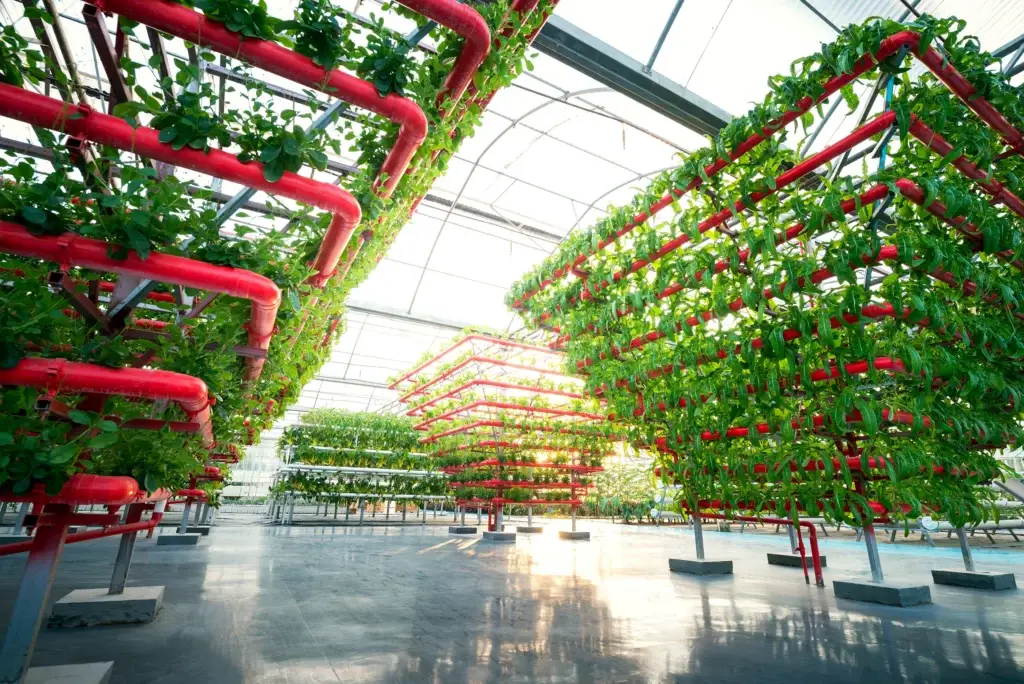
Multi-tier indoor cultivation is one of the fastest-growing configurations in the commercial cannabis and CEA space, driven by the economics of maximizing canopy per square foot in licensed, fixed-footprint facilities.
Racking Design and Layout
Commercial vertical setups most commonly use two or three-tier mobile racking systems with integrated ebb-and-flow flood trays or per-plant drip zones per tier. Tier clearance in commercial cannabis flower rooms typically runs 24–36 inches from canopy to the underside of the next shelf — enough for compact-genetics flowering plants with adequate airflow buffer.
Room design should account for aisle access, HVAC duct routing across tiers, and load capacity per shelf given substrate, plant, and irrigation weight. Engage your GC and MEP during the planning phase — racking loads and power distribution for per-tier lighting are not afterthoughts.
Lighting Strategy: Per-Tier Deployment
At commercial scale, per-tier LED bar systems running roughly 90–120 watts per bar per 4-foot canopy section are a common benchmark for veg and propagation tiers under LED, assuming efficient fixtures and moderate PPFD targets. Flowering tiers running full-cycle LED require higher PPFD targets, typically 600–1,000 µmol/m²/s depending on CO2 enrichment levels and crop.
Faven Lighting Chroma under-canopy bars are a widely used commercial-scale option for vertical tier lighting, with dimmable 120-watt, IP66-rated fixtures and spectrum control that suit under-canopy and tight-tier applications. Their slim 46-inch form factor fits flush between shelf and canopy without significantly compromising airflow or access when rows, fans, and clearances are planned correctly.
Fertigation at Scale
A Dosatron D14MZ2 inline with your header line delivers precise nutrient concentrate proportioning without electricity, operating as a water-powered doser with a 0.05–14 GPM flow range and a 1:500 to 1:50 dilution range (0.2–2%). This is a reliable architecture for drip zones in multi-tier rooms when plumbed with appropriate filtration, pressure, and bypass provisions. Pair with Netafim drip stakes for emitter-level consistency across every plant.
For a complete breakdown of fertigation system design, see our fertigation automation guide.
Environmental Control
Vertical rooms create layered microclimates — temperature and humidity differentials between top and bottom tiers are real in most setups. Deploying sensors per zone and managing HVAC zoning by tier height is the standard approach in dialed commercial operations.
The TrolMaster Hydro-X PRO Environmental Control System supports multi-zone sensor arrays, allowing up to 50 sensors and multiple control modules to be linked to one controller, so you can tie specific sensors to specific control functions in a multi-tier room. This gives you real per-tier environmental data rather than a single room average. Integrated lighting control via the TrolMaster adapter ecosystem means lighting across all tiers can be managed from a single interface. For room-by-room dehumidification in commercial vertical facilities, Quest dehumidifiers are widely used and sized using manufacturer tools and evapotranspiration calculations to match canopy density and the higher moisture load that multi-tier grows generate.
For a deeper look at grow room layout planning, see our grow room example designs and grow room automation guide.
Why Shop Vertical Growing Equipment at Hydrobuilder
Hydrobuilder carries the full equipment stack for vertical growing, from racks and tier lighting to fertigation systems and environmental controls — all in one place with commercial account support available for volume orders. We work directly with co-op partners like Faven, Netafim, Dosatron, and TrolMaster, which means access to current product support, technical specs, and sizing guidance for your build.
If you’re ready to put together a vertical grow system, contact our team or explore our commercial account options for volume pricing and build consultation.
FAQ SECTION
Q: What is vertical growing in agriculture?
A: Vertical growing is the practice of cultivating plants in stacked, tiered layers rather than a single horizontal plane. Each tier has its own lighting, often its own irrigation zone, and is designed to maximize plant density within a fixed floor footprint. Systems range from simple two-shelf hobby setups to engineered commercial facilities with mobile racking, per-tier LED bars, and automated fertigation.
Q: What are the advantages and disadvantages of vertical farming?
A: The main advantage is space efficiency — a two-tier system roughly doubles canopy within the same footprint, and three-tier systems can approach triple canopy where ceiling height and lighting allow. Commercial operations also gain workflow density when each tier is standardized. The tradeoffs are real: each tier requires its own dedicated lighting, airflow doesn’t move naturally through stacked canopy without directional or vertical-flow fans, heat stratification creates microclimates between tiers, and upfront capital costs are higher than single-level setups. The economics work best for high-value crops in facilities where floor space is the constraint.
Q: Is vertical farming profitable?
A: Profitability depends heavily on crop selection, facility efficiency, and input cost management. Vertical growing can reduce cost per pound by increasing canopy within a fixed licensed or leased footprint, but only when lighting, irrigation, and environmental systems are efficiently designed, sized, and operated. The largest margins go to operations that have minimized electricity per gram, standardized workflows across tiers, and dialed nutrient programs. For commercial cannabis, the per-square-foot yield improvement is the primary driver of ROI.
Q: What lighting do you need for a vertical grow system?
A: Each tier needs its own dedicated light source — a single overhead fixture cannot adequately serve multiple tiers. For propagation and vegetative tiers, T5 or LED bars mounted to the underside of the shelf above are standard. For flowering tiers or high-light crops, higher-output under-canopy LED bars are required, such as dimmable 120-watt, IP66-rated under-canopy fixtures designed for tight spaces. The Faven Lighting Chroma series is designed for under-canopy and vertical applications with spectrum control that fits this use case. For full-canopy top-tier coverage, fixtures like the Growers Choice ROI-FF 650W or Matrix M4 are well suited when matched to your target PPFD and footprint.
Q: How do you manage airflow in a vertical grow?
A: Standard oscillating fans don’t penetrate stacked canopy effectively. Vertical-flow fans directed downward through the canopy column — like the Covert V-Fan with its conical outlet — are designed for tiered environments and help keep air moving at every level when deployed in sufficient quantity and locations. Dead zones between tiers increase humidity, pathogen pressure, and VPD differentials. In commercial setups, per-tier sensor placement helps identify airflow and humidity gaps before they affect crop health.
Q: Can you grow cannabis vertically?
A: Yes, and it’s increasingly common in commercial cannabis facilities. The most common vertical cannabis workflows use two or three-tier mobile racking for veg, propagation, and mother rooms, with some operations running short-variety flowering crops on stadium-style systems. Genetics selection is important — compact, short-internode cultivars with fewer leaves are significantly easier to manage in vertical configurations. Canopy height per tier typically runs 24–36 inches in commercial flower rooms to balance plant size and airflow.
Q: How do you automate a multi-tier vertical grow?
A: Lighting timers and automated irrigation per zone are the baseline. At commercial scale, integrated environmental controllers like TrolMaster’s Hydro-X PRO system allow multi-zone sensor arrays, multi-channel lighting control, and automated HVAC management from a single interface, with support for many sensors and control modules. Dosatron inline, water-powered dosers on irrigation headers automate nutrient delivery proportioning without electricity. The goal is to eliminate per-tier manual tasks so a consistent team can manage more canopy.
Q: What crops are best for vertical growing?
A: Compact, fast-cycling crops with shallow root zones are the best fit: lettuce, herbs, microgreens, spinach, and kale thrive in vertical setups. Climbing crops like peas and cucumbers work well with trellis support. For indoor cannabis, compact-genetics flowering varieties with short internodes and manageable foliage are strongly preferred. Heavy fruiting crops like melons are generally too weighty for standard racking without structural upgrades.
Q: How much does a vertical growing system cost?
A: Cost varies enormously with scale and specification. A hobby two-tier setup with a basic rack, T5 lighting, and manual irrigation can start under $500. A single commercial multi-tier mobile racking system with per-tier LED bars, integrated irrigation, and environmental controls can run $15,000 to $50,000+ per room depending on room size, rack specification, and equipment selected. The per-square-foot capital cost is higher than single-level setups but the canopy return per dollar is substantially higher over time when the system is fully utilized.
Q: How do vertical growing systems handle irrigation across multiple tiers?
A: Each tier needs an independent irrigation zone rather than a shared header with equal pressure. In commercial drip systems, Netafim emitters per plant deliver consistent flow rates across every tier regardless of moderate head pressure variation when systems are properly designed. Dosatron inline, water-powered dosers on the main header deliver consistent nutrient concentrations to all zones simultaneously within their rated flow and ratio ranges. Ebb-and-flow tier trays are also widely used in vertical propagation and veg setups.