

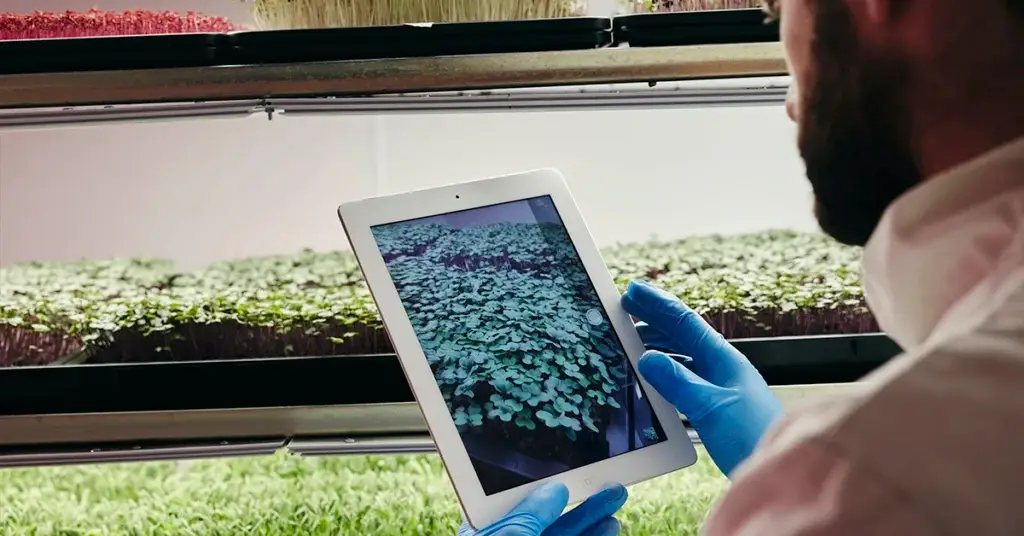
Grow room AI technology is actively running in licensed cannabis facilities and commercial greenhouses right now — delivering measurable labor savings, tighter environmental consistency, and earlier pest detection. For commercial cultivators, the core question is no longer whether AI is real. It’s which tools are worth the investment, what your data infrastructure needs to look like first, and how to sequence implementation without disrupting a running crop.
The foundation hasn’t changed: sensors measure, controllers act, apps log, AI analyzes. What’s changed is the maturity and accessibility of that final layer — and what it’s worth per pound of finished product.
Is Your Grow Room Actually AI-Ready? (Self-Audit)
Before evaluating any AI tools, run this checklist against your current setup. Every “no” is infrastructure work that must happen before AI tools can function reliably.
- Calibrated sensors? Temperature, RH, and CO₂ probes calibrated within the last 90 days, positioned at canopy height, away from direct HVAC airflow and lighting heat zones.
- Continuous data logging? Your controller is logging timestamped sensor data around the clock — not just alarming on threshold breaches.
- Stable network? Wi-Fi or wired connectivity is consistent inside each room. AI cloud tools lose their historical dataset every time the connection drops.
- Event tagging discipline? Maintenance events, transplants, spray applications, and equipment swaps are logged with timestamps in your controller or a shared record. AI anomaly models cannot distinguish a real problem from a routine event without this context.
- At least 30–90 days of clean baseline data? AI forecasting and anomaly detection require a clean operating history to define “normal.” New rooms or recently reconfigured stacks need this runway before AI alerts are reliable enough to act on without manual verification.
- Media sensors installed (for predictive irrigation)? Moisture and EC probes at root zone level are required to generate the dry-down data that predictive irrigation models learn from.
If you can check all six, your stack is ready for AI layering. If not, start there — the controller and sensor upgrades described below build that foundation while delivering immediate standalone value.
What Grow Room AI Actually Does — And What It Still Can't
Grow room AI is a pattern-recognition and prediction layer that sits on top of your existing controller infrastructure. It does not replace your TrolMaster, Growlink, or Agrowtek controller. Those systems still handle all device switching, dimming, and response — AI reads the resulting data stream to detect drift, forecast conditions, and surface alerts before they become crop losses.
Four use cases are delivering results in commercial operations today.
1. Computer-Vision Canopy Scouting
AI-powered cameras inspect canopy images to flag pests, disease, stress, or uneven growth early enough to intervene before visible damage spreads. Cannabis facilities running vision-based scouting report labor reductions in routine canopy checks and more consistent detection outcomes compared to manual walkthrough schedules — particularly in large rooms where human scouts cover the same zones at varying intervals.
The AC Infinity SPECTRON AI-Powered Grow Camera is purpose-built for this application. It mounts at a fixed canopy angle, feeds continuous imagery to an onboard AI model that tracks plant health and development stage, and sends alerts when anomalies are detected between manual checks. For commercial operations running multiple rooms, the SPECTRON provides the persistent coverage that weekly manual scouts cannot.
2. Predictive Irrigation and Fertigation
AI irrigation models learn your crop’s dry-down patterns from media moisture, EC, and climate logs — then recommend pulse timing and volume based on actual plant demand rather than fixed schedules. Early controlled environment agriculture research on AI-assisted irrigation identifies this as the highest-ROI application category, with studies reporting water use reductions in the 15–30% range under optimized predictive systems compared to fixed-schedule baselines (results vary by crop, substrate, and initial schedule efficiency).
This tightens crop steering execution in rockwool and coco, reduces irrigation overshoot, and smooths runoff EC variance — the compounding variables that determine whether a steering protocol produces top-tier flower or just adequate flower.
3. Short-Term VPD Forecasting
Near-term VPD predictions let your system nudge RH or dim canopy lighting before a spike, rather than reacting after it happens. Machine learning models applied to greenhouse environment data consistently demonstrate reliable VPD prediction at 15–60 minute horizons — the window where preemptive HVAC or humidification adjustments can prevent overshoot rather than chase it.
Think of it as cruise control for transpiration: the system sees the curve ahead rather than steering by what’s already in the mirror.
4. Anomaly Detection
Rather than triggering on fixed thresholds, anomaly detection learns your room’s normal operating signature and flags deviations — drifting sensors, sticky relays, failing fans, or data patterns that historically precede a crop event. This is consistently cited by commercial cultivators as the most accessible day-one win, because it requires no new hardware: only a well-configured controller and continuous logging.
Real-world example: A six-room licensed cannabis facility running TrolMaster Hydro-X controllers added anomaly detection across all rooms. During late flower in Room 4, the system flagged an unusual RH drift pattern over a 36-hour window — the kind of gradual variance that sits below standard threshold alarms. Investigation revealed a failing relay on a dehumidifier unit that was cycling erratically rather than shutting down hard. Catching it 48 hours earlier than a manual check would have prevented a humidity spike during the most mold-susceptible stage of the crop cycle.
What AI Still Cannot Do
AI cannot compensate for uncalibrated probes, inconsistent sensor placement, or intermittent network connectivity. A model trained on bad data produces bad predictions — confidently. Before any AI layer, verify that your sensor infrastructure meets the calibration and placement standards in the self-audit above.
AI also cannot make cultivation decisions autonomously. It surfaces information faster and more consistently than manual monitoring. The grower or facility manager still makes the call.
The Controller Ecosystems That Make AI Work
TrolMaster — Data-Rich Modular Control for Sealed Rooms and Small Facilities
TrolMaster’s AI-adjacent strength is data density. The Hydro-X Pro (HCS-2) supports up to 50 sensors and 50 control modules per controller, with granular output linking — specific sensors controlling specific devices — that produces the sub-zone data AI anomaly detection and VPD forecasting depend on. The base Hydro-X (HCS-1) is a single-zone controller with more limited module expansion, suited to smaller operations building their first logging foundation.
TrolMaster Hydro-X Environmental Control System — The core single-room environment controller. The included 3-in-1 sensor covers temperature, humidity, and light. Add the 4-in-1 sensor to include CO₂ monitoring in the same unit. Supports HVAC, dehumidifiers, humidifiers, CO₂ dosing, lighting, and irrigation outputs.
TrolMaster Hydro-X PRO — Adds up to 50 sensors and 50 control modules, plus enhanced multi-zone and sub-zone capability over the standard Hydro-X. Better suited to rooms with distinct environmental zones (propagation area vs. canopy vs. perimeter) where zone-level data produces meaningful AI differentiation.
TrolMaster Aqua-X Irrigation Control System — Irrigation scheduling with optional WCS-2 moisture/EC/temperature media sensors. The dry-down logs this system produces are exactly the dataset predictive irrigation AI models need. Pair with Hydro-X for combined climate + irrigation data in a unified log.
Compatibility note: TrolMaster’s RJ12 ecosystem is largely proprietary. Third-party sensors require the dry contact or 0–10V expansion boards to integrate. Agrowtek and Growlink sensors do not plug directly into TrolMaster inputs. For mixed-brand environments, a Growlink Integration HUB is required to bridge sensor types.
Entry cost range: Hydro-X base system approximately $400–$600. Full environment + irrigation + CO₂ safety stack (Hydro-X + Aqua-X + Carbon-X) typically $1,200–$1,800 depending on sensor and module configuration.
Best fit: Sealed rooms and single-to-small multi-room facilities that want modular, expandable control with the richest available sensor ecosystem in the mid-market price range.


AC Infinity Controller AI+ — Built-In AI for Tent and Single-Room Growers
The AC Infinity Controller AI+ Environmental Controller is the most accessible entry point for AI-assisted grow room management. It integrates temperature, humidity, CO₂, and light data, applies machine-learning logic onboard to flag anomalies and recommend adjustments, and works natively with the AC Infinity Soil Sensor Probe for media-level dry-down monitoring.
The AC Infinity SPECTRON AI-Powered Grow Camera integrates with the Controller AI+ ecosystem to add visual canopy monitoring alongside climate data — giving tent and single-room growers a complete AI scouting and climate stack in one platform.
Compatibility note: The Controller AI+ is purpose-built for the AC Infinity ecosystem. It works natively with AC Infinity inline fans, the SPECTRON camera, and the soil sensor probe. Integration with third-party HVAC, dehumidifiers, or irrigation controllers requires relay or dry-contact adapters and is not officially supported by AC Infinity for AI-driven functions.
Entry cost range: Controller AI+ approximately $200–$350. Full tent-scale AI stack (Controller AI+ + SPECTRON + Soil Probe) approximately $450–$700.
Best fit: Tent growers and single-room operators entering AI-assisted workflows for the first time. Not the right choice for multi-room commercial operations requiring facility-wide data aggregation.


Growlink — Cloud-First Workflows and Best-in-Class Lighting Control
Growlink’s strongest AI-adjacent feature is its cloud data architecture. The platform’s historical trend archives, combined with 4-Channel lightLINK dimming (up to 15 fixtures per channel), create the kind of rich, stage-annotated dataset that makes DLI analysis and lighting-led anomaly detection actionable rather than decorative.
The modular LINKS platform (powerLINK, relayLINK, valveLINK + HUB) allows zone-by-zone device control expansion without infrastructure replacement. For mixed-brand stacks, the Agrowtek Integration HUB bridges Agrowtek sensors and devices into Growlink’s cloud OS — making hybrid deployments viable for facilities that already have Agrowtek infrastructure and want Growlink’s cloud dashboard on top.
Compatibility note: Growlink integrates well with standard 0–10V lighting (via lightLINK) and most common HVAC and irrigation equipment via relay modules. It does not natively integrate with TrolMaster RJ12 sensors. For TrolMaster-Growlink hybrid stacks, you’d be running parallel systems with separate data streams — workable, but not unified logging.
Entry cost range: Growlink starter hub + one or two LINKS modules typically $300–$600. Full lighting + climate + irrigation stack $800–$1,500+.
Best fit: Single and multi-room facilities that want cloud-first dashboards, excellent lighting automation (sunrise/sunset, stage-based intensity, DLI targets), and a modular expansion path.
Agrowtek — Enterprise PLC Control with Integrated Nutrient Dosing
For multi-room and multi-facility commercial operations, Agrowtek delivers PLC-grade logic with native nutrient dosing — the combination that produces the richest dataset for AI-assisted forecasting and anomaly detection at scale. The GCX manages climate, irrigation, CO₂, and nutrient dosing for up to 100 GrowNET devices; the GCX+ scales to up to 200 GrowNET devices. VNC remote access is built in, making it viable for facilities with remote management requirements.
Agrowtek’s data depth is its competitive advantage for AI integration. A GCX running a full room stack — climate, irrigation, CO₂, and dosing — logs more data points per minute than most mid-market controllers log per hour. That data density is what makes AI forecasting models genuinely accurate rather than approximately useful.
Compatibility note: Agrowtek runs GrowNET as its device communication protocol. MODBUS expansion is available. Agrowtek sensors and devices can bridge into Growlink via the Agrowtek Integration HUB for cloud dashboard access. Not natively compatible with TrolMaster RJ12 or AC Infinity ecosystems without relay interfacing.
Entry cost range: GCXmini (single-room entry) approximately $1,500–$2,500. Full GCX multi-room stack $3,000–$8,000+ depending on module and sensor configuration. Typically requires integrator support for initial setup.
Best fit: Multi-room commercial sites with integrators or in-house engineering staff. Significant setup complexity relative to TrolMaster or Growlink — not appropriate for facilities without technical capacity to configure and maintain a PLC-style system.
| Brand | Best Scale | Entry Cost Range | AI-Ready Strengths | Key Constraints |
|---|---|---|---|---|
| TrolMaster | Single room → small facility | $400–$1,800 | Dense sensor ecosystem (Hydro-X Pro); room + media data; CO₂ safety | Proprietary RJ12; base HCS-1 limited expansion |
| AC Infinity Controller AI+ | Tent → single room | $200–$700 | Built-in AI logic; native SPECTRON camera integration | Limited third-party compatibility for AI functions |
| Growlink | Single → multi-room | $300–$1,500+ | Cloud dashboards; lightLINK dimming; Agrowtek bridge | Lighter native fertigation; parallel data if mixed-brand |
| Agrowtek | Multi-room enterprise | $1,500–$8,000+ | 100–200 GrowNET device scale; native dosing; VNC remote | PLC complexity; integrator typically required |
Sensor Calibration and Placement Standards
AI tools are only as accurate as the data they analyze. These are the minimum standards for AI-ready sensor infrastructure.
Calibration intervals:
- Temperature and RH probes: calibrate every 90 days minimum; replace probes showing drift beyond ±2°F / ±3% RH from a reference device
- CO₂ sensors: calibrate every 6 months; most modern sensors (Vaisala, Sensirion, SenseAir) drift less than 50 ppm/year under stable conditions
- Media moisture/EC probes: clean and calibrate every crop cycle; substrate residue degrades accuracy faster than time
Placement rules:
- Primary T/RH/CO₂ sensors: canopy height, 12–18 inches from the nearest plant canopy surface, away from direct airflow from HVAC diffusers, dehumidifier exhaust, and lighting heat zones
- In rooms with multiple light tiers: place sensors at each tier’s canopy height, not at a midpoint average — each tier is a distinct microclimate
- For sub-zone AI analysis: at least one sensor per 400–600 sq ft; one per 200–300 sq ft for rooms with high spatial variance (sealed rooms with concentrated CO₂ dosing points, or rooms with mixed equipment placement)
- Media sensors (for predictive irrigation): mid-container depth for substrate crops; measure at least two containers per zone as the monitoring pair
Network stability: Wired Ethernet is preferable over Wi-Fi for controllers managing AI cloud logging. If Wi-Fi is required, ensure the access point is inside or directly adjacent to the cultivation space — signal degradation through dense steel infrastructure is common in purpose-built facilities.
Starter Blueprints by Scale
Tent or 4×4–5×5 Single Room
Stack: AC Infinity Controller AI+ for climate and fan control. Enable anomaly alerts immediately — they require no configuration beyond stable logging. Add Soil Sensor Probe once baseline climate is dialed in (allow 30+ days of clean data before trusting irrigation alerts). Add SPECTRON camera for canopy scouting if pest pressure or yield consistency is a priority.
Cost to AI-ready: $200–$700 depending on whether camera is included. No integrator required.
Single Sealed Room
Stack: TrolMaster Hydro-X for environment control, Aqua-X for irrigation dry-down logging, Carbon-X for CO₂ safety. Run 60–90 days of clean logs before enabling AI forecasting. Layer VPD forecasting first; add predictive irrigation recommendations once media sensor logs are established. Camera scouting (AC Infinity SPECTRON or equivalent) can be added independently.
Cost to AI-ready: $1,200–$1,800 for full TrolMaster stack + sensor buildout.
Multi-Room Commercial (4–20 Rooms)
Stack: Agrowtek GCX/GCX+ for climate, irrigation, and dosing at room scale. Add Growlink lightLINK for unified lighting control and cloud dashboards across rooms. Deploy SPECTRON cameras in high-value rooms (late flower) for persistent canopy monitoring. Standardize sensor models and placement across all rooms before deploying any AI analysis — cross-room data comparisons require consistent sensor baselines.
Cost to AI-ready: $5,000–$15,000+ depending on room count and module configuration. Integrator budget typically $2,000–$8,000 for initial setup and configuration.
For detailed guidance on building automated nutrient delivery into these stacks, see our fertigation automation guide and CO₂ management calculator.
CO₂ Safety: Non-Negotiable Before Any AI Layer
This section applies to every sealed room running CO₂ supplementation, regardless of controller brand or AI integration stage.
CO₂ at grow room enrichment levels (800–1,200 ppm for vegetative growth; 1,200–2,000 ppm for flower under high-intensity lighting) is harmless to humans at brief exposure. But sealed rooms accumulate CO₂ rapidly when dosing equipment malfunctions, and the margins between enrichment levels and dangerous exposure are smaller than most growers realize:
| CO₂ Level | Effect | Regulatory Threshold |
|---|---|---|
| 400 ppm | Ambient outdoor air | – |
| 1,000 ppm | ASHRAE/IAQ guideline — investigate source | ASHRAE 62.1 |
| 1,200–2,000 ppm | Standard enrichment target for flower | – |
| 5,000 ppm | NIOSH/OSHA 8-hour TWA ceiling — headache, fatigue | NIOSH REL / OSHA PEL |
| 10,000 ppm | Cognitive impairment begins | – |
| 40,000 ppm+ | Oxygen displacement — dangerous, potentially fatal | – |
A regulator failure in a sealed room can push CO₂ from 1,500 ppm to dangerous levels in under 10 minutes depending on room volume and dosing rate. AI anomaly detection alone is not a substitute for a dedicated CO₂ alarm and interlock system.
The TrolMaster Carbon-X CO₂ Alarm System handles up to 13 zones with independent interlocks. Pair it with your primary controller — it operates independently of the Hydro-X ecosystem, so a controller failure doesn’t disable your CO₂ safety layer.
Use our CO₂ calculator to confirm appropriate dosing rates and safety margins for your room volume.
What's Coming in the Next 12–24 Months
Mobile + AI canopy scouting. Purpose-built hardware like the SPECTRON represents the current state. The next phase is app-based capture with AI triage — a grower photographs a zone on a tablet and receives a pest/stress assessment within seconds, without fixed camera infrastructure. This lowers the hardware barrier significantly for operations that need flexible coverage.
Zone-level predictive irrigation. Current AI irrigation tools learn patterns at the room or block level. Emerging systems are moving toward individual zone predictions that prevent pressure drops, eliminate irrigation timing conflicts between zones, and adapt to mid-canopy-stage changes without manual recipe edits.
Energy-aware climate control. Algorithms that balance setpoints, fixture dimming schedules, and real-time utility pricing are showing the strongest early evidence in commercial building environments, with controlled agriculture studies catching up. Facilities in markets with time-of-use electricity rates will see the earliest ROI. Early commercial greenhouse studies suggest 10–20% HVAC energy reductions under AI-assisted setpoint management, with results varying significantly by baseline efficiency and climate zone.
Consolidated UX. The multi-dashboard reality — one app for the controller, one for lighting, one for irrigation, one for AI analysis — is the primary friction point for commercial adoption. The near-term product trend is consolidation: fewer dashboards, more actionable recommendations surfaced inside the apps growers already use daily.
For Commercial Operations: Building an AI-Ready Facility
For facilities managing 1,000+ sq ft across multiple rooms, AI-readiness is primarily an infrastructure investment, not a software one. The sequenced approach:
Phase 1: Standardize sensors and logging. Every room, same sensor models, same placement protocol, same calibration schedule. Mixed sensor types produce incomparable datasets that prevent meaningful cross-room AI analysis.
Phase 2: Establish clean baseline data. Run 60–90 days of continuous, event-tagged logging before enabling any AI analysis. Label every maintenance event, equipment swap, spray application, and transplant in your controller log. This context is what separates an AI alert from a false positive.
Phase 3: Deploy anomaly detection. The lowest-friction, highest-value AI application. Requires no hardware additions if Phase 1 and 2 are complete. Set up cross-room dashboards to compare environmental signatures and catch outlier rooms early.
Phase 4: Layer VPD forecasting and predictive irrigation. Once anomaly detection is producing reliable, actionable alerts (2–4 weeks of calibrated use), layer forecasting. Add predictive irrigation once media sensor logs are clean and consistent.
Phase 5: Camera scouting. Deploy vision scouting (SPECTRON or equivalent) in high-value or high-risk rooms first. Late-flower cannabis rooms, rooms with documented pest history, and rooms with the lowest manual scouting frequency are the highest-ROI targets.
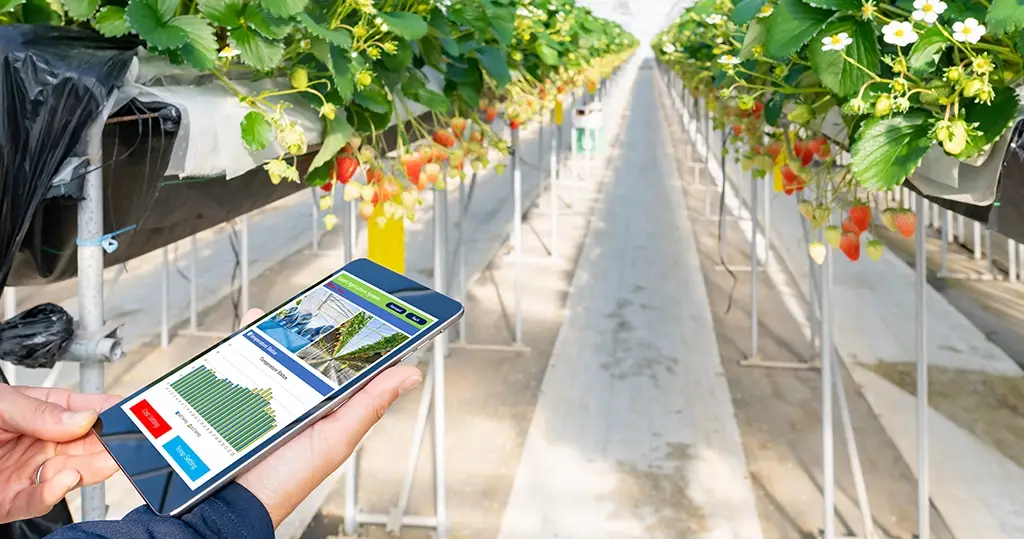
Why Shop HydroBuilder for Grow Room Technology
HydroBuilder carries the complete ecosystem for AI-ready grow rooms — TrolMaster, AC Infinity, Growlink, and Agrowtek — alongside the sensors, expansion modules, and cables to build integrated stacks rather than isolated components. Commercial accounts get dedicated support for equipment sizing, cross-brand compatibility questions, and sourcing across controllers, sensors, and cameras.
Our Learning Center covers the foundational workflows that make AI tools productive:
VPD management, automated fertigation, and crop steering protocols are the data infrastructure your AI stack learns from.
100% Secure Shopping | Commercial Accounts Available | Largest Selection of Grow Room Technology
Example: FAQs
Q: What is a smart grow room and where does AI fit in?
A smart grow room uses networked sensors and a controller to manage lights, HVAC, CO₂, and irrigation, with cloud or app-based logging for data history. AI sits on top to add forecasting, anomaly detection, and optional computer-vision canopy scouting. It enhances an existing control stack — it does not replace it.
For AI to function, three things must be in place: calibrated sensors in correct positions, continuous timestamped logging, and a stable network connection. Without all three, AI analysis produces unreliable output regardless of the software platform. For commercial facilities, this means the AI-readiness investment is primarily sensor infrastructure and logging discipline — the controller and software components are secondary.
Commercial application: The fastest path to AI value in a multi-room facility is anomaly detection on existing controller data. If your rooms are already logging continuously, you may be 30–90 days of baseline establishment away from actionable anomaly alerts without any new hardware.
Q: What AI features actually help commercial cannabis growers right now?
The four working use cases are computer-vision canopy scouting, predictive irrigation, VPD forecasting, and anomaly detection. Anomaly detection and VPD forecasting are the most accessible because they require only a well-configured controller and clean logging. Predictive irrigation requires media sensors. Vision scouting requires a dedicated AI camera.
In terms of ROI sequencing, anomaly detection delivers value fastest (day one, no new hardware required if logging is already established). Predictive irrigation has the highest per-pound yield impact in rockwool and coco systems where dry-down precision drives flower quality. Vision scouting has the highest labor-savings potential in large rooms with historically manual scouting workflows.
Commercial application: Facilities above 5,000 sq ft with documented pest pressure or irrigation inconsistency across zones typically see the fastest return on the full AI stack.
Smaller single-room operations see the fastest return from anomaly detection and VPD forecasting alone.
Q: Will AI increase my yield?
AI doesn’t directly increase yield — it improves the precision and consistency of the conditions that drive yield. Reduced environmental variance, earlier anomaly detection, and tighter irrigation steering produce more consistent canopy development and lower crop loss rates. Early controlled environment agriculture studies suggest energy efficiency gains in the 10–20% range for HVAC under AI-assisted climate control, with results varying by baseline efficiency and facility design.
The clearest yield-adjacent mechanism is catching problems earlier. A pest population identified at detection threshold via AI vision scouting requires significantly less intervention than one caught at visible damage. A dehumidifier failure identified 48 hours early by anomaly detection prevents a humidity spike; the same failure caught manually 12 hours later may require an emergency defoliation and a lost week of canopy recovery.
Commercial application: Track pre-AI versus post-AI consistency metrics: room-to-room variance in finished weights, percentage of crop meeting top-tier grading criteria, and outlier plant frequency per harvest. These are the signals that show AI ROI — not raw yield per se.
Q: Do I need special hardware for AI in my grow room?
For anomaly detection and VPD forecasting, no new hardware is required if you already have a data-logging controller and calibrated sensors. For computer-vision scouting, a dedicated AI grow camera (such as the AC Infinity SPECTRON) is required. For predictive irrigation, media moisture and EC sensors are needed if not already installed.
The principle: AI is as good as its data inputs. Audit sensor coverage and logging continuity before purchasing AI-specific hardware. Unstandardized sensor placement and calibration gaps will limit AI performance regardless of the software layer on top.
Q: What CO₂ level is dangerous in a grow room?
The ASHRAE/IAQ guideline flags 1,000 ppm as a threshold to investigate indoor air sources. NIOSH and OSHA both set 5,000 ppm as the 8-hour TWA ceiling. At 10,000 ppm, cognitive impairment begins. At 40,000+ ppm, oxygen displacement becomes dangerous. Standard grow room enrichment targets (1,200–2,000 ppm for flower) are safe with proper ventilation, but sealed room equipment failures can push levels to dangerous thresholds in under 10 minutes depending on room volume and dosing rate.
Dedicated CO₂ alarm and interlock systems — independent from your primary environmental controller — are non-negotiable in sealed rooms running CO₂ supplementation. AI anomaly detection is not a substitute: it detects patterns in data it can see, but is not a life-safety system and does not replace hardwired CO₂ alarms.
Q: Is grow room AI only for cannabis?
No. Most AI tools deployed in indoor cultivation are crop-agnostic and are already running across leafy greens, herbs, vine crops, and floriculture. Cannabis adopted these tools early because the value per square foot justified the infrastructure investment. The same VPD forecasting, predictive irrigation, and anomaly detection workflows apply directly to any high-value greenhouse crop.
Expanded: The practical difference is that cannabis cultivation typically runs tighter VPD targets and more aggressive crop-steering protocols than most other controlled environment crops — meaning AI tools calibrated for cannabis are generally over-capable for other crops rather than under-capable. If anything, the ROI case is faster in cannabis because the margin-per-pound justification is clearer.
Q: How do I calibrate grow room sensors for AI accuracy?
Calibrate temperature and RH probes every 90 days minimum, comparing against a calibrated reference device and replacing any probe showing drift beyond ±2°F or ±3% RH. CO₂ sensors should be calibrated every 6 months. Media moisture and EC probes should be cleaned and recalibrated each crop cycle, as substrate residue degrades accuracy faster than time. All sensors should be positioned at canopy height, away from direct HVAC airflow and lighting heat sources.
Sensor placement is as important as calibration interval. A perfectly calibrated probe positioned in a dead air zone or directly under a dehumidifier exhaust will produce data that is accurate for that microspot but meaningless for canopy management. AI anomaly detection learns from whatever data your sensors provide — placement errors become permanent model biases.
Q: How does predictive irrigation work in a grow room?
Predictive irrigation models learn a crop’s dry-down patterns from media moisture and EC sensor logs, then calculate when and how much to irrigate based on current conditions and historical patterns — rather than fixed schedules. Instead of irrigating at set times regardless of actual substrate moisture, the system recommends pulse timing and volume that matches real plant demand, tightening crop steering and reducing overshoot.
Commercial application: The ROI is clearest in large rockwool or coco-based systems where manual schedule adjustments are labor-intensive. Facilities running 20+ rooms with fixed irrigation schedules typically see the most immediate impact — the per-room optimization that would otherwise require a dedicated cultivation manager per zone can be partially automated.
Q: What's the difference between TrolMaster and Growlink for AI?
TrolMaster’s strength is hardware data density — the Hydro-X Pro’s proprietary RJ12 sensor ecosystem supports up to 50 sensor inputs per controller, and the room + media data combination (Hydro-X + Aqua-X) creates a rich dataset for anomaly detection and predictive irrigation. Growlink’s strength is cloud data architecture and lighting control — its historical trend archives and stage-based lightLINK dimming recipes make it better suited to facilities where lighting management and cloud accessibility are the primary AI-adjacent workflows.
The two systems are not natively compatible in a unified logging architecture — running both in the same facility means managing parallel data streams. If you need a single integrated dataset across climate, irrigation, and lighting, choose one ecosystem and build within it. If your facility already has Agrowtek infrastructure and wants Growlink’s cloud UX on top, the Agrowtek Integration HUB bridges the two cleanly.
Q: How much does an AI-ready grow room controller system cost?
Entry-level AI-assisted control for a tent or single room (AC Infinity Controller AI+ with soil probe) runs $200–$700. A full TrolMaster environment + irrigation + CO₂ safety stack for a single sealed room typically runs $1,200–$1,800 depending on sensor and module configuration. Multi-room commercial stacks built on Agrowtek GCX with Growlink cloud integration run $5,000–$15,000+ for equipment, plus integrator costs of $2,000–$8,000 for setup and configuration. Sensor infrastructure (probes, cabling, media sensors) adds $500–$2,000 per room at commercial scale.
Commercial application: Budget the sensor buildout and integrator costs explicitly — they’re consistently underestimated in facility planning and are the components most likely to delay AI activation timelines.