
Vapor pressure deficit (VPD) is one of the environmental metrics that most directly controls whether your plants are growing efficiently or just surviving. More than temperature alone, more than relative humidity alone — VPD combines both into a number that tells you the actual drying pressure the air is putting on your plants’ leaves right now.
Get it right, and stomata stay open, transpiration flows steadily, and nutrients move from root to canopy the way they’re supposed to. Get it wrong in either direction, and your plants will compensate — by closing stomata, stalling nutrient flow, and diverting energy away from growth and yield.
Whether you’re running a tent in your spare room or managing multiple flowering rooms at commercial scale, the principles are the same, but the tolerances get tighter as your operation grows.
 Grower Tools
Vapor Pressure Deficit (VPD) Calculator
Dial in temperature and humidity for healthier transpiration and faster growth. Use Simple for quick checks — Advanced adds leaf temp offset and growth-stage targets. Need help? Talk to a Grow Expert.
VPD Calculator
Enter your canopy air temperature and relative humidity. Switch to Advanced to include leaf temperature offset and get growth-stage targets.
How to use this calculator
- Enter air temperature (°F) at canopy height.
- Enter relative humidity (%) at canopy level.
- Advanced: add a leaf temp offset and select your growth stage for target comparison.
- Tap Calculate VPD — your result appears instantly.
- Adjust your environment with humidifiers, dehumidifiers, fans, or AC until VPD is in range.
Target bands: Propagation 0.4–0.8 kPa · Vegetative 0.8–1.2 kPa · Flowering 1.2–1.6 kPa
📊 Interactive VPD Heatmap — See Where You Land Visual ▾
Chart shows VPD across all temperature & humidity combinations.
Your current reading is plotted as a dot — it updates live as you change inputs above.
Hover or tap any cell to see the exact VPD value.
Targets: Propagation 0.4–0.8 · Vegetative 0.8–1.2 · Flowering 1.2–1.6 kPa.
Need help dialing in your environment?
Our grow experts can recommend the right monitors, humidifiers, and controllers for your setup.Use the VPD Calculator above — enter your air temperature and relative humidity at canopy level, and it will show your current VPD in kPa alongside the target range for your growth stage. Switch to Advanced mode to include a leaf temperature offset for greater precision.
What Is Vapor Pressure Deficit?
Vapor pressure deficit is the difference between how much water vapor the air could hold at full saturation and how much it is actually holding — expressed in kilopascals (kPa).
Think of it as the air’s “thirst.” Dry, warm air is very thirsty — it pulls moisture aggressively from leaf surfaces. Humid air is nearly satisfied — it accepts little water vapor from the plant, so transpiration slows or stops.
The formula in simplified terms:
VPD = Saturation Vapor Pressure (SVP) − Actual Vapor Pressure (AVP)
SVP is determined by temperature alone — as temperature rises, air can hold exponentially more water vapor. AVP is determined by relative humidity. When you change either temperature or humidity, you shift VPD, which is why chasing RH alone without knowing your temperature gives you an incomplete and often misleading picture.
How to Calculate VPD — Use Our Free Calculator
The VPD calculator at the top of this page does the math instantly. You don’t need to memorize formulas or work through the equation manually — just enter your current conditions and you’ll have your reading in kPa in seconds.
Simple mode (quick daily checks):
- Enter your air temperature (°F) measured at canopy height — not at the ceiling, not at the sensor mounting bracket on the wall
- Enter your relative humidity (%) at canopy level
- Tap Calculate VPD — your result appears alongside a color-coded indicator showing whether you’re below, within, or above the target range for your selected growth stage
Advanced mode (precision monitoring): Switch to Advanced to add a leaf temperature offset (°F). Leaves typically run 2–4°F cooler than the surrounding air due to evaporative cooling at the stomata. Entering a negative offset (e.g., -3) shifts the calculation to leaf VPD — the actual pressure your plants are experiencing, not just the room air. You can also select your growth stage to compare your result directly against the recommended target band.
Where to place your sensor for accurate readings: Mount your thermometer and hygrometer probe at mid-canopy height, roughly at the level of the upper bud sites. A sensor at ceiling level reads the warmest, driest air in the room — consistently lower RH and higher VPD than what your plants actually experience. A sensor below the canopy reads the cooler, more humid air trapped near the root zone. Canopy height is the only position that gives you actionable data.
Target bands for quick reference:
- Propagation / Seedling: 0.4–0.8 kPa
- Vegetative: 0.8–1.2 kPa
- Flowering: 1.2–1.6 kPa
Why VPD Beats Relative Humidity as a Metric
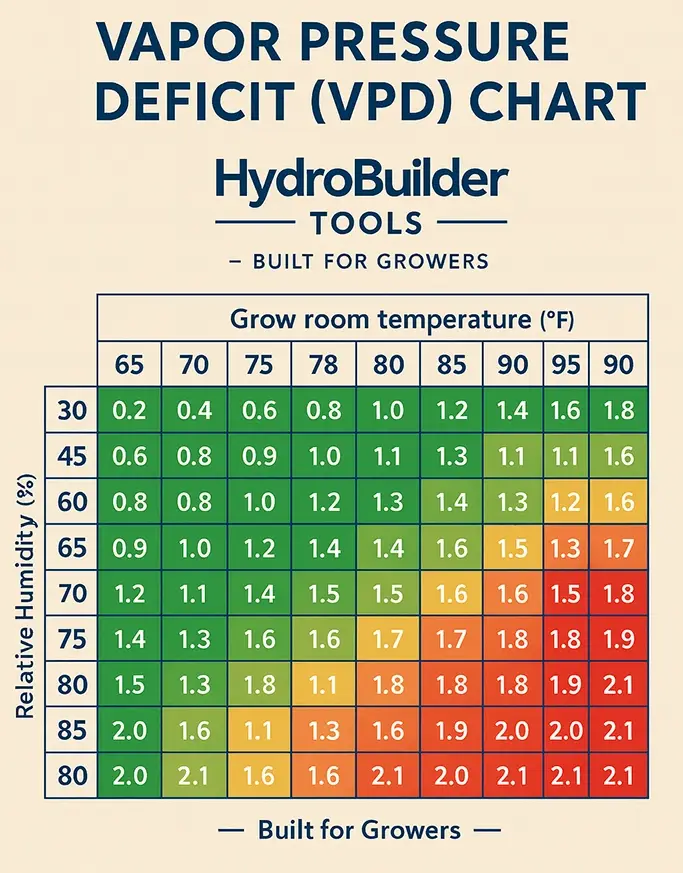
A reading of 60% RH at 65°F is a completely different environment for your plants than 60% RH at 80°F — yet your hygrometer shows the same number in both cases. At 65°F/60% RH, VPD is roughly 0.6 kPa (on the low side for flowering), while at 80°F/60% RH, VPD climbs to approximately 1.3 kPa (right in the flowering sweet spot for many cultivars).
This is why experienced cultivators — and every commercial operation worth its square footage — have shifted from chasing RH numbers to managing VPD directly.
How VPD Affects Plant Growth and Yield
Stomatal Control
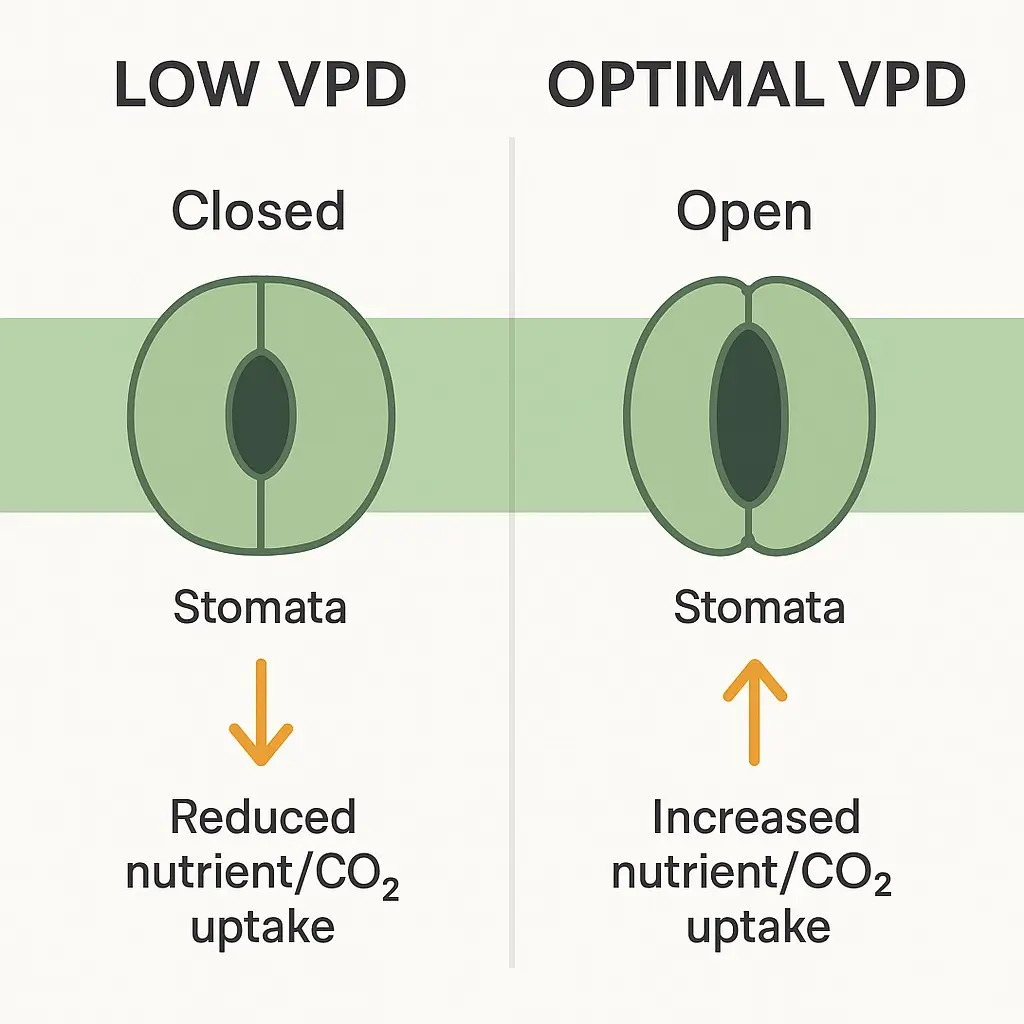
Plants regulate water loss through stomata — microscopic pores on leaf undersides — and VPD is a primary driver of whether stomata open wide, partially close, or shut completely.
- VPD too low (at or below ~0.4 kPa): Air is too humid, so there’s little pressure differential between the saturated interior of the leaf and the outside air. Transpiration slows dramatically, stomata tend to close, and the result is sluggish nutrient uptake, slow growth, increased susceptibility to fungal pressure (Botrytis, powdery mildew), and tip burn from calcium accumulation at growth points.
- VPD in target range: Stomata stay mostly open, water and dissolved minerals move steadily through the plant via the transpiration stream, and the plant can exchange gases — absorbing CO2 and releasing O2 — at the rate photosynthesis demands.
- VPD too high (above ~1.6–1.8 kPa): Transpiration demand can outpace what roots can deliver, so the plant protects itself by closing stomata to conserve water, which stalls photosynthesis, reduces CO2 absorption, and can cause wilting, tip burn, and signs of nutrient excess at leaf margins from concentrated delivery.
The Transpiration Stream and Nutrient Uptake
Transpiration isn’t just about water movement — it’s the primary mechanism that moves calcium, magnesium, and other relatively immobile nutrients from the root zone into growing tissue. Poor VPD management is a common root cause of calcium and magnesium deficiencies that growers often misdiagnose as feeding problems.
If your plants are showing interveinal chlorosis or tip curl despite adequate nutrient solution EC, checking and correcting VPD is often more effective than immediately increasing feed strength.
VPD and CO2 Efficiency
In high-light, CO2-enriched rooms, VPD management becomes even more financially significant. CO2 only generates ROI when stomata are open enough to absorb it, so running CO2 at 1,200–1,500 ppm in a room where VPD is out of range — forcing stomata partially or fully closed — wastes gas on every injection cycle.
Optimal VPD doesn’t just prevent problems; it maximizes the return on every other input you’re spending on, from lighting to irrigation to CO2.
Understanding Leaf VPD vs. Air VPD
The calculator on this page offers two modes for a reason.
Air VPD uses your canopy air temperature and relative humidity, which is a good approximation and faster to measure.
Leaf VPD factors in the actual temperature of the leaf surface, which often runs a few degrees different from the surrounding air because of evaporative cooling or radiant heat. This difference means the vapor pressure inside the leaf is slightly different than it would be at air temperature, which shifts the true VPD the plant is experiencing.
For casual monitoring and trend-checking, air VPD is sufficient, but for dialing in your environment with precision — especially in late flower when disease pressure and trichome development are most sensitive — leaf VPD gives you the actual number the plant is responding to.
How to measure leaf temperature: Use a handheld infrared (IR) thermometer pointed at the upper leaf surface at canopy height, away from stems and buds. Take several readings across the canopy and use the average; in a well-circulated room under LED, leaves often run 2–4°F cooler than air, while under very high radiant heat (HPS, CMH) they may run slightly warmer.
Advanced mode in the calculator accepts your leaf temperature offset directly; enter a negative value (for example, -3 for leaves 3°F below air temp) and the result automatically corrects to leaf VPD.
VPD Targets by Growth Stage
Different stages of plant development require different VPD environments, and the ranges below are established targets for cannabis cultivation. Adjust toward the higher end of each range under elevated CO2 and with mature root systems capable of high water delivery.
| Growth Stage | Air Temp (°F) | RH (%) | Target VPD (kPa) |
|---|---|---|---|
| Propagation / Seedling | 72–78 | 70–80% | 0.4–0.8 |
| Early Vegetative | 75–82 | 60–70% | 0.8–1.0 |
| Late Vegetative | 75–82 | 55–65% | 0.9–1.2 |
| Early Flower (Weeks 1–3) | 75–80 | 50–60% | 1.0–1.3 |
| Mid Flower (Weeks 4–6) | 73–78 | 45–55% | 1.2–1.5 |
| Late Flower / Finish (Weeks 7+) | 70–76 | 40–50% | 1.4–1.6 |
A note on stage transitions: Moving VPD incrementally — in gradual shifts of about 0.1–0.2 kPa between stages — is less stressful than abrupt jumps. Plants under consistent environmental pressure tend to harden appropriately, while plants experiencing rapid swings often show the same symptoms as VPD extremes.
Propagation and Seedling (0.4–0.8 kPa)
Young plants and fresh cuttings have undeveloped root systems that cannot yet deliver water at a high rate. Low VPD keeps transpiration demand minimal, allowing foliage to remain turgid while roots establish, which is why high RH targets at this stage (70–80%) are common.
A dome over propagation trays is not just for warmth — it maintains the localized high-humidity microclimate that new cuttings depend on, and as roots develop and dome venting begins, VPD naturally rises toward vegetative targets.
Vegetative Growth (0.8–1.2 kPa)
Established plants with developed root systems can handle — and benefit from — increased transpiration demand. VPD in the vegetative range drives active water and nutrient flow, supporting rapid cell expansion and structural development.
At the higher end of vegetative VPD (around 1.0–1.2 kPa), calcium delivery into new growth is particularly efficient, so for cultivars prone to calcium deficiency under high light intensity, maintaining the upper vegetative VPD range can reduce or prevent problems before they appear.
Flowering Stage (1.2–1.6 kPa)
As plants transition into flower, two competing priorities shape VPD management: driving late-stage bulking through active transpiration and reducing disease risk as bud density increases.
Lower RH in flower (roughly 40–55%) serves both goals, keeping VPD in a productive range while reducing the surface moisture that Botrytis cinerea (bud rot) requires to establish, which is especially important in dense, tight cultivars where airflow through the canopy is limited.
In late flower (weeks 7+), some cultivators deliberately push VPD toward the upper end of the range (about 1.4–1.6 kPa) to drive final mineral deposition, slightly dehydrate leaf tissue, and encourage trichome development — a form of environmental finish steering. This should only be done when roots are robust and irrigation is dialed in, because the margin for stress-induced lockout is narrow at these levels.


Night-Cycle VPD Management
Most VPD guides focus on lights-on conditions and leave night management as an afterthought, which is a meaningful gap for commercial operations running precision environments.
When lights go off, room temperature typically drops 5–10°F, and if RH remains unchanged, VPD often falls dramatically — sometimes below 0.5 kPa — creating overnight conditions that encourage pathogen pressure and slow the plant’s ability to rehydrate appropriately before the next light cycle.
Night VPD targets:
- Propagation: approximately 0.5–0.7 kPa
- Vegetative: approximately 0.7–0.9 kPa
- Flower: approximately 0.9–1.2 kPa
To maintain these ranges through the dark period, you need to actively manage humidity alongside temperature, which typically means the dehumidifier runs during the transition to lights-off and the early dark period, not just at peak transpiration during the day. Automated controllers with separate day/night setpoints handle this automatically, which is one of the strongest practical arguments for environmental automation in any operation running more than a few lights.
How to Adjust VPD in Your Grow Room
Once you’ve taken a VPD reading (using the calculator above), adjustment follows straightforward logic: you have four levers — dehumidification, humidification, cooling, and heating. In most real-world grows, RH is the faster and more practical lever, because temperature adjustments affect the entire room and interact with CO2, HVAC load, and plant metabolism in ways that make them slower to fine-tune.
VPD Is Too Low (Air Too Humid)
Immediate actions:
- Run dehumidification — and add capacity if your existing unit cannot hold the target RH under peak transpiration load.
- Increase airflow across the canopy to prevent humid microclimates at dense bud sites.
- Slightly increase room temperature (1–3°F) if RH correction alone is insufficient.
Common causes of chronically low VPD: undersized dehumidification for the lighting load, high plant density without adequate canopy airflow, or irrigation runoff/open reservoirs adding moisture load that the dehumidifier cannot keep pace with.
Quest Dehumidifiers — Quest’s overhead dehumidifiers are widely used in commercial grows, with the 225 pint/day unit appropriately sized for many single-room operations in the roughly 2,000–3,000 watt range under typical indoor cannabis conditions, and larger 335–746+ pint models available for higher total moisture loads in large commercial spaces. Sizing guidance: use about 1 pint of nominal capacity per 100 watts of lighting as a baseline, then add 20–30% for plant transpiration load in dense canopy and adjust further for local climate and infiltration.
For full dehumidifier sizing methodology, see our grow room dehumidifier sizing guide.
VPD Is Too High (Air Too Dry)
Immediate actions:
- Add humidification — ultrasonic units respond quickly, while steam-based units are more consistent in very large spaces.
- Lower room temperature if possible (reduce HVAC setpoint or adjust lighting schedule if conditions are severe).
- Check that exhaust rates are not pulling too much dry air in from outside the room during hot/dry conditions.
AirGrean UltraSonic Humidifier — Available in 150, 300, and 600 pint/day configurations (capacity ratings based on 24-hour operation under standard conditions; actual output varies with room RH and temperature). Ultrasonic units produce fine cool mist that disperses quickly and does not raise room temperature the way steam humidifiers do, making them particularly compatible with LED-lit rooms where radiant heat is lower.
Environmental Monitoring — Know Your Numbers Before You Adjust
You can’t manage VPD without accurate, canopy-level readings of both temperature and relative humidity. A sensor zip-tied to a tent pole two feet above the canopy is giving you an approximation, not actionable data for crop steering.
AC Infinity Handheld Leaf VPD & Temperature Monitor — Measures both air temp/RH and leaf surface temperature simultaneously, calculating leaf VPD directly and making it useful for spot-checks at canopy level and for calibrating fixed sensor positions in larger rooms.
For ongoing monitoring and automated setpoint control, pair environmental sensors with a dedicated controller.
TrolMaster Hydro-X Environmental Control System — The Hydro-X monitors temperature, humidity, and light levels from a single 3-in-1 canopy sensor and controls dehumidifiers, humidifiers, fans, heaters, and ACs on independent day/night setpoints. For operations that have already experienced one preventable mold outbreak or significant VPD deviation event, the ROI on automation is usually straightforward once you account for crop value and labor savings compared with manual adjustment.


VPD Troubleshooting: Real-World Scenarios
Scenario 1: Low VPD During Lights-Off, Fine During Day
Reading: Day VPD 1.2 kPa (target range) | Night VPD ~0.3–0.4 kPa (too low).
Cause: Temperature drops more than 10°F at lights-off and the dehumidifier is not maintaining RH in the dark period because transpiration demand has dropped and the unit is cycling off.
Fix: Set dehumidification to maintain a minimum RH target overnight — for example, holding about 50–55% RH in flower typically keeps night VPD in the 0.8–1.0 kPa range at common night temperatures. A controller with separate day/night humidity setpoints handles this automatically.
Scenario 2: Correct RH Reading, But Plants Showing Calcium Deficiency
Reading: 55% RH at 78°F = VPD ~1.3 kPa (looks fine on paper).
Investigation: The sensor is mounted at the ceiling, not at canopy level; in a dense flowering room with limited airflow, microclimates between bud sites may be running closer to 65% RH, which corresponds to a VPD around 0.7–0.8 kPa locally.
Fix: Move sensors to canopy height and add oscillating fans or through-canopy airflow to break up humid pockets. VPD uniformity across the canopy is as important as the average reading.
Scenario 3: Tip Burn Appearing in Late Vegetative Under High Light
Reading: 72°F/60% RH = VPD ~1.0 kPa (appears correct based on air data).
Investigation: Under high-intensity LED at close canopy distance, leaf surface temperature may be several degrees above air temperature due to radiant heating rather than net evaporative cooling, so leaf VPD could be significantly higher than air VPD suggests.
Fix: Measure leaf surface temperature with an IR thermometer, raise lights slightly or reduce intensity if the canopy is showing heat stress, or lower air temperature to compensate. This is why Advanced mode in the calculator accepts leaf temperature input.
For Commercial Operations: Scaling VPD Precision
Hobby growers can often get away with manual monitoring and reactive adjustments, but at commercial scale — multiple flowering rooms, automated irrigation, crop steering protocols — VPD becomes a precision KPI that should be logged, trended, and controlled automatically.
Multi-Zone Monitoring
A single controller managing a 5,000 sq ft facility through one sensor is a liability, because environmental conditions vary by position: proximity to HVAC supply/return, canopy density gradients, lighting coverage uniformity, and structural air leakage all create zone-specific VPD conditions.
The TrolMaster Hydro-X PRO supports multi-zone sensor networks and logs historical data for trend analysis — exactly the kind of environmental record-keeping increasingly required for licensed facility compliance documentation.
VPD and Crop Steering Integration
Commercial operators running data-driven crop steering programs use VPD as a key generative/vegetative steering variable alongside EC, irrigation frequency, and dryback targets. In vegetative steering phases, maintaining the lower end of the target VPD range encourages cell expansion, while in generative phases, pushing VPD toward the upper range (combined with reduced irrigation frequency and higher EC) drives more generative behavior in many cultivars.
This integration of environmental and irrigation parameters is what separates outcome-predictable, consistent commercial harvests from variable ones. For a complete look at how these variables interact, see our guide to irrigation and fertigation automation for crop steering.
Dehumidification Capacity Planning for Commercial Facilities
Commercial dehumidifier selection must account for total moisture load — not just lighting watts. Key inputs include:
- Lighting load: Use 1 pint/day per 100W of lighting as a baseline starting point.
- Plant transpiration: Add roughly 20–30% for mature canopy in full flower, and up to ~40% in very high-density SOG or multi-tier systems.
- Infiltration: Facilities in humid climates need additional capacity for unconditioned air entering the space.
- Night cycle management: Dehumidifiers must handle the transition load when lights cycle off and transpiration drops abruptly, preventing RH spikes.
Quest’s overhead ducted dehumidifiers are designed for integration into sealed-room HVAC designs, with the 225 pint/day unit appropriate for rooms with roughly 2,000–3,000W of lighting under typical indoor cannabis conditions and larger rooms scaling through 335, 506, and 746+ pint options as total moisture load increases.
For a complete facility sizing walkthrough, see our grow room dehumidifier sizing guide.
VPD and Heat Stress: When High Temperatures Break the Model
Under extreme heat events — room temps above about 85°F — standard VPD management becomes insufficient on its own. At these temperatures, even moderate RH may produce technically acceptable VPD readings, but the metabolic stress from heat independently suppresses photosynthesis and accelerates degradation of terpenes and cannabinoids.
For LED-lit rooms, above-canopy temperatures consistently above roughly 82–84°F are a signal to check HVAC capacity rather than adjusting VPD alone, because heat stress and VPD stress compound one another. See our guide to heat stress in plants for diagnosis and correction protocols.
Why Shop Environmental Equipment at HydroBuilder
HydroBuilder is a co-op-based distributor with direct purchasing relationships with Quest, TrolMaster, and AC Infinity — leading brands in professional grow room environmental control — so you get authentic gear backed by manufacturer warranties. You also gain access to technical support from growers who use this equipment in real facilities, which is critical when dialing in commercial environments.
Our team works directly with commercial operators, co-op partners, and equipment manufacturers, giving us visibility into what actually performs in production environments rather than just what looks good in a spec sheet.
Additional Resources
- Grow Room Dehumidifier Sizing Guide — capacity calculations for commercial rooms.
- Beginner’s Guide to CO2 Supplementation — why VPD management is a prerequisite for CO2 ROI.
- Irrigation and Fertigation Automation for Crop Steering — integrating VPD with irrigation data.
- Indoor Grow Room and Tent Ventilation Setup — airflow as a VPD management tool.
VPD: FAQs
What is VPD and why does it matter for growing cannabis?
VPD — vapor pressure deficit — measures the drying pressure the air exerts on your plants’ leaf surfaces, expressed in kilopascals (kPa), and it directly influences whether stomata stay open or close. Open stomata allow active transpiration, nutrient flow, and CO2 absorption, while closed stomata stall growth regardless of how well other variables are dialed in.
VPD gives you a single number that accounts for both temperature and humidity together, whereas chasing relative humidity alone without considering temperature can lead to conditions that look acceptable on paper but are limiting your plants in practice.
What is the ideal VPD for cannabis at each growth stage?
Target VPD varies by stage: propagation and seedlings generally perform best around 0.4–0.8 kPa (high humidity, moderate temps), vegetative growth targets about 0.8–1.2 kPa, and flowering typically ranges from roughly 1.0–1.3 kPa in early flower to about 1.4–1.6 kPa toward the end. The lower RH required in late flower (about 40–50%) also helps reduce Botrytis risk as bud density increases.
These are starting ranges — you can adjust toward the upper end under elevated CO2 (roughly 1,200+ ppm) and with mature, well-developed root systems capable of meeting higher transpiration demand.
Should I use leaf temperature or air temperature to calculate VPD?
Leaf temperature gives a more accurate result because leaves often run a few degrees different from the surrounding air due to evaporative cooling or radiant heating, which changes the saturation vapor pressure at the leaf surface. That difference means the VPD the plant actually experiences can deviate from what air-temperature-based calculations suggest.
For daily checks, air temperature VPD is a reasonable approximation, but for late-stage flower, propagation tuning, or diagnosing persistent environmental problems, measure leaf temperature with an IR thermometer and use the offset in the calculator’s Advanced mode.
How do I raise VPD in my grow room?
Raise VPD by reducing relative humidity, increasing temperature, or both, with running a properly sized dehumidifier usually being the fastest lever in most grows. A Quest overhead dehumidifier sized for your lighting load can typically drop RH by 10–15 percentage points within a reasonable time window around a lights-on transpiration peak when room airflow and ducting are correct.
Increasing air circulation also raises effective VPD at the leaf surface by breaking up localized humid microclimates in dense canopy areas.
How do I lower VPD in my grow room?
Lower VPD by adding humidity (running a humidifier), lowering room temperature (adjusting AC setpoints), or reducing exhaust rate if dry outside air is contributing to high VPD. Ultrasonic humidifiers respond quickly and do not add heat load; AirGrean’s ultrasonic units are a good fit for LED-lit rooms because they produce cool mist, whereas steam humidifiers add heat that can compound the problem under high-intensity lighting.
Why is my VPD correct on average but my plants still show stress signs?
Averages can hide microclimates, so a sensor mounted above the canopy or near the room center may read 55% RH while dense bud sites mid-canopy sit at 65–70% RH with minimal local airflow. If tip burn, calcium deficiency, or mold appears in specific canopy zones, the issue is usually localized VPD deviation rather than the room-average VPD.
Move monitoring sensors to canopy height and audit airflow across dense areas to ensure you are steering the environment the plants actually experience rather than just the room center.
Does VPD affect CO2 supplementation efficiency?
VPD affects CO2 supplementation efficiency directly because CO2 is absorbed through stomata, which close when VPD is too high or too low. Running CO2 at 1,200–1,500 ppm without VPD in the target range means stomata are not open enough to utilize it effectively, so much of that CO2 is wasted.
Dial in VPD first, then assess whether CO2 supplementation is delivering the yield response you expect for the cost and complexity of running it.
What VPD should I target at night when lights are off?
Night VPD targets are generally lower than daytime targets because transpiration slows without photosynthesis driving it, with typical starting points around 0.7–0.9 kPa in veg and roughly 0.9–1.2 kPa in flower. In practice, you maintain these by actively managing RH as the room cools, since many dehumidifiers will cycle off at night as transpiration drops and allow RH to climb unless you set a minimum humidity target or use a controller with separate night setpoints.
What equipment do I need to monitor and control VPD?
At minimum, you need a calibrated sensor at canopy height measuring temperature and RH, and if precision is a priority, an IR thermometer for periodic leaf-surface temperature checks. For automated control, an environmental controller like the TrolMaster Hydro-X ties these readings to relay-controlled dehumidifiers, humidifiers, and fans, maintaining VPD targets continuously without manual intervention.
Commercial operations should log environmental data so they can identify trends and catch drift before it costs them a harvest.
Can VPD management affect terpene and cannabinoid development?
VPD influences terpene and cannabinoid outcomes primarily through its effect on transpiration intensity and mild stress in late flower, when many cultivators steer toward the upper end of the VPD range. Higher-VPD finishes in the ~1.4–1.6 kPa range, combined with controlled dryback in the root zone, are a form of generative crop steering that many growers report associating with denser trichome development and stronger aromatic profiles, although results vary by cultivar and overall program.
This approach requires well-established root systems and dialed-in irrigation; attempting a high-VPD finish on plants already under water or nutrient stress will typically compound problems rather than improve quality.