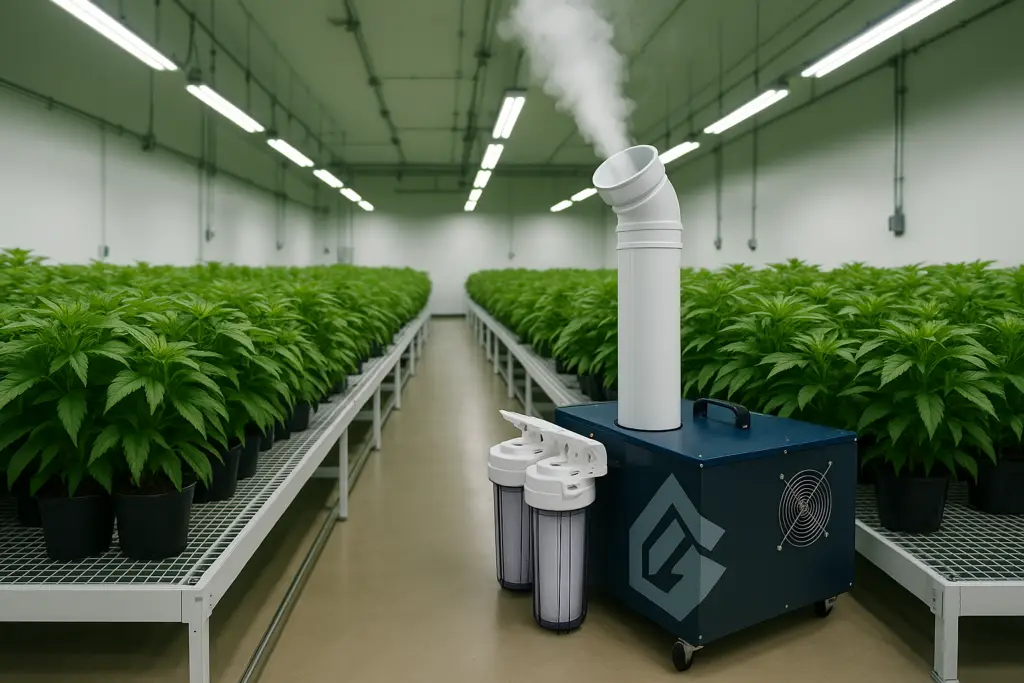
Maintaining the right humidity is one of the highest-leverage things you can do for plant health — and one of the easiest to get wrong. The best grow room humidifier for your setup is the one sized correctly for your actual moisture deficit, not just your square footage, and matched to your room’s air exchange, temperature, and control strategy. This guide covers how to size a unit as precisely as most growers need, which humidifier types work best in grow environments, and the top picks from tent to commercial facility.
Not sure what you need? Use the Grow Room Humidifier Sizing Calculator above to get your approximate output requirement in L/hr and PPD before you buy anything, then cross-check against manufacturer specifications.
Whether you’re running a single 4×4 tent or managing humidity across multiple cultivation bays, the principles below apply — though commercial operators will find dedicated guidance in the For Commercial Operations section.
Do You Actually Need a Humidifier?
Before buying anything, monitor your RH against the targets for your growth stage, ideally alongside canopy temperature so you can track VPD.
Target RH by stage (assuming typical mid-70s °F canopy temperatures):
- Seedlings/Clones: 70–80% RH
- Vegetative: 55–70% RH
- Early Flower: 50–60% RH
- Late Flower: 40–50% RH (lower late flower to reduce pathogen pressure)
If you’re consistently running below these ranges under your normal operating temperatures, a humidifier can help bring conditions into range; if you’re consistently at or above target, skip humidification and focus on dehumidification and airflow. If RH swings 10% or more between lights-on and lights-off, an environmental controller with day/night setpoints is as important as the hardware.
Low humidity symptoms before you reach for a humidifier: leaf edge curl, papery texture, tight stunted internodes despite healthy feeding, media drying faster than normal. These are signs your plants may be restricting stomatal opening to conserve moisture, which reduces CO₂ uptake and slows growth.
Quick checks first: Reduce unnecessary air exchanges, verify your intake/exhaust schedule, or seal tent leaks before sizing equipment. In many cases, the apparent “humidity problem” is primarily a ventilation problem in disguise.
How to Size a Grow Room Humidifier
The correct sizing approach accounts for your actual moisture deficit and ventilation, not just your tent’s square footage. Here’s what matters most:
The variables:
- Room volume (L × W × H)
- Temperature at canopy — warmer air holds more moisture, so the same RH deficit requires more moisture per cubic foot at 85°F than at 70°F
- Current vs. target RH — the gap between these gives your moisture deficit in g/m³ or grains/lb
- Air exchange rate (ACH) — every air change exports humidity; higher ACH means higher humidification demand
- Light type — HID/HPS generally generates more heat than equivalent LED setups, increasing evaporation and affecting moisture balance indirectly
The conceptual formula:
Moisture deficit (g/m³) × Room volume (m³) × ACH × light/operation factor ÷ 1000 ≈ Minimum L/hr required, under the assumptions used in the calculator.
Add roughly 20–25% headroom buffer so the unit is not pinned at 100% capacity during peak demand, especially in well-ventilated rooms.
These ranges are illustrative; actual needs depend strongly on temperature, ACH, and crop load. Use them as a rough starting point and confirm with the calculator and product specifications.
PPD ↔ L/hr conversion: 1 L/hr ≈ 50.7 PPD (1 L/hr × 24 hr/day × 2.113 pints/L). A 600 PPD unit requires approximately 11.8 L/hr of continuous output. Use the calculator above or a psychrometric tool for more precise planning in commercial settings.
For the most accurate result — especially in well-ventilated rooms or commercial environments — use the sizing calculator embedded at the top of this page and, for large projects, consult HVAC or mechanical design data. Enter your dimensions, temperature, current RH, and ACH for an output requirement you can cross-reference with manufacturer ratings.
Ultrasonic vs. Evaporative vs. Steam: Which Type Is Best?
Ultrasonic humidifiers are the dominant choice in grow rooms, and for good reason. They produce ultra-fine cool mist via high-frequency vibration, respond quickly to RH changes, and typically add very little sensible heat to the room compared to steam or boiler-based systems. The tradeoff is that they perform best with clean (ideally RO or distilled) water to minimize mineral “white dust” that can settle on leaves, equipment, and filters over time.
Evaporative humidifiers (wick or drum designs) have a natural self-limiting characteristic — as RH rises, the evaporation rate slows, making overshoots less likely. They are generally more tolerant of tap water than ultrasonics and often have simpler maintenance profiles, though they introduce airflow and filter/wick replacement as ongoing considerations. The downsides are slower RH response, potential fan noise, and periodic media replacement costs.
Steam or central fogging systems offer very high output capacity and integrate well with building-level climate control and high-ACH facilities. The tradeoff is higher power draw, more complex installation, and safety considerations around hot steam and water near electrical equipment. These systems are best suited for controlled environment agriculture at scale rather than hobby tents.
The verdict for most growers: Ultrasonic units are a strong fit for tents and grow rooms where you can control water quality and maintenance. Evaporative humidifiers make sense when simplicity and forgiving water requirements are more important than rapid response, while steam and central fogging systems are geared toward commercial CEA facilities with engineered HVAC and central controls.
Best Grow Room Humidifiers by Size
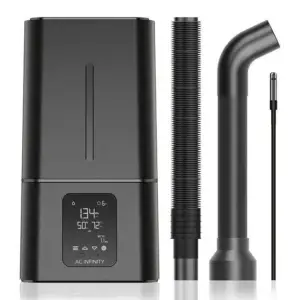
Small Tents (2×2 to 4×4) — AC Infinity CLOUDFORGE
For tent growers, the AC Infinity CLOUDFORGE is a well-rounded solution in the compact category. It uses EC ultrasonic technology to produce fine mist, offers smart controls and integration with the AC Infinity UIS ecosystem, and is designed to support plant growth through multiple stages with relatively quiet operation. The top-fill design simplifies daily maintenance in tight spaces; follow the manufacturer’s instructions for filling and routing hoses to avoid internal water pooling.
Works well in: 2×2–4×4 tents, clone rooms, seedling areas, early veg when sized and controlled appropriately
Controller integration: Compatible with AC Infinity UIS ecosystem and app-based controllers for automated humidity/VPD management
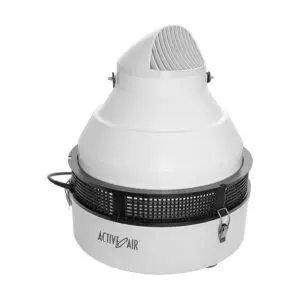
Mid-Size Rooms (4×8 to 10×10) — Active Air Commercial Humidifier
Scaling up from tent to dedicated grow room means needing a unit that can sustain output over 8–12+ hours without constant attention. The Active Air Commercial Humidifier covers many mid-size operations, with models rated up to approximately 75 PPD and 200 PPD output depending on the specific unit. It is built for continuous-duty grow environments, has a multi- or directional fogging outlet for canopy-level distribution, and supports direct water connection for reduced manual filling.
Works well in: 4×8 to 10×10 rooms and similar multi-light setups when output ratings are matched to calculated demand
Placement tip: Position the fog outlet so mist is introduced into circulating airflow, not directly at the canopy or light fixtures, to encourage uniform distribution and avoid localized wetting.
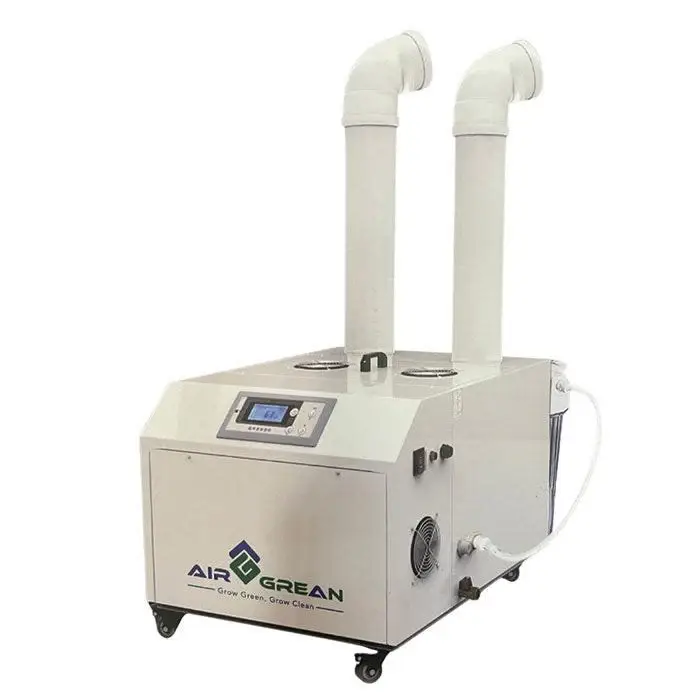
Large Facilities — AirGrean UltraSonic Humidifier
For operations managing multiple bays or rooms above roughly 1,000 ft³, the AirGrean UltraSonic Humidifier provides higher output capacity and commercial build quality to scale. AirGrean’s ultrasonic units are available in approximately 150, 300, and 600 PPD configurations, are typically caster-mounted for easy repositioning, and are designed for continuous-duty operation in production facilities. The 600 PPD model can be particularly effective in veg bays where maintaining 60–65% RH at canopy level is part of the strategy for rapid growth, assuming the system is properly sized and integrated with dehumidification and control.
Use RO or similarly low-mineral water in all AirGrean units, as mineral buildup in high-output ultrasonics speeds transducer wear and gradually reduces output if not managed.
Works well in: Facilities roughly 1,000–10,000+ ft³, multi-room operations with appropriate zoning and controls
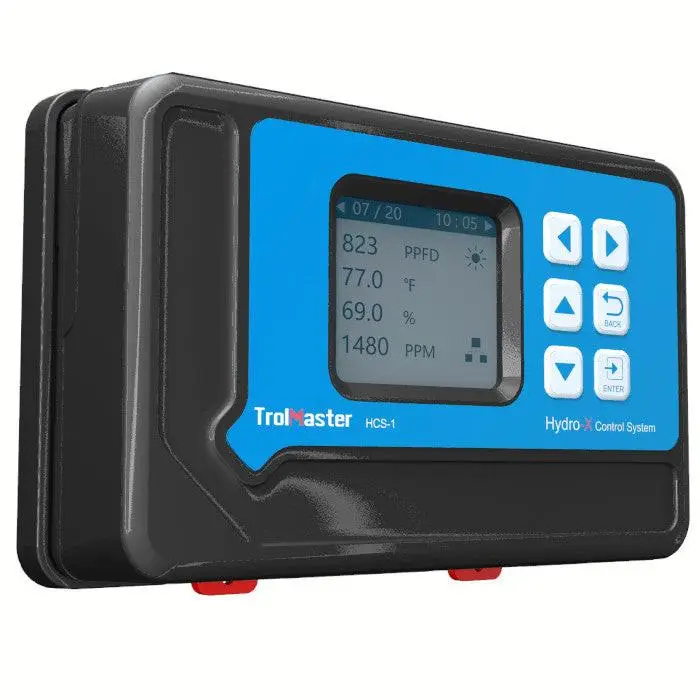
Controller pairing: TrolMaster Hydro-X or similar environmental systems for automated setpoint control and monitoring
Water Quality: The Factor Most Growers Overlook
For ultrasonic humidifiers, water quality directly affects equipment longevity, maintenance frequency, and air cleanliness.
Tap water issues: Municipal tap water often contains dissolved calcium, magnesium, and other minerals, plus residual disinfectants. In ultrasonic units, these minerals are atomized along with water into a fine aerosol, which can settle out as white dust on leaves, equipment, and light fixtures if mineral content is high. Over time, this residue can contribute to buildup on leaf surfaces and hardware, potentially interfering with light penetration, gas exchange, and sensor performance if not managed.
The solution: RO (reverse osmosis) or distilled water removes most dissolved minerals before they reach the ultrasonic transducer and fogging components. If you’re investing in commercial-grade humidification, it is worth matching that investment with appropriate water treatment; our guide to RO systems for growing plants covers sizing and setup.
If you can’t use RO: Use the highest-purity tap water available, increase cleaning frequency significantly (often weekly rather than biweekly), and monitor closely for early signs of white dust on leaves, equipment, or lenses.
Placement, Control, and Avoiding Overshoot
Placement: Direct the mist outlet above or lateral to the canopy, into a stream of moving air (near an oscillating fan or intake), rather than pointing directly at plant surfaces. Keep the unit elevated off the floor to prevent mist from accumulating in standing water, which increases mold risk.
Controller integration: Running a humidifier solely on its onboard hygrostat or manual settings increases the risk of overshoot. Connect it to an environmental controller with a humidity sensor at canopy height, positioned out of the direct fog stream; a 2–3% RH deadband is a common starting point to minimize short-cycling and controller conflict. The TrolMaster Hydro-X can coordinate both humidifier and dehumidifier control with day/night setpoints, which is critical for handling the RH spike that typically occurs at lights-off.
Lights-off management: RH almost always rises when lights go off because transpiration continues for some time while the heat driving evaporation is reduced. In flower especially, this spike can push RH into powdery mildew risk territory (for example, above about 60% RH at 75°F, depending on airflow and leaf wetness). Program lights-off setpoints 5–10% lower than lights-on targets, and ensure your dehumidifier is sized and controlled to handle the increased load; see our dehumidifier sizing guide for the other side of this equation.
Maintenance schedule:
- Every 1–2 days: Top off water; check for pooling or leaks
- Weekly: Drain and rinse tank; wipe internal surfaces; inspect nozzles or outlets
- Biweekly–monthly: Disinfect with a manufacturer-approved sanitizer such as diluted H₂O₂; rinse thoroughly
- Quarterly (or per manufacturer guidance): Inspect ultrasonic transducers; replace wick/filter media if applicable
Humidity, VPD, and Why RH Alone Isn't Enough
RH percentage is a useful proxy, but vapor pressure deficit (VPD) is the key metric governing plant transpiration and evaporative demand. VPD incorporates both temperature and humidity, so two rooms at 60% RH can behave very differently if one runs cool and the other warm.
For precision crop steering, especially in cannabis cultivation, pair your humidity targets with a VPD chart calibrated to your actual canopy temperature rather than chasing an RH percentage alone. Our VPD guide and calculator walks through the relationship and provides target ranges by growth stage so you can choose humidity setpoints that align with your chosen temperature.
The practical implication: a 10% RH deficit at 65°F has very different effects than the same RH value at 82°F because the underlying VPD is different. Dialing in temperature first — then adjusting humidification to hit your VPD targets — makes humidifier management significantly more predictable.
For Commercial Operations
Commercial cultivation facilities — multi-room cannabis, CEA produce, propagation facilities — face humidity management challenges that differ fundamentally from tent growing in scale, system design, and risk tolerance.
Sizing commercial humidification: A veg facility with roughly 10,000 ft² of canopy, moderate ceiling height, LED lighting, and around 4 ACH at a target of about 65% RH can require 1,000+ PPD of humidification output, depending on the specifics of the design and load. This level of demand is beyond what multiple consumer units should handle and instead calls for dedicated commercial ultrasonic or centralized fogging systems with zone controls.
Scaling with multiple AirGrean units: For facilities segmented by room or bay, multiple AirGrean UltraSonic Humidifiers with individual controller integrations can provide zone-level control without the single point of failure of a fully centralized system. Each unit can run to its own humidity setpoint, allowing veg and flower zones to maintain different RH targets from the same core infrastructure.
Controller architecture: Commercial facilities should rely on dedicated environmental controllers rather than only using humidifier-integrated hygrostats. The TrolMaster Hydro-X and TrolMaster Hydro-X Pro platforms support multi-zone environmental control with humidifier/dehumidifier integration, day/night setpoints, and remote monitoring, which is a practical baseline for serious operations.
RO at scale: At commercial humidification volumes, tap water mineral loading becomes both a maintenance and crop-quality concern. Size your RO system to supply enough purified water for daily humidifier demand plus irrigation, accounting for storage and redundancy; our RO systems guide covers commercial-scale considerations.
HVAC integration: In facilities with centralized HVAC, coordinate humidification design with your HVAC engineer before specifying equipment. Many commercial HVAC systems dehumidify by design, so running active humidification against aggressive HVAC dehumidification wastes energy and increases wear on both systems. For new build-outs, contact our commercial team for system-level consultation and product selection support.
Ideal-Air Pro Series remains a cost-effective option for smaller commercial facilities where one or two higher-output standalone units can cover the full facility when properly sized. The Ideal-Air Pro Series Ultra Sonic Humidifier is available in 150, 300, and 600 PPD configurations, with caster wheels and continuous fill connections to better suit commercial duty cycles.
Why Buy From HydroBuilder?
We’re a grower-focused retailer with over 25,000 products curated for real cultivation environments. Our Learning Center, expert sales team, and commercial accounts program exist because we know that buying the wrong equipment ultimately costs more than delaying a purchase to get the right solution. Every product we carry is one that growers actually use, and our goal is to help match your equipment to your room, not just your budget.
If you’re outfitting multiple rooms or purchasing for a facility build-out, our commercial accounts team can assist with volume pricing, product mix, and coordinating timelines with your construction and commissioning schedules.