

High stress training (HST) is one of the most powerful levers you can pull as a grower. Done correctly, it breaks apical dominance, multiplies your bud sites, can push yield well beyond what an untrained plant can produce under the same conditions, and may increase terpene and cannabinoid density as part of the plant’s stress response in some cultivars. Done incorrectly — or at the wrong time — it adds weeks to your grow and costs you the yield it was supposed to create.
This guide covers every major HST technique: topping, FIMing, defoliation, super cropping, and manifolding. You’ll learn when to apply each one, how to execute them properly, how to layer them together in a progressive regimen, and what recovery actually looks like. The super cropping guide from our standalone article has been fully merged here so everything lives in one place.
Whether you’re training your first indoor plant or tightening up a multi-light production cycle, this is the reference you’ll come back to.
What Is High Stress Training?
High stress training is any technique that physically damages or removes plant tissue to redirect growth energy and break the plant’s natural tendency toward a single dominant cola. Plants exhibiting apical dominance concentrate growth hormones — primarily auxins — at the shoot apex, suppressing lateral branching below it; interrupt that signal, and the plant redistributes energy across multiple growth points simultaneously.
The key distinction from low stress training is the mechanism: LST bends and repositions without wounding, while HST cuts, pinches, or removes tissue. That wound triggers a biological stress response — the plant releases repair hormones, reroutes resources, and often overcompensates in ways that benefit the grower, at the cost of some recovery time. Expect growth to stall for a few days to a week after each session, and budget that time into your vegetative period from the start.
The complete list of HST techniques covered here:
- Topping
- FIMing
- Defoliation
- Super cropping
- Manifolding (mainlining)
HST vs LST: Which Should You Use?
Both categories of training are worth understanding, but they’re not interchangeable. LST is lower risk, keeps growth moving throughout the process, and is well-suited to autoflowers and beginners. HST produces more dramatic structural changes and typically higher yield potential in photoperiod strains when well executed, but it demands healthy plants, precise timing, and adequate recovery windows.
The better question isn’t “which one” but “how do you combine them?” The most productive approach most growers land on is using HST to create structure (multiple colas, horizontal branching) and LST to refine that structure and maintain an even canopy through the rest of veg. We’ll come back to this in the progressive regimen section below.
For a full breakdown of LST mechanics, see our complete low stress training guide.

When to Start High Stress Training
Timing is everything. The right window is during vegetative growth, once the plant is established enough to absorb stress but before the tissue has hardened to the point where manipulation risks snapping rather than bending.
General rules:
- Never start on seedlings — wait until the plant has at least 4–5 pairs of true leaves
- The specific technique dictates the specific timing (detailed under each section below)
- Always work on healthy plants — stressed or deficient plants compound problems, they don’t bounce back well
- Do your training within a few hours of lights-on when metabolic activity is highest
- Keep temperature and RH stable during recovery; environmental swings during the healing window slow the process significantly
Can you HST during flower?
Mostly no. Once you flip to 12/12, the plant’s energy is directed toward bud production, not structural repair. Introducing cutting or pinching stress at this stage risks disrupting development, inducing hermaphroditism under certain conditions, and — with supercropping specifically — snapping branches that are now more rigid and brittle. There are limited exceptions: defoliation is commonly used in early and mid-flower for light penetration and airflow management, and lollipopping lower growth during the first two weeks of flower can concentrate energy at the productive canopy. But broad-scope HST belongs in veg.
Topping — The Best Starting Point for HST
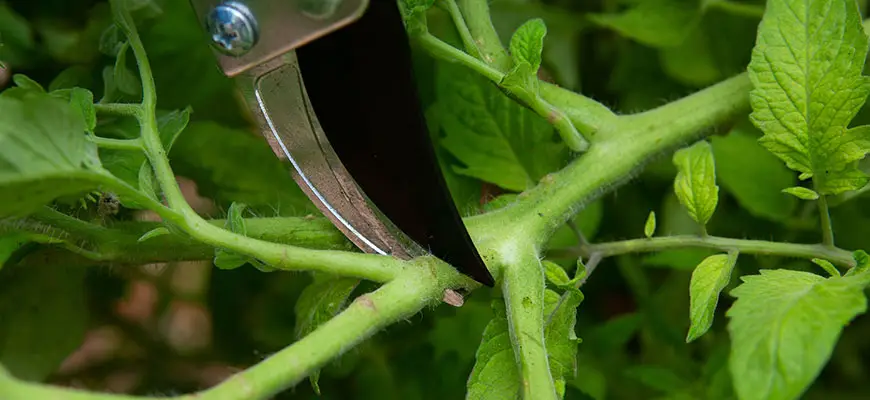
Topping is the simplest HST technique and the right entry point for most growers. All it requires is a clean, sharp pair of scissors or pruners — HBX Titanium Curved Precision Garden Trimming Scissors work well here — and a steady hand.
How topping works: You remove the dominant shoot tip (the apical meristem), which cuts off the auxin signal suppressing lateral growth below it. The two nodes just below the cut immediately receive the redirected energy and shoot upward, giving you two main colas where you had one. Top those two and you have four, top again and you have eight — though there are diminishing returns past a certain point, and each topping adds recovery time.
When to top: Once the plant has 4–5 pairs of true leaves, typically 3–5 weeks into veg for most indoor cannabis plants. Topping too early on fragile seedlings can cause setbacks that outweigh the benefit.
How often: Top as needed to break apical dominance as new dominant shoots emerge. Three to four toppings over the course of veg is a reasonable ceiling for most indoor photoperiod grows; spreading energy across too many colas eventually dilutes bud density rather than multiplying it, and every plant has a genetic yield ceiling.
After topping: Give the plant 5–7 days before any additional high-stress training. Watch the two shoots below the cut for vigorous regrowth — that’s your signal the plant has recovered and is ready for the next manipulation.
FIMing — More Colas Per Cut, Less Precision Required
FIMing is a variation on topping where instead of cleanly removing the shoot tip, you pinch or cut off roughly 70–80% of it — leaving a small stub behind. The name comes from “F*** I Missed,” which captures how it was discovered: an imprecise topping that produced unexpected results.
Why FIMing can outperform topping: Because you’re leaving partial tissue at the cut site, the plant’s recovery response is different. Rather than redirecting energy to two lower nodes, it stimulates the stubs of the partially removed growth point plus multiple lateral sites simultaneously, so a well-executed FIM can produce 3–4 new growth tips per cut compared to topping’s reliable 2.
The tradeoff: FIMing is less predictable. Topping gives you a near-guaranteed two-cola split every time. FIMing gives you a higher ceiling but variable results depending on how much tissue you leave and where exactly you cut. Use sterilized scissors like the HBX Heavy Duty Bypass Pruner for precise cuts.
When to FIM: Same window as topping — 4–5 pairs of true leaves minimum — and typically after the plant has established a strong root system. You can alternate techniques across different training sessions or try both on different plants in the same run to compare outcomes.


Defoliation — Removing Fan Leaves to Open the Canopy
Defoliation is the most continuous HST technique in the stack — it’s not a one-time event but an ongoing garden management task. The goal is removing large fan leaves that are blocking light from lower bud sites or creating dead air zones that invite humidity-related issues like powdery mildew.
What defoliation does:
- Improves light penetration into the lower canopy
- Redirects plant energy from foliage production toward lateral branching and flower development
- Reduces leaf-to-leaf contact, improving airflow and lowering disease pressure
- Helps maintain clear sight lines for scouting pest activity
How much to remove: There’s no universal answer — it depends on plant density, grow light type, and canopy structure. The working principle is to remove fan leaves that are shading productive bud sites without stripping the plant of photosynthetic capacity, because over-defoliation can slow growth and limit yield. Selective removal beats aggressive stripping every time: a defoliated plant should still look like a plant, not a stem.
When: Throughout veg and into the first few weeks of flower. Many growers do a heavier defoliation pass during the stretch phase of early flower to set up light penetration for the remainder of the cycle.
See our guide on pruning to increase yield for a deeper breakdown of how defoliation fits into the broader pruning strategy.
Super Cropping — The Most Powerful (and Demanding) HST Technique
Super cropping is the technique growers tend to either avoid out of intimidation or overuse without understanding the mechanism. Done correctly, it’s arguably the single most impactful HST move you can make — it achieves horizontal growth, strengthens branch structure, and triggers a strong stress-response that many experienced growers associate with improved resin and secondary metabolite production. Commercial and hobby growers report that super cropping can increase overall yield and resin density by improving canopy utilization and activating defense pathways, though exact gains depend heavily on genetics and overall environment.
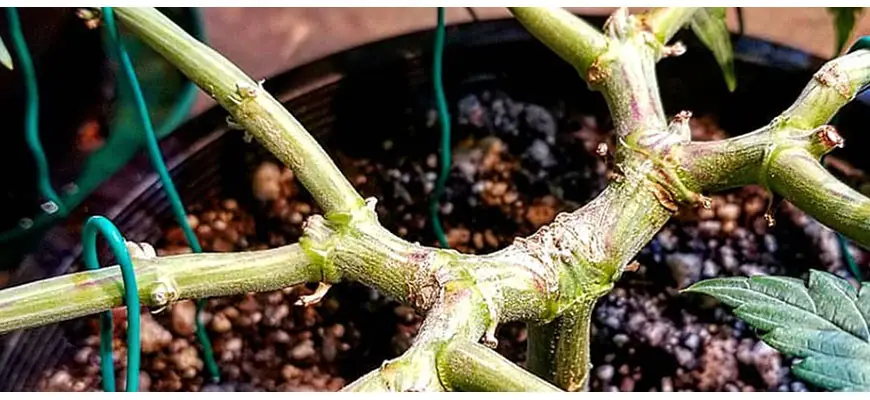
What super cropping actually does: You’re not cutting anything. You’re pinching and bending a branch to damage the inner tissue (the vascular and structural cells) without rupturing the outer epidermis. The plant goes into repair mode, overcompensates, and deposits a thick callus “knuckle” at the bend point; that joint ends up stronger than the original tissue and better able to support heavy flowers, while the branch is now more horizontal and contributes to a flat, even canopy rather than competing vertically.
The biochemical dimension: When cells are physically damaged, the plant releases jasmonic acid and other wound-response compounds that are part of its defense system. These same signaling pathways are linked to increased terpene and secondary metabolite production, which is why many growers report quality improvements alongside yield gains, although the magnitude of these changes is cultivar- and environment-dependent and not guaranteed.
Step-by-Step: How to Super Crop
Step 1: Select your branches
Target branches that are pliable but not brand new. You want stems that have some structure — green, not woody — but aren’t so young that they offer no resistance. If a branch bends easily without your intervention, it’s too young; if it doesn’t give at all when you squeeze gently, it’s already too hardened and you risk snapping rather than pinching. Start with branches that still have that slight give.
If you’ve only topped once and have two main colas, super crop both at the same node height to keep the canopy even. If you have multiple colas, work systematically across all of them.
Step 2: Pinch and bend
Using your thumb and index finger, apply firm, even pressure at the point where you want the bend — typically a few nodes down from the growing tip. Squeeze gently at first, then gradually increase pressure while rocking the stem slowly side to side; you’re trying to break up the internal cell structure without creating an open wound on the outside, and you’ll feel the stem shift from rigid to soft and pliable at that joint once the inner tissue gives way.
Once it’s pliable, gently fold the branch over toward the direction you want — usually horizontal or close to 90 degrees. If you’re running a trellis system, the HBX Heavy-Duty Mesh Garden Trellis Netting can help hold branches in position as they heal. You can also use AC Infinity Soft Twist Ties to secure the bent branch to a stake until the knuckle forms and the branch holds position on its own.
Step 3: Repair if needed
Even careful growers occasionally snap a branch. Don’t panic — plants are more resilient than they seem. If the outer skin tears, splint the break with duct tape or plant tape immediately to hold the two sides together and limit pest/pathogen exposure at the wound. In many cases the plant will seal the damage and the branch will survive, and the knuckle that forms at the repair site will be visible proof of recovery.
When to super crop: Mid-to-late veg, once the plant has several branches and they’ve hardened off enough to have structure. Plan to leave at least two weeks between your super cropping session and flipping to flower so the plant can fully recover and strengthen those joints.
Can autoflowers be super cropped? Yes, but only with tighter timing and more caution. Because autoflowers run on a fixed schedule, you have a narrower window, so work during the first 3–4 weeks of growth while stems are still pliable and the plant has enough veg time left to recover. The stakes are higher — a mistake costs more of your total grow time — so practice on photoperiod plants first if possible and keep stress conservative on autos.


Manifolding (Mainlining) — Maximum Structure, Maximum Commitment
Manifolding is the most labor-intensive HST approach, but growers who commit to it often report some of their heaviest harvests per plant. It’s a system rather than a single technique — a structured process of combining topping, LST, and defoliation to build a symmetrical “candelabra” plant architecture from the ground up.
The premise: You want to eliminate any growth that won’t receive direct light from your canopy and channel all plant energy into an equal number of main colas at identical heights. Every cola gets similar access to nutrients and light and produces at a comparable pace.
The process:
- Grow your plant until you have one main cola and two visible lateral shoots below it — usually 2–3 weeks into veg
- Top the main shoot and strip all growth below the two lateral nodes, leaving just those two lateral shoots
- Tie both laterals down horizontally in opposite directions — you now have a flat “T” shape
- As the plant recovers and new growth emerges along those horizontal shoots, you can top them again and repeat the process
- Continue eliminating lower growth throughout the grow, keeping only what can receive adequate light
What you end up with: A flat plant with 4, 8, or 16 evenly matched colas depending on how many topping rounds you complete. Light distribution is nearly uniform, and the harvest is more consistent and predictable than with many other training methods when executed correctly.
The cost: Manifolding typically adds around 2–4 weeks to your total vegetative period, and soil or more complex mainline variants can push that longer, because each topping round requires full recovery before the next. If you’re running a tight production schedule, this may not fit; for growers optimizing for maximum yield per plant in a longer cycle, it’s often worth the time investment.
Building a Progressive Training Regimen
The techniques above produce their best results when sequenced deliberately rather than applied ad hoc. Here’s a framework you can adapt to your specific setup, strain, and space:
Weeks 2–3: First topping once 4–5 pairs of true leaves are present. Wait 5–7 days for the two new shoots to establish and show vigorous growth.
Weeks 3–4: Begin LST. Tie the two recovering shoots down horizontally to start building your canopy width. If you’re manifolding, perform your first defoliation pass now to eliminate lower growth below the canopy.
Week 5: Super crop the main branches if they’ve hardened off enough. This is also a good point for a second topping of the dominant shoots if you haven’t started manifolding and still have sufficient veg time left.
Weeks 5–8: Ongoing defoliation as needed. Remove fan leaves that are blocking light or creating stagnant air pockets, and continue LST to maintain canopy shape. At this point you’re largely in maintenance mode — the structure is set and you’re refining it.
Pre-flip: One final defoliation and cleanup pass. Remove any lower growth that won’t contribute to the canopy, and leave at least two weeks between your last super cropping session and the flip to flower so plants can fully recover.
This sequence isn’t fixed — strain genetics, grow room height, and your target plant count all affect how you adapt it. Sativas and sativa-dominant hybrids typically handle more aggressive training and have longer recovery tolerance, while more sensitive or compact varieties may need gentler intervention and longer recovery windows. Start on one plant if you’re trying a new technique and don’t risk the whole run on an untested approach.
Recovery Management After HST
Recovery isn’t passive — it’s something you actively support. The same environmental factors that drive healthy vegetative growth also accelerate recovery from training stress.
Water and feed immediately after a training session. A well-hydrated plant with adequate nutrients at the root zone will repair tissue faster than one running on the edge of a deficit. If you’re using silica supplements (which strengthen cell walls) or calcium/magnesium support, these are particularly relevant during recovery phases.
Maintain stable temperature and humidity. Fluctuations during the repair window slow the process. For most cultivars in veg, a target of roughly 70–80°F with 55–70% RH keeps you within a common VPD range for healthy vegetative growth and recovery; fine-tune setpoints using a VPD chart, your specific cultivar, and your room design. VPD in range matters here — a plant that’s not transpiring efficiently isn’t moving nutrients to repair sites efficiently either.
Allow at least a week between training sessions. Back-to-back sessions without adequate recovery add cumulative stress that can stall growth for longer than either individual session would have. Watch the newest leaves — if they’re showing vigorous growth, the plant has recovered; if they’re still curled or stalled, wait before applying more HST.
Use clean, sterilized tools every time. Open wounds are entry points for pathogens. Wipe your scissors or pruners with isopropyl alcohol between plants and, ideally, between cuts on the same plant if you’re doing heavy defoliation work. For precision work during training sessions, the HBX Precision Garden Trimming Scissors give you clean, accurate cuts that minimize tissue damage beyond the intended cut site.
Final Notes Before You Get Started
A few principles worth keeping front of mind as you put these techniques into practice:
Work on healthy plants only. Training a deficient, overwatered, or diseased plant doesn’t activate the desired growth response — it piles stress onto stress. The plant needs resources in reserve to recover from HST.
Your vegetative period will be longer than you think. First-time HST growers consistently underestimate how much recovery time adds up across multiple sessions. Budget at least 2–3 additional weeks of veg compared to an untrained run if you’re topping, super cropping, or manifolding aggressively; this is not wasted time — you’re building structure that pays out at harvest.
Track your results. Every strain responds differently. Keep notes on which technique produced the best outcome in your specific setup, and adjust your training stack, timing, and intensity based on real data over multiple harvests.
For all the plant training supplies you need — trellis netting, twist ties, stakes, scissors, and pruners — we carry everything from entry-level hobby tools to commercial-scale options.
For Commercial Operations: Scaling HST Across Multiple Lights
At scale, the individual-plant focus of most HST guides doesn’t translate directly. Commercial operators running 10+ lights need to think about HST as a system-level decision rather than a per-plant technique.
Standardize your training protocol per cultivar. The biggest efficiency gain in commercial HST is eliminating variability across the canopy. Pick one primary technique per cultivar (typically topping plus LST for most commercial runs, with super cropping reserved for high-value cultivars and teams with the right skill level) and train every plant in that block the same way. Inconsistent canopy height under fixed-position lights creates yield variation that compounds across hundreds of plants.
Super cropping at scale requires trained staff. It’s a technique that demands feel and judgment — assign it to your most experienced cultivation team members and keep it as a designated task rather than part of general maintenance. Mistakes are expensive at scale, and overly aggressive super cropping can reduce yield or increase herm risk, especially in more sensitive cultivars. For most commercial operators, topping and FIMing offer the best yield-to-labor ratio.
Trellis netting is essential infrastructure, not optional. Once you’re running super cropped or heavily topped plants across multiple tables, HBX Heavy-Duty Plastic Garden Trellis Netting keeps the canopy organized, prevents branch damage during irrigation and maintenance, and gives your team something to work with during late-veg training and early-flower tuck. For larger operations, commercial bulk-roll trellis options from Grower’s Edge are worth considering for cost efficiency across multiple rooms.
Timing uniformity is a production scheduling issue. In a commercial operation, you need every plant in a block to be flippable at the same time. Build your HST schedule backward from your flip date: last supercropping session must be at least 14 days before the flip, last topping at least 10 days, and final defoliation 5–7 days. Deviations from this schedule either delay the flip or compromise recovery — both cost money.
Defoliation at commercial scale is labor-intensive but non-negotiable. Budget the labor accordingly. A large-canopy multi-light room running dense plant populations without adequate defoliation will have humidity issues, reduced light penetration, and elevated disease pressure. Plan your defoliation schedule into your SOPs and avoid cutting it simply to save labor time — you’ll pay for it in other ways.
For a complete look at maximizing production output across all dimensions, see our guide on how to increase cannabis yield.
High Stress Training: FAQs
What is high stress training (HST) and how does it work?
High stress training is a category of plant manipulation techniques — including topping, FIMing, super cropping, defoliation, and manifolding — that physically damage or remove plant tissue to break apical dominance and redirect growth energy across multiple bud sites. The stress response triggers hormonal redistribution, structural adaptation, and in many cases increased branching and bud-site development, which can translate into wider plants, more colas, and larger harvests than untrained plants produce under the same conditions when the rest of the environment is optimized.
When should you start high stress training?
HST belongs in the vegetative stage, once the plant has at least 4–5 pairs of true leaves and is visibly healthy, generally after 3–5 weeks from germination indoors. Starting on seedlings risks stunting growth before a stable root system is established. The specific technique dictates the specific timing — topping and FIMing can begin earlier in veg on well-rooted plants, while super cropping requires branches to have enough structure to pinch without simply snapping. Avoid HST during flower, with the exception of defoliation and selective lollipopping in the first two weeks of the flowering stage.
Does high stress training actually increase yield?
HST can increase yield when executed correctly during vegetative growth on healthy plants, primarily by creating more well-lit colas and improving canopy efficiency. The mechanism is documented: breaking apical dominance through cutting or pinching redistributes auxin and cytokinin signals, activating lateral meristems that would otherwise remain suppressed, and techniques like super cropping help flatten the canopy so more sites receive optimal PPFD. The caveat is that poorly timed or overly aggressive HST can cost you more yield than it creates, particularly if recovery time isn’t adequately built into the schedule or if plants are already stressed.
Can you high stress train autoflowering plants?
You can, with significant caveats. Autoflowers run on a fixed internal timeline regardless of photoperiod, which means any recovery time you give to HST comes directly out of the plant’s productive growth window. Topping early (within the first 2–3 weeks) is achievable on auto-specific varieties bred for resilience, but it’s risky and results vary widely by genetics. Super cropping and manifolding are generally not recommended for autoflowers, because the recovery demand is high relative to the available veg window, so LST is usually the preferred training method for autos to keep stress low while still shaping the canopy.
How long does it take for plants to recover from HST?
Recovery time ranges from about 3 days for light defoliation to 1–2 weeks for topping, FIMing, or super cropping, depending on the technique, the plant’s overall health, and environmental conditions during recovery. Plants recover faster in stable temperature and humidity with adequate water and nutrients available, particularly when veg VPD is kept in a reasonable range and root-zone health is strong. The visual signal to look for is new growth resuming at the branch tips — that’s confirmation the plant has processed the stress and is moving forward.
What is a super cropping knuckle and is it a problem?
A super cropping knuckle is a thickened callus that forms at the point where you pinched and bent a branch, indicating that the plant has repaired and reinforced the damaged tissue. It’s a sign of successful recovery, not a problem: the plant deposits additional structural tissue and lignin at the wound site, which makes that section of the branch stronger than it was before training and better able to support heavy flowers. Knuckles can get quite large on plants that have been super cropped multiple times, and many growers see them as a marker of effective training.
Should I combine HST and LST?
Yes — this is the most effective approach for most growers. Use HST (particularly topping and FIMing) to create multiple dominant growth points and initiate horizontal branching, then use LST to maintain and refine that canopy shape without adding much additional recovery time. The two techniques address different things: HST creates structure by breaking apical dominance, and LST maintains that structure and keeps light distribution even as plants grow. See our complete low stress training guide for how to integrate both methods across the full vegetative cycle.
What tools do I need for high stress training?
At minimum: a clean, sharp pair of scissors or pruners for topping and FIMing; twist ties or soft garden wire for LST and securing super cropped branches; and trellis netting to support the canopy as it develops. Duct tape or plant tape should be kept on hand for repairing accidental branch snaps during super cropping. For commercial operations, bulk twist ties like AC Infinity Heavy-Duty Twist Ties and bulk trellis netting in commercial roll sizes are worth the investment. The most important requirement isn’t a specific tool — it’s that all cutting tools are sterilized before use to reduce disease risk.
What's the difference between topping and FIMing?
Both remove or partially remove the apical meristem (the growing tip) to redirect growth energy to lateral shoots. Topping removes the tip cleanly and reliably produces two dominant shoots, giving you straightforward structure and recovery. FIMing removes approximately 70–80% of the tip, leaving a stub that the plant responds to differently — often producing 3–4 new growth tips instead of 2, but with more variability from plant to plant. Both are viable; topping is more beginner-friendly, while FIMing offers more potential for cola multiplication per cut for experienced growers comfortable with less predictable results.