

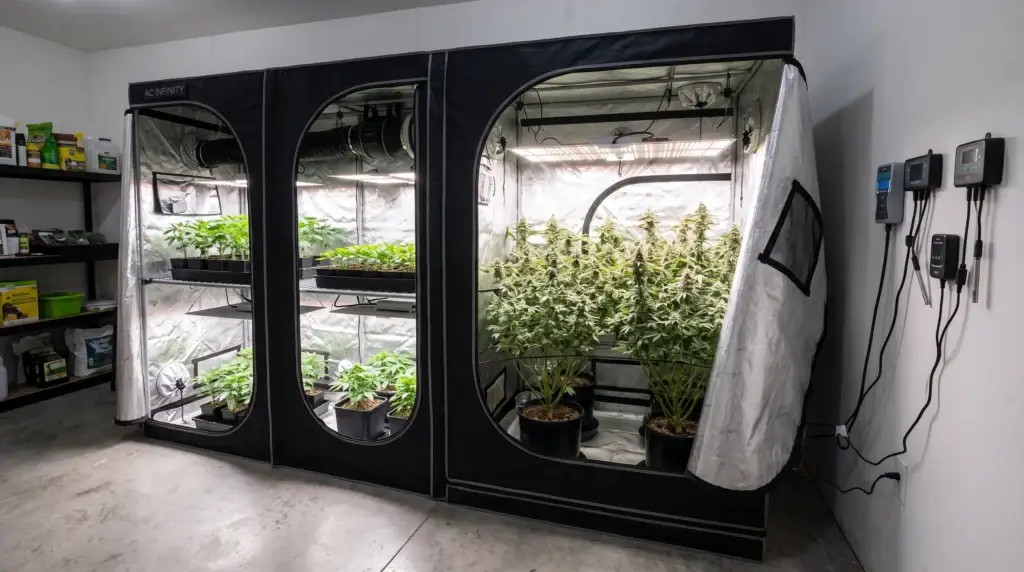
A perpetual harvest is the most reliable way to increase your annual yield without upgrading a single piece of equipment. Instead of running one crop at a time and sitting idle between cycles, you stagger your plants across multiple chambers so something is always in flower and something is always coming up behind it. The result: harvests every 8–10 weeks instead of two or three times a year.
Whether you’re running a pair of home grow tents or managing a multi-room commercial facility, the perpetual harvest model works at any scale. Hobby growers use it to keep their jars full year-round; commercial operators use it to maintain consistent production and cash flow. The principles are the same — only the infrastructure changes.
What Is a Perpetual Harvest?
A perpetual harvest is a rotation system where plants are always at different stages of growth simultaneously. While one batch is in late flower approaching harvest, the next batch is vegging, and a fresh set of clones or seedlings is rooting behind them. When you harvest, the veg plants slide into flower, the clones move into veg, and the cycle continues without interruption.
The core requirement is two separate environments: one running an 18/6 light cycle for vegetative growth, and one running 12/12 for flowering. Serious setups add a third space for clones and seedlings, plus dedicated mother plant management.
This is distinct from simply growing back-to-back. In a back-to-back grow, you harvest everything, break down the room, clean, and replant — creating a gap of weeks with zero production. A true perpetual system has no gap.
How Many Spaces Do You Need?
The minimum is two: a veg space and a flower space. A three-space setup adds a dedicated propagation area, which keeps your veg chamber at the right stage rather than crowding young plants alongside established vegetation.
Two-space setup (minimum viable): Veg and flower running simultaneously. Clones and seedlings share the veg chamber — they tolerate the same 18/6 light schedule and similar temperature and humidity ranges. The main downside is timing pressure: you need your next set of clones rooted and ready precisely when the previous veg batch moves to flower.
Three-space setup (recommended): Separate chambers for propagation/clones, vegetative growth, and flowering. This gives you a clean buffer at each stage and makes timing far more forgiving. Each chamber can also be dialed in to stage-specific environmental targets without compromise.
Four-plus spaces (commercial scale): Dedicated rooms for mother plants, propagation, veg, and two or more flower rooms staggered to produce a harvest every two to three weeks. This is the production model used by licensed commercial facilities to maintain consistent weekly or biweekly output.

Multi-Chamber Grow Tents: The Easiest Starting Point
If you’re running a home or small-scale setup, a multi-chamber grow tent is the most practical way to start. These divide a single footprint into two sealed chambers — one for veg, one for flower — with separate ventilation and no light bleed between sections.
The Covert 3′ x 4′ Multi-Chamber Grow Tent is the right size for a one- to two-plant perpetual rotation where the goal is personal supply. The larger Covert 4′ x 5′ Multi-Chamber Grow Tent fits more plants per cycle and works well for growers who want the flexibility of a multi-chamber setup without dedicating separate tents to each stage.
If you’re ready to scale beyond a single tent, running two separate tents — one for veg, one for flower — gives you more independent control over each chamber and allows you to size them differently. Your flower space typically needs to be larger than your veg space, since plants stretch and expand during early bloom.


Photoperiod vs. Autoflowering: Which Works Better?
Photoperiod strains are the standard for perpetual grows because you control the transition to flower by changing the light schedule. Plants veg until you’re satisfied with their size and structure, then the 12/12 flip triggers bloom. This control is what makes scheduling predictable.
Autoflowering strains are an option, particularly for single-tent setups where running two separate light schedules isn’t practical. Autos flower regardless of photoperiod, so you can germinate a new plant every few weeks and maintain staggered harvests under a single 18–20 hour light cycle. The tradeoff is that autos can’t be cloned, so you’re always starting from seed, and genetic consistency across batches is harder to maintain.
For most growers who want tight scheduling control and the ability to run a mother plant, photoperiod strains with a dedicated veg and flower space remain the cleaner system.
Seeds vs. Mother Plant vs. Clones
Your propagation strategy determines how predictable and efficient your perpetual cycle becomes.
Seeds: The simplest starting point, but introduces genetic variability between batches and requires consistent germination timing. If a few seeds fail or pop late, your schedule slips.
Clones from a rotating batch: You take cuttings from your veg plants before they move to flower, root them, and they become the next veg batch. No dedicated mother plant required, but your clone timing needs to be exact — usually 2–3 weeks before your current veg batch transitions to flower.
Dedicated mother plant: The most consistent approach. A mother is kept in permanent veg on 18/6 and never sent to flower, supplying clones on demand. Every cutting is genetically identical to the last, which means predictable cycle lengths, consistent yield characteristics, and no germination variables. A small separate space or a corner of your veg chamber is all a mother needs — she just needs adequate light and regular feeding to stay vigorous.
For propagation plugs, iHort Q-PLUGs are a reliable choice used in commercial facilities and adaptable to hobby cloning. iHort Q-PLUG Starter Plugs root consistently and transfer easily to any growing medium. Clonex Rooting Gel remains the standard for cutting preparation, and Clonex Rooting Gel is carried in sizes suited to both occasional home cloning and regular production schedules.

Lighting for Each Stage
Each chamber in your perpetual system has different lighting requirements, and you’ll want to treat them independently rather than running identical setups.
Propagation and clones: Low-intensity, blue-spectrum light. T5s or low-wattage LED bars are appropriate here — you want consistent, gentle light to encourage rooting without stressing unrooted cuttings. The Matrix 18 Watt LED Clone Light is built for this purpose, running cool and at the right intensity for seedlings and clones without creating heat stress in a confined propagation space.
Vegetative chamber: Higher intensity, blue-dominant spectrum, 18/6. You want robust canopy development before the flip. The Growers Choice ROI-FV 350 Watt Vegetative LED is purpose-built for vegetative production — optimized for the blue spectrum range that drives lateral growth and node density before flower.
Flowering chamber: Full-spectrum, high-output, 12/12. This is where your largest light investment goes, since yield is set here. The Growers Choice ROI-FF 650 Watt Flowering LED is a full-cycle fixture tuned for flower production and scales well to 4×4 and 5×5 canopy footprints.
Nutrients for a Perpetual System
Running veg and flower simultaneously means you’re mixing nutrient formulas at the same time every week. Having a nutrient line that covers both stages cleanly — without requiring separate product lines for each phase — simplifies this considerably.
HGV Dry nutrients are formulated around this reality.
HGV Dry – Grow covers the vegetative phase with nitrogen-forward nutrition for canopy development, while HGV Dry – Flower delivers the phosphorus and potassium ratios needed to drive bloom and density. Both are water-soluble concentrates that mix cleanly and scale from small-batch home mixing to commercial-volume reservoir management.
For the vegetative stage, supplement with growth enhancers, silica, cal-mag, and micronutrients as appropriate. In the flower chamber, bloom boosters and a clean flushing agent in the final weeks rounds out the cycle.


How to Set Up Your Perpetual Harvest: Step by Step
Step 1: Set Up Your Propagation Space
Start 10–12 cuttings or seeds. Clones should be taken from established mother plants or from your vegging plants 2–3 weeks before that veg batch transitions to flower. Keep your propagation space at 75–82°F with humidity between 70–80% relative humidity. Maintain 18/6 lighting.
Allow clones 10–14 days to develop a healthy root mass before transitioning them to the veg chamber. Don’t rush this — underdeveloped roots in the veg chamber will set your timing back further than the extra few days costs you.
Step 2: Move Rooted Clones into the Veg Chamber
Once your clones are rooted, move them to the veg chamber under 18/6. Target conditions: 75–85°F with 60–70% RH. Start them on your vegetative nutrient formula and allow 1–2 weeks of undisturbed growth before beginning any plant training — topping, LST, or super cropping — to build the canopy structure you want going into flower.
Total veg time from rooted clone is typically 4–6 weeks, depending on desired plant size and your flowering chamber dimensions.
Step 3: Flip Veg Plants to Flower
When your plants have reached the target size — roughly half their expected final height, accounting for stretch — move them to the flower chamber and switch to 12/12. At the same time, your next batch of rooted clones should be ready to move into the now-empty veg chamber.
The flower chamber should be sized generously — your plants will stretch significantly in the first 2–3 weeks of 12/12. Target conditions in flower: 70–80°F with 45–55% RH during lights-on, stepping down humidity as you approach harvest to reduce botrytis risk. Supplement with your bloom nutrient formula and bloom boosters from early flower through the bulking phase.
Step 4: Harvest and Repeat
Most photoperiod strains flower in 8–10 weeks. By the time you’re harvesting the first crop, your second veg batch is ready to flip, and your third set of clones is rooted and waiting.
Harvesting, drying, and curing the first batch happens in parallel with the cycle continuing — your grow room is never idle.
Following this schedule, you can achieve 5–6 harvests per year from a two-space perpetual system, versus the 3–4 that are typical with back-to-back single-room grows.
For a visual walkthrough of different room configurations that support this model, see our grow room design guide.
Sample Perpetual Harvest Schedule
This example uses 8-week flowering strains with a 6-week veg period from rooted clone:
| Week | Propagation Space | Veg Chamber | Flower Chamber |
|---|---|---|---|
| Week 1 | Batch 1 cloning | — | — |
| Week 3 | Batch 2 cloning | Batch 1 in veg | — |
| Week 9 | Batch 3 cloning | Batch 2 in veg | Batch 1 flowering (week 1) |
| Week 11 | Batch 4 cloning | Batch 3 in veg | Batch 2 flowering (week 1) |
| Week 17 | Continuous | Continuous | Harvest every ~8 weeks |
Adjust veg time to tune your intervals. Longer veg = larger plants and potentially higher yield per harvest, but longer time between crops. Shorter veg = smaller plants, faster cycling. Most growers find 4–6 weeks from rooted clone the right balance. Running two flower chambers shifts the balance dramatically — with 8-week flowering strains and staggered flips, you can be harvesting every 3–4 weeks.

Pros and Cons of a Perpetual Harvest
Benefits
Consistent supply. The most obvious advantage: you’re always pulling harvest, and gaps between grows disappear entirely.
Risk mitigation. If pests, disease, or an equipment failure hits one chamber, the rest of your rotation continues unaffected. A catastrophic single-room loss doesn’t mean months without production.
More control per cycle. Each batch gets your full attention during its stage. You’ll push better results in flower when you aren’t also managing the stress of newly transplanted seedlings in the same space.
Greater genetic diversity over time. With a running rotation, you can introduce new strains more easily — start a new batch alongside your existing rotation without disrupting it.
Skills compound faster. Running continuous cycles means you’re solving problems and observing results year-round rather than in isolated seasonal bursts. You improve as a grower much faster. Check out pruning and training techniques to get more from each cycle.
Drawbacks
More work, always. There’s no off-season and no idle period. Something always needs attention.
Strain discipline required. Running strains with significantly different flowering times across chambers creates scheduling headaches. The tighter your strain selection, the cleaner your rotation. If you want to grow multiple strains with different timelines, you’ll want more chambers or careful staggering.
Higher initial investment. Two or three separate chambers with independent lighting, ventilation, and environmental control costs more upfront than a single-room setup. The yield-per-year math typically justifies it, but it’s real capital.
Sanitation pressure. Perpetual systems mean your facility is never fully empty — you can’t do a complete teardown and deep sanitization between all crops simultaneously. IPM discipline and regular room sanitation protocols are more critical, not less.
For Commercial Operations
Commercial perpetual harvest systems operate on the same principles but at an entirely different infrastructure level. Rather than two grow tents, you’re designing rooms.
The standard commercial layout uses a 1:2 or 1:3 ratio of vegetative space to flowering space. Veg rooms run smaller because plants at this stage are compact — a veg room needs to support half as many canopy square feet as each flower room. Most facilities running perpetual models include at least one dedicated mother room and a separate propagation room for cloning at scale.
Staggered flower rooms are the engine of commercial perpetual production. With two flower rooms and 8-week strains, staggering your flips by four weeks means a harvest every four weeks. Three staggered rooms reduce that interval further. Larger licensed operations run 6–8 flower rooms with weekly harvest rotation.
Lighting at commercial scale demands fixtures that are dimmable, daisy-chainable, and compatible with centralized environmental control. The Growers Choice ROI-E720 scales across commercial flower rooms, and pairing it with a TrolMaster Hydro-X Environmental Control System allows centralized management of light schedules, temperature, and humidity across multiple rooms from a single controller.
Fertigation at commercial perpetual scale almost always means automated nutrient delivery via inline dosing. Dosatron-based systems inject nutrients proportionally into your irrigation lines, eliminating hand-mixing and ensuring consistent EC across all irrigation events in both veg and flower rooms simultaneously.
Crop steering becomes a powerful tool in a perpetual commercial setup. Since you’re always running plants in both veg and flower, you can apply vegetative and generative steering protocols simultaneously in their respective chambers — adjusting irrigation frequency, dry-back targets, and EC to drive plant behavior at each stage. For more on this topic, see our crop steering guide.
Room turnaround between harvest and the next flip determines your true cycle efficiency. After harvest, the flower room needs cleaning, sterilization, and reset before the next veg batch enters. Minimizing this window — through efficient harvest workflows and fast turnaround sanitation protocols — directly increases your annual production.
Start Your Perpetual Harvest
If you’re ready to build your first perpetual rotation, start with your space configuration. Multi-chamber grow tents are the cleanest entry point for home growers. If you’re already running a single-room setup and ready to add a second chamber, two separate tents give you more independent control and room to grow into.
Grow Like a Pro – Shop Top-Rated Equipment at Hydrobuilder.com
- 100% Secure Shopping
- Largest Selection of Products
FAQ SECTION
Q: What is a perpetual harvest in cannabis growing?
A: A perpetual harvest is a cultivation method where plants are kept at different growth stages simultaneously — clones rooting while others veg, veg plants while others flower — so that harvests occur at regular intervals throughout the year rather than in a single annual or semi-annual cycle.
Expanded: The system requires at minimum two separate environments: one running an 18/6 light cycle for vegetation and one running 12/12 for flowering. Instead of harvesting everything at once and restarting from scratch, you’re always cycling plants through the stages in a staggered rotation.
Commercial application: Licensed facilities use perpetual systems with multiple staggered flower rooms to achieve weekly or biweekly harvests and maintain consistent product flow to dispensaries.
Q: How many times can you harvest with a perpetual harvest?
A: With a standard two-chamber setup and 8–10 week flowering strains, you can expect 5–6 harvests per year. Adding a second flower room and staggering your flip dates can effectively double that frequency.
Expanded: The number is primarily limited by your flowering strain’s cycle length. Strains with 8-week flower times in a two-room perpetual setup typically yield a harvest every 8–10 weeks. Two staggered flower rooms cut that interval to every 4–5 weeks. Short-flowering autoflowering strains can push frequency even higher in single-tent setups.
Commercial application: Well-run commercial facilities with 4–6 staggered flower rooms can achieve near-continuous production, with harvests occurring every 1–2 weeks.
Q: Do you need a separate room for veg and flower in a perpetual harvest?
A: Yes. Photoperiod cannabis requires different light schedules for veg (18/6) and flower (12/12), and light contamination between the two stages can cause stress, hermaphroditism, or re-vegging. Two physically separated, light-proof environments are the minimum requirement.
Expanded: Multi-chamber grow tents solve this for home growers by building two sealed chambers into a single footprint. Alternatively, two standard grow tents of different sizes — a smaller one for veg, a larger one for flower — give you more flexibility and independent climate control.
Commercial application: Commercial facilities build dedicated rooms with independent HVAC and lighting systems for each stage, plus separate propagation and mother plant rooms.
Q: Can you do a perpetual harvest with autoflowers?
A: Yes, and it requires less infrastructure. Because autoflowering strains flower on a timer rather than photoperiod, you can run seedlings, mid-growth plants, and plants approaching harvest all under the same light schedule in a single space, staggering new plants every 2–3 weeks.
Expanded: The tradeoff is that autos cannot be cloned, so every batch starts from seed — introducing more variability in timing and yield than a photoperiod mother-plant system. For growers who want a low-infrastructure perpetual rotation without managing two separate light environments, autos are a practical option.
Commercial application: Most commercial licensed operations run photoperiod strains for tighter genetic consistency and yield predictability, though some craft operators use autoflowers for specific fast-turnaround SKUs.
Q: What strains work best for perpetual harvest?
A: Strains with consistent, predictable flowering times work best — typically 8–10 week bloomers that you’ve grown before and understand. Avoid mixing strains with significantly different cycle lengths in the same rotation until you’re comfortable managing the scheduling.
Expanded: Running the same strain — or strains with identical flowering windows — across your rotation makes scheduling far more predictable. If you want genetic variety, consider running two separate, parallel rotations with matched timing rather than mixing into the same chamber sequence.
Commercial application: Commercial operators typically select 2–4 core cultivars with compatible cycle lengths for their perpetual model, reserving experimental or long-flowering strains for isolated single-room runs.
Q: How do you manage nutrients in a perpetual harvest?
A: You’ll be mixing vegetative and flowering nutrient formulas simultaneously every feeding cycle. Using a single brand’s two-part or three-part system designed to work together eliminates compatibility issues and simplifies your mixing protocol.
Expanded: Keep separate labeled reservoirs or mixing containers for each stage. Track EC and pH independently per chamber — flowering plants typically run higher EC than veg plants, and pH targets may differ slightly depending on your growing medium.
Commercial application: Commercial perpetual systems typically use automated fertigation to inject stage-specific nutrient concentrations on a programmed schedule, removing manual mixing from the equation entirely.
Q: What is a mother plant and do you need one for a perpetual harvest?
A: A mother plant is a vegetative plant kept on permanent 18/6 and never sent to flower. It exists solely to supply clones. You don’t need one — you can clone from your rotating veg plants instead — but a dedicated mother gives you genetic consistency and on-demand cuttings without relying on timing from the main rotation.
Expanded: A mother plant requires only a small space and modest light, and she’ll keep producing cuttings indefinitely as long as she’s fed and healthy. For growers running 4+ plants per cycle and wanting identical genetics every time, a mother plant is worth the extra space.
Commercial application: All serious commercial perpetual operations maintain dedicated mother rooms with selected, tested phenotypes. Genetic consistency is a production and quality control requirement at commercial scale.
Q: How often should you clean grow rooms in a perpetual harvest?
Each chamber should be thoroughly cleaned and sanitized between every crop cycle. Because a perpetual system means at least one room is always occupied, you clean each room individually during its natural vacancy window between harvest and the next batch entering.
Expanded: The flower room is vacant for a short period between harvesting a crop and introducing the next veg batch — that’s your cleaning window. Propagation and veg chambers cycle faster, so their cleaning intervals are shorter. Regular IPM monitoring throughout the cycle is essential because there’s never a full facility reset.
Commercial application: Commercial facilities maintain strict room turnover SOPs with defined sanitation steps, dry-back periods, and environmental reset procedures between each crop cycle.