


Organic garden pest control starts with a clear definition — not everything labeled “natural” qualifies — and works outward from there. Whether you’re growing tomatoes in raised beds, managing a greenhouse, or running an indoor cultivation operation, the principles are the same: choose inputs that meet USDA organic standards (typically OMRI‑approved), match the right tool to the right pest, and build a system that prevents problems rather than only reacting to them.
This guide covers the legal definition of organic, the products that are actually approved for certified growing, and a practical toolkit for keeping pests under control without synthetic chemistry.
Applicable to all types of growers: Hobby gardeners will find the fundamentals here — from neem oil rotations to sticky trap placement. Commercial growers should also scroll to the section below for guidance on scaling organic IPM across larger facilities.
What Makes Pest Control "Organic"?
Organic pest control means using only inputs that are permitted under the USDA Certified Organic program — specifically, materials reviewed and approved by the Organic Materials Review Institute (OMRI) or otherwise allowed under the National Organic Program (NOP). What OMRI listing actually means goes deeper than marketing copy: OMRI evaluates every ingredient in a product, not just the active, to ensure the full formulation meets organic standards.
If you’re growing for personal use, you don’t need to hold yourself to USDA certification standards. But if you plan to sell certified organic produce, every input — pesticide, fertilizer, fungicide, and soil amendment — must be OMRI listed or otherwise documented as compliant with the National List and your certifier’s requirements.
OMRI-Approved Active Ingredients: The Core List
These active ingredients are commonly found in products that can be approved for use in certified organic production when formulated and labeled appropriately:
- Azadirachtin (neem seed extract — insecticide/nematicide)
- Pyrethrin (chrysanthemum flower extract — contact insecticide)
- Bacillus thuringiensis (BT — microbial insecticide)
- Beauveria bassiana (mycoinsecticide)
- Spinosad (fermentation-derived insecticide)
- Beneficial nematodes (biological control)
- Insecticidal soap / potassium salts of fatty acids
- Sulfur (fungicide/miticide)
- Copper-based fungicides
- Diatomaceous earth
- Kaolin clay
- Humic acids, fish emulsion, alfalfa meal, dolomite lime, calcium as soil and nutrient inputs when approved under organic standards
What to Avoid
These conventional inputs are not permitted in organic programs regardless of how they’re marketed:
Glyphosate, bifenthrin, permethrin, fipronil, dicamba, acephate, and synthetic pyrethroid compounds (which are distinct from natural pyrethrin).
When in doubt, look for the OMRI crest on the label and verify the exact product name against the OMRI database. If it’s not there, check the active ingredients against the National List and consult your organic certifier before using it in a certified program.
How to Control Garden Pests Organically
Start With Scouting, Not Spraying
The most cost-effective step in any organic pest management program costs nothing: regular observation. Walking your garden or facility weekly — checking undersides of leaves, soil surface near stems, and new growth — lets you catch infestations while they’re still small and manageable. Organic treatments generally work best as preventatives or against early-stage populations; waiting until you have a full outbreak sharply reduces your options and often requires harsher interventions.
For monitoring flying insects (fungus gnats, whiteflies, aphids, thrips), deploy HBX Yellow Sticky Traps — roughly one trap per 10–25 sq ft is a common starting density for most garden and grow room settings, with higher densities used in higher‑pressure situations. Check them weekly; sudden spikes on the cards indicate a pressure change before visible plant damage begins, which is the foundation of any integrated pest management strategy.
Floating Row Covers: Physical Exclusion

Floating row covers are one of the most reliable non-chemical tools for keeping pests off crops entirely. They block aphids, cabbage worms, tomato hornworms, squash bugs, and root maggot flies without any chemical inputs at all, simply by providing a physical barrier. They also provide incidental protection from early frost and heavy precipitation, helping maintain more stable microclimates around crops.
The limitation is pollination: row covers must come off during flowering on crops that require insect pollination. Use them during vegetative stages, remove at bloom, and reinstall after fruit set if extended protection is needed, or rely on side‑venting designs that allow some pollinator access while still reducing pest entry.
Beneficial Nematodes: Soil-Borne Biological Control
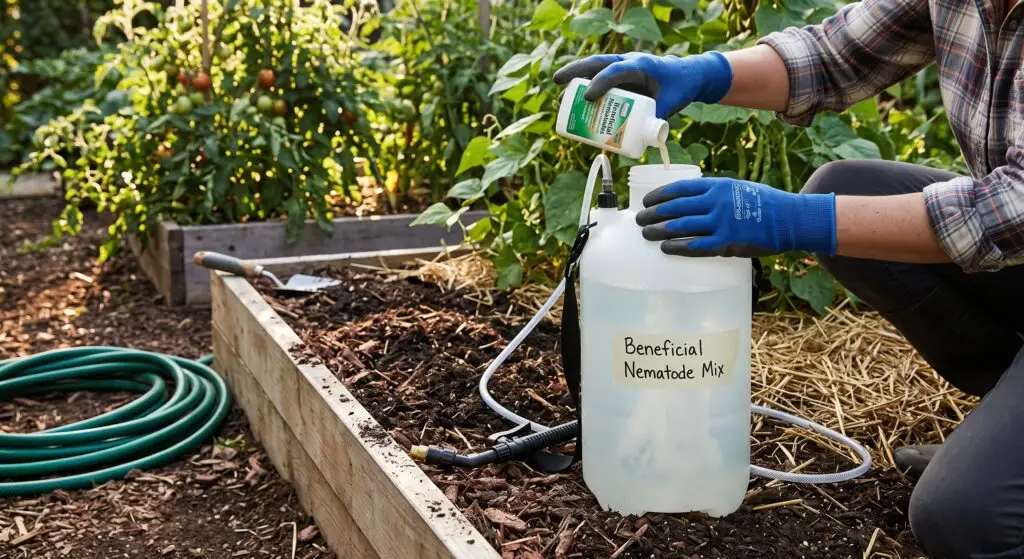
Beneficial nematodes are microscopic organisms that parasitize soil-dwelling pest larvae — releasing symbiotic bacteria that kill the host over the course of several days under favorable conditions. They’re effective against cutworms, fungus gnat larvae, root maggots, Japanese beetle grubs, and other soil-stage insects when soil moisture and temperature are within the species’ preferred range.
Different nematode species target different pests:
- Steinernema feltiae (Sf) — best for fungus gnats, shore flies, and many cool-soil applications (effective down to around 50°F/10°C)
- Steinernema carpocapsae (Sc) — effective against caterpillars, cutworms, and soil-surface pests
- Heterorhabditis bacteriophora (Hb) — effective against Japanese beetle grubs and white grubs at soil depths of roughly 3–8 inches
ARBICO Organics NemAttack Steinernema Feltiae Beneficial Nematodes are well-suited for fungus gnat pressure in container and raised-bed growing. For grub control, ARBICO Organics NemaSeek Heterorhabditis Bacteriophora Beneficial Nematodes target the soil-dwellers responsible for root damage. Apply to moist soil, avoid UV exposure during application, and water in immediately to move nematodes into the root zone, following the storage and handling directions on the package.


Sticky Traps and Pheromone Traps
Beyond sticky monitoring cards, yellow and blue sticky traps are an active control tool for low-to-moderate flying pest pressure. Yellow traps attract whiteflies, leafhoppers, cucumber beetles, fungus gnats, and aphid adults, while blue traps are more specific to thrips. Mealybugs and whiteflies are effectively monitored with yellow cards throughout the season to catch changing pressure levels.
Replace traps when they’re covered or after heavy rain or irrigation that reduces stickiness. Traps are diagnostic as much as they are control — they tell you what’s present and at what pressure level before you decide what intervention is warranted, helping you time sprays and biological releases more precisely.
Best Organic Pest Control Products

Neem Oil
Neem oil concentrate is one of the most versatile tools in many organic growers’ toolkits. It contains azadirachtin, an insect growth regulator that disrupts molting and reproduction in soft-bodied insects, plus other compounds that deter feeding and can suffocate susceptible pests on contact. It functions as both an insecticide and a fungistat, with labeled efficacy against issues like powdery mildew and certain leaf-spot problems alongside its insect control properties.
Apply only at label-recommended rates and intervals — often every 7–14 days preventively, or more frequently within label limits during active infestations — and avoid exceeding the maximum number of applications per season. Apply at dusk or in low light, since neem compounds break down in UV and wet foliage in direct sun can increase phytotoxicity risk. Dyna-Gro Pure Neem Oil Concentrate is cold-pressed and highly concentrated — dilute per label instructions and use a compatible surfactant for best coverage. Full guide: how to use neem oil in the garden.
BioSafe AzaGuard: Azadirachtin-Based Insecticide & Nematicide
BioSafe AzaGuard is a highly concentrated azadirachtin-based formulation available for certified organic use. It provides translaminar and limited systemic activity as described on the label, helping protect treated tissue from a broad range of insect pests as well as plant-parasitic nematodes. It’s OMRI listed and EPA-registered for many greenhouse, outdoor, and indoor food and non‑food crops.
Always follow the AzaGuard label for rate, timing, and application method; foliar and soil‑drench rates are specified in ounces per gallon or per area depending on the crop and target pest. It is generally compatible with BT products and beneficial nematode programs when applied in separate passes. For best results in established infestations, rotate AzaGuard with a contact insecticide (such as insecticidal soap or pyrethrin where appropriate) to hit insects at multiple life stages while staying within resistance‑management guidelines.
Bacillus Thuringiensis (BT)
BT is a naturally occurring soil bacterium whose insecticidal proteins are effective against specific insect groups depending on the strain. Bt kurstaki (Btk) targets caterpillars — cabbage loopers, tomato hornworms, cabbage worms, and squash vine borer larvae are all susceptible when they ingest treated foliage. Bt israelensis (Bti) is specific to fungus gnat and mosquito larvae, while Bt tenebrionis targets Colorado potato beetle larvae.
The precision of BT is one of its greatest advantages: it has minimal impact on beneficial insects, pollinators, and predatory insects when used according to label directions. Apply to leaf surfaces where larvae are actively feeding, making sure to maintain coverage on new growth. BT residues tend to decline over several days of UV exposure and after heavy rain or irrigation, so most labels call for reapplication every 3–7 days during active pest pressure and after significant rainfall.
BioSafe BioCeres WP: Beauveria Bassiana Mycoinsecticide
BioSafe BioCeres WP is a wettable powder formulation of Beauveria bassiana, a naturally occurring entomopathogenic fungus. It works by infecting and killing insects on contact and through ingestion, and under suitable humidity and temperature conditions the fungus can spread within a population as infected insects die and sporulate.
It is labeled for control or suppression of aphids, thrips, whiteflies, spider mites, and fungus gnats, making it particularly useful for building long-term biological control alongside beneficial insects when applications avoid direct spraying of predator release sites. Apply at 7–10 day intervals or as directed on the label; because it is a living organism, avoid tank-mixing with fungicides and apply when temperatures are within the label’s recommended range (often 60–90°F) and humidity is adequate for infection.
Pyrethrin: Contact Knock-Down
Pyrethrin — not to be confused with synthetic pyrethroids — is a contact insecticide derived from chrysanthemum flowers. It provides rapid knock-down against a wide range of pests including aphids, spider mites, grasshoppers, and leafhoppers when sprayed directly on target insects. Pyrethrin breaks down relatively quickly in sunlight and in the environment, which is why many organic programs use it as a rescue or “knock-down” spray rather than a long‑term residual.
The trade-off is that pyrethrin is broad spectrum and will affect beneficial insects, including pollinators, if applied while they’re active. Apply in the evening, after pollinator activity has subsided, and avoid spraying flowering crops whenever possible. PyGanic Gardening 5.0% EC is a high-potency OMRI-listed pyrethrin concentrate labeled for many garden and crop situations; rotate it with more selective tools such as azadirachtin or BT to avoid overuse of contact chemistry.
Insecticidal Soap
Insecticidal soap — the potassium salt of fatty acids — works by penetrating and disrupting the cell membranes of soft-bodied insects on direct contact. It’s effective against aphids, mealybugs, whiteflies, leafhoppers, and early-stage spider mites when good coverage is achieved.
Safer Brand Insect Killing Soap Concentrate is a reliable OMRI-listed formulation for both garden and indoor use, and like other true insecticidal soaps it has minimal residual effect once dried and weathered. Apply thorough coverage — the soap must contact the pest directly to be effective, so cover undersides of leaves and dense canopy areas — and avoid applying in extreme heat (above roughly 90°F) or to drought-stressed plants, which can increase phytotoxicity risk.
Diatomaceous Earth
Diatomaceous earth (DE) is made from the fossilized shells of diatoms ground to a fine powder. The microscopic sharp edges abrade the waxy coating on the exoskeletons of crawling insects, causing them to dehydrate over time. Effective against ants, beetles, earwigs, slugs, and soil-surface insects, DE is typically applied as a dust to soil surfaces, around plant bases, or along pathways insects use to reach crops.
It must be reapplied after overhead watering or rain that wets and moves the dust. Use food-grade DE only — the pool filter grade is processed differently and is not appropriate for garden use. Apply with a duster for even distribution, and avoid breathing the fine particles during application by using a suitable dust mask or respirator.
Lost Coast Plant Therapy
Lost Coast Plant Therapy is a plant-based essential oil formulation using ingredients such as peppermint, rosemary, and clove oils suspended in a soap solution. It’s labeled for use against mites, aphids, whiteflies, and fungus gnats, and works primarily as a contact insecticide and mild fungistat when sprayed directly onto pests and foliage. The ready-to-use formulation is particularly convenient for hobby growers; concentrate options are available for larger operations that need to cover more canopy per mix.
Apply at the label-recommended intervals — often every 5–7 days during active infestations — and always test a small area of your crop before broad application to rule out sensitivity. As with other oil‑containing sprays, avoid combining applications with other oil products or sulfur and avoid mid‑day, high‑light spraying to reduce phytotoxicity.
Building an IPM Program for Your Garden
A single product applied reactively is far less effective than a systematic approach. Integrated pest management combines preventive, biological, mechanical, and chemical controls in a tiered way — you use the lowest-impact approach that gets the job done, and escalate only when monitoring shows that more aggressive steps are justified.
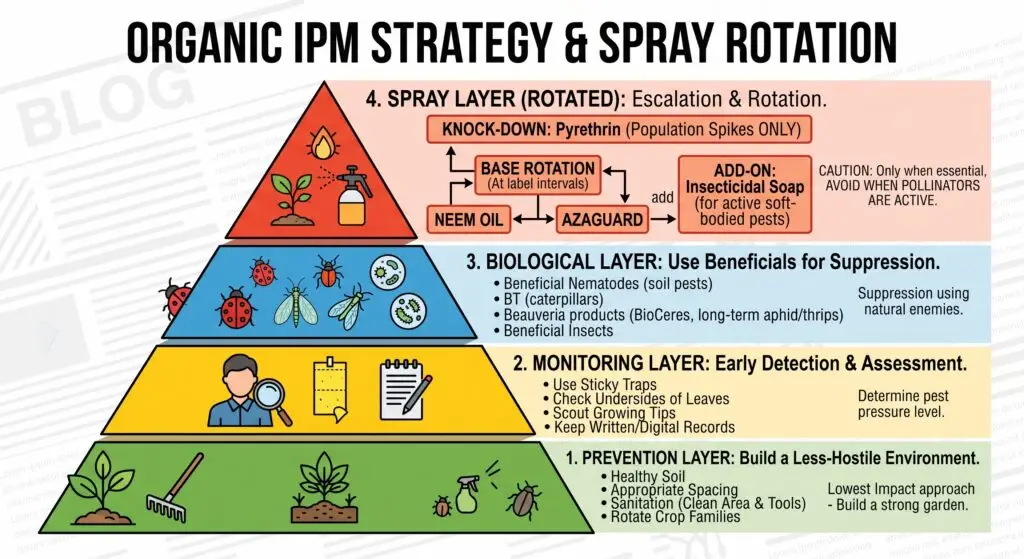
A basic organic IPM program looks like this:
- Prevention layer: healthy soil, appropriate spacing, cultivar choice, sanitation between plantings, and rotation of crop families to reduce host continuity for specific pests and diseases.
- Monitoring layer: weekly sticky trap checks, scouting undersides of leaves and growing tips, and keeping simple written or digital records of pressure levels by bed or room.
- Biological layer: beneficial nematodes for soil pests, BT for caterpillar pressure, BioCeres or other Beauveria products for long-term aphid/thrips suppression, and beneficial insects where compatible with your chemistry program.
- Spray layer (rotated): neem oil or AzaGuard as the base rotation at label-approved intervals; add insecticidal soap for active soft-bodied pest pressure; use pyrethrin only for knock-down when populations spike and when pollinators are not active.
Read our complete guide on the most common grow room pests and diseases for pest identification support, and check the best pesticides and fungicides article for a broader product comparison.
For application tools, the best garden sprayer guide covers how to match your sprayer to your spray volume and crop type so you can achieve consistent coverage without wasting product.
For Commercial Operations
Commercial cultivation operations — greenhouses, indoor facilities, and licensed production sites — face distinct organic IPM challenges at scale: higher plant density, limited airflow in enclosed spaces, and the economic consequences of a missed outbreak across many plants.
Facility sanitation as prevention: Between crop cycles, treat appropriate growing-area surfaces with Prokure V Chlorine Dioxide Liquid according to the label to reduce surface pathogen loads and certain pest eggs or larvae before your next planting. Prokure’s chlorine dioxide technology is effective against many fungal spores, molds, bacteria, and odor‑causing microbes on hard, non‑porous surfaces, and it complements BioSafe’s liquid treatment products rather than replacing them.
Scaled spray programs: BioSafe AzaGuard and BioSafe ZeroTol 2.0 together can address a wide range of insect, nematode, and microbial disease challenges in commercial facilities when integrated into a comprehensive IPM plan — AzaGuard handles many listed insect and nematode pests, while ZeroTol 2.0 (a hydrogen peroxide/peroxyacetic acid-based fungicide/bactericide/algaecide) handles algae, botrytis, powdery mildew, and bacterial pathogens on labeled crops and surfaces. AzaGuard is OMRI listed; ZeroTol 2.0 is not OMRI listed but is widely used in both conventional and organic operations where allowed by the certifier, so always confirm acceptability with your organic program before use.
Spray equipment: For operations covering large canopy areas, the HBX Pump Sprayer 8 Liter provides the tank capacity and consistent spray pressure needed for reliable foliar coverage in small to mid‑size rooms. Reduce between-application contamination risk by dedicating separate sprayers for fungicides and insecticides and labeling them clearly, and consider higher‑capacity or powered sprayers as canopy size increases.
Trap density: In commercial facilities, HBX Yellow Sticky Traps at around one trap per 10–25 sq ft provide baseline monitoring coverage, with many growers increasing density in entry corridors, near doors, and in historical hot spots. Logging trap counts by zone weekly and graphing trends over time helps identify entry points and hot spots before problems spread across the facility.
Beneficial insects at scale: ARBICO Organics offers commercial-volume nematode products for facility-scale soil drench programs, and many distributors carry predatory mites, parasitoid wasps, and other beneficials in bulk packs suitable for greenhouse and indoor rooms. For above-canopy biological control, BioSafe BioCeres WP can be deployed on a scheduled interval alongside your spray program when chemistry is selected to be compatible with beneficial releases and label restrictions.


Final Thoughts on Organic Garden Pest Control
Organic pest control requires more system than chemistry — the products work best when they’re deployed proactively, rotated to prevent adaptation, and layered with biological and mechanical controls rather than used as one-off rescue sprays. Start with scouting and prevention, build from there, and lean on OMRI-listed inputs and label directions when treatment is needed to keep your program compliant and effective.
The fungus gnats article is a good example of how to apply this layered approach to a specific, common pest, combining cultural control, biologicals such as Bti and nematodes, and targeted sprays as needed.
Frequently Asked Questions About Organic Pest Control
Q: What is the most effective organic pest control method?
A: No single method is universally most effective — organic pest control works through layers. Sticky trap monitoring catches pressure early, beneficial nematodes handle soil-stage pests, BT targets caterpillars specifically, and neem oil or AzaGuard provide rotational foliar coverage under many organic programs. The combination, deployed according to labels and pest biology, outperforms any individual product, especially when used preventively before populations build.
Q: Does organic pest control really work?
A: Yes, when it’s matched to the right pest and used within a structured IPM plan. Organic products work best as preventatives or against low-to-moderate pest pressure, and many act more slowly than broad-spectrum synthetic contact insecticides while requiring more frequent applications within label limits. The tradeoff is that properly managed organic programs build healthier, more resilient growing systems over time and typically avoid the long‑residue or ecosystem risks associated with many conventional chemistries.
Q: What is the safest organic pesticide to use on vegetables?
A: Insecticidal soap (potassium salts of fatty acids) and BT are among the most targeted and lower-impact choices for edible crops when used according to label directions. Insecticidal soap breaks down relatively quickly and has minimal residual activity, and many formulations have no or short pre-harvest intervals for listed crops. BT products are pest-specific, non-toxic to mammals at labeled rates, and break down with UV exposure and weather, but you should always confirm label requirements for each crop before application.
Q: Can I use neem oil on my organic garden?
A: Yes — neem oil and azadirachtin-based products can be approved for certified organic use under OMRI and USDA National Organic Program standards when the specific formulation is listed. Use cold-pressed, pure neem oil or OMRI-listed azadirachtin formulations (not synthetic blends that only contain small amounts of neem) and confirm that the exact product carries OMRI listing for your crop type. Apply preventatively at label-recommended intervals, preferably at dusk, and avoid application to open flowers to protect pollinators and beneficials.
Q: What kills garden pests naturally without harming beneficial insects?
A: BT products are among the most pest-specific tools — each strain targets only one or a few insect groups (caterpillars, fungus gnat larvae, or beetles) and generally leaves most beneficial insects unharmed when used as directed. BioSafe BioCeres WP (Beauveria bassiana) applied strategically can also be relatively low-impact on many adult beneficial insects when growers avoid spraying directly onto beneficial release sites. Physical methods — row covers, sticky traps, and hand-picking — have zero chemical bystander impact, while pyrethrin and broad-spectrum insecticidal soaps will affect beneficials if applied during active pollinator hours.
Q: When should I start using organic pest control — before or after I see pests?
A: Before. Organic programs are most successful when they are prevention-first: establishing a neem oil or AzaGuard rotation, deploying sticky traps, and applying beneficial nematodes before pest pressure builds dramatically improves outcomes. Once a population is well established, organic options often require more time and more frequent applications to regain control, and you may need rescue tools like pyrethrin (where allowed) or higher-intensity azadirachtin programs to bring a high-pressure infestation back to manageable levels while staying on-label.
Q: How often should I spray organic pesticides?
A: Spray frequency depends on the product label, pest, crop, and environment. As a general pattern, many neem oil or azadirachtin programs use 7–14 day intervals preventively and move to tighter intervals (for example, every 4–7 days) under active pressure, within label limits. BT products are often applied every 3–7 days when caterpillar larvae are present, while insecticidal soap may be used every 4–7 days for soft-bodied insects as long as the crop tolerates it. Always follow each product’s label for maximum single and seasonal rates, re-entry intervals (REI), and pre-harvest intervals (PHI).
Q: What organic pesticides are approved for certified organic growing?
A: Common OMRI-listed input categories approved for certified organic production include: azadirachtin, pyrethrin, BT (various strains), Beauveria bassiana, Spinosad, beneficial nematodes, insecticidal soap, sulfur, copper-based fungicides, diatomaceous earth, and kaolin clay, provided the specific product formulation is OMRI listed or otherwise approved by your certifier. Look for the OMRI crest on the product label and verify details at the OMRI database; more detail is available in our OMRI listing explained guide.
Q: How do I know which organic pesticide to use for my specific pest?
A: Identify the pest first — see our most common garden pests guide for help, and use sticky traps or hand lenses where needed. As a general rule: caterpillars → BT; soil-stage insects (fungus gnats, grubs, cutworms) → beneficial nematodes plus Bti; soft-bodied insects (aphids, whiteflies, mealybugs) → insecticidal soap plus neem or azadirachtin; mites → neem or azadirachtin plus compatible miticides or insecticidal soap rotations; fungal diseases alongside insect pressure → tools like AzaGuard combined with approved fungicides such as ZeroTol 2.0 where certifier-approved.