

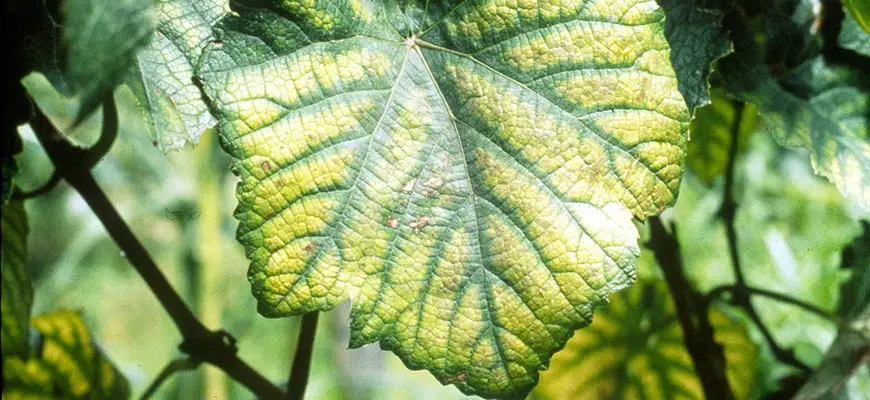
Magnesium deficiency is one of the most common — and most misdiagnosed — nutrient problems in indoor growing. It causes interveinal chlorosis that looks deceptively similar to iron or sulfur deficiency, and applying the wrong fix can make things worse. This guide covers everything growers need to know: what magnesium actually does in plants, why deficiencies happen (including the pH lockout scenario most guides miss), how to accurately identify what you’re seeing, and how to correct it without disrupting the rest of your nutrient balance.
Whether you’re managing a home grow tent or a licensed cannabis facility, the diagnostic logic is the same — but the correction protocol and prevention strategy differ meaningfully at scale.
What Does Magnesium Do for Plants?
Magnesium is the central atom in every chlorophyll molecule, making it indispensable for photosynthesis. Without adequate magnesium, your plant literally cannot capture and convert light energy — regardless of how powerful your grow lights are.
Beyond chlorophyll synthesis, magnesium serves several other critical functions:
- Enzyme activation — magnesium activates more than 300 enzyme reactions, including those driving ATP synthesis and nitrogen metabolism
- Phosphorus transport — it acts as a carrier molecule that helps move phosphorus through the plant’s vascular system
- Sugar loading — facilitates the movement of photosynthates (sugars and carbohydrates) from leaves to actively growing zones like roots, shoots, and flowers
- Cell membrane stability — supports structural integrity throughout the plant
Because magnesium is a mobile nutrient, the plant can relocate it from older leaves to support newer growth when supplies run low. This mobility is the key to understanding why deficiency symptoms appear where they do — and why they don’t look like a deficiency in a non-mobile nutrient like calcium.
Why Magnesium Deficiency Happens: Root Causes
Magnesium deficiency in plants doesn’t always mean there’s no magnesium present. More often, the magnesium is there but unavailable. Understanding the distinction is what separates a grower who corrects the problem from one who keeps adding CalMag without result.
True magnesium deficiency — not enough Mg in the root zone:
- Soft or RO (reverse osmosis) water with naturally low mineral content
- Coco coir and inert hydroponic media that supply no baseline nutrition
- Light soils or sandy substrates with poor mineral retention
- Outdoor growing after heavy rainfall leaches soluble nutrients from soil
Induced deficiency (lockout) — Mg is present but the plant can’t absorb it:
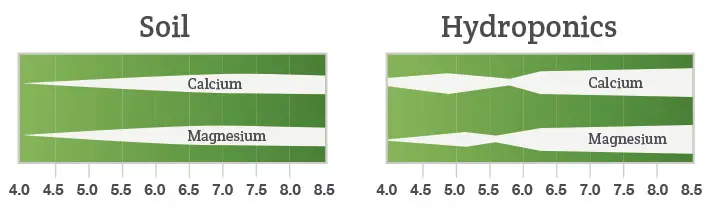
- pH out of range — the single most common cause in hydroponic systems; magnesium is most available between pH 5.8–6.5 in hydro and 6.0–6.8 in soil
- Ionic antagonism — excessive calcium, potassium, or ammonia-based nitrogen competitively blocks magnesium uptake at root sites; this is why feeding harder can worsen the deficiency
- Cold root zone — root zone temperatures below 65°F significantly impair Mg uptake even at correct pH
- Overwatering or poor drainage — oxygen-depleted root zones can’t absorb minerals effectively
Before adding any magnesium supplement, confirm which scenario you’re in. Check your pH first — a simple adjustment often resolves the problem entirely without any additional supplementation.


How to Identify Magnesium Deficiency in Plants
Magnesium deficiency produces a distinctive visual pattern once you know what to look for. The challenge is distinguishing it from iron and sulfur deficiencies, which can look similar.
Classic symptoms — in order of progression:
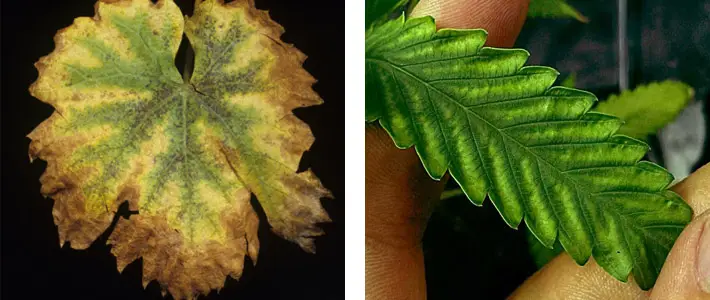
- Interveinal chlorosis on older/lower leaves — yellowing appears between the veins while the veins themselves remain green (this green-veined yellowing is the diagnostic signature of Mg deficiency; in iron deficiency, new growth yellows first)
- Leaf curl — affected leaves may begin curling under at the margins
- Rust-brown or bronze spotting — as deficiency progresses, necrotic spots develop in the chlorotic areas
- Upward spread — with continued deficiency, yellowing advances toward mid-canopy leaves; by this stage, the deficiency is moderate-to-severe
- Leaf drop — severe, prolonged deficiency causes defoliation beginning at the bottom of the plant
Why older leaves show symptoms first: Because magnesium is mobile, the plant actively strips it from mature leaves to keep newer growth healthy. Early-stage deficiency shows almost exclusively in the lower canopy. This is the opposite of calcium deficiency, which hits new growth first. If you see yellowing in brand new growth, look at calcium and iron before magnesium.
The pH–Magnesium Connection: The Step Most Growers Skip
pH management is the most important and most overlooked factor in magnesium availability. In hydroponic systems, magnesium is most soluble and plant-available between pH 5.8 and 6.5. Above or below this window, even a well-formulated nutrient solution delivers less usable Mg.
In soil and coco, the optimal pH range shifts slightly higher (6.0–6.8), where both magnesium and calcium remain available without competing with each other.
Practical rule: If you see interveinal chlorosis and your pH is out of range, correct the pH before adding any Mg supplement. In many cases, pH correction alone resolves the symptoms within a week. Adding more CalMag into a locked-out root zone doesn’t help — it can actually worsen antagonism if calcium levels climb further.
For hydroponic operations, HGV Condition – pH Down and HGV Condition – pH Up are formulated for direct use in nutrient solutions without dilution — a meaningful advantage in recirculating systems where accurate pH adjustments matter.
See our full guide to measuring and adjusting pH for plant nutrition for calibration procedure and a complete availability chart.
The Magnesium Deficiency Diagnostic Sequence
Don’t reach for a supplement until you’ve ruled out lockout. Follow this order:
- Check pH — measure your reservoir or runoff. Adjust if outside 5.8–6.5 (hydro) or 6.0–6.8 (soil/coco)
- Check EC — is your EC significantly higher than your target? High EC can indicate ionic buildup that’s causing competitive lockout
- Check root zone temperature — below 65°F? Warm it up before adding supplements
- Check nutrient ratio — are you running unusually high calcium, potassium, or ammoniacal nitrogen? High doses of any of these can suppress Mg uptake
- Check your water source — if you’re on RO or very soft water, you likely have true deficiency; supplement accordingly
If all above are in range — true Mg deficiency is likely; proceed with supplementation
How to Correct Magnesium Deficiency
Once you’ve confirmed the cause, your correction strategy depends on severity and grow system.
For Mild to Moderate Deficiency (Symptoms on Lower Canopy Only)
Root-zone application: Add a CalMag supplement at the manufacturer’s recommended rate — typically 1–5 mL per gallon depending on product concentration. Increase feed gradually; don’t double-dose. Recheck pH after adding any supplement, as they can shift solution pH.
Foliar spray for faster uptake: A foliar application delivers magnesium directly through leaf tissue, bypassing root-zone issues entirely. Mix 2 tsp of Epsom salt (magnesium sulfate) per gallon of water — or use a dedicated chelated CalMag product at label rate — and spray lower and mid-canopy leaves until runoff. Apply during lights-off or when temperatures are below 80°F to prevent foliar burn. The HBX Pump Sprayer – 8 Liter is well-suited for this application across larger canopies.
For spot treatment on individual plants, the HBX Handheld Pump Sprayer – 2 Liter allows targeted application without overspray.
Epsom salt: Magnesium sulfate (Epsom salt) is the most affordable and immediately soluble magnesium source. It supplies Mg and sulfur — a useful pairing since sulfur supports the same enzyme pathways. Dilute at 2 tsp per gallon for foliar use; at 1 tsp per gallon for root-zone application in established plants. Epsom salt has no pH-buffering capacity, so measure pH after adding to your reservoir.
For Moderate to Severe Deficiency (Spreading to Mid-Canopy)
Flush the root zone with pH-corrected water at 1.5x reservoir volume, then reintroduce nutrients at a reduced EC (approximately 70% of your normal target) with additional CalMag supplementation. This clears accumulated salt antagonists before reintroducing balanced nutrition.
Cal-Mag Supplements: What to Look For
A quality CalMag supplement delivers both calcium and magnesium in a chelated or highly soluble form for rapid absorption, along with iron (which shares the same deficiency pathway). Products vary significantly in Ca:Mg ratio — pay attention to which element is driving the deficiency before selecting.
Botanicare Cal Mag Plus — the most widely used CalMag supplement in the industry, delivering 2% nitrogen, 3.2% calcium, and 1.2% magnesium. Formulated for hydroponic and coco use, compatible with most nutrient lines, and well-suited for RO water growers who need to build a mineral baseline. Available in multiple sizes for home and commercial operations.
General Hydroponics CALiMAGic — a chelated liquid concentrate that delivers calcium and magnesium in bioavailable form with iron. Designed for the GH Flora Series but compatible across nutrient programs. Works well in DWC and recirculating systems where precise mineral control matters.
Athena Blended CaMg — Athena’s professional-grade 2-0-0 liquid concentrate, engineered for commercial cultivation with batch-to-batch consistency. Part of the Athena Blended nutrient system but functions as a standalone CalMag additive in any program.
Preventing Magnesium Deficiency Before It Starts
Reactive supplementation works, but prevention costs less and protects yield more reliably.
- RO water users: Supplement CalMag from the start of your feed cycle; every reservoir fill. RO water strips both Ca and Mg, making deficiency predictable without supplementation
- Coco growers: Coco naturally sequesters calcium and competes with magnesium uptake; maintain elevated CalMag throughout the grow. Review our guide to growing in coco for baseline feeding rates
- Soil growers: Amend with dolomite lime at transplant — it releases both calcium and magnesium slowly over several weeks, providing a stable baseline without the periodic overhead of liquid supplementation. Target a slightly acidic-to-neutral soil pH (6.2–6.8) to keep Mg available throughout the grow
- Monitor nutrient ratios: Review your complete nutrient formula for Ca:Mg ratio; ideally 3:1 to 4:1. Programs that run high-calcium base nutrients may need proportionally more magnesium supplementation
For growers using HGV Nutrients, the HGV Base formula (14.5-0-0) provides calcium as a consistent component of every feed — designed to keep the Ca:Mg ratio stable when dosed per program guidelines.
Magnesium Toxicity: Rare but Worth Knowing
Magnesium toxicity is uncommon under normal growing conditions, but it can occur when supplementing aggressively without monitoring EC and nutrient ratios. The clearest consequence isn’t visible leaf symptoms — it’s the suppression of calcium uptake. Excess magnesium ions compete with calcium at root uptake sites, potentially causing a secondary calcium deficiency even when calcium is abundant in the solution.
If you’re feeding additional CalMag and see new-growth symptoms (brown tips, stunted young leaves, tip curl), consider whether over-supplementation has inverted your Ca:Mg balance. The fix is usually a flush followed by a properly balanced feed rather than additional supplementation.
For Commercial Growers: Magnesium Management at Scale
In multi-room operations, magnesium deficiency can propagate quickly through shared reservoir systems and recirculating infrastructure. These protocols address the elevated stakes of commercial-scale Mg management.
Prevention at the Water Preparation Stage
Commercial facilities running RO or deionized water must build a mineral baseline on every batch. CalMag supplementation in the RO holding tank — before nutrients are added — is standard protocol in well-run CEA operations. Athena Blended CaMg and Botanicare Cal Mag Plus are both available in commercial case quantities for this use.
Facilities using injection-based fertigation (Dosatron units, inline injectors) can pre-batch a CalMag concentrate for consistent dosing across all rooms. See our guide to fertigation automation for concentrate mixing ratios.
Environmental Factors That Compound Deficiency Risk
At commercial scale, root zone temperature management matters more than in single-tent operations. Slab temperature below 65°F — common in ground-level facilities without bottom-heat infrastructure — consistently suppresses magnesium uptake regardless of solution Mg levels. Address the thermal environment before adding more supplement.
High-intensity lighting programs that maximize photosynthesis rate also increase magnesium demand. Facilities running 1,000+ µmol PPFD canopy targets will require proportionally higher Mg availability than the same crop at lower light intensities. Tissue testing is the most reliable calibration tool — reserve your diagnosis for what’s actually in the plant, not what’s in the reservoir.


Tissue Testing vs. Visual Diagnosis
Visual diagnosis is appropriate for home growers and small operations where speed matters. At commercial scale, visual diagnosis alone is insufficient. A plant showing no visual symptoms can still be subclinically deficient — running below optimal Mg levels without triggering chlorosis — with measurable impact on photosynthetic efficiency and secondary metabolite production.
HydroBuilder’s Grow Diagnostics service provides laboratory tissue analysis that quantifies Mg alongside 15+ other elements, giving facility managers accurate correction targets rather than guesswork. This is particularly valuable when investigating unexplained yield variance across rooms.

Correcting a Facility-Wide Deficiency Event
If deficiency is identified across multiple rooms simultaneously:
- Pull pH logs from all rooms and identify pattern (often a drift in a shared RO post-filter or batch mixing error)
- Standardize reservoir pH across all affected rooms to 5.8–6.0 (hydro) or 6.2–6.4 (coco)
- Introduce foliar CalMag at 1x label rate as a bridge correction while root-zone correction takes hold
- Conduct mid-crop tissue test 10–14 days after correction to confirm response
- Audit base nutrient formula for Ca:Mg ratio and adjust going forward
More in the Nutrient Deficiency Series
This guide is part of the HydroBuilder Learning Center’s complete nutrient deficiency series:
Why Shop at Hydrobuilder.com
HydroBuilder carries the full range of Cal-Mag supplements and nutrient management tools used by home growers and commercial cultivators — including professional formulations available in case quantities. Our commercial accounts team can advise on volume pricing and program compatibility for licensed facilities.
Example: FAQs
Q: What does magnesium deficiency look like in plants?
A: The signature symptom is interveinal chlorosis — yellowing between the leaf veins while the veins themselves remain green — appearing first on older, lower leaves. As deficiency progresses, rust-brown necrotic spots develop in the chlorotic areas, leaves may curl under, and the yellowing advances upward through the canopy. Because magnesium is mobile in plants, it moves away from older tissue to support newer growth, which is why lower leaves show symptoms first. This distinguishes Mg deficiency from iron or calcium deficiency, which typically present in new growth.
Q: How do I fix a magnesium deficiency in my plants?
A: Start by checking and correcting pH before adding any supplement — pH-induced lockout is the most common cause, and supplementing into a locked-out root zone wastes product and can worsen ionic antagonism. If pH is in range (5.8–6.5 in hydro, 6.0–6.8 in soil), apply a CalMag supplement at label rate through the root zone and consider a foliar spray of 2 tsp Epsom salt per gallon for faster uptake. New healthy growth should appear within 5–10 days in fast-growing crops. Damaged older leaves will not recover — you’re looking for cessation of symptoms and healthy new growth as confirmation the correction is working.
Q: Can too much magnesium hurt plants?
A: Yes, though toxicity is much less common than deficiency. The primary risk isn’t direct toxicity but competitive suppression of calcium uptake — excess Mg ions block calcium at root absorption sites, potentially triggering a secondary calcium deficiency. If you’re supplementing CalMag and see new-growth symptoms appearing (tip burn, curling young leaves), excess Mg is one possible cause. A flush followed by a properly balanced feed resolves most cases. Monitoring EC and maintaining a 3:1 to 4:1 Ca:Mg ratio in your nutrient solution prevents the problem in the first place.
Q: What's the difference between magnesium deficiency and iron deficiency?
A: The location of symptoms is the key distinction. Magnesium deficiency shows interveinal chlorosis on older, lower leaves first (mobile nutrient, moves to new growth). Iron deficiency shows interveinal chlorosis on newer, upper growth first (immobile nutrient, can’t relocate). If the yellowing with green veins is happening at the top of the plant, look at iron and pH before magnesium.
Q: Is Epsom salt a good source of magnesium for plants?
A: Epsom salt (magnesium sulfate) is an effective, affordable, and immediately soluble magnesium source. It delivers Mg and sulfur simultaneously — a useful combination since sulfur supports many of the same enzyme pathways as magnesium. It has no buffering capacity, so always measure pH after adding it to a reservoir. Use at 2 tsp per gallon for foliar applications, 1 tsp per gallon for root-zone supplementation in established plants. It’s a reliable correction tool but doesn’t address underlying pH or ionic imbalance issues — those must be corrected separately.
Q: Why do I keep getting magnesium deficiency even after adding CalMag?
A: The most common reasons: (1) pH is out of range and the Mg you’re adding isn’t bioavailable; (2) calcium or potassium levels in your nutrient solution are high enough to competitively block Mg uptake; (3) root zone temperature is below 65°F, suppressing uptake regardless of solution concentration; or (4) your CalMag dose is inadequate for your water source — RO water users often need full CalMag supplementation on every fill. Work through the diagnostic sequence above to identify which scenario applies before increasing your CalMag dose.
Q: How much magnesium do plants need compared to other nutrients?
A: Magnesium is classified as a secondary macronutrient — needed in meaningful quantities but generally in smaller amounts than the primary macronutrients (N, P, K). Plants typically contain 0.15–0.50% magnesium by dry weight under normal growing conditions, with cannabis and other fast-growing dicots often falling in the 0.25–0.50% range during peak vegetative growth. Demand increases during periods of rapid vegetative growth and heavy flowering, when chlorophyll production and sugar loading intensify. High-intensity lighting programs that push photosynthesis rates also increase Mg demand proportionally.
Q: Does growing in coco coir make magnesium deficiency more likely?
A: Yes. Coco coir has a naturally high cation exchange capacity and a strong affinity for calcium ions, which means it can sequester Ca from your nutrient solution and drive a secondary Mg imbalance. Growers in coco should supplement CalMag as a standard part of every feed — not just as a reactive correction — and pay close attention to their Ca:Mg ratio throughout the grow. This is one reason growers switching from soil to coco often encounter unexpected Mg symptoms in their first run.
Q: At what pH is magnesium most available to plants?
A: In hydroponic systems, magnesium is most plant-available between pH 5.8 and 6.5, with peak availability around 6.0–6.2. In soil and coco, the optimal range is slightly higher: 6.0–6.8. Outside these ranges, Mg precipitates or becomes bound to substrate particles in forms the plant can’t absorb. A pH drift of even 0.5 units outside the optimal range can measurably reduce Mg availability, which is why pH correction is always the first step in the diagnostic process.
Q: How do commercial cannabis operations prevent magnesium deficiency across multiple rooms?
A: Large commercial operations typically address this at the water preparation stage: supplementing CalMag into RO holding tanks before nutrients are added, ensuring every reservoir starts from the same mineral baseline. Injection-based fertigation systems (Dosatron units) allow facilities to dose CalMag as a consistent percentage of every irrigation event. Tissue testing every 2–3 weeks provides early warning of subclinical deficiency — before visual symptoms appear and before yield impact is measurable. HydroBuilder’s Grow Diagnostics service provides laboratory tissue analysis for commercial operations seeking quantified nutrient data.