
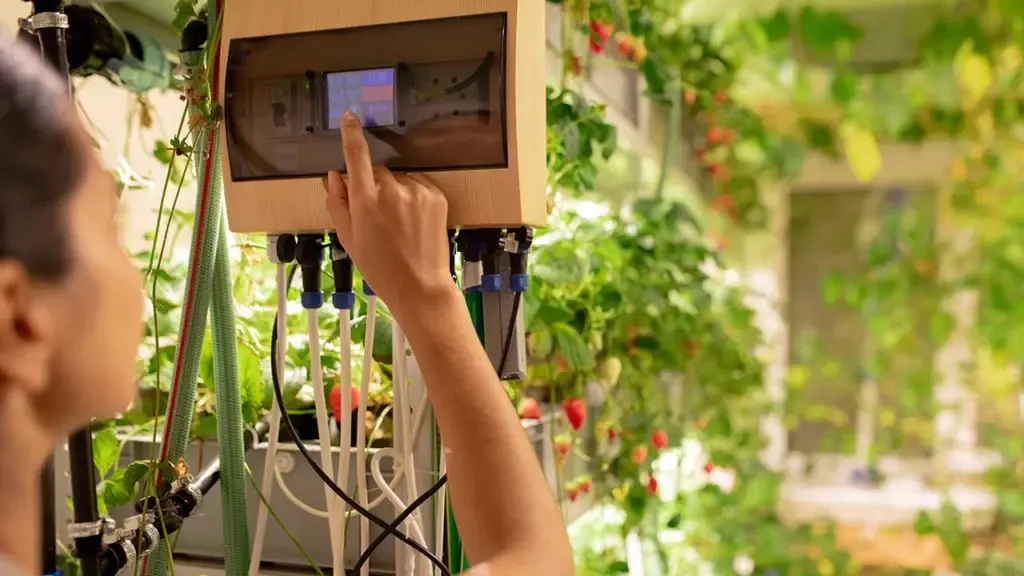
Most growers building a crop steering program get the irrigation hardware right. They spec the drip stakes, set up the Dosatron, dial in the controller schedule — and then run the entire program without a single sensor in the substrate. Not because they don’t care about root-zone data, but because substrate sensors feel optional until the crop tells you otherwise. By then, you’ve already lost days of steering precision you can’t get back.
Irrigation automation is where crop steering actually happens. Your decisions about VWC targets, dryback depth, and EC ratios are only as good as the system executing them. In coco and rockwool, consistent, repeatable delivery of water and nutrients is what separates a documented steering program from a daily improvisation session — and the difference between those two approaches shows up clearly at harvest.
This guide covers how to structure, time, and automate your irrigation and fertigation program to support deliberate steering outcomes in coco coir bags and rockwool blocks. If you’re newer to the foundational concepts — what VWC is, how the P1/P2/P3 framework structures your day, or why drain EC is your primary report card — start with What Is Crop Steering? Coco & Rockwool Explained first. That article covers the “why.” This one covers the “how” of building and automating the system that executes your steering strategy.
Why Automation Makes Steering Repeatable
Automation achieves three things that matter in a steering context.
Repeatability. The same irrigation events fire at the same time, with the same volume and frequency, every day unless you deliberately change them. This means your VWC and EC data reflects your steering decisions — not operator variability from shift to shift. Without that consistency, the trends you’re analyzing were produced by a process that changed daily, and the data is correspondingly noisy.
Scalability. Once an irrigation zone is calibrated, it can run dozens or hundreds of emitters simultaneously — providing uniform output at every plant position when the hydraulics and filtration are designed correctly. Manual watering cannot be made truly uniform at commercial scale.
Responsiveness. Advanced controllers can trigger irrigation based on actual substrate VWC rather than a fixed clock, allowing the system to adapt to real plant demand and ambient conditions rather than a preset schedule that may over- or under-deliver depending on the day’s VPD.
Designing Your Day Plan: The P1/P2/P3 Framework
A steering-capable irrigation schedule follows the P1–P3 framework: three distinct phases each day with different purposes. Automating this framework means configuring your controller to match each phase’s intent, then refining based on sensor data.
P1: Morning Ramp-Up
P1 begins at or shortly after lights-on, when substrate VWC is at its overnight minimum after the P3 dryback. The goal is to rehydrate the substrate to near field capacity before entering the active steering window.
Vegetative bias: Start P1 earlier and ramp up with smaller, more frequent pulses. The canopy should be actively transpiring — wait until lights, VPD, and leaf temperature confirm the plant is pulling water before firing the first event.
Generative bias: Delay the first P1 shot to allow a longer pre-irrigation dryback period. A deeper overnight dryback requires more P1 pulses to recover, so build this into your schedule as a defined P1 window (typically 60–90 minutes after lights-on) rather than a single event.
Timer configuration: Fire the first irrigation event 30–45 minutes after lights-on. For rockwool, P1 shots are typically larger or more frequent than subsequent P2 pulses — the partially dry block offers more resistance and requires more volume to reach field capacity. For coco, the ramp is gentler: coco’s slower drainage response and higher moisture buffering mean it doesn’t recover from dryback as rapidly as rockwool.
Validation: Confirm with substrate sensors that P1 is actually reaching the intended VWC before entering P2. A schedule assumption is not a data point.
P2: Active Steering Window
P2 is where most of your irrigation events occur and where you actively maintain the VWC range that signals vegetative or generative intent. Short, right-sized pulses keep VWC within a tight band and give you a clean lever for EC control. Long, infrequent irrigations cause large VWC swings that blur EC signals and make steering slower, noisier, and less consistent.
Vegetative steering: Target higher VWC (often 60–75% in rockwool and 55–70% in coco for commercial cannabis programs under appropriate VPD), maintain smaller drybacks between pulses, and run higher pulse frequency. The goal is to keep the substrate consistently moist within the target band, reducing the stress signal that would push a more generative response.
Generative steering: Target lower VWC, allow larger drybacks between pulses, and reduce pulse frequency during mid-P2. The goal is controlled substrate drought — mild, deliberate stress that pushes the plant toward reproductive energy allocation within cultivar-safe limits.
P2 frequency: reading the drain EC signal
- If drain EC rises day-over-day: Salts are stacking. Add midday pulses, increase shot size slightly, or reduce input EC.
- If drain EC stays below input EC: Dilution is occurring. Trim total daily volume or reduce pulse count.
- If drain EC tracks input EC closely: Balance is holding. Maintain and fine-tune based on plant cues and steering phase.
Timer configuration: A recycling timer format is standard for P2 — set event duration (commonly 30–120 seconds at 0.5 GPH per emitter, delivering roughly 0.25–1.0 oz per pulse depending on flow rate and container size) and a cycle interval that maintains your target VWC range. Calibrate P2 interval against actual sensor data rather than theoretical values.
P3: Overnight Dryback
P3 begins at the last scheduled irrigation event before lights-off and continues through the dark period. The depth of your P3 dryback is one of the most powerful steering levers in coco and rockwool programs.
Generative push: Allow a larger overnight dryback — for rockwool, a generative target of approximately 10–15% VWC reduction from field capacity is a common starting range under stable VPD conditions. For coco, targets are similar, but the actual dryback depth achieved depends heavily on ambient VPD and transpiration load, since coco loses moisture more slowly.
Vegetative maintenance: Keep a shallower overnight dryback — approximately 5–8% in rockwool under vegetative conditions — to maintain moisture levels and reduce the generative stress signal.
Avoid zero dryback: Eliminating overnight dryback entirely blurs EC signals, invites moisture-related problems, and removes one of your most direct steering levers. Some dryback, every night, is non-negotiable in a documented steering program.
Timer configuration: Set your last P2 event 60–120 minutes before lights-off — enough time for substrate EC to equilibrate post-irrigation before the dryback window opens. Avoid irrigating during the dark period unless plant health or extreme VPD conditions justify it.
Quick Math: Sizing Pulses & Matching Drippers
The formula for calculating volume per irrigation event is straightforward:
Emitter flow (L/h) × event duration (minutes) ÷ 60 = liters delivered per emitter per event
Use this to convert controller on-time into actual volume, so you can verify that your scheduled events are moving VWC by the intended number of percentage points rather than guessing.
A few rules that prevent common mistakes:
- Right-size your shots. Each event should move VWC by a few percentage points — enough to register on a sensor trend, but not enough to cause surface flooding or push significantly past field capacity. If you’re running back-to-back pulses to hit your target, your events are undersized relative to your emitter flow rate.
- Keep events short. If an event exceeds approximately 3–5 minutes at your installed emitter flow rate, you either need more emitters per plant position or a higher-flow emitter. Short, controllable pulses are the goal — long events blur the VWC curve and reduce your steering precision.
- Distribute evenly. For larger containers (5+ gallon coco bags), consider multi-outlet MOD assemblies to improve surface distribution. A single drip stake in a 5-gallon bag creates a wetting front that doesn’t reach all edges — multi-point distribution solves this without requiring more emitter flow.
- Match dripper flow to container size. For rockwool blocks and 1–3 gallon coco bags, 0.3–0.5 GPH emitters are appropriate for high-frequency small pulses. For 5+ gallon coco bags, 1.0 GPH assemblies allow faster saturation during P2 without impractically long event durations — assuming zone pressure and filtration support the flow.
Pressure-Compensating Drip: The Delivery Foundation
For coco bags and rockwool blocks in drip-to-waste or recirculating configurations, pressure-compensating (PC) drip stakes are the commercial standard for a fundamental reason: they maintain a near-constant flow rate across their rated pressure range, even when reasonable line pressure variation exists in the zone. Every emitter delivers approximately the same volume per event — and that uniformity is what makes substrate sensor data trustworthy. If your sensor block is receiving meaningfully more or less water than your outlier plants, your VWC readings don’t represent the room.
Netafim Drip Stake Assemblies are a commercial cultivation standard. Their pressure-compensating WPCJL emitters with built-in CNL check valves deliver consistent flow across a rated pressure range (approximately 10–58 PSI for typical 0.5 GPH Woodpecker-style emitters), and the check valve helps prevent line draining between irrigation events. That small feature has a significant impact on P1 ramp-up consistency, since a drained line introduces an unpredictable lag before the emitter delivers its first volume.
For standard rockwool blocks and smaller coco bags (1–3 gallon), 0.5 GPH assemblies are typically appropriate for high-frequency small pulses. For larger coco bags (5+ gallon), 1.0 GPH assemblies allow faster saturation per event without requiring impractically long durations. For multiple plant positions from a single header point, Netafim’s 2-Way and 4-Way MOD assemblies simplify layout and reduce tubing runs in dense canopy configurations.
Commercial Note: For facilities with 200+ plant positions per zone, perform a uniformity check before crop. Pull the first and last drip stake on each lateral and time flow output from each into an HBX Measuring Cup over 60 seconds. A properly designed pressure-compensating Netafim system should measure within approximately ±5% across the zone when operating within its rated pressure. Variance above about 10% means inspecting line pressure, elevation changes, and filter cleanliness before blaming the emitters.


Automating Fertigation: Dosatron & the HGV Manifold
Dosatron: Water-Powered Proportional Dosing
One of the most widely deployed fertigation automation platforms in commercial indoor cultivation is the Dosatron water-powered injector. Dosatron units are water-driven and require no external electricity — they inject nutrients at a fixed ratio relative to water flow within their specified flow and pressure ranges. This means your dilution ratio remains consistent across normal flow fluctuations, which matters in facilities where multiple irrigation zones run simultaneously and header pressure varies.
The Dosatron D14MZ2 covers a flow range of 0.05–14 GPM and a dilution ratio of 1:500 to 1:50 (approximately 0.2–2%). Viton seals provide chemical compatibility with neutral to mildly acidic nutrient solutions, and the integrated bypass hardware allows any single injector to be taken in or out of the water line without interrupting delivery from other dosers in the manifold. For high-volume header lines, the Dosatron D40-series units scale to higher flow rates with a similar ratio range, using the same NDS manifold architecture.
The HGV Nutrient Manifold Configuration
For commercial operations running a coordinated steering program, the Dosatron Lo-Flo manifold configuration for HGV Nutrients pre-configures four injectors in series:
- HGV Condition – Clear first, for continuous irrigation line hygiene as directed on the product label
- HGV Base (constant across all growth stages) — the calcium-nitrogen foundation (14.5-0-0)
- HGV Grow (vegetative) OR HGV Flower (generative) — swapped at the single injector by growth stage
- HGV Condition – pH Up final, for pH correction before the solution reaches the emitters
The swap between HGV Grow (3-6-22, nitrogen-forward vegetative formula) and HGV Flower (0-10-26, phosphorus, potassium, and sulfur-rich generative formula) at the Dosatron injector is one of the cleanest steering transitions available in an automated program. Delivered EC can remain constant while the macro ratio shifts — meaning your plants receive a coordinated nutritional signal that reinforces the irrigation-based steering direction. Pair this swap with your transition from vegetative to generative VWC targets for a multi-signal steering push toward flower.
HGV Nutrients are formulated for proportional dosing systems: they dissolve into stock concentrates that inject to deliver consistent EC at each emitter when the system is correctly calibrated. The Dosatron Nutrient Delivery System Kit for HGV Nutrients pre-configures this manifold with injectors, mixing chamber, monitor kit, and water hammer arrestor as a complete fertigation skid in Lo-Flo (14 GPM) and Hi-Flo (40 GPM) configurations. HGV’s technical team provides commissioning support for EC program design and injector setup.


Closing the Loop: Inline Monitoring Downstream
A Dosatron tells you what ratio it’s injecting — but it does not directly confirm what EC or pH is arriving at the plant. For any steering program where EC targeting matters, inline monitoring at or just downstream of the manifold is essential.
The Bluelab Guardian Monitor with Wi-Fi provides continuous reservoir or inline pH, EC, and temperature monitoring with visual alarms and remote access via the Edenic app. In a steering program with phase-specific EC targets, knowing your delivered EC in real time — rather than inferring it from stock concentrations and ratio settings — improves both the accuracy and speed of your adjustments. Catching a ratio drift early prevents multiple days of off-target feeding.
For spot verification at the emitter level — confirming what EC is actually leaving the last drip stake on a lateral — the Hanna Instruments GroLine Portable pH/EC/TDS Meter is a reliable handheld tool. Test at the first, middle, and last emitter position on each lateral; significant EC drift across a run (more than approximately 0.2 EC units across a 50-foot lateral) can indicate filter restriction, line scaling, or injector performance degradation.


Irrigation Controllers: Timer-Based vs. Demand-Based
Timer-Based: The Operational Foundation
Most commercial coco and rockwool operations run timer-based irrigation — and for many facilities, this is exactly the right approach. Timers define your event schedule with precision: start time, duration, and frequency. This directly controls how much water each plant receives per day and how that volume is distributed across P1, P2, and P3.
The TrolMaster Aqua-X Irrigation Control System manages up to 30 individually programmable irrigation zones (24VAC solenoid valves or 120VAC pumps) with remote schedule access via the TrolMaster app. Each zone can run a recycling timer, a time-of-day schedule, or a combination — meaning you can configure your first P1 shot 30 minutes after lights-on, pulse every 90 minutes through P2, and cut irrigation at a fixed time before lights-off to protect your P3 dryback window. The modular OA6-24 expansion boards scale from a single room to a multi-room facility by adding boards rather than replacing the controller, with up to five modules per system providing 30 individually controlled valve outputs.
Demand-Based: Substrate-Triggered Irrigation
Timer-based irrigation doesn’t adjust when VPD or ambient conditions change. On a high-light, high-VPD day, plants transpire faster than the schedule delivers and VWC undershoots your target; on a cool, low-VPD day, the same schedule may overwater and compress your P3 dryback. Demand-based irrigation addresses this by triggering events when substrate VWC drops to a user-set threshold.
The TrolMaster Aqua-X Pro adds this capability through integration with TrolMaster’s WCS water content sensors. When a connected WCS sensor detects VWC below your programmed trigger point, the Aqua-X Pro fires the irrigation event — Feed-on-Demand mode maintains a target VWC floor without constant manual schedule adjustments. For facilities already on TrolMaster’s Hydro-X environmental platform, Aqua-X Pro integrates into the same controller ecosystem, allowing irrigation and climate to be coordinated from a single system.
Most experienced growers use a hybrid approach: a fixed P3 cutoff timer to protect the overnight dryback, combined with demand-based triggering during P2 to maintain the VWC range without daily schedule adjustments as environmental conditions shift. See our companion article on VPD management for more on how ambient conditions drive transpiration and should inform your irrigation program.


The One Sensor Most Growers Skip (And Regret Later)
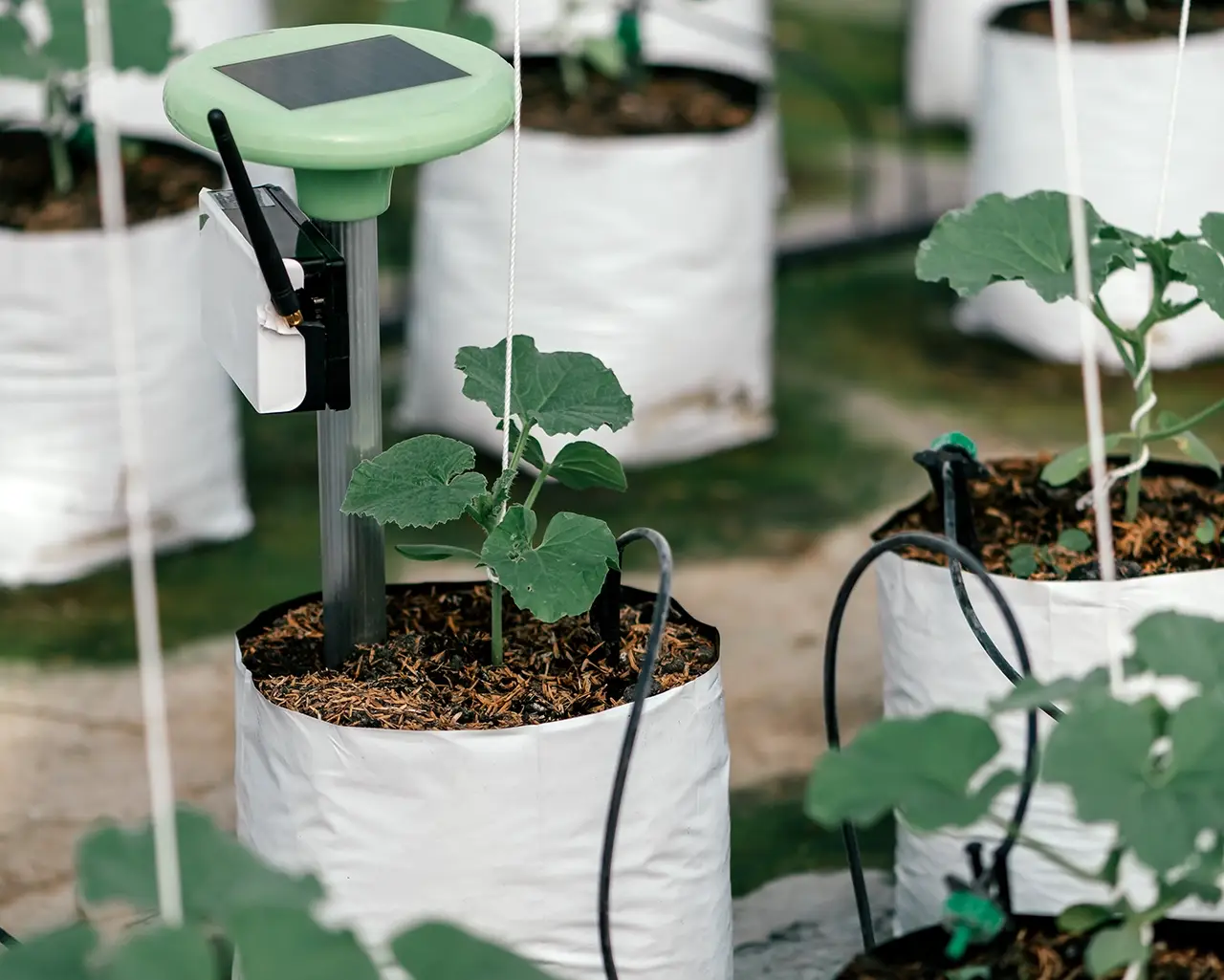
Substrate sensors are the most consistently skipped component in an otherwise well-built irrigation stack — and the one growers most commonly wish they’d added sooner. You can have precise drip stakes, Dosatron fertigation, automated timers, and meticulous schedules, and still have no direct visibility into what’s happening inside your substrate. That gap is what sensors close, and it’s the gap that separates a steering program built on real data from one built on assumptions about what the schedule is achieving. You can’t fix what you can’t see.
What Goes Wrong Without Sensors
Missed dryback targets. You set a P3 cutoff based on what worked last crop, but ambient VPD has shifted. Actual overnight dryback is shallower or deeper than intended, and you may not catch it until you’ve run several days off-target.
Salt accumulation goes undetected. Substrate EC can rise significantly in blocks or bags before it appears as elevated drain EC — particularly in rockwool, where the salt profile is not uniform. By the time drain EC signals a problem, stress may already be suppressing uptake.
Population variance is invisible. In a room with 50–500 plants, environmental gradients are real. Plants near the air inlet transpire faster than plants in the center; without sensors at multiple positions, your VWC data from one plant reflects one position — not the range of conditions the irrigation system is actually serving.
Uniformity failures accumulate silently. A partially clogged emitter or pressure drop on a lateral causes specific positions to dry down faster. Without substrate monitoring, this may go unnoticed until plants show stress; with sensors, diverging VWC trends surface the issue before crop quality is compromised.
AROYA SOLUS: Spot-Check Monitoring
The AROYA SOLUS 3-in-1 Wireless Sensor is a strong first choice for data-driven steering programs. It combines the TEROS 12 commercial-grade substrate sensor — built on more than 20 years of soil moisture research — with Bluetooth connectivity and the free SOLUS by AROYA app for iOS and Android.
Each reading delivers three data points: volumetric water content (VWC), substrate temperature, and substrate EC. Together these give you a direct view of root-zone conditions at that position: how wet the substrate is, whether temperature is likely to suppress uptake, and whether salts are accumulating or flushing.
Set the substrate calibration in the AROYA app to match your media type — coco and rockwool have different dielectric signatures and require separate calibration profiles for accurate VWC readings. For recurring monitoring, take readings at the same positions at the same time each day to build a dryback trend curve grounded in measured data rather than schedule assumptions.
Practical placement: Put one SOLUS in the most favorable position in the room (center canopy, middle bench, lowest VPD exposure) and one in the most challenging position (air inlet row, edge bench, or most vigorous cultivar). The gap between the two VWC curves tells you your actual population variance — and gives you an honest answer about whether your irrigation system is delivering uniformly across the room.
TrolMaster WCS-2: Continuous Logging
TrolMaster Aqua-X 3-in-1 Water Content Sensor integrates directly into the existing controller ecosystem. The WCS-2 delivers continuous water content percentage, substrate temperature, and substrate EC readings via a multi-prong sensor inserted into the grow medium, with up to eight sensors connected to a single Aqua-X controller and individual alarm limits per variable.
When connected to the Aqua-X Pro, the WCS-2 enables Feed-on-Demand automation: the controller fires when VWC drops below your set threshold, maintaining a target moisture range without fixed timers. This is especially valuable during the transition from vegetative to generative steering, when dryback targets shift and a timer-only approach would require frequent manual adjustments to stay on target.


Sensor Placement: Where the Data Comes From
Sensor data is only as useful as the placement strategy that generated it. A single sensor in the optimal position gives you best-case data — not a picture of room-wide performance.
For Rockwool Blocks
Insert sensors horizontally into the center of the block, with all three prongs fully embedded in the media. Avoid the top 15–20% of the block (the drier zone above the wetting front) and the bottom 5–10% (the drainage zone where EC may be diluted). The target measurement zone is the middle third, where the active root zone and bulk nutrient solution reside at field capacity. For 4-inch starter blocks seated in 6-inch production blocks, place sensors in the outer production block — not the starter plug — to reflect the root zone environment once colonization is complete.
For Coco Bags
Horizontal insertion into the middle third of the bag is the target. Avoid placement near drip stake entry points (localized saturation zone) or drainage holes (artificially low EC from dilution). For large-format bags (5+ gallon), multiple sensor placements per bag help characterize vertical EC stratification — a common issue where top irrigation and bottom drainage create a salt gradient through the bag height.
Population Monitoring: A Four-Position Map
Rather than relying on one representative plant, design a sensor placement map that captures actual variance in your room:
- Position 1: Center bench, mid-canopy — typically best-case conditions
- Position 2: End bench or edge row near air inlet — typically highest transpiration demand
- Position 3: Heaviest or fastest-uptake cultivar in the room — highest water demand. Over multiple crop runs, per-cultivar VWC data from this position becomes the basis for strain-specific irrigation profiles — the foundation of a repeatable strain optimization program.
- Position 4: Most challenging infrastructure position — furthest from main header, highest expected pressure variation
These four positions give you a realistic picture of the range of conditions your irrigation system is serving across the population — not just at a single measured point. Track trends from each position daily to diagnose schedule or hardware issues early.
Distribution Uniformity: Your Data Depends on It
Sensor data and drain EC readings are only trustworthy if your irrigation system is delivering uniformly. A sensor in a position receiving significantly more or less water than the average is not a basis for adjusting the room’s schedule.
Uniformity check: At least once per crop cycle, run a timed flow test. During an irrigation event, collect output from the first and last emitter on each lateral into graduated cylinders for 60 seconds. Volumes should be within approximately 5% of each other in a properly functioning pressure-compensating system. Any emitter showing more than about 10% deviation should be inspected and typically replaced before crop.
Key maintenance actions:
- Match dripper flow to pulse size so events are short and effective
- Use PC emitters on long headers or mixed elevations — non-compensating emitters will create EC and VWC variance that steering cannot overcome
- Maintain filters: a partially clogged filter reduces zone pressure and skews emitter uniformity without obvious signs
- Walk lines weekly for leaks, crushed tubing, and clogged stakes
- Verify distribution uniformity periodically — poor DU makes a scheduling problem look like a hardware problem and vice versa
Also check out our Daily, Weekly, and Monthly Grow Checklists for a practical framework for integrating these tasks into your SOPs.
Using Drain EC & Drain % as Control Variables
Drain EC and drain fraction are the most accessible steering data points for most operations, and they remain essential diagnostic tools even in sensor-equipped facilities.
Collect drain from your representative tray or container 60–90 minutes after the last P2 event of the day, once drainage has stabilized, and compare to your input (delivered) EC:
- Drain EC > Input EC and rising: Salts are accumulating. Increase drain percentage by adding pulse volume or frequency, reduce input EC slightly, and monitor plant response.
- Drain EC ≈ Input EC: Salt balance is relatively stable. Maintain and fine-tune based on plant cues and steering phase.
- Drain EC < Input EC: Dilution is occurring. Reduce pulse volume or frequency, provided plants are otherwise healthy.
Track daily drain fraction: Drain volume divided by applied volume. Run the lowest drain percentage that keeps drain EC near target while honoring local water-use limits. Unnecessarily high drain fractions waste water and nutrient solution; insufficient drain allows salt accumulation. For a full treatment of how drain EC fits into your steering program, see our crop steering fundamentals guide.
The limitation of drain EC alone is that it’s a lagged, averaged signal. It cannot tell you whether elevated drain EC is uniform across the population or concentrated in a few containers. Drain EC is a reliable steady-state management tool, but a less reliable early-warning signal for developing problems — at least one substrate sensor at a challenging position in your room provides real-time data that drain EC cannot replicate.
Playbooks: Starting Points to Adapt
These are starting frameworks — not universal prescriptions. Strain genetics, canopy load, VPD conditions, and facility design all require adaptation.
Rockwool, Weeks 3–6 Flower (Generative Focus)
Start P1 later, delay first drain by using fewer and slightly larger events, and allow a larger overnight dryback (approximately 10–15% VWC reduction from field capacity under stable VPD conditions, adjusting for your facility’s actual transpiration load). If drain EC spikes, add pulses at solar peak or slightly increase shot size. Re-check distribution uniformity if substrate variance rises — an EC spike in one position before others often indicates an emitter issue rather than a schedule issue. Pair this irrigation approach with an HGV Grow → HGV Flower injector swap timed to coincide with your generative steering transition.
Coco Bag, Balanced Program
Start P1 earlier, maintain moderate drybacks between P2 pulses, and aim for steady daily drain to help manage salts. Buffer and rinse coco before planting; early in the crop cycle, expect slower substrate EC response to recipe changes due to coco’s cation-exchange capacity — judge success by multi-day trends rather than single readings. Coco’s slower drainage response means P2 intervals can be spaced slightly wider than equivalent rockwool programs at the same container size. Monitor substrate EC stratification in larger bags, where the top of the bag may accumulate salts while the bottom runs lower EC from proximity to drainage.
Maintenance & SOPs: Keep It Clean, Keep It Repeatable
Weekly:
- Clean strainers and filters on all zone headers
- Walk all lateral lines for leaks, crushed tubing, and clogged emitters
- Verify valve function on each zone — a stuck solenoid creates invisible irrigation failure
- Clean and inspect Dosatron units; verify bypass function
Per run (between crops):
- Calibrate all pH and EC meters before planting
- Pressure-test all irrigation lines and confirm emitter flow at first and last stake per lateral
- Validate Dosatron injection ratios with a timed volumetric test (collect output into a graduated cylinder over a timed interval and compare to expected output)
- Flush manifold and irrigation lines with HGV Condition – Clear or other line-cleaning products rated for your system, following manufacturer directions; this removes salt and biofilm buildup before the next run
- Confirm sensor placement and calibration
Daily logging: Export water content, substrate EC, drain percentage, drain EC, and input EC/pH. Use the data to plan tomorrow’s schedule — not to confirm today’s assumptions.
Troubleshooting: Read the Graphs
VWC “saw-tooth” pattern is too steep: Individual pulses are too large or too far apart. Shrink pulse size or shorten interval spacing.
Rising substrate EC despite adequate drain: First check input EC consistency and Dosatron ratio — a ratio drift can raise delivered EC without you noticing. Then verify meter calibration and temperature compensation. Finally, check emitter uniformity — if one position is receiving significantly less water, salts accumulate faster than drain EC signals would indicate.
Uneven VWC across blocks or bags: Replace any clogged drippers, verify zone pressure is within the emitter’s rated range, and consider whether line routing creates elevation differences that require pressure-compensating emitters to overcome.
Frequent overflow or surface flooding: Reduce shot size, increase dripper count or flow rate per position, and check for perched water in containers from media compaction or drainage hole obstruction.
Drain EC suddenly drops below input EC: Check for a manifold issue — a Dosatron bypass accidentally engaged, a stock tank running low, or a mixing ratio that has drifted. Verify delivered EC at the emitter with a handheld meter before assuming the plants have dramatically increased water uptake.
Sustainability & Compliance Notes
- Use pulse control to minimize runoff while still achieving EC targets. Short, frequent pulses can achieve better saturation uniformity with less total volume than single large events.
- Consider recirculation where allowed, sanitize return lines with products compatible with your media and plants, and monitor pathogen risk if recirculating.
- Keep water use logs — daily VWC, drain percentage, and drain EC — for water board submissions, internal audits, or facility certifications. The same data logging that improves your steering decisions also serves compliance documentation.
For Commercial Operations: Building a Scalable Automation Stack
For operations running 500+ plants across multiple rooms or facilities, the automation stack requires deliberate architecture. Here is a proven framework:
Fertigation layer: The Dosatron Nutrient Delivery System for HGV Nutrients provides a pre-configured fertigation skid. The Lo-Flo configuration handles up to 14 GPM; Hi-Flo scales to 40 GPM for high-volume header lines. The manifold runs four injectors in series: HGV Condition – Clear for line hygiene, HGV Base as the constant calcium-nitrogen foundation, then HGV Grow or HGV Flower swapped by growth stage, and HGV Condition – pH Up for final pH correction. Bluelab inline monitoring downstream verifies delivered EC and pH in real time.
Delivery layer: Netafim pressure-compensating drip stakes at every plant position, operating within their rated pressure range for uniform discharge. Each solenoid valve serves a single bench or cultivation row — no cross-bench zones — so schedule changes for a particular strain or growth stage affect only the intended plants.
Control layer: TrolMaster Aqua-X Pro with WCS-2 substrate sensors at representative positions. Feed-on-Demand can be enabled for P2 with a fixed timer cutoff for P3 entry. OA-series expansion boards provide individual zone control for all 24VAC solenoid valves. The full schedule is accessible and adjustable remotely via the TrolMaster app.
Monitoring layer: AROYA SOLUS sensors at scouting positions — minimum one per room per cultivar — delivering additional VWC, EC, and temperature data over time. Daily VWC trend logging creates a crop-run dataset that improves steering decisions with each successive run.
Environmental integration: HBX Thermo-Hygrometers at each canopy level in every room track ambient temperature and humidity — conditions that directly drive substrate dryback rates and must be considered when interpreting WCS sensor trends. For full integration, TrolMaster Hydro-X environmental controllers can manage VPD, CO₂, and temperature from the same platform as your irrigation control.
For more on how coco and rockwool differ in their irrigation response, see our complete guide to growing in coco coir and our rockwool for plants guide. For full system architecture, see our Hydroponics 101 commercial growing guide.


Why Shop HydroBuilder for Irrigation & Automation
HydroBuilder is one of the largest dedicated hydroponic and commercial cultivation retailers in North America. For irrigation and automation specifically, we stock a full commercial-grade product stack — Dosatron water-powered dosers across GPM and ratio configurations, Netafim drip stake assemblies across multiple emitter rates and tubing lengths, TrolMaster Aqua-X irrigation controllers and expansion modules, AROYA substrate sensors, and Bluelab monitoring equipment — with support staff who work daily with commercial accounts, from single-room buildouts to large-scale multi-site facilities.
Our commercial team can provide volume pricing on bulk emitter packs, help configure a Dosatron manifold for your nutrient program, and assist with TrolMaster Aqua-X zone mapping for multi-room facilities. Reach out via our Commercial Accounts page if you need help designing or scaling a steering-capable irrigation stack.
Key Takeaways
- First-drain timing, pulse sizing, and drain EC trends are three core levers of irrigation-based steering
- Short, right-sized pulses beat long events for both precision control and water efficiency
- Dosatron proportional injection — especially paired with an HGV Base/Grow/Flower manifold — provides consistent, recipe-flexible EC delivery without external electricity
- Substrate sensors don’t replace drain EC; they add real-time root-zone visibility that drain EC alone cannot provide
- Distribution uniformity determines whether your sensor data, drain EC, and VWC trends are trustworthy — verify it at least once per crop cycle
- A documented, reproducible process scales. Schedule assumptions do not.
Frequently Asked Questions: Irrigation & Fertigation Automation for Crop Steering
Q: How do I automate irrigation for crop steering in coco or rockwool?
A: Start with a timer-based controller — like the TrolMaster Aqua-X — to schedule P1 ramp-up events after lights-on, P2 pulses throughout the day, and a hard cutoff before lights-off for P3 dryback. Add substrate sensors to validate that your scheduled events are achieving your VWC targets rather than assuming they are. For operations that need more adaptability, upgrade to demand-based irrigation with TrolMaster WCS sensors feeding the Aqua-X Pro, which fires events automatically when VWC drops to a set threshold within your defined window.
The build sequence is: reliable delivery (Netafim PC drip stakes) → consistent fertigation (Dosatron D14MZ2 manifold) → smart controller (Aqua-X or Aqua-X Pro) → substrate sensing (AROYA SOLUS or WCS-2) to verify and refine. The sensors tell you whether the rest of the stack is doing what you think it’s doing at the root zone.
Commercial application: Larger operations typically run Dosatron D14MZ2 units in series on a Lo-Flo manifold, TrolMaster Aqua-X Pro managing 12–30 individual zones, and AROYA SOLUS sensors at multiple room positions to characterize population-level VWC variance.
Q: What's the difference between timer-based and demand-based irrigation for crop steering?
A: Timer-based irrigation fires on a fixed schedule regardless of actual substrate conditions — predictable, easy to audit, and appropriate for many commercial operations with consistent environmental controls. The limitation is that it doesn’t automatically adjust when VPD or temperature shifts affect transpiration, so a schedule that worked on one day can over- or under-deliver on another.
Demand-based irrigation fires when substrate VWC drops to a threshold read by a moisture sensor, so it adapts more directly to actual plant uptake. This is most valuable during phase transitions and in facilities with significant environmental variation between rooms. Most experienced commercial growers use a hybrid: fixed P3 cutoff timer to protect overnight dryback, combined with demand-based P2 triggering to hold the target VWC floor without constant schedule changes.
Commercial application: Demand-based mode delivers the most value during weeks of prioritized generative steering when VPD fluctuates, because maintaining a consistent VWC floor is critical during that window.
Q: How often should I water in coco vs. rockwool for crop steering?
A: The right frequency depends on container size, emitter flow rate, plant size, transpiration demand, and your target VWC range — not a single universal number. That said, typical commercial programs run approximately 6–14 P2 irrigation events per day in coco and 8–20 in rockwool under high-density cannabis canopies with appropriate VPD.
Rockwool drains faster and has lower water-holding capacity, so it benefits from higher-frequency, shorter pulses. Coco buffers moisture longer and responds more slowly to schedule changes, making slightly wider spacing between pulses more common. The practical method: identify your target P2 VWC range and desired maximum dryback between events (typically 3–5% VWC), measure how quickly VWC drops between events with a substrate sensor, and calculate frequency to hold your target range. Adjust emitter flow rate before drastically changing event duration to avoid over-saturating per pulse.
Commercial application: In multi-strain rooms, cultivar-specific irrigation zones allow different P2 frequencies for high-uptake vs. low-uptake strains — essential for steering uniformly across mixed populations.
Q: Do I need substrate sensors to run a crop steering program?
A: Sensors aren’t strictly required — many growers achieve meaningful steering using drain EC, drain percentage, and visual plant cues. But sensors make steering significantly more precise and scalable. Without substrate data, you’re managing the root zone through lagging indicators and visual observations rather than real-time measurement.
The practical gap is largest in commercial operations with population variance, environmental gradients, or multiple cultivars. In these situations, a single drain EC check at the main drain doesn’t reveal what’s happening at the plant level across the room. One AROYA SOLUS sensor at a challenging position often surfaces issues — uneven delivery, unexpected salt accumulation, inadequate dryback depth — that would otherwise only appear as reduced quality or yield at harvest.
Commercial application: Most operations that implement substrate sensing report noticeable reductions in crop variability within one or two runs, because they diagnose and correct trends earlier — before stress manifests visibly.
Q: What is dryback in crop steering and how do I measure it?
A: Dryback is the percentage reduction in substrate VWC between your last P2 irrigation event and the first P1 event the following day. A deeper dryback generally drives more generative outcomes; a shallower dryback maintains vegetative momentum. The depth of P3 dryback is one of the most direct steering levers available.
To measure it accurately, you need substrate sensors. Take a reading immediately before your P3 cutoff event and again immediately before your first P1 shot. The VWC difference, expressed as a percentage of field capacity, is your measured dryback. Compare this to your target for the steering phase and adjust your P3 cutoff time or P2 total volume accordingly. For continuous logging, the TrolMaster WCS-2 generates a nightly dryback curve — the actual shape of VWC decline through the overnight window.
Commercial application: Consistent, logged dryback curves across multiple crop runs reveal how your overnight dryback depth varies with ambient VPD and canopy load — knowledge that allows proactive schedule adjustments rather than reactive corrections after stress signals appear.
Q: How do I set up a Dosatron for a three-part nutrient program in coco or rockwool?
A: The Dosatron NDS for HGV Nutrients pre-configures this setup. Injection order matters: run HGV Condition – Clear first through a D14MZ3000 injector for continuous line maintenance as specified on the label. Follow with HGV Base through a D14MZ2 (constant across all stages), then HGV Grow or HGV Flower through a second D14MZ2 (swapped at the injector by growth stage), and HGV Condition – pH Up through a final D14MZ3000 for pH correction.
After setting ratios, verify delivered EC with a calibrated meter at the first and last emitter positions on each lateral, and adjust Dosatron ratios to hit your EC target — actual delivered EC can vary from theoretical values due to source water EC, stock mixing tolerance, and injector variance. Never rely solely on calculated concentrations to confirm what’s reaching your plants.
Commercial application: Quarterly injector volumetric tests — timed output into a graduated cylinder compared to expected output at the set ratio — confirm that Dosatron units are delivering within their stated range. Units showing significant variance should be serviced with a Dosatron rebuild kit before the next crop.
Q: Can I run coco and rockwool on the same Dosatron manifold?
A: Yes. A single Dosatron manifold can serve both media types through separate irrigation zones on a common header, as long as zones and schedules are designed independently for each medium. The nutrient solution delivered is identical; what differs is the irrigation schedule — rockwool typically runs higher-frequency, shorter pulses compared to coco due to its lower water-holding capacity and faster drainage.
Configure separate solenoid valve zones for rockwool and coco rows on your TrolMaster Aqua-X controller. Program independent P2 schedules and dryback targets for each zone, and verify with media-specific sensor calibration profiles.
Commercial application: Multi-media facilities running both rockwool and coco often do so for cultivar performance comparison across substrates. Separate zones are essential for any A/B trial to be interpretable — shared schedules produce confounded data.
Q: What's the best way to confirm my irrigation is delivering evenly to all plants?
A: Run a timed flow test. During an irrigation event, collect output from the first emitter on a lateral and the last emitter on the same lateral into separate graduated cylinders for 60 seconds; volumes should be within approximately 5% of each other in a properly functioning pressure-compensating system. Test three or four lateral runs per zone to build a representative picture. For EC uniformity, test delivered EC at the first, middle, and last emitter positions with a calibrated handheld meter. Significant EC drift across a run (more than approximately 0.2 EC units over 50 feet) indicates filter restriction, line scaling, or injector performance issues.
Commercial application: Schedule uniformity checks at the start of each new crop cycle. Emitter replacement and minor plumbing corrections cost far less than the yield impact of one bench receiving substantially less water than another.
Q: How does VPD affect my irrigation schedule?
A: VPD directly drives plant transpiration rate. Higher VPD means plants pull water from the root zone faster; lower VPD reduces uptake. When ambient VPD changes significantly — between days, or between lights-on and lights-off — the same irrigation schedule produces different VWC outcomes because the plant uptake rate has changed.
In practical terms: a P2 schedule calibrated around a given VPD (for example, ~1.2 kPa) may overhydrate the substrate on a lower-VPD day and underdeliver on a higher-VPD day. This is why demand-based irrigation and substrate monitoring are so valuable — they observe actual VWC rather than assuming the schedule produced the intended result. Use our
VPD calculator and guide for reference targets by growth stage.
Commercial application: Operations on TrolMaster Hydro-X for environmental control can integrate VPD setpoints with Aqua-X irrigation schedules — when VPD rises above a threshold, additional P2 pulses can be triggered automatically to help maintain the VWC floor while preserving a fixed P3 cutoff.
Q: How do I read drain EC to manage my steering program when I don't have substrate sensors?
A: Drain EC is the most accessible steering data point without sensors. Collect drain from your representative container 60–90 minutes after the last P2 event of the day, once drainage has stabilized, and compare to your input EC: drain EC above input and rising means salts are accumulating (add volume or reduce input EC); drain EC approximately equal to input means balance is holding; drain EC below input means dilution is occurring (reduce pulse volume or frequency). This decision ladder is covered in detail in our crop steering fundamentals guide.
The key limitation: drain EC is a lagged, averaged signal. It cannot tell you whether the issue is uniform across the population or concentrated in a few containers. Add at least one substrate sensor at a challenging position to get real-time data that drain EC alone cannot provide — the investment in a single AROYA SOLUS typically returns its cost within a single crop run through reduced variability and faster course correction.
Commercial application: At commercial scale, one drain EC reading at the zone outlet reflects the weighted average of all containers in that zone. Individual containers with salt stress or irrigation failure remain invisible until they show visible symptoms.