

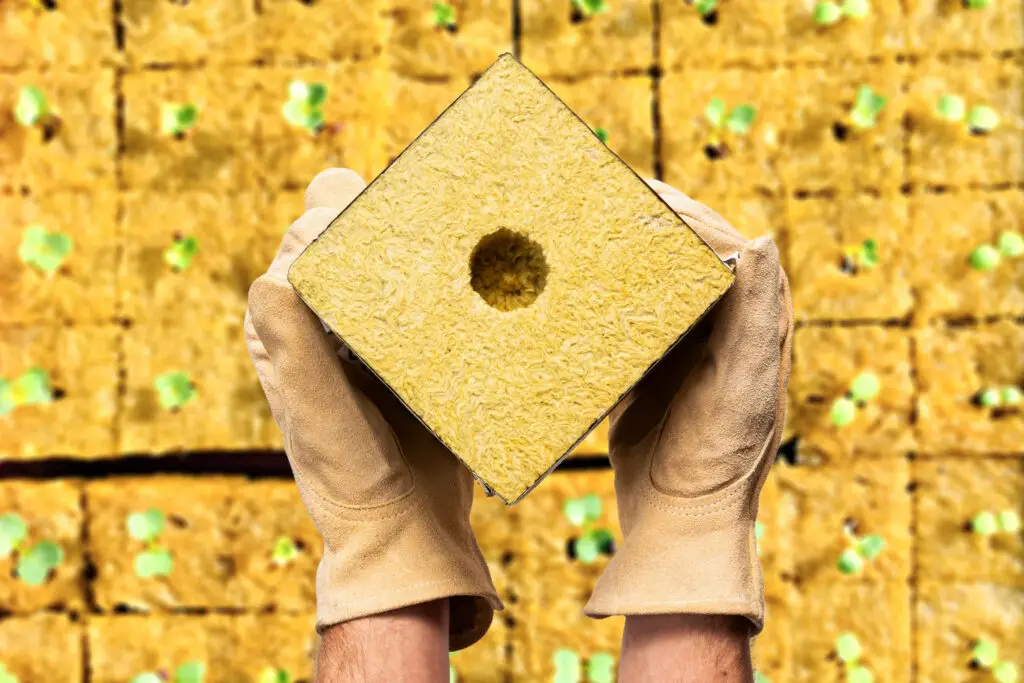
Rockwool is one of the most versatile and widely used grow media in hydroponics — prized for precise moisture control, excellent aeration, and a fully inert structure that puts the grower in complete control of nutrition. Whether you’re starting seeds and clones in small cubes or running a full commercial slab system, this guide covers everything you need to grow plants in rockwool successfully.
Growing at scale? Commercial slab culture, drip irrigation setup, and multi-room rockwool protocols are covered in the For Commercial Operations section below.
What Is Rockwool?
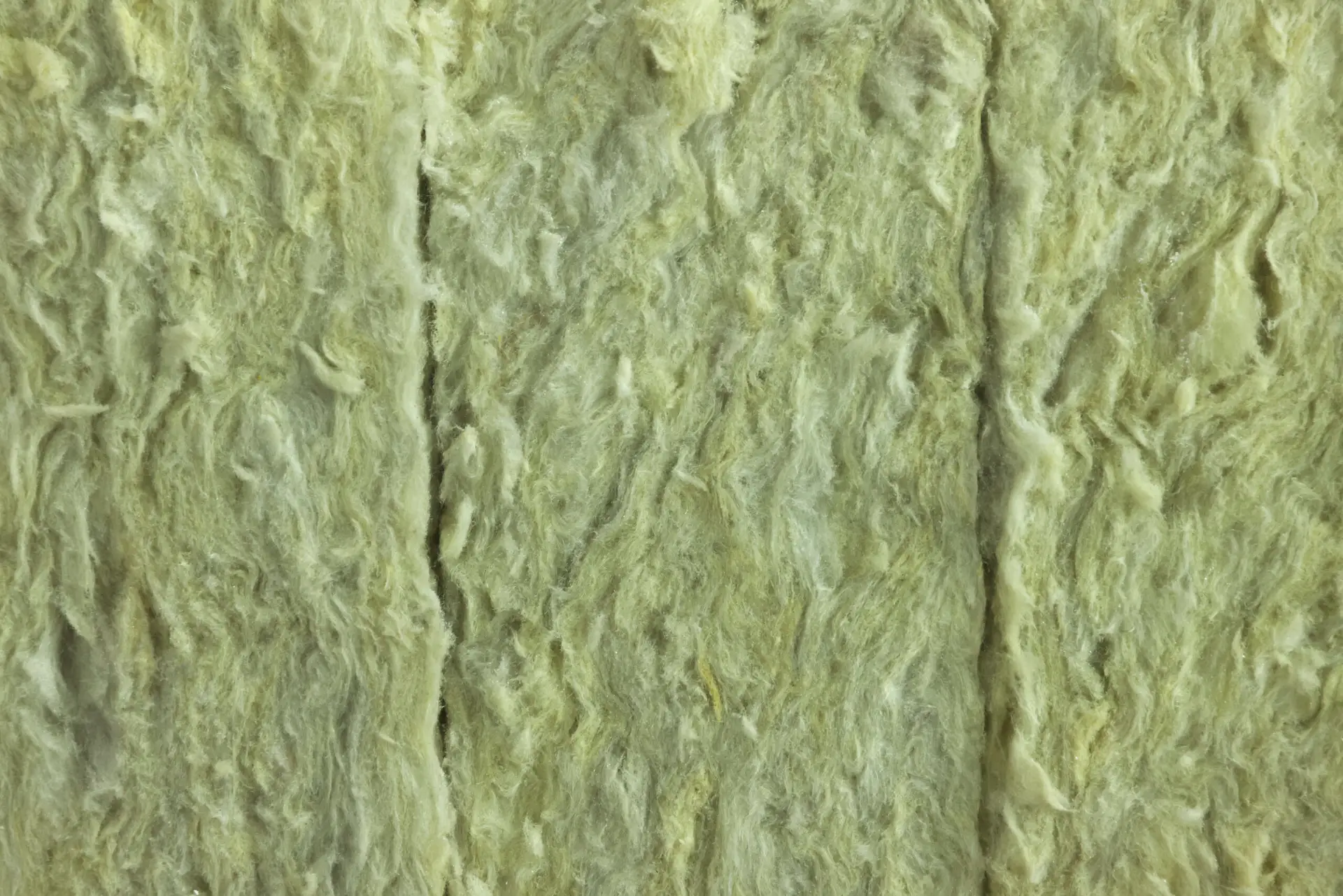
Rockwool is an inert, man-made substrate formed when basalt rock, chalk, and sand are melted together at extreme temperatures and spun into thin fibers — similar to the process used to make fiberglass insulation. The result is a dense, fibrous matrix with exceptional water-holding capacity and built-in air pockets that keep the root zone oxygenated.
Because rockwool provides zero nutrient charge (EC/PPM of essentially zero), it gives growers complete control over what the plant receives. There’s no buffering, no decomposition, and no hidden chemistry. What you put in is exactly what your plants get — making it the preferred media for precision cultivation, especially when growing hydroponically with a defined nutrient program.
One important distinction: “rockwool” also refers to building insulation material. When shopping online, results for generic “rockwool” often return construction products. Look for horticultural-grade rockwool from suppliers like VidaWool or Grodan, both available in our grow media collection.
Benefits of Growing Plants in Rockwool
Rockwool’s core advantage is simultaneous water retention and air porosity — a combination most substrates can’t match. Well-managed rockwool maintains roughly ~80% water-holding capacity with ~15% air-filled porosity, giving roots constant moisture access without oxygen deprivation.
Key advantages:
- Fully inert: No nutrient charge means zero interference with your feed program. EC readings reflect only what you’ve added.
- Consistent structure: Unlike coco or soil, rockwool doesn’t shrink, compact, or change physical properties across multiple cycles.
- Sterile: Manufactured at temperatures that destroy pathogens and weed seeds — no pre-treatment required beyond pH adjustment.
- Scalable format: From 1.5″ starter plugs to 36″ slabs, rockwool works at every production scale without switching systems.
- Reusable: With proper sanitation between cycles, quality rockwool blocks and slabs can be used for multiple runs.
- Precision irrigation-compatible: Rockwool’s consistent hydraulic properties make it ideal for drip irrigation and automated fertigation systems.
Where rockwool is less ideal: It requires more careful watering management than soil — particularly in the early stages — and its high initial pH demands preparation before use. Disposal also requires attention; rockwool is not biodegradable and should not be landfilled.
Rockwool vs. Other Growing Media
For growers choosing between media, the decision usually comes down to system type, crop, and operational scale.
| Media | Water Retention | Air Porosity | Inert? | Scalable to Commercial? |
|---|---|---|---|---|
| Rockwool | High (~80%) | Good (~15%) | Yes | Yes — slabs standard |
| Coco Coir | High | Good | Near-inert (slight K) | Yes — bags standard |
| Clay Pebbles | Low | Excellent | Yes | Yes — DWC/RDWC |
| Perlite | Low–Medium | Excellent | Yes | Mixed media only |
| Peat Moss | High | Low when compacted | No | Limited |
Coco is the most common alternative and suits many of the same systems. The key difference: coco has slight cation exchange capacity (minor K buffering), breaks down over time, and is biodegradable — rockwool has none of these properties. For growers using crop steering protocols, rockwool’s predictable hydraulic behavior gives more precise control over generative vs. vegetative steering. For more on media selection, see our definitive guide to hydroponic grow media.
Types of Rockwool for Plants
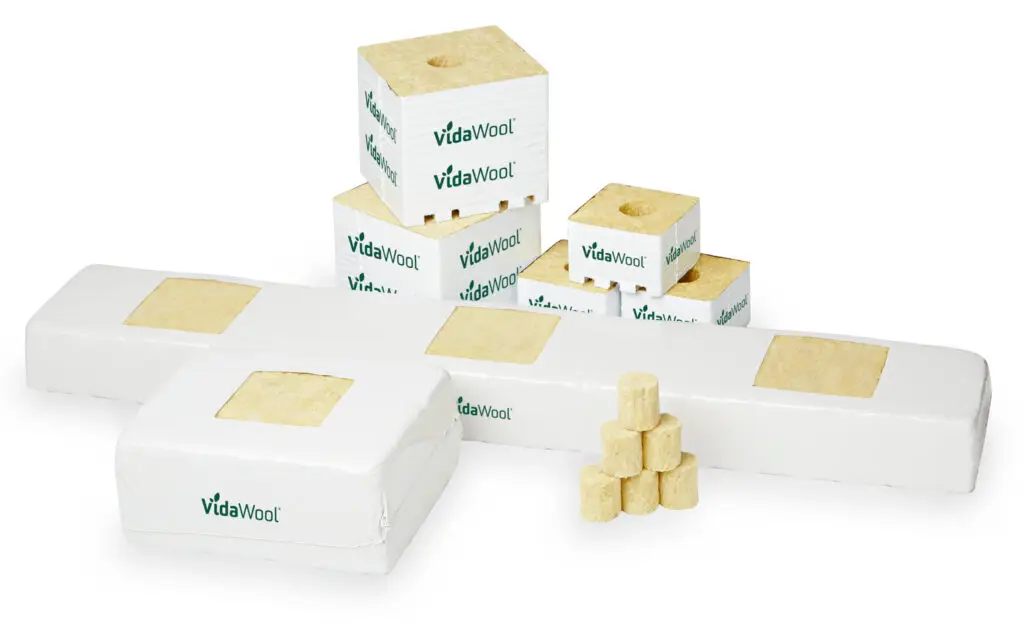
Rockwool comes in multiple formats, each matched to a specific growth stage. Choosing the right format matters — mixing the wrong sizes at transplant creates irrigation and rooting problems.
Starter Plugs / Propagation Plugs
Small-diameter cylindrical or square plugs designed for seed germination and clone rooting. Typically 1.5″ diameter, they provide just enough moisture and support for early root development without retaining too much water around a fragile root tip.
The VidaWool Rockwool Starter Plugs come in cases of 2,000 — the right format for consistent propagation at any scale. For a complete propagation setup that pairs with rockwool plugs, the iHort 50 Deep Prefilled Excel Plug Tray provides the structure and pre-filled media to get uniform germination from day one.
Cubes and Blocks
The workhorse format — used both for standalone growing and as the transplant vessel that sits inside larger slabs. Standard sizes range from 2″ veg cubes to 4″ and 6″ blocks for production grows.
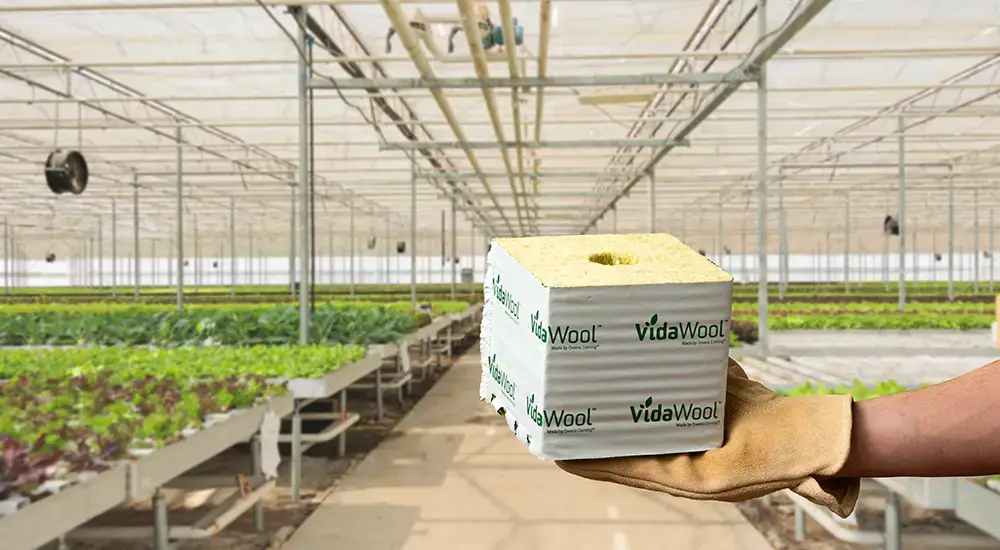
For hobby and mid-scale production, Grodan Gro-Block Improved is a reliable option available in multiple sizes. For commercial scale, the VidaWool Rockwool Block 190 with Hole, 6″ x 6″ x 5.3″ features VidaWool’s Hydro-Xtend™ water dispersion technology and UV-protection lining — meaningful advantages in multi-light environments where block exposure is common.
Slabs
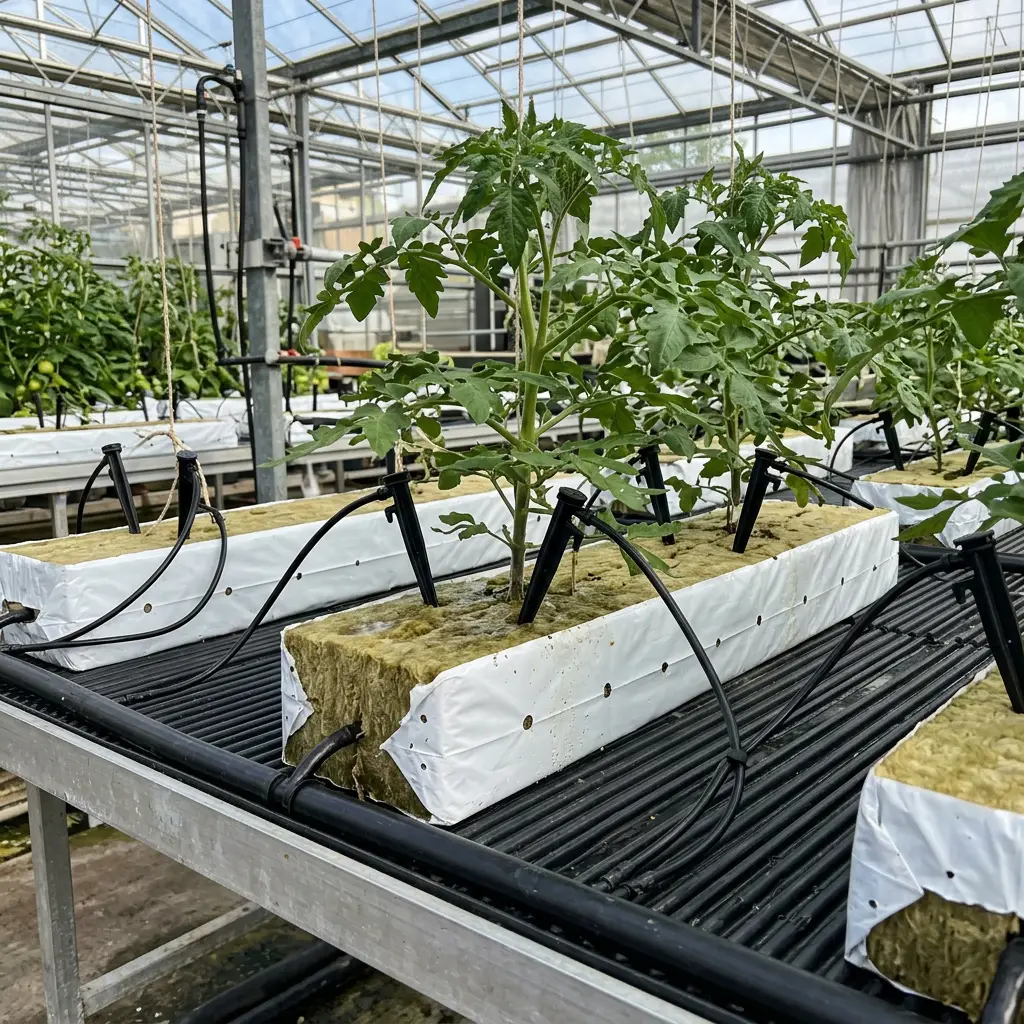
Horizontal slabs are the commercial format — a single slab supports multiple plants through an entire production cycle. They sit in trays or channels on benching, accept one or more drip stakes per plant site, and drain freely through pre-drilled holes. Standard slab dimensions run 3–4″ high by 6–8″ wide by 36–39.5″ long.
The VidaWool Rockwool Slab is available in both HC Slab (higher water-holding capacity) and HC Wide Slab variants to match different crop and irrigation strategies.
Grow Sheets
Pre-cut sheet formats used for high-density propagation and seedling production, often in commercial nursery or clone rooms. The VidaWool Grow Sheet comes in both wrapped and unwrapped versions in 98-hole sheets.
Block Covers
Once blocks are transplanted to slabs, covering exposed rockwool prevents algae growth and moisture evaporation. The HBX Block Cover, 6 Mil, Black/White Poly is sized for both 4″ and 6″ blocks — the black side down blocks light, white side up reflects it.
Shop by format:


How to Prepare Rockwool for Growing
Every piece of rockwool must be pH-adjusted before use. Fresh rockwool is alkaline — typically pH 7.5–8.5 — which will lock out phosphorus, iron, manganese, and other micronutrients if not corrected. This is the most commonly skipped step, and the cause of most early rockwool failures.

Step 1: Pre-Soak in pH-Adjusted Water
Mix a pre-soak solution buffered to pH 5.5–6.0 — slightly more acidic than your target growing range, because the alkaline rockwool will push the water’s pH up during soaking. Do not use nutrient solution for the pre-soak; plain pH-adjusted RO or filtered water is sufficient.
Submerge plugs, cubes, or blocks fully for a minimum of 1–2 hours. For slabs, soak for 2–4 hours or until fully saturated. After soaking, lift and gently shake off excess water — do not squeeze, which compresses the fiber structure and reduces air porosity. Target field capacity: moist throughout but not dripping. For accurate, repeatable pH management across your feed program, see our guide to nutrients and pH and our pH meter calibration guide.
Step 2: Allow to Drain to Field Capacity
After soaking, set blocks or slabs elevated on a wire rack or tray so excess water drains freely. Rockwool at field capacity should feel evenly moist but not waterlogged — the weight difference from fully saturated to field capacity is significant and you’ll learn to feel it quickly.
Step 3: Seed or Clone Insertion
Rockwool is ready to use once drained to field capacity and pH-verified (measure drain water — target 5.8–6.2). Insert seeds point-down into the pre-drilled hole of a starter plug, or gently seat a fresh clone cutting into the hole with minimal air gaps around the stem.
How to Water Rockwool
Rockwool requires a different watering mindset than soil. Because it retains water effectively but dries out somewhat at the surface, visual inspection is unreliable — a block can look dry on top while saturated at the bottom.
Hand watering: Water when the block feels notably lighter than at field capacity. With 6″ blocks, this typically means watering once or twice per day in late veg/early flower depending on plant size, VPD, and ambient temperature. Always water with pH-adjusted nutrient solution in the 5.8–6.2 range.
What not to do:
- Don’t water on a rigid schedule without feeling block weight
- Don’t oversaturate — sitting water at the base of a block restricts oxygen
- Don’t let rockwool dry out completely — unlike coco, recovery from true drought stress in rockwool can be slow and root damage may occur
Feed strategy: Rockwool’s inert nature means every watering should include nutrients at the appropriate EC for the growth stage. Unlike soil, there’s no nutrient reserve — missed feedings create immediate deficiency. For commercial operations integrating automated irrigation, see the Commercial Operations section below.
Why Growers Are Switching to VidaWool
VidaWool has become the preferred rockwool brand for serious commercial cultivators — not just because of origin (North American-manufactured, 50+ years of mineral wool innovation) but because of meaningful engineering differences.
Hydro-Xtend™ Water Dispersion Technology ensures even moisture distribution laterally through the slab, eliminating the dry zones that form in competing brands near the end of long slabs. In commercial slab culture with 3–5 plants per slab, uniform moisture distribution directly translates to uniform growth rates and yield consistency.
UV-Protection Lined Blocks resist degradation in high-light environments — a real issue in double-ended HPS and high-intensity LED rooms where block exposure is unavoidable between canopy gaps.
Sustainable manufacturing: VidaWool maintains lower environmental impact in production relative to conventional mineral wool — relevant for operations pursuing sustainability certifications.
VidaWool products are available in both retail case quantities and full commercial pallets:


How to Properly Dispose of Rockwool
Rockwool is not biodegradable and should not go to landfill. Because it doesn’t break down, it persists indefinitely in the environment if disposed of improperly.
Best disposal options:
- Recycle through manufacturer programs: Grodan and VidaWool both have recycling networks in North America. Contact your supplier to confirm current program availability in your region.
- Repurpose as soil amendment: Break used rockwool into small pieces (pea-size and smaller) and incorporate into outdoor garden beds. It improves drainage and moisture retention without altering soil chemistry. This is most practical for small hobby-scale volumes.
- Check local waste programs: Some municipalities have construction mineral wool recycling that accepts horticultural rockwool — call your local waste authority.
For large commercial volumes (pallets per cycle), establish a recycling protocol before starting — disposal logistics at scale require planning.
For Commercial Operations: Rockwool Slab Culture at Scale
Commercial slab culture is the production standard for tomatoes, cucumbers, peppers, and high-value crops grown hydroponically. A well-designed slab system with precise irrigation control can support yields that soil or even coco cannot match, with the consistency required for licensed operations.
Slab Selection
For commercial production, the primary choice is between HC Slabs (high water-holding capacity — more forgiving irrigation window, better for generative steering in late flower) and HC Wide Slabs (greater surface area for larger root systems and higher plant density). VidaWool’s commercial slab lineup covers both:
- HC Slab with Hole, 3″H x 6″W x 39.5″L — standard single-row format
- HC Wide Slab with Hole, 3″H x 8″W x 36″L — higher plant density and two-drip-stake configurations
Irrigation: Drip Stakes in Rockwool
Commercial rockwool requires automated drip irrigation for consistent results at scale. The Netafim WPCJ Drip Stake Assembly is the industry standard — pressure-compensating emitters maintain uniform flow rates across long slab runs regardless of line pressure variation. In rockwool slab culture, standard configuration is one drip stake per plant site, with short-duration, high-frequency irrigation events (4–8 minutes, 6–12 times per day depending on crop stage, DLI, and VPD).
For fertigation automation at scale, see our guide to how to choose a Dosatron system.
Crop Steering in Rockwool
Rockwool’s predictable hydraulic properties make it the preferred media for active crop steering — the practice of deliberately managing substrate water content to push plants toward vegetative or generative modes. Key parameters:
- Vegetative steering: Maintain higher substrate water content (WC), irrigate with smaller dry-back periods, higher nitrogen ratio
- Generative steering: Allow greater dry-back between irrigation events (10–25% WC drop), increase EC, shift K:Ca ratio
Rockwool is particularly well-suited to crop steering because its physical properties don’t change with repeated wet/dry cycles the way coco does over time. For a deep dive into the methodology, see What Is Crop Steering: Coco & Rockwool.
Block-to-Slab Transition
In commercial slab culture, plants are propagated in small plugs, transplanted to 4–6″ blocks for vegetative development, and then staged onto slabs before canopy develops. Timing matters: roots should be visible at the base and sides of the block before slab placement. Placing blocks on slabs too early results in slow colonization; too late creates root-binding and transplant stress.
Use HBX Block Covers on all exposed block surfaces once placed on slabs — uncovered blocks lose moisture unevenly and support algae growth under high-intensity lighting.
Why Shop at HydroBuilder for Rockwool
HydroBuilder carries the most complete commercial rockwool selection available online — VidaWool and Grodan blocks, slabs, starter plugs, and grow sheets in both retail cases and pallet quantities. As an authorized VidaWool partner, we stock the full range including pallet formats typically unavailable from general retailers. Our commercial team works directly with licensed cultivators on substrate selection, system design, and volume sourcing.
Contact our commercial team for facility-scale pricing and logistics support.
Rockwool for Plants: Frequently Asked Questions
Q: What pH should I soak rockwool in before planting?
A: Soak in water pH’d to 5.5–6.0. Fresh rockwool is alkaline (pH 7.5–8.5), so the pre-soak solution should be slightly more acidic than your target growing range to account for buffering. After soaking, measure drain water — target 5.8–6.2 before planting. This pH correction step is mandatory; skipping it causes immediate nutrient lockout.
Q: Can you reuse rockwool after a grow?
A: Yes, with proper sanitation. Remove root mass, rinse thoroughly, and sterilize between cycles. Most commercial growers get 2–3 cycles from quality slabs before compression and fiber breakdown reduce hydraulic performance. Blocks used for a single veg/clone cycle can often be reused more times than slabs that supported a full production run.
Q: How often do you water plants in rockwool?
A: Watering frequency depends on plant size, ambient temperature, VPD, and light intensity — not a fixed schedule. Small seedlings in propagation may need watering once every 1–2 days; large flowering plants in 6″ blocks under high-intensity lighting may need watering 2–3 times per day. Learn to judge by block weight rather than clock time. Commercial operations use automated drip irrigation with 6–12 short events per day.
Q: Is rockwool safe to use for growing plants?
A: Yes, horticultural-grade rockwool is safe for plant production. During dry handling, wear gloves and a dust mask — loose rockwool fibers are an irritant to skin and airways. Once wetted, these concerns are minimal for normal use. Avoid handling dry, friable used rockwool without protection.
Q: What is the difference between rockwool blocks and rockwool slabs?
A: Blocks are standalone cubed formats used during vegetative development or as single-plant containers. Slabs are long horizontal formats used in commercial production where multiple plants grow from one slab, irrigated via drip stakes. In a standard commercial workflow, plants propagate in plugs, develop roots in blocks, then transplant onto slabs for production.
Q: How do you prevent algae on rockwool?
A: Algae grows wherever wet rockwool is exposed to light. Cover all exposed rockwool surfaces with block covers or opaque poly film, keep rockwool collections from being flooded with standing nutrient solution, and maintain adequate air circulation. In production rooms, unexposed rockwool (under a plant canopy) rarely has algae issues.
Q: Does rockwool need nutrients added to every watering?
A: Yes. Rockwool is fully inert — it provides zero nutrients. Every irrigation event should include a complete nutrient solution calibrated to the crop stage. Unlike soil, there is no nutrient buffer or microbial release to fill gaps between feedings. Missing a feeding in rockwool is immediately visible within 24–48 hours in sensitive crops.
Q: What is the best rockwool for commercial cannabis production?
A: For licensed commercial cannabis, VidaWool HC Slabs and Block 190 are the current standard in North American facilities. VidaWool’s Hydro-Xtend™ technology provides more uniform lateral moisture distribution than competing brands — critical for consistent plant development across long slab runs. Grodan remains a strong alternative with a longer commercial track record internationally.
Q: Can rockwool be used in a DWC or deep water culture system?
A: Not typically. Rockwool is designed for drip or flood-and-drain systems. Its water-holding capacity is too high for submersion-based systems where roots float directly in oxygenated solution. For DWC systems, net pots with clay pebbles or purpose-made netted media are standard. Rockwool is most at home in slab/drip, ebb-and-flow, and NFT systems.
Q: How is rockwool different from coco coir for hydroponics?
Rockwool is inert with no cation exchange capacity; coco has minor K/Ca exchange activity. Rockwool has more consistent physical properties across multiple cycles; coco breaks down over time. Rockwool is non-biodegradable; coco is organic and biodegradable. For crop steering, rockwool gives more predictable hydraulic behavior. Coco is generally more forgiving for hand-watering growers and requires less precise pH pre-treatment. Read more in our growing in coco guide.