

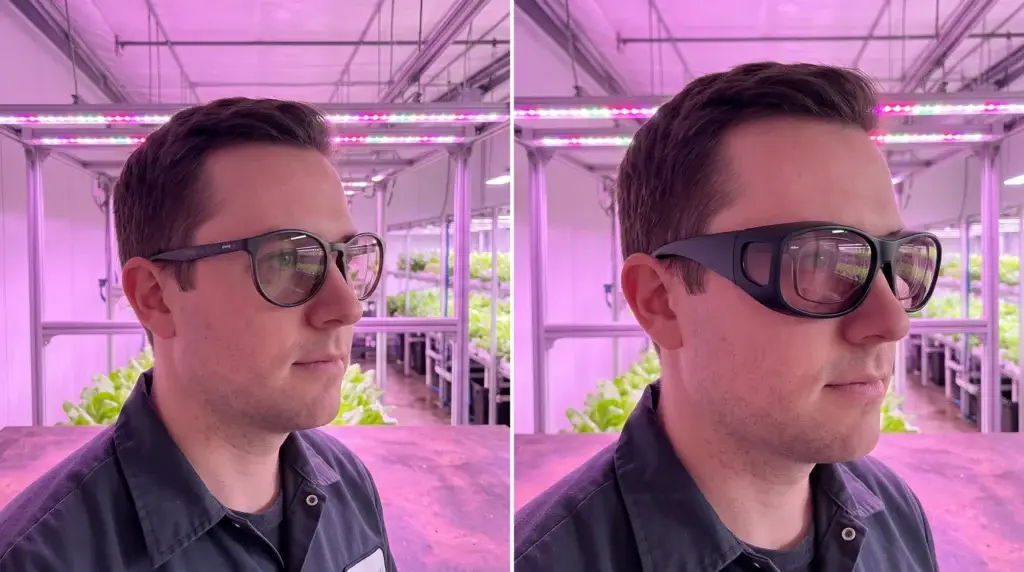
Grow room glasses do two separate jobs, and most listings blur them. The tinted lens corrects color so you can read leaves for pests and deficiencies: green for red-and-blue (“blurple”) LEDs, blue or a dedicated HPS lens for sodium light, and gray for white full-spectrum LEDs. Protection is a different claim, and it only counts when the maker names a rating or standard you can check. If you move between rooms, a three-lens kit covers all three lights. If you run HPS and want a named impact rating, Method Seven’s HPS+ frames list ANSI Z87+S. Never judge protection by how dark the tint looks.
Color Correction and Eye Protection Are Separate Claims

Color correction is a viewing aid. AC Infinity describes its lenses as made to "neutralize the color of your grow light" for a color-accurate look at the plants. Method Seven says its HPS+ lenses use notch filtering to restore natural color so pests and nutrient problems are easier to spot. Both are claims about what you see. Neither says anything about what reaches your eyes or what happens if something hits the lens.
Protection claims have to stand on their own evidence: a stated UV rating, a named impact standard such as ANSI Z87.1, a marking on the frame and lens, or a test the maker can point to. Listings range from a full set of named standards to nothing at all. Grow1's Gruve listings say the glasses reduce "exposure to potentially harmful radiation" but give no standard, rating or percentage. Active Eye's HPS listing names an FDA regulation and ANSI Z87.1. Same shelf, very different paperwork, and that gap is what you're really shopping on.
A tinted lens also doesn't diagnose anything. It makes a magnesium-deficient leaf or a mite stipple easier to see, but confirm what you think you see by pulling a leaf into neutral white light before you treat.
Match the Lens Color to Your Light

The two three-lens kits we carry, from AC Infinity and Vivosun, use the same color logic: green for blurple LEDs, blue for amber, yellow or HPS light, and gray for full-spectrum white light. Dedicated HPS glasses skip the kit and build one lens for sodium light.
| Your light | What it does to how plants look | Lens the makers pair with it | Options we carry |
|---|---|---|---|
| Blurple (red and blue) LED | Leaves look purple or nearly black | Green lens | AC Infinity and Vivosun kits; Grow1 Gruve LED (listing doesn't say which LED spectrum) |
| White full-spectrum LED | Close to natural but very bright | Gray lens | AC Infinity and Vivosun kits |
| HPS | Heavy orange and yellow cast | Blue kit lens, or a dedicated HPS lens | Kits, plus Active Eye HPS, Method Seven HPS+ and Grow1 Gruve HPS |
| CMH or LEC | Whiter than HPS, varies by lamp | Lens the maker names for CMH | Check the maker's guidance; no dedicated CMH lens in stock today |
Blurple LED rooms
Red-and-blue fixtures throw a magenta cast that makes healthy leaves look sick and hides real problems. A green-tinted lens is the fix, and it's tuned for that one spectrum. One eBay buyer of a blurple-oriented pair put it plainly: under blurple light the leaves looked naturally green, but anywhere else everything looked cyan. Method Seven's own site makes the same point about its Cultivator Blurple LED lens, which it lists for "blurple, pink, or magenta spectrum LED lighting" and marks "Not for use with white full spectrum LED lights."
White full-spectrum LED, CMH and LEC
Modern white LED bars look close to daylight, so the job is more about brightness and a slight color shift than a heavy correction. That's why the kits use a gray lens here. Method Seven sells separate full-spectrum lenses (its FX line) designed for full-spectrum LED or CMH lighting, but we don't carry those right now. If you're still choosing fixtures, our guide to LED grow light options covers how white and red-heavy spectrums differ.
HPS rooms
Sodium light is the hardest to see through, and it's where the dedicated lenses earn their price. The polymer HPS+ lenses on Method Seven's Cultivator and Citadel frames are made by Carl Zeiss; the Evolution uses a German mineral glass lens with a silver coating meant for double-ended HPS fixtures, and our product listing adds rooms above 10,000 watts. If you run 1000W DE fixtures, our roundup of HPS grow lights covers the lamps themselves.
Mixed rooms and moving between rooms
None of our listings claims a single lens for a room running HPS and LED together. If you split time between an HPS flower room and an LED veg room, a three-lens kit lets you swap lenses at the door. Our sales team's experience is that LED glasses hold up reasonably well under LED, HPS and outdoors. HPS lenses lack some of the wavelengths LEDs and the sun give off, but in an HPS room they give truer color than LED lenses. So if you own one pair and work mostly under HPS, make it an HPS pair. In a true mixed room, test the HPS-matched lens against the gray lens under your actual light, and check a leaf you already know is healthy: keep whichever lens shows it as plain green rather than tinted blue or orange.


Grow Room Glasses Compared by What the Maker States

Every entry below is the manufacturer's claim as given on our product listing on October 28, 2026. None of it is independent test data.
| Glasses | Lens setup | Light the maker lists | Protection claim on the listing | Standard named |
|---|---|---|---|---|
| AC Infinity Grow Room Glasses | 3 swappable polycarbonate lenses, wraparound frame, padded lining | Red/blue LED, amber or warm white, full spectrum and sunlight | UV 400+, blocks UVA and UVB | None |
| Vivosun Indoor LED Anti-UV | 3 swappable lenses, fits over prescription glasses | Red/blue LED, yellow or HPS, full spectrum | UV 400+, shields UVA and UVB | None |
| Grow1 Gruve LED | Single lens | LED (spectrum not stated) | Reduces exposure to "potentially harmful radiation" | None |
| Grow1 Gruve HPS | Single lens | HPS and MH | Same wording as the LED version | None |
| Active Eye HPS | Single lens, polycarbonate frame | HPS | 100% UVA, UVB and UVC | FDA 21 CFR 801.410 and ANSI Z87.1 impact |
| Method Seven Cultivator HPS+ | Zeiss polymer lens, half-jacket frame | HPS | Blocks UV and near-infrared | ANSI Z87+S and CSA Z94.3 |
| Method Seven Citadel HPS+ | Zeiss polymer lens, wrap frame | HPS | Blocks UV and near-infrared | ANSI Z87+S |
| Method Seven Evolution HPS+ | Mineral glass lens, TR90 frame | HPS, including DE and rooms over 10,000 W | UV and infrared protection | None in the product text |
If you move between LED and HPS rooms
The AC Infinity Grow Room Glasses are the simplest fix for a grower with more than one kind of light: three polycarbonate lenses, a wraparound frame with a removable padded lining, and clear color guidance for each lens. There's no named impact standard, so don't count on them for anything beyond the UV claim. The Vivosun Indoor LED Anti-UV Grow Room Glasses follow the same three-lens plan, with a frame built to go over prescription glasses plus a case and cloth.
If you run HPS and want a named impact rating
Method Seven is the brand customers tend to favor, in our sales team's experience. The Method Seven Cultivator HPS Plus is the entry point to Zeiss-made notch-filter lenses and lists both ANSI Z87+S and the Canadian CSA Z94.3 standard. The Citadel HPS Plus puts the same lens in a fuller wrap frame and lists ANSI Z87+S. The Method Seven Evolution Perfect Color HPS Plus moves to scratch-resistant mineral glass that won't haze. It's the priciest pair here, and its product text doesn't list a Z87 rating, so buy it for the optics and check the frame stamp if impact matters.
If you want a lower-cost single-purpose pair
The Active Eye HPS Growroom Lenses cost well under the Method Seven line and still name the FDA impact rule and ANSI Z87.1 on the listing. For the lowest cost, Grow1 makes the Gruve glasses for LED lights and a Gruve HPS version. They're color tools. The listings give no rating, standard or percentage for their protection wording, so treat them that way.


What Grow Lights Actually Do to Your Eyes
With horticultural LEDs, the main concern is blue light, not UV. For anyone working under full-spectrum LEDs for hours a day, HydroBuilder's sales team doesn't hedge: if you want to keep seeing well for the long haul, eye protection isn't optional. A Dutch industry leaflet from Stigas and Glastuinbouw Nederland, written with NSVV, Wageningen University and Signify and reported by Hortidaily in May 2023, says standard assimilation LEDs contain little to no UV or infrared and aren't considered hazardous to skin. It names blue light in the 400 to 500 nm range as the concern, with possible retinal damage after prolonged viewing, and says risk depends on wavelength, exposure time, intensity and distance. Treat that as industry guidance, not a US rule.
Some fixtures do add UV diodes, and supplemental UV-B bars are built to emit it. Check the spec sheet for any UV channel. With UV in the room, glasses only cover your eyes, so long sleeves and gloves matter too. Our article on UV light for plants covers that equipment.
Fixtures are tested and sorted into photobiological risk groups, RG0 through RG3, under the lamp safety standard IEC 62471. Hortidaily reported in December 2025, crediting the Dutch advisory group DLVge, that under Dutch rules RG3 fixtures aren't permitted where people work. With RG2, you never look into the source and you keep the maker's prescribed distance; where that distance can't be kept, special safety glasses are mandatory in the Netherlands. In the US and Canada, horticultural fixtures certified to UL 8800 get a photobiological assessment consistent with IEC 62471, and according to In Compliance Magazine (October 2020), RG3 isn't permitted for horticultural lighting under that standard. Ask your fixture maker for the risk group and follow the cautionary markings on the fixture.
Distance is still the cheapest control. Hang lights at the height the manual gives and don't look straight up into a running fixture, with or without glasses. Our guide to setting up grow lights covers hanging height and layout.
How to Read the Protection Claims on a Listing

"UV 400" is the maker's own claim
AC Infinity and Vivosun both list "UV 400+" and say their lenses block UVA and UVB. Neither listing names ANSI Z87.1, a test lab or a light transmission figure. AC Infinity's own product page, checked October 28, 2026, states no visible light transmission percentage for any of its three lenses. Read UV 400 as a UV filtering claim. It isn't an impact rating, and it isn't a splash rating.
Z87 and Z87+ are impact markings
NIOSH explains that industrial safety eyewear is marked Z87 for normal safety wear and Z87+ for high impact, and that the rating is required on both the frame and the lens. It also notes that ordinary eyewear is usually stamped ANSI Z80, an ophthalmic standard for qualities like clarity, which does not indicate an industrial protection level (NIOSH, June 2022).
The Cultivator HPS+ listing reads "meets or exceeds ANSI-Z87+S & CSA-Z94.3," and the Citadel HPS+ "meets or exceeds ANSI-Z87+S." On its own site, where these models are now sold as HPS Classic, Method Seven calls the Cultivator an "ANSI Z87+S and CSA Z94.3 safety rated frame." Our Cultivator listing also writes it as "MSZ87+S" in one spot, so look for the actual stamp on both frame and lenses when the pair arrives. The Evolution's product text talks about UV and infrared protection but doesn't mention Z87. Z87+ tells you about impact. Z87.1 also has lens markings for filtering, including U for ultraviolet and R for infrared. If the lens carries neither mark, ask the maker for test documentation on that exact lens.
The FDA impact rule covers all eyeglasses and sunglasses
Federal rules require eyeglasses and sunglasses sold in the US to have impact-resistant lenses. The referee test drops a 5/8-inch steel ball, about 0.56 ounce, from 50 inches onto the lens, and the lens must not fracture (21 CFR 801.410). Active Eye says its HPS lenses exceed this rule and the ANSI Z87.1 impact standards, and that they pass UVA, UVB and UVC testing. The listing doesn't say whether that means basic (Z87) or high-impact (Z87+), and it doesn't name a lab or share a report, so check the mark on the frame and lens. It's still a maker's claim with named standards behind it, which is more than most listings give you.
OSHA's rule is written for employers
A home grower isn't covered by OSHA's eye and face protection rule, and none of the grow glasses we carry lists the filter shade number it calls for. For licensed facilities with employees, the rule (29 CFR 1910.133) requires:
- eye protection against hazards including liquid chemicals and "potentially injurious light radiation"
- side protection where there's a flying object hazard
- devices meeting ANSI Z87.1-2010, 2003 or 1989 (R-1998)
Its shade table lists welding, cutting, brazing and soldering, not grow lights. Our sales team isn't aware of commercial buyers asking for Z87.1-rated grow glasses, so if your facility needs that rating, ask for it by name. The person responsible for safety should assess your actual fixtures and tasks, and grow glasses may be only one piece of what they specify.
Mistakes That Cost Growers a Clear Look at Their Plants
Mixing up LED and HPS glasses is one the sales team sees customers make. An HPS lens pulls out orange and yellow, so under a blurple fixture the canopy just looks wrong, and you'll start chasing problems that aren't there. Match the lens to the light, or swap lenses at the door.
Trusting a dark tint is another. Darker only cuts visible light; it says nothing about UV filtering or impact resistance.
Spraying with grow glasses still on is a bigger mistake than it sounds. OSHA lists liquid chemicals as a separate eye hazard from light, and the pesticide label is the rule for what eye protection to wear while mixing and spraying. Color filtering adds nothing against splash, so swap to the eyewear the label calls for.
Don't push the glasses up to stare into a fixture and find a hot spot, either. A PAR meter, or a look at the canopy from the side, tells you more.
Gaps at the sides are the last one. Clip-on lenses and loose frames let light in around the edge, where it never passes through the lens. A wrap frame or a close-fitting fit-over frame covers more.
Fit, Prescription Glasses and Getting Used to the Tint
If you wear prescription glasses, you need a frame built to go over them or a pair made with your prescription. OSHA's rule asks employers for the same thing on the job: eye protection that includes the prescription or fits over prescription lenses without knocking either pair out of position. Vivosun says its frame fits over prescription glasses. For any other pair, try it with your own glasses on before you rely on it for a long day in the room.
Scratches and haze cost you the clarity you bought the glasses for. Clean them the way the maker directs. Vivosun includes a lens cloth and case, and Active Eye's pouch doubles as a cleaning cloth.
Frequently Asked Questions
Are regular sunglasses good enough in a grow room?
For reading plants, usually not. Sunglasses darken all the light evenly, so under HPS or blurple LEDs the canopy is still orange or purple, only dimmer. Method Seven makes this point about sunglasses in its own listings. Some filter UV and some don't. A grow lens matched to your light gives truer color, and its protection claims still need checking.
Can I take plant photos under HPS light without the orange cast?
Yes, with a camera filter instead of glasses. Method Seven makes the Catalyst HPS Phone and Tablet Filter, which brings its HPS color correction to a phone or tablet camera. That helps when you're sending photos to someone for a second opinion on a deficiency or pest. Without it, photos under HPS look orange and can make healthy leaves look yellowed.
Do grow room glasses reduce eye strain?
AC Infinity and Vivosun both say their lenses ease eye strain under grow lights, and Method Seven says poor lenses cause fatigue and headaches. Those are maker claims, not test results. If you get headaches, spots or blurred vision that don't go away after leaving the room, see an eye care professional rather than switching lenses.
Which lens should I wear in a greenhouse under natural sunlight?
AC Infinity lists its gray lens for full-spectrum light and sunlight, so in a sunlit greenhouse the gray lens from a three-lens kit is the maker's pick. If the greenhouse runs supplemental HPS at night or on dark days, switch to the HPS-matched lens whenever the lamps are carrying most of the light.
You can compare every pair, from three-lens kits to Zeiss-lensed HPS frames, in our grow room glasses and eyewear collection.