Your grow room electricity costs are one of the most predictable—and controllable—expenses in indoor cultivation. Whether you’re running a single tent in a spare bedroom or managing multiple rooms in a commercial facility, understanding what your setup actually draws in kilowatt-hours is the first step toward smarter, more profitable growing.
Use the calculator below to estimate your daily, monthly, and yearly electricity costs based on your actual equipment—lights, fans, AC, dehumidifiers, CO₂ systems, and more.
Bridge Statement: This guide is built for all growers. If you’re running a 4×4 tent or a 4,000-square-foot facility, the same core formula applies—what changes is scale, equipment voltage, and how aggressively you can optimize. Scroll to the commercial operations section for facility-specific workflow guidance.
How to Use the Grow Room Electricity Calculator
The calculator is straightforward. Enter your actual power draw—not advertised or “equivalent” watts—for each device, along with daily runtime and your local electricity rate ($/kWh). The tool calculates your costs on a daily, monthly, and yearly basis.
Here's what to enter for each device category:
Grow Lights: Use the nameplate wattage from your driver or ballast spec sheet, not the marketing equivalent. A fixture listed as “1000W HPS equivalent” may draw 650W actual – that difference matters on your bill. If you’re running LED grow lights, check the driver label or the product spec sheet for true draw.
Ventilation & Fans: Inline fans, oscillating fans, and exhaust systems typically run at lower wattages individually, but many run 24/7. Enter each fan separately for accuracy so total runtime is reflected correctly.
Climate Control: AC units, dehumidifiers, and heaters often equal or exceed lighting costs depending on your climate, room size, and sealing. Enter the rated wattage and estimated daily runtime; AC units cycle on and off, so use a realistic runtime estimate (typically 50–70% duty cycle in many rooms) rather than 24 hours unless you know they truly run continuously.
Other Devices: CO₂ injectors, water pumps, timers, and controllers add up. They may seem minor individually, but in an always-on environment, they contribute meaningfully to your monthly total and should be included for accurate budgeting.
Your Electricity Rate: Check your utility bill for your rate in dollars per kilowatt-hour ($/kWh). Rates in the US typically range from about $0.08 to $0.30/kWh depending on location, time-of-use tier, and utility provider, and commercial accounts often have demand charges on top of consumption rates—see the commercial section below.
Performance note: All cost estimates depend on your actual equipment wattage, local utility rates, and daily runtime. Climate, room insulation, and equipment efficiency ratings will affect real-world results, so treat calculator outputs as planning estimates rather than exact bills.
What Devices Consume the Most Electricity in a Grow Room?
Grow room power consumption breaks down into four main categories. Understanding where your watts go helps you prioritize where to reduce costs.
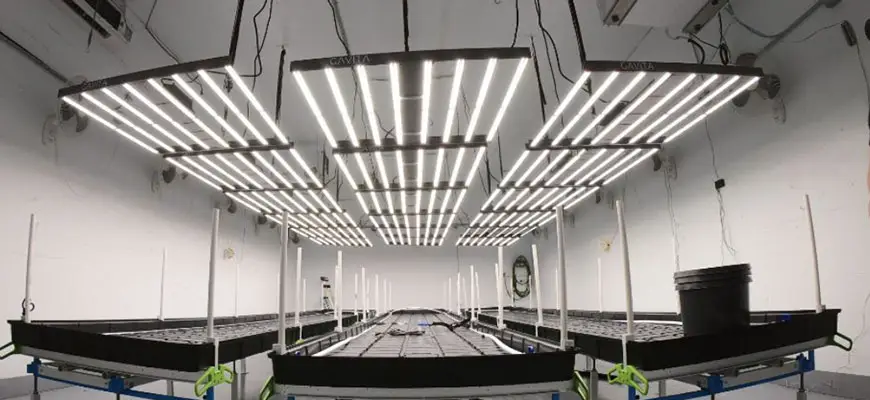
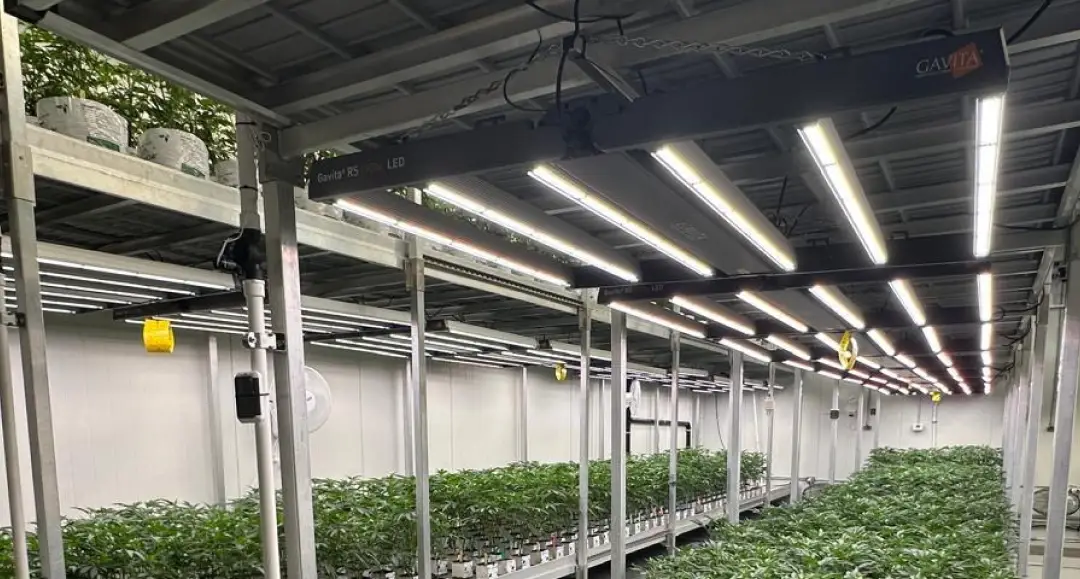
Grow Lights are the largest single draw for most cultivators. A room with ten 1,000W HID fixtures running 18 hours/day at $0.15/kWh costs roughly $810/month from lighting alone, assuming a 30-day billing period. Modern high-efficiency LEDs can reduce this significantly—commercial-grade bar-style fixtures in the 650–720W range often replace 1,000W HPS fixtures while maintaining comparable or superior yields when PPFD and distribution are properly matched to the canopy. Our LED vs. HPS guide covers the efficiency comparison in detail.
Climate Control (AC and dehumidification) is frequently the second-largest draw. In sealed rooms, dehumidifiers and AC units work hardest during the lights-on period when lighting heat loads are highest. In warmer climates or poorly insulated spaces, climate control can equal or exceed lighting costs. Refer to our grow room air conditioner sizing guide and dehumidifier sizing calculator to right-size your equipment—oversized equipment wastes electricity cycling on and off inefficiently and may control humidity and temperature less precisely.
Ventilation & Fans tend to draw lower individual wattages but run continuously. An inline fan rated at 150W running 24 hours/day, 30 days/month at $0.15/kWh costs about $16/month, and that cost scales with your rate and runtime. Multiply that across three to five inline fans, circulation fans, and exhaust systems, and it adds up to a meaningful share of total energy use.
Ancillary Equipment—CO₂ generators, water pumps, controllers, and timers—typically contribute around 5–15% of total draw. CO₂ burners can be a meaningful load during their active periods because they also add heat to the space. Use the “Other Devices” section of the calculator to capture this accurately and avoid underestimating your total usage.
The Basic Electricity Cost Formula
If you want to run the numbers yourself before entering them in the calculator, the formula is simple:
Monthly Cost = (Watts ÷ 1,000) × Hours Per Day × Days Per Month × $/kWh
Example: A 1,000W HPS grow light running 18 hours/day for 30 days at $0.15/kWh:
(1,000 ÷ 1,000) × 18 × 30 × $0.15 = $81/month per fixture
Ten fixtures running the same schedule = $810/month from lighting alone, before any climate control, ventilation, or ancillary equipment are factored in.
For a complete picture, the calculator handles multiple devices simultaneously and gives you a daily, monthly, and yearly breakdown at once based on your actual inputs.
How to Reduce Grow Room Electricity Costs Without Hurting Yield
Small improvements in efficiency compound over time. Here are the highest-impact changes, in order of return on investment.
1. Switch to High-Efficiency LED Grow Lights
Modern high-efficiency LEDs produce more grams per watt than HPS in controlled conditions—while drawing fewer actual watts. The Growers Choice ROI-FF 650W LED Grow Light is a strong example: it has a 650W rated input power, a 1,950 µmol/s PPF output, and a 3.0 µmol/J efficacy rating according to manufacturer specifications, which places it at the high end of commercial-grade efficiency. At this output level, it can replace a 1,000W DE HPS fixture in many flowering applications while reducing lighting draw by roughly 35%, assuming comparable PPFD at canopy and appropriate fixture spacing and mounting height. That reduction in wattage also cuts the heat load your AC and dehumidification systems must manage, creating a secondary savings on climate control that is frequently underestimated.
For growers on a tighter budget or in smaller spaces, the Growers Choice ROI-E420 LED Grow Light draws about 420W with 2.6 µmol/J efficiency—a strong choice for 3.5×3.5 to 4×4 flower footprints in typical indoor cannabis rooms with optimized hanging height and environmental control. At typical utility rates and a 12-hour flower photoperiod, it costs roughly $11–$14/month to operate per fixture at $0.12–$0.15/kWh, assuming a 30-day month.
2. Right-Size Your Climate Control Equipment
Oversized dehumidifiers and AC units cycle rapidly (short-cycling), which wastes electricity and reduces equipment lifespan. Use our dehumidifier sizing calculator and BTU calculator to match equipment capacity to your actual load before purchasing, then confirm selections against manufacturer performance tables and, for larger facilities, HVAC design guidance. An appropriately sized unit running at around 70–80% capacity typically runs more efficiently and maintains tighter environmental control than an oversized one at a 30% duty cycle.
3. Monitor Your Environment With Accurate Data
You can’t optimize what you don’t measure. The HBX Thermo-Hygrometer with LCD Display is a reliable, cost-effective way to track temperature and humidity with Min/Max memory across lights-on and lights-off cycles. This data tells you whether your climate control equipment is running longer than necessary and whether your grow room environment is in the range where plants use light and nutrients efficiently, so you can make changes that save power without compromising plant health.
4. Optimize Light Schedules by Growth Stage
Vegetative plants running an 18/6 photoperiod cost more per month than flowering plants on 12/12 because total daily hours of operation are higher. If you’re using a perpetual grow model, accurately tracking which rooms are in which stage and their associated costs helps you budget correctly and identify where schedule changes might reduce peak loads. Use our grow light coverage calculator to confirm you’re running the right fixture count for your canopy size—unnecessary fixtures are pure waste with no yield benefit.
5. Automate and Control Your Equipment
Manual adjustments are error-prone and labor-intensive. Automating your lights, fans, and climate control through an environment controller reduces runtime waste and prevents equipment from running during periods it isn’t needed. The TrolMaster Hydro-X Environmental Control System integrates lighting, temperature, humidity, and CO₂ management on a single platform through compatible control modules, with programmable setpoints and alert thresholds. The included 3-in-1 sensor monitors temperature, humidity, and light levels so you have accurate room data without guesswork; additional CO₂ sensors and device stations can be added as needed. Over a 12-month crop cycle, automated setback schedules can meaningfully reduce total runtime across all devices compared to manual operation.
6. Factor in Time-of-Use Rates
Many utilities offer time-of-use (TOU) pricing, where electricity costs more during peak hours (often late afternoon and early evening) and less during off-peak periods. Running your lights-on cycle during overnight off-peak hours can reduce your effective $/kWh rate significantly, especially for large rooms or multi-room facilities; always confirm actual TOU windows and rate differentials with your utility. Check with your utility provider and use the advanced TOU mode in the calculator (if available) to compare scenarios and identify the schedule that best balances plant needs, labor, and cost.
Understanding Advertised Watts vs. Actual Draw
One of the most common errors in grow room budgeting is using a fixture’s advertised or “equivalent” wattage instead of its actual power draw. This matters because your electricity meter—and your bill—measures actual watts consumed, not marketing equivalents.
Actual wattage is what the driver or ballast draws from the wall. This is the number to use in the calculator and in all cost projections, and it should match the fixture’s input power specification within normal tolerances.
Advertised or equivalent wattage (common in older LED panel marketing) compares perceived output to an HPS reference. A “1000W equivalent LED” might draw only 450–600W actual—which is actually good news for efficiency, but you still need the real number for accurate cost calculation.
Where to find actual wattage:
- The driver or ballast specification label on the fixture
- The product spec sheet (look for “actual power draw” or “input power”)
- The product page on HydroBuilder (spec sheets linked on most products)
For HID lights (HPS, MH, CMH), the ballast wattage is typically close to the actual draw, though digital ballasts running at reduced settings (e.g., 50%, 75%) draw less than their maximum rating. Check your ballast’s operating spec and dimmer setting before entering numbers in the calculator.
Common Equipment Wattage Reference
Use these as starting estimates if you don’t have exact specs. Actual draw varies by brand and model—always verify against your specific product specs or nameplate ratings.
Always use actual nameplate or spec sheet data for accurate results, and consult manufacturer documentation for continuous versus peak draw where available.
For Commercial Operations
Demand Charges: The Hidden Cost on Commercial Utility Bills
Home growers pay only for energy consumed (kWh). Most commercial utility accounts include a demand charge—a fee based on your peak power draw (measured in kilowatts) during a defined billing window, typically the highest 15-minute average draw recorded that month.
In a facility running 40 × 1,000W HID fixtures on a single schedule that all power on simultaneously, that 40kW peak can generate a demand charge that, in some utility tariffs, approaches or even exceeds the consumption charges for the same billing period. Staggering light-on schedules across rooms to smooth the peak load is one of the most effective ways commercial operators reduce their effective electricity cost per kilowatt-hour under demand-based rate structures.
Commercial Energy Benchmarks
Well-optimized indoor cannabis cultivation facilities often target roughly 1.5–3.5 kWh per gram of dry flower, depending on climate zone, lighting technology, HVAC/dehumidification design, and how tightly environmental setpoints are controlled. Facilities running older HID systems in warm climates without efficient dehumidification often see 4–6+ kWh/gram, especially if vapor pressure deficit and airflow are not optimized.
Tracking this metric against your electricity bill gives you a meaningful benchmark for operational efficiency over time and helps quantify the impact of equipment upgrades or schedule changes.
Automation at Commercial Scale
At multi-room scale, manual monitoring is not practical. The TrolMaster Hydro-X Environmental Control System supports multi-room deployment with per-room programming, alert thresholds, and relay stations for controlling lighting, dehumidifiers, fans, CO₂ systems, and HVAC from a centralized interface. Facilities running 10+ rooms benefit substantially from automated setpoint management versus manual adjustments, both in labor savings and in avoiding costly environmental events (humidity spikes, temperature excursions) that waste energy without benefiting the crop.
The HBX Thermo-Hygrometer works as a low-cost, room-by-room redundant check alongside controller sensors—particularly useful during power cycles, equipment failures, or during facility audits where independent readings are helpful for verification.
Lighting Efficiency Upgrade Path
For commercial facilities evaluating an HPS-to-LED conversion, the energy analysis starts with calculating your current lighting cost per flowering canopy square foot per week, then comparing it to the same metric under a proposed LED specification. At $0.12/kWh across a 10,000W HPS room (10 × 1,000W), lighting alone runs approximately $432/month during a 12/12 flower cycle, assuming a 30-day month. Converting to 650W-class LED fixtures reduces that to approximately $280/month for the same total number of fixtures—before accounting for reduced AC load from lower heat output and any changes in fixture count or PPFD targets.
Pair this analysis with our LED vs. HPS comparison guide to model the full payback period including fixture cost, reduced HVAC load, maintenance savings, and improved lamp life.
Why Shop at HydroBuilder
HydroBuilder carries the LED grow lights, environmental monitors, and climate control equipment that help you run a tighter, more efficient operation—with expert advisors available to help you model energy costs and equipment configurations before you buy.
Our catalog includes high-efficiency LED grow lights from top-performing brands, environment controllers including the full TrolMaster Hydro-X ecosystem, and monitoring tools like the HBX Thermo-Hygrometer. Whether you’re upgrading a single fixture or planning a full facility buildout, our grow advisors can work through the numbers with you so your equipment plan and operating budget line up from day one.