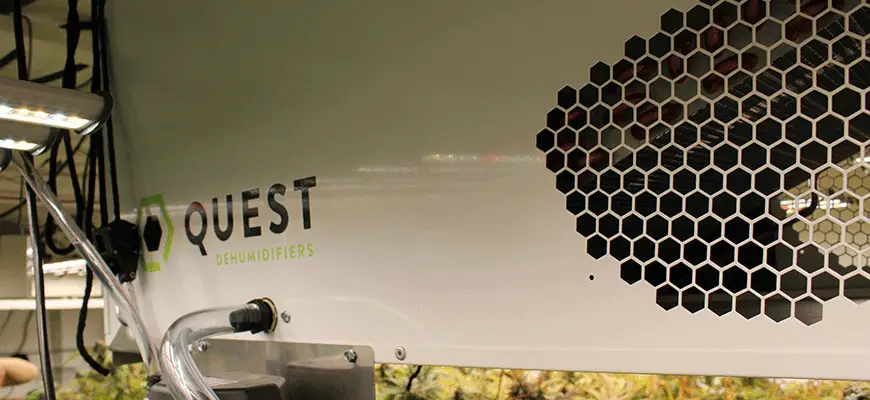
If you’re struggling with excess moisture when growing indoors, you need the best grow room dehumidifier for the task. These days, there truly is a unit for every grower out there.
Whether you’re a hobbyist growing in a tent or a commercial grower with hundreds of plants packed into your facility, you need a dehumidification system that can stand the test of time and protect your crop.
But with so many different brands and styles online, which one is best for you?
Today, we’re going to help you choose the right one for you and your grow. We’ll cover why you need one of these in your room regardless of scale. Then, we’ll explain how we selected the top picks this year.
Then, we’ll outline which dehumidifier is best for which type of grower. By the end of this article, you’ll be able to easily select the right one! Let’s dive in.


Do All Grow Rooms Need A Dehumidifier?
Do all grow rooms need a dehumidifier? Some do, but some do not.
Grow rooms that are struggling with too much water in the air need a dehumidifier. They are essential to prevent problems such as powdery mildew, bud rot, and other fungal conditions that can affect your harvest.
If you have a small grow room with just a couple plants, you likely won’t need a dehumidifier. You should be able to adequately control high humidity levels with an exhaust system to expel hot, moist air.
However, larger grow rooms with lots of plants are going to inevitably be incredibly moist. Think about it this way. The moisture you put into your plants (with each watering/feeding) will be released back into the environment.
If you don’t remove this water from the air of the grow room atmosphere, you’ll end up with a super humid environment capable of causing problems.
Most commercial growers cannot afford to forego a dehumidifier in their facility. With your crop on the line, this is an essential investment. It will ensure your plants make it to harvest. Don’t risk crop failure related to high humidity.
What Makes The Best Grow Room Dehumidifier?
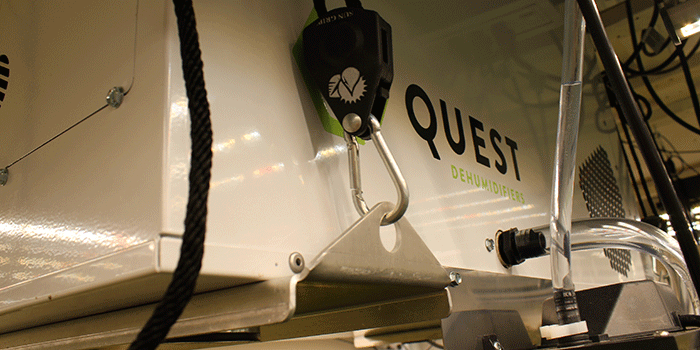
We feel that it’s important for us to cover the criteria we used when selecting these systems. This way, you know what to look for when you’re shopping for yours.
Brand Reputation
First and foremost, we considered brand reputation. The products you’ll find on our site are sourced from the top brands the horticulture industry has to offer. They all have outstanding reputations for producing reliable, quality dehumidifiers.
The best dehu brands in the industry and a sneak peek at who you’ll see on our list, our Quest & Ideal-Air. Most of the units you’ll find from these brands come with a warranty. This helps eliminate any stress you have about your investment. You can rest assured you’re acquiring a unit that the brand stands behind. Should anything go wrong, they will help make it right and get your environment back to where it needs to be.


Moisture Removing Capabilities (Pints Per Day)
We also looked at a unit’s ability to remove moisture from the growing environment. After all, that’s the sole purpose of a dehumidifier!
Dehu’s are sized by how many pints they can remove in a day. This metric is known as pints per day (PPD). It is one of the biggest determinants in finding which dehumidifier is right for you.
You can learn more about sizing your dehumidifier in our complete guide. There, you’ll learn how to size a unit for soil grows vs hydroponic grows, a typical grow room vs a harvest drying room, and much, much more! It is a must read for anyone looking to buy a dehumidifier online.
Dehumidifier Energy Efficiency
All dehumidifiers are capable of removing moisture. That’s just what they do. What really separates the best grow room dehumidifiers from the rest?
How efficiently they are able to remove moisture.
This is rated in pints removed per kilowatt-hour (Pints/KWH). Smaller units are sure to be really efficient. But, this is tougher to accomplish as you increase the size of a dehumidifier.
Yet, it is not impossible. Some of the products you’ll read about below are capable of removing 800+ pints per day while maintaining high energy efficiency of around 6.6 Pints/KWH!


Can The Dehumidifier Cool Your Grow Room, Too?
The other main environmental concern you’ll have is maintaining temperature in the grow room. With all the equipment you bring into the grow room such as lights, CO2 devices, and of course – dehumidifiers, you’ll be raising the BTU’s of the room.
BTU’s are a measurement of how much heat energy is released into the atmosphere. The higher your BTU’s, the harder you’ll have to work to remove excess heat and bring temperatures down.
In many cases, this will require a grow room air conditioner. Another investment may sound out of the question for certain grows. This is why you should invest in a dehumidifier capable of cooling the grow room environment as well!
That’s right. Select units will actually take the humid air, dehumidify and cool it. Then, they will release it back into the atmosphere. The result is bringing the temperature down and really helping you dial in your grow room environment.
Of course there are other things that went into our decision making process for the best dehumidifiers for indoor growing. We listened to what some of the best growers in the industry have said, and took their input as well. Let’s get into our top picks this year!
What Are The Best Grow Room Dehumidifiers?
We know that ‘the best grow room dehumidifier’ is not a one size fits all answer. Different types of growers will be better suited with different units. This is why you really need to understand your particular grow room.
We already mentioned you should read our guide on sizing your dehumidifier. This will help you select the right one. We’ll start by covering the best systems for smaller spaces, and work our way up to huge commercial units.
Best For Small Grow Tents or Rooms – Ideal-Air Dehumidifier
We aren’t going to start our list off with the biggest, most powerful units we have. We know just how many smaller spaces are struggling with excess humidity.
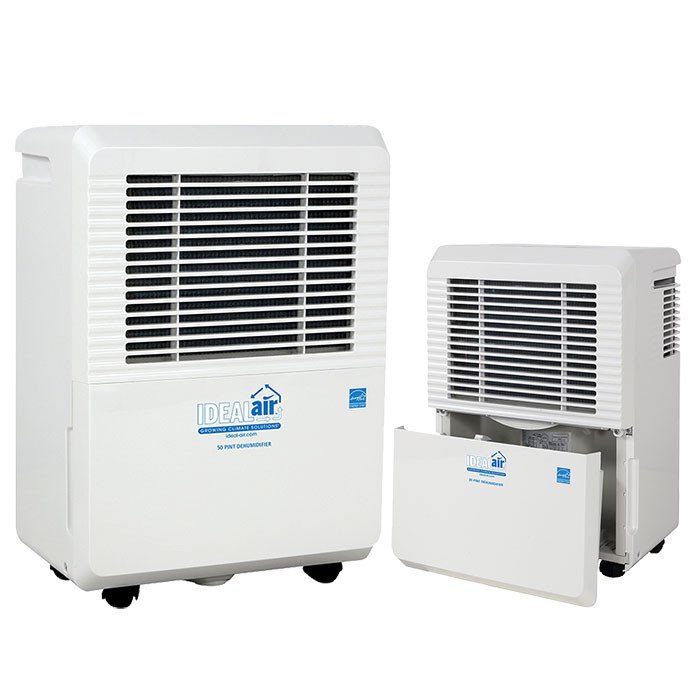
That’s why we want to highlight the Ideal Air Portable Dehumidifiers. These are small, mobile units. They can easily fit in the corner of your small closet grow, a grow tent, or really any small space needing dehumidification! With a few different sizes, you can choose between:
- 22-30 PPD
- 30-50 PPD
- 50-80 PPD
- 60-120 PPD
These small dehumidifiers are rated at AHAM standards. And, they start at just over $230. This is a reasonable investment for hobbyists looking to cultivate top shelf in their own home.
But, they aren’t just cheap units. They come equipped with a bunch of features to improve your grow and automate your work, including:
- Auto restart in power failure
- Digital LED screen to control the unit
- You can plumb the system and continuously drain the condensate
- Low temperature defrosting
- Quick filter changeouts to keep the unit running as intended
- Heavy duty compressor will stand the test of time
- 1 year warranty on electrical components, 5 year warranty on compressor
- Automatic shut-off when reservoir is full of condensate, to protect the unit from excess moisture itself
Grow tents are somewhat notorious for producing humid environments, and Ideal Air Portable Dehumidifiers are the solution. Learn more by heading over to the product page and seeing if these are right for you!
Best For Medium/Large Growers – Ideal-Air Pro Series Dehumidifier
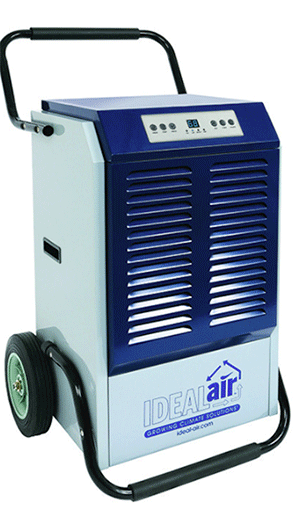
If you’re a medium to large hobby grower, or even a boutique grower and the previously mentioned units are too small for you, but you can’t justify investing in the Quest Overhead units (which we’ll cover in a minute), the Ideal-Air Pro Series Dehumidifiers are probably for you!
These are the most affordable professional style horticulture units, available in three different sizes: 60, 100, and 180 pints per day.
It features automatic restart in case of a power outage, and easy to use digital humidity levels readings.
Other cool features that you may not expect in this price range include built-in defrost, durable powdery coated construction with a heavy-duty compressor, removable & washable filter, and more.
Best Overall Units – Quest Overhead Dehumidifiers
There is no doubt that Quest is the industry leader in horticultural dehumidification.
They will make more than one appearance on this list (spoiler alert!), but we wanted to start with the most popular, best-selling dehumidifiers currently on the market – The Quest Overhead Dehumidifiers.
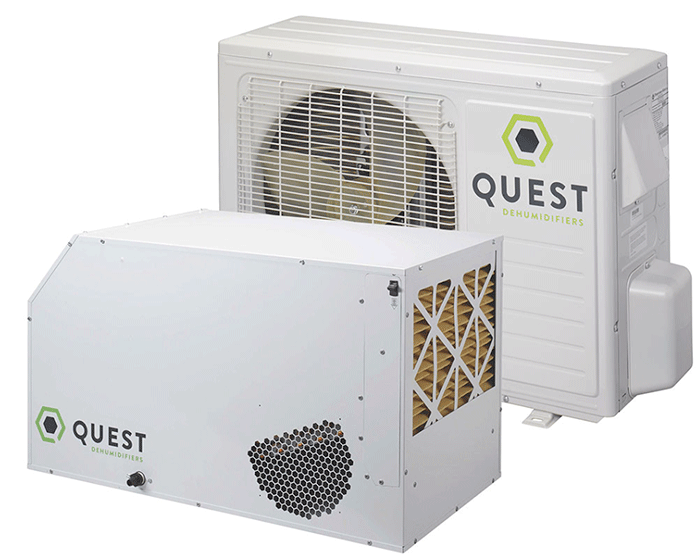
These premium systems can be implemented by serious hobby growers with the budget for the best, but they are more commonplace in larger boutique grows and commercial facilities.
This family consists of eleven different sizes, ranging from 70 PPD all the way up to a mind-blowing 876 PPD!
But, the reason we consider these to be the best dehumidifiers for indoor growing is the energy efficiency across the entire line. Using patent-pending coil technology, these units operate as low as 4.8 Pints/KWH – this energy efficiency is unrivaled across the horticulture industry!
We want to highlight a few specific features you may be interested. Keep in mind that not each and every Quest Overhead Dehumidifier has the same features, so be sure to consult the individual product before purchasing.


- Cooling Capabilities – certain units implement an efficient split system that will help lower BTU’s in the grow room, managing heat and humidity levels simultaneously.
- Versatile, Plug & Play Installation – with option mounting brackets available for purchase, you can hang these units on the ceiling to get the most out of your valuable floor space, or install them on the floor.
- Built In Pumps – By adding the optional condensate built in pump & ducting kits before checking out, you can further free up space and provide the ultimate flexibility for any type of grow room!
- Standard MERV-11 Filtration In Each Unit – These filters will help capture unwanted particles, such as mold spores, and prevent them from being circulated back into your growing environment.
- Standard 5-Year Warranty – While these units are as good as it gets, and you can rest assured they’ll get the job done for years to come, the 5 year warranty will protect your investment.
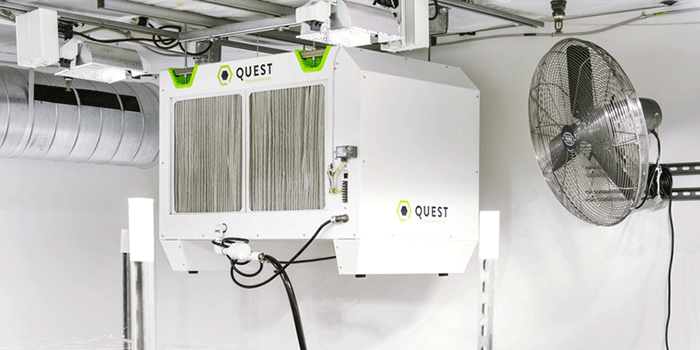
To learn about each and every Quest Overhead Dehumidifier, click the ‘shop now’ button below and check out the description where we highlight each individual unit!
Other Honorable Mentions – Quest IQ Series HVAC Dehumidifier Systems
Anden Grow-Optimized Dehumidifiers
Anden Dehumidifiers are designed for cultivation from the ground up. They utilizes innovative Variable-Speed, Low Grain Refrigerant Technology (VLGR patent pending) to deliver maximum performance and efficiency throughout the grow cycle. That means you can maximize your moisture removal capacity and maintain tight control over Vapor Pressure Deficit during late flower cultivation by modulating the refrigeration system to match the load.
Let’s take a closer look at VLGR Technology. This sophisticated system modulates the speed of dehumidification based on the precise load conditions of your grow environment, allowing for robust VPD performance across all growing conditions. The variable-speed refrigeration system keeps your dehumidifiers running during the challenging late flower stage where single-speed dehumidifiers require frequent defrost cycles. This increases capacity, efficiency, and most importantly, the stability of your grow environment.
AirGrean Dehumidifier
AirGrean has deep knowledge and extensive experience in controlled environment agriculture. Air AiGrean Dehumidifiers come in 3 different moisture removal capcities to choose from.
Available sizes:
- 50-80 pints/day
- 110 pints/day
- 210 pints/day
Best For Harvest Drying & Curing Rooms – Quest CDG 174 Dehumidifier
Technically you can use your existing unit, but if you have a separate drying and curing room you’ll want to use a dehumidifier specifically designed for combatting moisture in these environments.
Your plants are going to expel a ton of moisture into the air the first few days of drying. These rooms are as humid as it gets. To prevent losing your crop to bud rot in this final stage, you need a rugged dehumidifier that can handle this task!
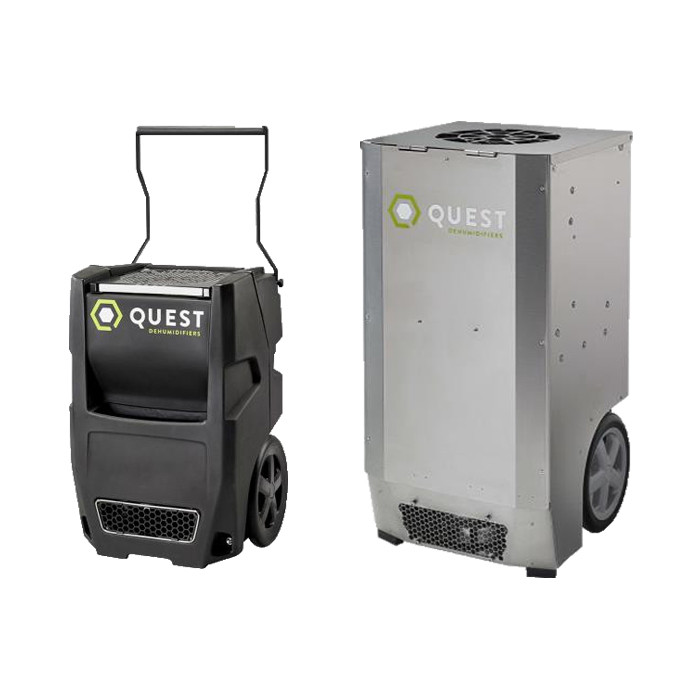
The Quest CDG Dehumidifier is built just for this. With two options – 75 PPD & 176 PPD – you can control the quick transpiration of moisture into your drying and curing chambers.
With heavy duty wheels and a transportation handle, you can easily move these around the grow room as needed.
Another thing that sets these apart is the MERV-8 Filtration it features. These filters capture mold, pollen, dust, and other unwanted spores that could affect your crop.
This effectively cleans the environment and keeps your plant quality safe! Learn more about drying and curing your harvest in our complete guide.
Final Thoughts On The Best Grow Room Dehumidifier
Here at Hydrobuilder, we are the one-stop shop for all things growing – indoors and outdoors.
We carry not only portable dehumidifiers and industrial dehumidifiers, but we also carry all the dehumidifier filters and parts you’ll need to keep your unit running in tip-top shape.
You should have a good idea of what the best grow room dehumidifier for your specific grow is by now. But if not, our experts are here to help you.
You can reach out to us by emailing or calling us (details below) and we’ll help you pick the perfect unit for your grow room, so you can feel good about investing in your crop.
Don’t risk losing your investment to mold or other moisture related problems – these dehumidifiers will pay for themselves with easy control of high humidity levels. Insure your crop with one today!

Dehumidifier Sizing Calculator
Calculate the exact dehumidifier capacity (PPD) your grow room or drying room needs — based on plant count, watering volume, and room size. Use Simple for a quick number or Advanced for growth-stage precision. Not sure what to buy? Talk to a Grow Expert.
Dehumidifier Sizing Calculator
Switch between Grow Room and Drying Room modes. Use Advanced to fine-tune by growth stage and transpiration rate.
How to use this calculator
- Choose your room type — Grow Room for active plants, Drying Room for post-harvest dry-down.
- Enter plant count and watering volume — use per-plant gallons applied at each watering and your watering interval.
- Switch to Advanced to select growth stage (flowering = higher transpiration) and room temperature.
- Click Calculate PPD Needed — your result includes a 25% safety buffer, which is industry best practice.
- Size up, not down — a unit running at 70–80% capacity is more efficient and lasts longer than one running at full load continuously.
Formula (Grow Room): Moisture load (pints/day) = Gal × Plants × Transpiration fraction × 8.34 × (1/Days between waterings) × 2
Formula (Drying Room): Water to remove = Wet weight × Moisture content % × 0.8 safety. PPD = (Water in lbs × 2.0) ÷ Dry-down days
Recommended unit size = Calculated PPD × 1.25 (25% buffer for peak loads)
💧 PPD Gauge — Required vs Unit Capacity Gauge ▾
Run a calculation above to see the gauge. The needle shows your required PPD — add your unit's rated capacity using the input below to compare.
Dehumidifier Sizing Quick Reference
| Setup | Plants | Gal/Water | Grow PPD (Veg) | Grow PPD (Flower) | Recommended Unit |
|---|---|---|---|---|---|
| 2×4 Tent | 2–4 | 0.5–1 gal | 10–20 PPD | 15–28 PPD | 30 PPD unit |
| 4×4 Tent | 4–6 | 1–2 gal | 20–40 PPD | 28–55 PPD | 50–70 PPD unit |
| 4×8 Tent | 8–12 | 1–2 gal | 35–70 PPD | 50–95 PPD | 70–105 PPD unit |
| 10×10 Room | 12–20 | 2–3 gal | 80–130 PPD | 110–175 PPD | 150–200 PPD unit |
| 20×20 Room | 30–60 | 2–4 gal | 180–320 PPD | 240–430 PPD | Multiple units or 300–500 PPD |
| Drying Room (20 lbs wet) | — | — | — | — | ~18–22 PPD over 12 days |
| Drying Room (100 lbs wet) | — | — | — | — | ~90–110 PPD over 12 days |
Ready to control your humidity?
Shop grow room dehumidifiers from top brands — Anden, Quest, AC Infinity, and more.