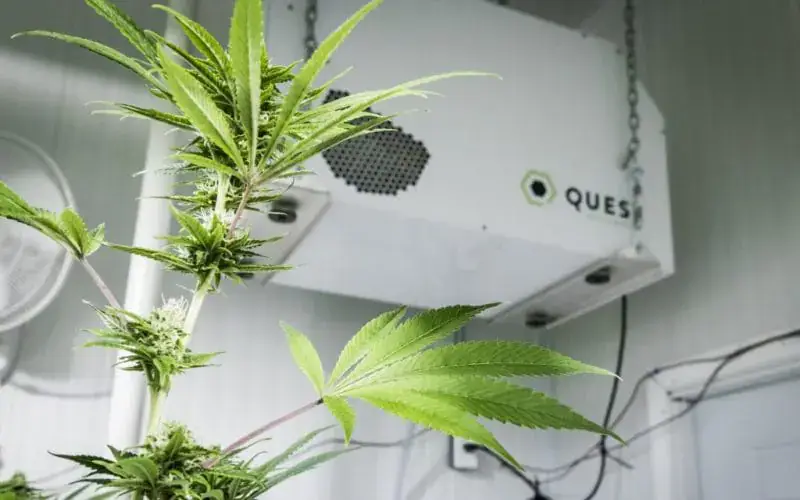
Grow room dehumidifier sizing is one of the most consequential decisions in controlled environment agriculture — get it wrong and you’re trading crop losses to powdery mildew and bud rot, or wasting energy on an oversized unit that short-cycles and dries the room unevenly. This guide gives commercial cannabis cultivators and serious hydroponic growers a precise, calculation-driven framework for selecting the right dehumidification capacity based on plant transpiration, lighting heat load, and target VPD ranges. We cover sizing formulas for soil, coco, and hydroponic systems; drying room requirements; equipment selection by facility scale; and recommended units at every capacity tier — all backed by real formulas and practical commercial examples.
Whether you’re spec’ing equipment for a new buildout or auditing an existing facility for humidity problems, start here.
Do All Grow Rooms Need a Dehumidifier?
Most commercial facilities and many serious hobby grows require dedicated dehumidification — but the threshold depends on scale, plant density, and your ventilation strategy.
Plants release the vast majority of their irrigation water back into the air as vapor through transpiration. In a sealed or semi-sealed grow room, that moisture has nowhere to go unless actively removed. A small tent with two or three plants and a properly sized exhaust fan may stay within target humidity ranges without a dedicated dehumidifier. Any room with ten or more actively transpiring plants, high-density canopies, or sealed CO₂ enrichment will almost certainly require one — particularly in the late-flower stage when transpiration peaks and target RH drops to 40–50%.
The consequences of undersized dehumidification are severe: powdery mildew and bud rot can devastate an entire harvest in days once established, and both pathogens thrive in the 55–70% RH range that is easy to drift into without adequate moisture removal. Oversizing carries its own costs — units running at low duty cycles consume energy inefficiently and may over-dry the room in cooler conditions. The goal is matching nameplate capacity (pints per day, or PPD) to your facility’s actual moisture load, with appropriate headroom for peak demand.
Understanding PPD: The Core Sizing Metric
Cannabis plants transpire the vast majority — often 95% or more — of the irrigation water they receive back into the grow room atmosphere under indoor conditions. This principle drives dehumidifier sizing: in sealed or semi-sealed rooms, water in ≈ water out is a reliable design assumption over the course of a day.
For commercial facilities, your daily irrigation volume is therefore the primary driver of dehumidification requirements, adjusted for growth medium, airflow, temperature, and VPD targets.
Base Sizing Formulas
Soil-Based and Soilless Cultivation
In soil and soilless mixes, not all applied water enters the air immediately — some is retained in the medium and released more slowly. A practical starting point:
Daily water input (gallons) × 8 pints × 0.4–0.6 = estimated base PPD requirement
The lower end (~0.4) fits heavier soils and less frequent irrigation; the higher end (~0.6) fits lighter mixes and high-frequency fertigation.
Hydroponic Systems
Hydroponic and recirculating systems release nearly all irrigation water back to the atmosphere through transpiration and evaporation. For sealed rooms, assume close to 100% return when sizing dehumidification. Two practical approaches:
Daily top-off–based:
Daily top-off volume (gallons) × 8 pints = base PPD requirement
Weekly reservoir–based (rough planning):
(Weekly reservoir change volume ÷ 7) × 8 pints = average daily PPD, then add a 20–30% safety margin for peak transpiration periods.
Quick Example
A 20-plant operation watering 1 gallon per plant daily carries a theoretical 160 PPD moisture load (20 gallons × 8 pints). For soil or soilless grows, planning for roughly 80–110 PPD base capacity is reasonable depending on medium type and room airflow.
Commercial Workflow: Calculating Total Moisture Load
For accurate commercial sizing, calculate total moisture load step by step, accounting for all major sources and applicable credits.
Step 1: Plant Transpiration Load
- Count total plants in flower (peak transpiration stage)
- Multiply by daily water per plant (gallons)
- Convert to pints: gallons × 8
- Apply growth-medium factor: soil/soilless ~0.4–0.6; hydro ~0.9–1.0
Step 2: Lighting Heat Load
Total flowering room wattage × 3.41 = BTU/hr heat output from lighting
Higher ambient temperatures increase the air’s moisture-holding capacity and can temporarily mask humidity problems. Many designers add 10–15% additional dehumidification capacity to account for lighting-driven humidity dynamics.
Step 3: HVAC Moisture Removal Credit
Air conditioners remove some moisture while cooling — but only when actively running. Check your AC specifications for a PPD rating if available, then apply a cycling factor.
AC moisture credit ≈ AC nameplate PPD × 0.4–0.6, simplified to ×0.5 for early design
This is a credit to be subtracted, not a replacement for dedicated dehumidification. AC units cannot reliably hold VPD targets in commercial grows because they cycle off when temperature setpoints are reached, allowing humidity to climb while plants continue transpiring.
Step 4: Environmental Adjustments
- Sealed CO₂ rooms: Add ~15–20% capacity for elevated transpiration in enriched conditions
- Active exhaust systems: Reduce effective dehumidification by ~20–30% — some moist air exits before passing through the dehumidifier
- VPD targets below ~1.0 kPa: Add ~10–15% capacity to maintain tighter humidity control at higher RH setpoints
Step 5: Size Up for Peak Loads
After applying all adjustments and credits, select nameplate dehumidifier capacity roughly 20–30% above the calculated requirement. This buffer:
- Covers cultivar differences and canopy density changes between cycles
- Compensates for filter loading and coil fouling over time
- Prevents units from running at 100% duty cycle continuously — a unit operating at 70–80% capacity runs more efficiently and has a longer service life
Dehumidifier Sizing Quick Reference
Estimated PPD by grow room size and plant count — includes 25% safety buffer:
Target Humidity and VPD Parameters by Growth Stage
Dehumidifier sizing must accommodate the full range of humidity requirements across the crop cycle. Typical commercial cannabis targets:
Exact targets vary by cultivar, temperature, and disease pressure. RH must always be interpreted together with temperature to hit your desired VPD.
Commercial sizing tip: Size dehumidification for late-flower requirements — when moisture load is highest and RH targets are tightest. Use grow room humidity controllers to dial back capacity during earlier stages.
Commercial Sizing Examples
Example 1: Medium Commercial Flower Room
Facility specs:
- Room: 20′ × 30′ × 10′ = 6,000 cubic feet
- Lighting: 15,000W LED (flower)
- Plant count: 100 plants
- Irrigation: 0.5 gallons per plant daily (hydro)
- Target: 50% RH at 78°F (~1.2–1.3 kPa VPD)
Calculation:
- Base transpiration: 100 plants × 0.5 gal × 8 pints × 0.95 (hydro) = 380 PPD
- Lighting heat adjustment +15%: 437 PPD
- 12,000 BTU mini-split AC credit (est. ~60 PPD nameplate × 0.5): −30 PPD → 407 PPD net
- Sealed room with CO₂ (+15%): 407 × 1.15 ≈ 468 PPD
- Safety margin (+25%): ~585 PPD target nameplate
Result: Select equipment providing 600+ PPD combined capacity. For this scale, a dual-unit overhead installation sharing the load generally outperforms a single large unit for redundancy, serviceability, and even air distribution across the canopy.
Example 2: Small Grow Tent
Setup:
- Tent: 4′ × 4′ × 7′ = 112 cubic feet
- Lighting: 480W LED
- Plants: 4 (soil/soilless)
- Irrigation: 1 gallon per plant every 2 days
Calculation:
- Average daily water: (4 plants × 1 gal) ÷ 2 days = 2 gal/day
- Soil/soilless factor: 2 × 8 × 0.5 ≈ 8 PPD base
- Active exhaust and safety margin: × 1.3–2.0 ≈ 10–16 PPD
Result: A 30–50 PPD portable dehumidifier provides ample capacity and headroom for this setup.
Equipment Selection: What Makes the Best Grow Room Dehumidifier
No single unit is best for every grower. The right choice depends on your PPD requirement, operating temperature, available voltage, floor space, and budget. Here’s how to match equipment to facility needs — and what to look for across the line.
What to Look for in a Grow Room Dehumidifier
Moisture removal capacity (PPD): Sized to your calculated load with 20–30% headroom. Undersizing guarantees humidity problems; headroom handles peak loads and equipment aging without constant full-duty operation.
Energy efficiency (pints/kWh): Standard units deliver roughly 2–4 pints/kWh. Premium horticultural units reach 5–8+ pints/kWh at 80°F/60% RH. Over a year of continuous operation, the gap between 3 and 6+ pints/kWh translates to significant electricity savings depending on runtime and local rates.
Operating temperature range: Refrigerant units lose capacity below ~65°F and may ice up below 60°F. If your facility operates in cooler ranges — drying rooms, cold propagation spaces — verify low-temperature performance or select a desiccant model.
Filtration: MERV-11 or MERV-13 filtration prevents mold spores and organic particulate from recirculating through your canopy. In commercial facilities, filtration is not optional.
Drain capability: Commercial units should plumb to a continuous drain. A portable dehumidifier with a 2–3 gallon reservoir will fill within hours at 100+ PPD — constant manual draining is operationally unsustainable at scale.
Warranty and serviceability: Look for 5-year warranties on the compressor and confirmed parts availability. Commercial dehumidifiers are infrastructure, not consumables.
Refrigerant vs. Desiccant Dehumidifiers
Refrigerant (Compressor-Based) Units
Best for standard grow rooms operating roughly 65–85°F with continuous or near-continuous operation.
How they work: Draw humid air over cold coils, causing condensation; collected moisture drains to a reservoir or plumbed drain.
Capacity range: ~30–876+ PPD for the full spectrum of commercial horticultural units.
Energy efficiency: Standard units deliver ~2–4 pints/kWh; premium overhead models with optimized coil technology typically reach 5–8+ pints/kWh at standard conditions.
Considerations:
- Efficiency and capacity drop at temperatures below ~65°F
- All units add heat to the space by converting latent heat into sensible heat — factor this into AC sizing
- Filters and coils require periodic maintenance to preserve airflow and efficiency
Most commercial growers find refrigerant units to be the most cost-effective option for typical flowering room temperatures.
Desiccant Dehumidifiers
Best for drying rooms, cold storage, and low-temperature applications (often below 56°F) where standard refrigerant units struggle.
How they work: Use moisture-absorbing material (typically silica gel) to pull humidity from the air, with a heated airstream regenerating the desiccant continuously.
Operating range: Effective down to around 35°F, with stable performance at 80–90% RH.
Applications:
- Post-harvest drying rooms targeting 55–60% RH at 60–65°F where temperatures may drop below 56°F
- Cold-temperature propagation areas
- Sealed environments where refrigerant units ice up or lose capacity
For cannabis drying rooms operating below 56°F, desiccant models are strongly recommended. Commercial horticultural refrigerant units like the Quest CDG are engineered to operate as low as 56°F — but where temperatures may dip lower, desiccant technology provides a reliable safety margin for the first 48 hours of harvest dry-down.
Portable vs. Overhead Installation
Portable Units (30–190 PPD)
Mobile, no permanent installation required, suitable for grow tents and small rooms, easy to redeploy as layouts change.
Best placement: Center of the room near the main canopy airflow path, elevated if possible, at least 2 feet away from AC supply outlets to avoid short-cycling conditioned air between units.
Best for: Facilities under ~1,000 sq ft, multi-room setups requiring flexible deployment, tent grows, and smaller boutique operations.
Overhead/Ceiling-Mount Units (155–876+ PPD)
Save floor space, integrate with ductwork, provide more even air distribution across large canopies, and reduce the risk of localized humidity zones.
Requirements: Professional installation, appropriate electrical service (often 240V for large units), and proper ducting or airflow design.
Best for: Multi-room facilities and warehouse grows where canopy access and uniform environmental control are priorities. Most facilities above ~2,000 sq ft benefit from overhead or distributed high-capacity units.
Recommended Dehumidifiers by Application
For Small Grow Tents and Rooms: Ideal-Air Pro Series
The Ideal-Air Pro Series Dehumidifier is one of the most accessible professional-grade options at this scale. Available in multiple PPD configurations, these units feature digital humidity controls, automatic restart after power interruption, built-in defrost, removable and washable filters, and a heavy-duty compressor with multi-year warranty coverage. The powder-coated construction is designed for the demanding humidity and organic-particulate environment of cultivation facilities.
For tent grows and small rooms, the combination of compact footprint, plug-and-play operation, and continuous drain capability makes these the practical choice when budget matters but performance cannot be compromised.
For Mid-Size Commercial Grows: Quest 225 Pint Dehumidifier
The Quest 225 Pint Dehumidifier operates on standard 208-230V service — making it the most accessible high-performance Quest unit for facilities that haven’t wired for 277V or 480V. At 225 PPD with strong efficiency ratings, it covers medium-sized flower rooms in the 5,000–10,000 sq ft range as a standalone unit or part of a multi-unit installation. This is the logical step up from portable units when a facility outgrows the 100–180 PPD tier.
For Large Commercial Grows: Quest Overhead Dehumidifiers
Quest overhead dehumidifiers are the standard against which commercial horticultural dehumidifiers are measured. The Quest overhead line spans from roughly 70 PPD to 876 PPD across multiple voltage configurations — 120V, 208-230V, 277V, and 480V for large-scale industrial installations.
What distinguishes Quest across the line is energy efficiency. Using advanced coil technology, Quest overhead units achieve some of the highest pints-per-kWh ratings in the category — a meaningful operational cost advantage in facilities running units year-round. Standard MERV-11 filtration is included across the line to prevent spore recirculation, and optional MERV-13 filters are available for facilities with higher particulate management requirements. Ceiling-mount installation frees floor space and provides superior air distribution compared to floor-standing units at equivalent PPD ratings.
For facilities requiring 600+ PPD, a multi-unit overhead installation typically outperforms a single large unit for redundancy, air distribution uniformity, and serviceability.
For Precision VPD Control: Anden Grow-Optimized Dehumidifiers
Anden grow-optimized dehumidifiers are engineered specifically for cultivation, using Variable-Speed Low Grain Refrigerant (VLGR) technology that modulates dehumidification output based on real-time load conditions. This approach provides a meaningful advantage during late flower — when single-speed units cycle on/off frequently and create humidity fluctuations that drive disease pressure — by continuously matching output to the actual moisture load. The result is tighter RH control and more stable VPD across the full 12/12 cycle.
Anden units pair well with digital dehumidifier controllers for facilities targeting precise VPD management across multiple rooms or zones.
For Harvest Drying and Curing Rooms: Quest CDG Series
Post-harvest drying environments present a different challenge than flower rooms — humidity spikes rapidly in the first 24–48 hours, rooms operate at lower temperatures (60–65°F), and RH control failure means immediate crop loss. The Quest CDG Dehumidifier is purpose-built for these conditions. Available in portable configurations with heavy-duty wheels and a transport handle, CDG units include MERV-11 filtration to capture mold spores, dust, and pollen from the drying environment. For commercial drying rooms, select CDG capacity at 2–3× your calculated daily PPD requirement to handle the initial moisture burst without losing RH control.
Drying Room Sizing: Special Considerations
Post-harvest drying requires a specialized sizing approach distinct from flower-room calculations.
Why Standard Sizing Often Fails
Fresh cannabis harvest typically contains 70–80% water by weight. A large fraction of that moisture — often 40–60% — is released in the first 24–48 hours of drying. Standard residential refrigerant units in cool, high-RH drying rooms may ice up or lose significant capacity at 80–90% RH; commercial horticultural units like the Quest CDG are engineered to operate as low as 56°F, but where temperatures may dip lower, capacity can still degrade and desiccant technology provides a reliable safety margin.
Drying Room Sizing Formula
- Estimate wet harvest weight (pounds)
- Calculate water content: weight × 0.75 (75% as a planning midpoint within the 70–80% range) = total water weight in lbs
- Determine peak evaporation window: typically 3–5 days for initial heavy moisture release
- Convert to daily PPD: (water weight in lbs × 8 pints/lb) ÷ peak-window days = daily PPD
- Select equipment at 2–3× the calculated daily PPD to handle the initial moisture surge
Drying Room Example
50 lb wet harvest:
- Water content: 50 × 0.75 = 37.5 lbs water
- Convert to pints: 37.5 × 8 = 300 pints total
- Peak window (4 days): 300 ÷ 4 = 75 PPD average
- Recommended capacity: 150–200 PPD to comfortably handle peak conditions at 60–65°F
For most cannabis drying applications targeting 55–60% RH at 60–65°F, verify your selected unit’s minimum operating temperature before purchase. Ensure continuous drain capacity to handle the first 72 hours of peak moisture release without manual intervention.
Integration with Complete Climate Control Systems
Dehumidification performs best as part of a coordinated climate strategy rather than in isolation.
Air Conditioning: Size AC for the BTU load from lighting and equipment, then treat moisture removal as a secondary variable benefit. See our grow room air conditioner sizing guide for AC-specific calculations and how to credit moisture removal against your dehumidifier requirement.
Ventilation: In sealed rooms, reduce exhaust during peak humidity periods so conditioned, dehumidified air is not immediately expelled before doing its work. For open-loop systems, coordinate exhaust timing with dehumidifier operation so airflow supports rather than fights humidity control.
Humidity Controllers: Automate your equipment to maintain precise RH targets and stable VPD across day/night cycles. The TrolMaster Hydro-X is the industry standard for multi-zone commercial facilities, managing temperature, humidity, VPD, and CO₂ from a single interface. For monitoring without full automation, the HBX Thermo-Hygrometer stores Min/Max values across lights-on and lights-off cycles — essential for diagnosing the humidity swings that drive disease pressure in commercial rooms.
Operational Efficiency and Energy Considerations
Commercial dehumidifiers represent significant ongoing operational cost. Right-sizing and efficiency selection directly affect your facility’s bottom line.
Energy Efficiency Ratio (Pints/kWh)
Standard units: typically 2–4 pints/kWh. High-efficiency models: commonly 5–8+ pints/kWh at 80°F/60% RH. Over a year of heavy operation, the difference between 3 pints/kWh and 6+ pints/kWh can translate to hundreds or thousands of dollars in electricity savings depending on runtime and local energy rates.
BTU Heat Output Management
All dehumidifiers add heat to the space by converting latent heat into sensible heat.
- Estimate heat load added: watts × 3.41 = BTU/hr added to the room
- Include dehumidifier heat output in AC sizing and duct design
- Position units away from cold air intakes of AC systems to avoid short-cycling
Maintenance Schedule
- Filters: Clean or replace every 2–4 weeks in high-use grow environments
- Coils: Inspect quarterly for dust, organic buildup, and nutrient residue; clean with approved coil cleaner
- Drains: Verify drain function weekly for plumbed units; check reservoirs daily for portable models
- Annual service: Refrigerant charge check, electrical inspection, fan motor and bearing inspection
Neglecting maintenance can reduce efficiency by 20–30% and shorten equipment life in units that often run 18–24 hours per day.
Why Shop at HydroBuilder for Dehumidification Solutions
Commercial cultivators trust HydroBuilder for environmental control equipment because we understand the unique demands of CEA operations. Our team includes experienced growers who size systems daily for facilities ranging from 4×4 tents to 50,000+ sq ft warehouses.
Technical Expertise: Call 888-815-9763 to speak with cultivation specialists who understand transpiration rates, VPD targets, and facility design. We help you avoid costly undersizing or oversizing mistakes before equipment is purchased.
Commercial-Grade Selection: We stock industry-trusted dehumidification brands — Quest, Ideal-Air, Anden, Active Air, XPOWER — proven in demanding cultivation environments, with models covering roughly 30 PPD to 876 PPD and strong efficiency ratings across the range.
Complete System Integration: Beyond dehumidifiers, we supply grow room air conditioners, environmental controllers, and ventilation systems for turnkey climate control. Our team designs coordinated systems where AC, dehumidification, and controls work together efficiently rather than fighting each other.
Commercial Support Programs: Volume growers receive dedicated account management, commercial pricing, and priority technical support tailored to facility scale and complexity.
Educational Resources: Our Learning Center provides ongoing guidance on environmental management — from VPD optimization to complete facility design — to help you optimize operations beyond initial equipment selection.
Whether you’re spec’ing a new buildout or troubleshooting existing climate issues, HydroBuilder provides the products, expertise, and support to maintain optimal growing conditions