

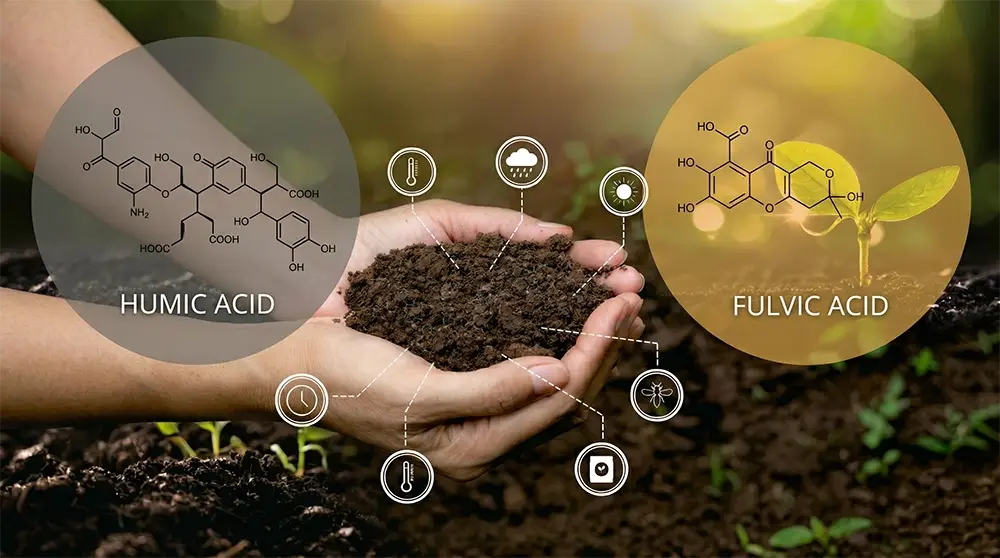
Humic acid and fulvic acid are two distinct types of naturally occurring organic compounds that can support nutrient uptake, soil health, and plant growth in virtually every growing system when used correctly. If you’ve started researching plant nutrition, you’ve likely encountered both terms — sometimes used interchangeably, but they’re not the same thing. Understanding the differences between humic acid vs fulvic acid will help you use them strategically rather than guessing.
Whether you’re growing vegetables in a backyard raised bed, running a soil-based cannabis operation, or managing a hydroponic facility on coco coir, both of these compounds can be valuable additions to a well-designed nutrient program. This guide breaks down the science, the practical benefits, and exactly how to apply each in your grow.
Growing in coco or hydroponics? Jump down to the section on inert media applications for tailored guidance. Running a large-scale commercial operation? See our commercial workflow section for injection dosing and fertigation integration.
What Are Humic Substances?
Humic substances — including humic acids, fulvic acids, and humins — are complex organic compounds formed over long periods through the microbial decomposition of plant and animal matter. They’re found naturally in rich, dark materials such as leonardite (a near-coal carbon deposit) and in well-aged compost. Modern agricultural and horticultural soils are often relatively low in these compounds due to tillage, chemical fertilizer overuse, and the deliberate use of sterile inert media like coco coir, rockwool, and clay pebbles.
Adding humic and fulvic acids to your nutrient program helps replace some of what modern growing practices remove or never provide in the first place, especially in inert systems.
What Is Humic Acid?
Humic acid is the larger-molecule fraction of humic substances. It is typically extracted as a dark brown to black solid when a strong base (alkaline solution) applied to organic matter is subsequently acidified — the fraction that precipitates out is referred to as humic acid. Its high molecular weight means it moves less freely through the soil matrix, making it best suited for improving the soil environment at a structural and biological level rather than serving as a fast-translocating nutrient carrier.
Key characteristics:
- Large, high-molecular-weight molecule
- Dark brown or black in color
- Soluble in alkaline conditions, precipitates under acidic pH
- Primarily functions in the root zone and soil matrix
- Supports microbial activity, improves soil structure, enhances water retention
- Acts as a natural chelating agent that can hold mineral nutrients, helping reduce leaching and certain lockout interactions
Humic acid can be used throughout the entire plant life cycle — from germination through late flower — and is compatible with virtually all nutrient systems when dosed properly. It is available in both dry powder and liquid forms, and can be used in soil, coco, and hydroponic applications.
What humic acid does in your grow: When applied to soil or soilless media, humic acid increases cation exchange capacity (CEC), meaning the substrate can hold and release more positively charged nutrients (calcium, magnesium, potassium) on demand. It also supports beneficial microbial populations in the root zone, which break down raw organic matter into plant-available forms. In inert media like coco, where native humic content is near zero, supplemental humic acid helps approximate some of the biological richness of a living soil when combined with appropriate microbial inoculants and good fertigation practices.


What Is Fulvic Acid?
Fulvic acid is the smaller-molecule, lighter-colored fraction of humic substances. Where humic acid precipitates under acidic conditions, fulvic acid stays dissolved across all pH ranges — both acidic and alkaline — making it more mobile and reactive in solution. Its lower molecular weight and higher oxygen content allow it to form small, soluble complexes that are readily absorbed by plant tissues and across cell membranes, which gives it different capabilities than humic acid.
Key characteristics:
- Small, low-molecular-weight molecule
- Light yellow to golden in color
- Soluble at all pH levels (acid and alkaline)
- Readily absorbed by plant tissue — effective as a foliar spray
- Helps transport nutrients into and within plant tissues by forming chelated complexes
- Powerful natural chelator — binds to micronutrients and helps carry them across biological barriers
- For products like BioAg Ful‑Power, is designed not to affect solution pH or electrical conductivity (EC) at recommended rates
Fulvic acid is sometimes called a more “mobile” version of humic acid, though this undersells how different their mechanisms actually are. Where humic acid primarily improves the soil environment and macro-level nutrient availability, fulvic acid works closer to the cellular level by helping ferry chelated nutrients through root and leaf surfaces into plant tissues.
What fulvic acid does in your grow: Fulvic acid forms soluble complexes with micronutrients like iron, zinc, manganese, and copper, keeping them available even in challenging pH conditions. It can be applied as a root drench or foliar spray — when applied to leaves, it can penetrate the cuticle and move nutrients into the mesophyll. In hydroponic systems running inert media, fulvic acid can improve the utilization efficiency of the nutrient solution you’re already providing by helping keep micronutrients available and mobile.
Humic Acid vs Fulvic Acid: Side-by-Side Comparison
| Property | Humic Acid | Fulvic Acid |
|---|---|---|
| Molecular weight | High | Low |
| Color | Dark brown/black | Light yellow/golden |
| pH solubility | Alkaline only | All pH ranges |
| Primary application zone | Root zone / soil matrix | Root zone + foliar |
| Primary mechanism | Soil structure, CEC, microbial support | Nutrient chelation and tissue-level transport support |
| Foliar use | Not ideal (large molecule) | Highly effective |
| Does it affect EC? | Typically minimal at proper rates | Product-dependent; Ful-Power is designed not to increase EC at label rates |
| Inert media value | High | High |
| Best used | Soil, soilless, hydro (root drench) | Soil, soilless, hydro, foliar |
Do You Need Both?
For most grows, humic and fulvic acids can be beneficial because they have complementary mechanisms that often work better together than separately when your core nutrient and environmental program is already dialed in.
Humic acid creates the foundation — a more biologically active, chemically accessible root environment. Fulvic acid then takes advantage of that environment by helping transport available nutrients into plant tissue more efficiently. Using only humic acid is like building a road without many vehicles on it; using only fulvic acid is like having fast delivery trucks but fewer routes and hubs to operate from.
In hydroponic or coco grows — where growing media like coco, rockwool, and clay pebbles contain essentially no native humic substances — both acids are strong candidates if you want to approximate some of the functional benefits of a living soil, as long as base nutrition and irrigation are well controlled. The complete guide to growing in coco coir covers this in detail: inert media gives you full control, but also full responsibility for every biological input your plants receive.
When used together, humic and fulvic acid have been shown in research and field trials to improve water relations in soil, support healthy microbial activity, influence the uptake of some metals and salts, improve photosynthesis and metabolic function, and in some cases allow growers to maintain performance at slightly lower nutrient application rates because more of what you apply stays available and gets used.
Are Humic and Fulvic Acids Worth It If You're on a Budget?
Humic and fulvic acids can be worth the investment, but priority still goes to a complete, balanced nutrient system and stable environmental control. If you’re choosing between buying a complete nutrient line and buying humic additives, the nutrient system comes first.
That said, humic and fulvic acids may improve nutrient utilization efficiency — the grow-room equivalent of getting more miles per gallon — especially in systems where every molecule of nutrition must be supplied externally. For growers running coco or inert media, these acids can support more efficient use of your existing nutrients over time, provided dosing and irrigation are well managed.
Primary Solutions
BioAg Ful-Power — Our top choice for fulvic acid supplementation. BioAg Ful‑Power is a fast-acting liquid fulvic acid isolate produced using a proprietary biological process without harsh chemistry, and it is formulated so it will not affect pH or EC at recommended rates. The result is an OMRI-listed concentrate that is compatible with most irrigation hardware and, at proper dilution, will not clog drippers or sprayers. It works in soil, coco, rockwool, DWC, NFT, drip, and foliar applications. Application rates for soil/soilless/hydroponics around 15–30 mL/gal (1:100 to 1:300 dilution) and for foliar sprays at similar ratios are consistent with third-party label references; for propagation, soaking cutting medium at approximately 35 mL/gal for 24 hours is a common use pattern to support early root development. Ful‑Power is compatible with all fertilizers and can be used at any stage from seed to late flower when integrated into a balanced program.
BioAg Liquid Ful-Humix — Our top choice for humic acid supplementation. BioAg Liquid Ful‑Humix is a soluble, concentrated humic acid liquid that helps reduce the uptake of sodium, aluminum, and certain other metals that can negatively affect plants by chelating and complexing them in the root zone, while also improving nutrient efficiency and uptake. It may stimulate beneficial microorganisms and may help convert raw organic matter into more plant-available forms. Application rates for soil/soilless/hydroponics generally align with low mL-per-gallon ranges similar to typical humic concentrates, making it straightforward to pair with Ful‑Power; always follow the current product label for exact dosing and adjust based on crop response. Both products are produced using BioAg’s biological process methodology and are shelf-stable under normal storage in production environments.
Performance Nutrition Agra-Rouse is a highly concentrated humic acid solution derived from leonardite ore, designed for professional application in all growing systems. It’s a strong option when high-concentration humic supplementation and flexible application methods are a priority.
Impello Biosciences Tribus Original is a rhizobacteria inoculant that pairs naturally with humic and fulvic supplementation — these acids help support the microbial environment that Tribus colonizes, creating a synergistic root-zone biology package.
Canna Nutrients Rhizotonic is a root stimulator that complements humic/fulvic applications during the vegetative and early flowering stages, particularly in coco and hydroponic systems where robust root zone development is critical.


Supporting Tools and Products
HBX Thermo-Hygrometer with LCD Display — Humic and fulvic acid efficacy is influenced by environmental conditions because nutrient uptake and transpiration are tightly tied to temperature and relative humidity. Monitoring temperature and relative humidity helps ensure your plants are operating in ranges where nutrient uptake is optimized (typically 65–80°F, 45–65% RH during vegetative growth, depending on cultivar and VPD targets).
HBX Pump Sprayer 8 Liter — For foliar applications of fulvic acid, a reliable pressurized sprayer is essential. Fulvic acid’s small molecular size and high solubility make it ideal for foliar delivery; an 8-liter pump sprayer handles commercial-scale foliar runs with consistent pressure and a fine mist pattern.
Certis Biologicals AgSil 16H Potassium Silicate — Silica supplementation and humic/fulvic acids work as a complementary stack for plant resilience. Potassium silicate strengthens cell walls, while fulvic acid can improve how those cells access key nutrients, especially micronutrients. Note: if using alongside HGV Condition – Level, that product already provides potassium silicate, so there is generally no need to double up on silica inputs.
How to Apply Humic and Fulvic Acids: Practical Guidelines
In soil: Add humic acid (as a root drench) when transplanting and throughout the vegetative period to build CEC and support microbial activity. Fulvic acid can be added to your regular feed schedule or applied as a foliar during any growth stage, following product-label rates and good spray practices. For soil growers, humic acid’s effect on soil biology and structure compounds over multiple applications, particularly when combined with organic matter and proper irrigation.
In coco or soilless media: Because these substrates contain little to no native organic content, both acids become key biological inputs rather than purely optional ones once base nutrition is covered. Apply them with every watering or on a 3x/week schedule, at label rates, to approximate some of the functional benefits of living soil. Coco is particularly prone to calcium and magnesium issues; the chelating action of both humic and fulvic acids can help keep these nutrients in a plant-available form when overall pH and EC are well managed. Learn more about coco vs soil tradeoffs for additional context on inert media nutrition management.
In hydroponics: Add fulvic acid directly to your nutrient reservoir at recommended rates — a product like Ful‑Power is formulated not to affect pH or EC, but you should still verify with your own meters. Add humic acid at lower concentrations (for example starting near a 1:300 dilution, per typical humic labels) to minimize reservoir darkening and monitor for any equipment fouling. Both can be compatible with drip systems, DWC, ebb and flow, and NFT when used at appropriate dilutions; review your specific product label and test system behavior before scaling.
For mixing order guidance, review how to mix plant nutrients correctly.
As a foliar spray: Fulvic acid’s ability to facilitate nutrient movement across surfaces makes it exceptionally effective as a foliar additive. Apply during lights-off or low-light periods to prevent rapid evaporation and potential leaf injury, and always follow label guidance for dilution (commonly in the 15–30 mL/gal range for Ful‑Power-type products). Humic acid is generally not recommended for foliar use due to its large molecular size and potential to leave residue.
Propagation: Soak rooting cubes, plugs, or cuttings in a diluted fulvic acid solution (around 35 mL/gal for products like Ful‑Power) for 24 hours prior to placing cuttings, in line with common label recommendations. This supports early root development by improving how the cutting accesses the limited nutrition and water available in the propagation media.
Compatibility with Your Nutrient Line
Both BioAg Ful‑Power and Liquid Ful‑Humix are documented as compatible with all fertilizers and foliar sprays when used as directed. Ful‑Power specifically is formulated not to affect the pH or EC of your nutrient solution at recommended rates, making it a low-risk addition to most existing nutrient programs — including synthetic, organic, and hybrid systems.
Most humic products, including Liquid Ful‑Humix, have minimal impact on EC and only modest impact on pH when dosed properly, but actual effects depend on water source and total nutrient load, so always confirm with your own instruments during initial trials. In practice, many growers find that humic and fulvic acids integrate cleanly into multi-part nutrient lines as long as mixing sequence and dilution are respected.
Growers running HGV Nutrients should note HGV’s position that most additives don’t justify the cost when the core nutrient system is dialed in. That said, humic and fulvic acids are among the more evidence-supported categories of plant supplementation, and growers running inert media specifically (coco, rockwool, DWC) may find genuine benefit from their addition; running a side-by-side test and letting your data guide the decision is the most reliable approach.
For Commercial Operations: Scaling Humic and Fulvic Acid Programs
Commercial cultivators running large-scale coco, rockwool, or recirculating hydroponic systems have significant potential upside from consistent humic/fulvic supplementation — and significant risk from inconsistent application. At scale, manual tank mixing introduces variability. Here’s how professional operations commonly integrate these compounds.
Dosatron or Dosmatic injection: Both Ful‑Power and Liquid Ful‑Humix are liquid concentrates compatible with proportional injection systems when diluted correctly. A dedicated Dosatron can inject at a fixed ratio (typically in the 1:200 to 1:300 range, depending on the final target concentration and label rates) off a stock tank, delivering consistent concentration with every irrigation cycle without manual measurement.
Stock tank concentration: As a rough planning example, at a working 1:200 dilution ratio, a 55-gallon drum of a fulvic product like BioAg Ful‑Power can yield on the order of 11,000 gallons of working solution, which is sufficient for multiple production cycles in many medium-scale facilities. Exact volume will depend on your dosing strategy, irrigation frequency, and plant count.
EC and pH monitoring: At commercial rates, BioAg documentation indicates that Ful‑Power does not affect pH or EC, and Liquid Ful‑Humix is generally used at levels where EC and pH impact are small. However, any additive added at scale should be validated in your specific water chemistry before full deployment. Use an HBX Thermo-Hygrometer alongside a calibrated EC/pH meter for complete environmental and solution monitoring.
IPM integration: Humic and fulvic acids are not pest or pathogen treatments, but supporting a healthy root zone biology and more efficient nutrient status through consistent humic supplementation can improve the plant’s overall stress tolerance. For commercial IPM programs, these should be considered part of baseline cultural and nutritional practice, not a primary disease control tool.
For commercial pricing and volume orders on BioAg products, request a commercial account quote.
Why Shop at HydroBuilder for Humic & Fulvic Acid Products?
HydroBuilder carries the full BioAg lineup — one of the more widely used and field-tested families of humic/fulvic products in professional cultivation. Unlike general-purpose online retailers, our team includes cultivation advisors who can help you integrate these products into an existing nutrient and fertigation program specific to your crops and system.
We stock retail and commercial sizes, offer volume pricing on request, and provide expert support seven days a week. If you’re managing a multi-facility operation, we can work with your agronomist or cultivation director to build a custom program. Call us at 888-815-9763 or contact our team.
Humic Acid vs Fulvic Acid: FAQs
Q: What is the difference between humic acid and fulvic acid?
Humic acid is a large, heavier molecule that works primarily in the soil matrix to improve structure, water retention, and nutrient holding capacity, while fulvic acid is a smaller, lighter molecule that stays soluble at all pH levels and is readily absorbed into plant tissues, making it effective as both a root drench and foliar spray. They have different mechanisms and generally work best together when integrated into a balanced nutrient and irrigation program.
Expanded context: Both are derived from the same source material — the decomposition of organic matter — but the molecular weight and solubility differences produce distinct roles. Humic acid enriches and buffers the root environment; fulvic acid helps transport chelated nutrients into and within plant tissue more efficiently. Using them together creates a more complete organic supplementation stack than either provides alone.
Commercial application: Commercial operations running inert media (rockwool, coco, DWC) have essentially no native humic or fulvic acid content in their growing system. Both compounds must be supplied externally if you want those specific functions, and proportional injection via systems like Dosatron can help ensure consistent delivery at scale.
Q: Can you use humic acid and fulvic acid together?
Yes — they are complementary compounds that often work better in combination than separately when the rest of your program is stable. Humic acid improves the root environment, while fulvic acid improves how efficiently plants can access and absorb nutrients from that environment. Most professional programs that use humic substances incorporate both at some stage.
Expanded context: The BioAg products Ful‑Power (fulvic) and Liquid Ful‑Humix (humic) are designed to be used together. Third-party references cite Ful‑Power at 15–30 mL/gal (1:100 to 1:300 dilution) and propagation soaks at 35 mL/gal; Liquid Ful‑Humix is used at low mL‑per‑gallon rates for soil/soilless/hydroponics, so they can be combined in a single reservoir or tank mix without complicated math, as long as total EC and pH targets are respected. Ful‑Power is formulated not to affect solution pH or EC at recommended rates, but growers should still verify when building new stock solutions.
Commercial application: Commercial programs often inject both compounds off a shared stock tank, with humic at a slightly lower concentration (for example 1:250–1:300 working ratios) to limit reservoir darkening while still delivering agronomically meaningful rates.
Q: Is humic acid good for plants in hydroponics?
In hydroponic systems that use inert media (coco, clay pebbles, rockwool), there are no native humic substances, so supplemental humic acid can help replicate some of the buffering and chelation benefits of living soil while supporting root-zone microbial activity.
Expanded context: At appropriate dilution, humic acid products designed for fertigation typically will not clog drip emitters or sprayers and have only a modest effect on pH or EC, but this is product- and system-dependent. Add humic acid to your nutrient reservoir starting at conservative rates (for instance near the low end of the label, often around a 1:300 working dilution) and confirm stable solution characteristics and distribution before scaling to the entire facility.
Commercial application: Inline injection off a dedicated Dosatron or similar unit eliminates much of the variability seen in manual mixing for commercial hydroponic systems. As a planning example, at a 1:200 dilution, a 55-gallon drum can yield roughly 11,000 gallons of working solution, but actual consumption will depend on irrigation volume, plant density, and frequency.
Q: What does fulvic acid do for plant roots?
Fulvic acid chelates micronutrients — binding to elements such as iron, zinc, manganese, and copper — and helps carry them across root surfaces and into plant tissues, improving micronutrient availability and uptake efficiency.
Expanded context: Because fulvic acids are low in molecular weight and fully soluble across the crop pH range, they are well-suited to move through the root zone and interact with nutrients at the root interface, and they can also function effectively in foliar sprays. When applied to leaves, fulvic acid can penetrate the waxy cuticle and deliver chelated nutrients into leaf tissues, which is especially useful for addressing micronutrient issues or supporting high-demand phases.
Commercial application: Foliar fulvic acid applications are commonly used during early vegetative growth and again during stretch to support rapid cell division and nutrient demand. Apply during lights-off or low-light periods at label-recommended dilution rates (often in the 15–30 mL/gal range for Ful‑Power-type products) and ensure fine, even coverage without runoff.
Q: Does humic acid affect pH or EC?
At recommended application rates, many humic and fulvic acid products have only minimal impact on pH and EC, but the exact effect depends on formulation, water source, and total nutrient load. BioAg Ful‑Power specifically is formulated so it will not affect pH or EC at label rates, while Liquid Ful‑Humix is generally used at low enough concentrations that its effect is modest.
Q: Can I use humic acid as a foliar spray?
Fulvic acid is the preferred choice for foliar applications due to its small molecular size, high solubility, and ability to facilitate nutrient movement into leaf tissues. Humic acid, with its larger molecular weight and tendency to form darker solutions, is not well-suited for foliar use and is best applied as a root drench or through fertigation.
Q: When should I start using humic and fulvic acid in my grow?
Both can be used from germination through late flower when integrated correctly. For soil or soilless grows, starting at transplant helps support root zone development from day one. In propagation, a fulvic acid soak at roughly 35 mL/gal for 24 hours, as cited on Ful‑Power application references, can support early root development in cuttings and germinating seeds.
Q: Are humic and fulvic acids OMRI certified?
OMRI status is product-specific. BioAg Ful‑Power is OMRI listed, making it suitable for many organic production programs. BioAg Liquid Ful‑Humix is not currently listed as OMRI; certified organic operations should confirm all supplement inputs against their certifier’s most recent requirements.
Q: How much humic acid do I need for a commercial operation?
At a 1:200 dilution ratio, a 55-gallon drum of liquid humic or fulvic concentrate can produce roughly 11,000 gallons of working solution, which is a useful planning benchmark. For a 10,000 sq ft facility with daily irrigation cycles, actual consumption will vary based on plant count, canopy density, system type, and irrigation volume per event, so a volume quote and usage model are recommended for accurate cost projections.
Q: How is fulvic acid different from seaweed extract?
Both can improve plant growth and nutrient uptake, but through different primary mechanisms. Fulvic acid primarily chelates and helps transport minerals, with strong effects on micronutrient availability and solution chemistry. Seaweed extract provides plant hormones (such as cytokinins and auxins) and organic compounds that stimulate cell division, root branching, and stress tolerance; they are complementary, not interchangeable, and many growers use both together in a targeted supplement program.