

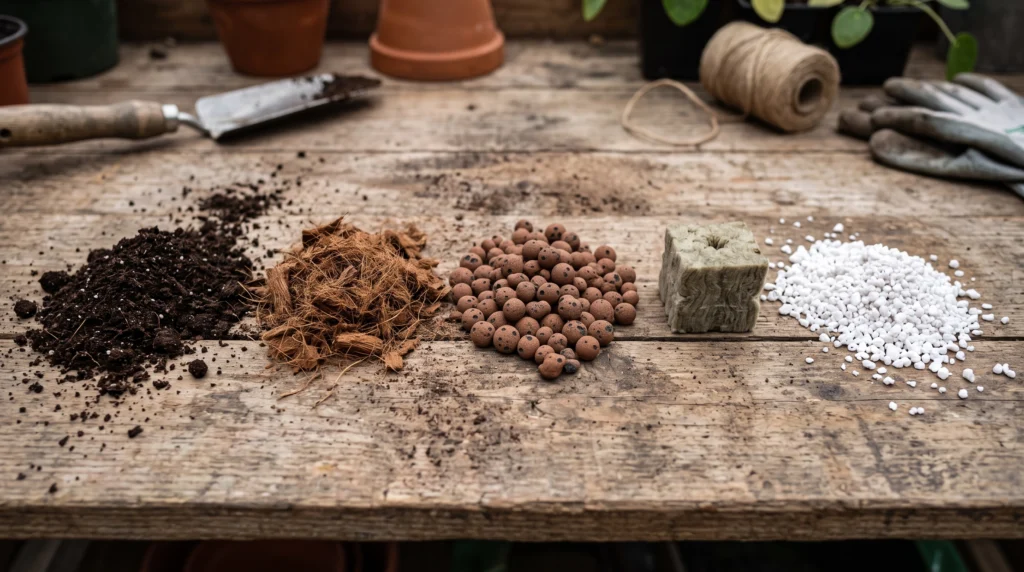
The grow media you choose determines how your root zone retains moisture, delivers oxygen, and responds to your feed program. Get it right, and everything downstream — irrigation frequency, nutrient management, and canopy response — becomes easier to dial in. Get it wrong, and you’ll fight root zone problems that have nothing to do with your technique.
This guide covers every major grow media type: soil, coco coir, rockwool, clay pebbles, perlite, and organic soil amendments. For each one, you’ll find how it works, what system it fits, and how demanding it is to manage day-to-day.
Whether you’re running your first tent or building out a commercial cultivation facility, the right substrate is the foundation of a successful grow.
What Is Growing Media?
Growing media — sometimes called substrate or growing medium — provides three things your plants cannot do without: physical support for roots, moisture retention, and air porosity in the root zone. Some media also supply nutrition (soil), while others are completely inert (rockwool, clay pebbles) and depend entirely on the nutrient solution you deliver.
The distinction matters because it determines how you feed. Inert media require you to dial in EC, pH, and irrigation frequency from day one. Soil buffers those inputs and gives new growers more margin for error. Neither is better — they suit different skill levels, goals, and system types.
What Makes One Media Better Than Another for Your Setup?
The right grow media for your garden depends on four factors: the system type you’re running (passive vs. active irrigation), how frequently you can water or check your setup, whether you want organic or synthetic nutrient programs, and what scale you’re operating at. A media that’s ideal for a flood table is often wrong for a drip system, and what works for a bedroom tent grower may be a poor fit for a 10,000 sq ft facility.
Soil and Potting Mix
Soil is the most forgiving grow media available and the natural starting point for beginner growers. A quality potting mix contains peat or coco, perlite or vermiculite for drainage, and often pre-loaded nutrients and mycorrhizal inoculants. Plants can draw on those nutrients immediately, without requiring you to dial in a full feed program from the first day.
Soil’s buffering capacity is its defining advantage. If you overfeed slightly or let pH drift, the soil matrix absorbs some of that error. It retains moisture for longer than most media, so watering frequency is lower — typically every 2–3 days rather than multiple times per day, depending on container size, environment, and plant stage.
The tradeoff is control. Soil’s built-in nutrient content makes it harder to precisely manage EC and plant response. For growers who want to steer plants aggressively through veg and flower, the inert media options below give much more direct control.
Best for: Beginners, organic growers, container gardens, outdoor-to-indoor transition grows
System compatibility: Hand watering, drip (with appropriate container), passive wicking systems
pH range to maintain: 6.0–7.0
Premium potting mixes like FoxFarm Ocean Forest and FoxFarm Happy Frog are co-op partner products that deliver consistent, well-buffered substrate with microbial populations already established. Both are available individually or on pallet for larger operations.


Coco Coir and Soilless Mixes
Coco coir has become the dominant grow media in modern indoor cultivation — and for good reason. It offers excellent moisture retention, outstanding root aeration, and a naturally slightly acidic pH that suits most nutrient programs. Unlike soil, it’s effectively inert, so plants depend on the nutrient solution you provide. That inertness is exactly what precision growers want: full control over what goes into the root zone.
Coco is derived from coconut husk fiber. Quality coco is washed, buffered to remove excess sodium, and pH-stabilized to a usable 5.5–6.5 range for cannabis cultivation. RHP-certified products are widely recognized in commercial horticulture for consistency and cleanliness — look for that certification when sourcing for professional grows.
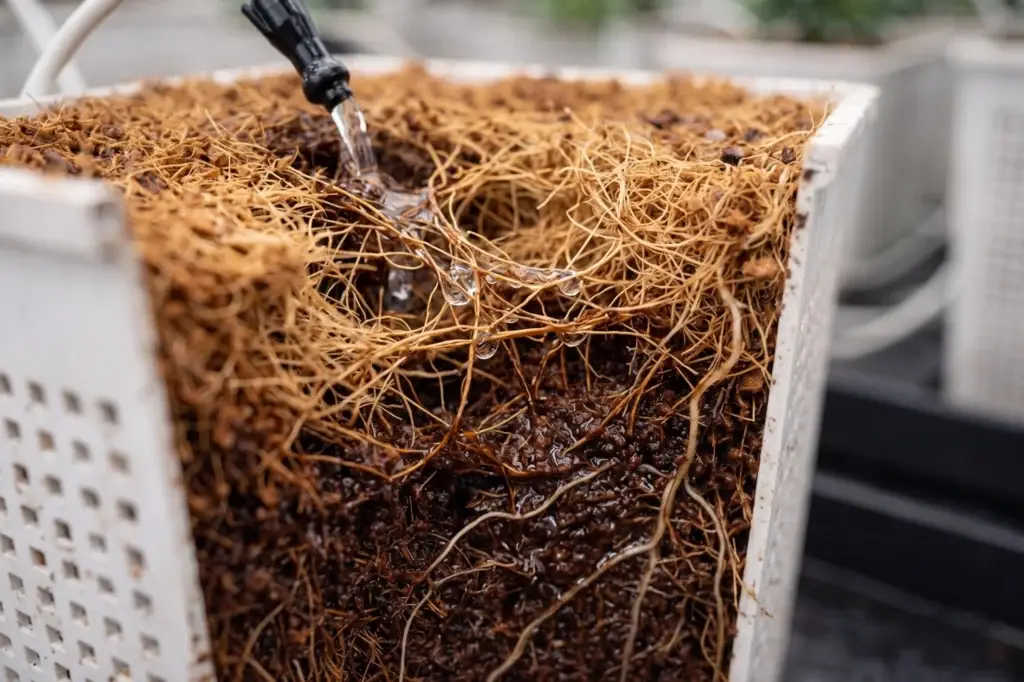
Coco vs. Soil: The Key Difference
Coco dries faster than soil, which means roots cycle through wet-dry patterns more frequently. That cycle is actually beneficial — it drives root development and helps prevent the stagnant moisture conditions that favor pythium and anaerobic root issues when irrigation is managed correctly. But it also means coco requires more attentive irrigation management than soil. Missing a watering window in straight coco is more consequential than missing one in a buffered potting mix.
Coco and Perlite: Why They're Often Combined
Mixing 30–40% perlite into coco coir is standard practice in many high-frequency automated drip programs. Straight coco holds more water than is optimal between irrigation events in those setups. Adding perlite increases drainage rate and improves oxygen exchange in the root zone — particularly important in dense container plantings where roots quickly fill the available volume.
For a deeper dive into managing coco, including buffering protocols, EC targets, and watering frequency by stage, see our complete growing in coco guide.
Best for: Intermediate to advanced growers; high-frequency irrigation programs; growers transitioning from soil who want more control
System compatibility: Drip (containers or grow bags), flood-and-drain, hand watering with attentive scheduling
pH range to maintain: 5.5–6.2
For commercial scale, Coirgro EZ Open Top Coco Coir Grow Bags offer pre-filled, aeration-enhanced bags in 1, 2, and 3 gallon sizes — designed for one-time-use drip programs with minimal setup time. For growers who want a premium pre-buffered coco with RHP certification, RxGreen Clean Coco Ready-to-Use Grow Bags deliver a lab-verified substrate with documented buffering specs. RxGreen also produces a Clean Coco 70/30 Coco Perlite blend — ready to run in high-frequency drip without additional amendment.
Clay Pebbles (LECA) and Growstones
Expanded clay pebbles — often called LECA (lightweight expanded clay aggregate) or hydroton — are a standard media for recirculating hydroponic systems. They don’t retain much moisture between irrigation events, which is precisely why they work: systems like DWC, RDWC, and ebb-and-flow deliver nutrient solution continuously or on timed cycles, so moisture retention in the media itself isn’t needed. What LECA does provide is a stable, pH-neutral physical structure that roots can anchor to while staying highly oxygenated.
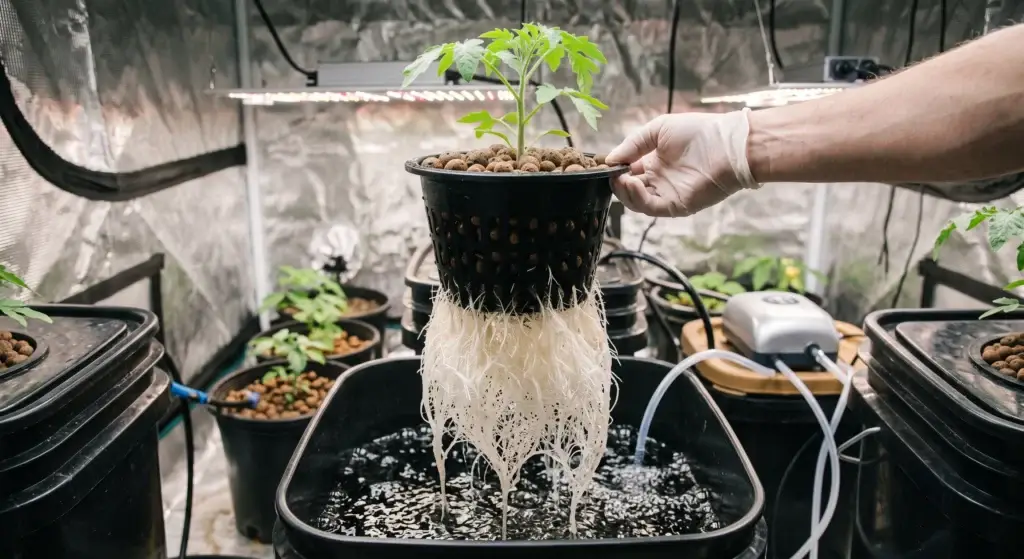
Growstones are made from recycled glass rather than fired clay. Their irregular, porous surface creates more texture for root adhesion and beneficial microbial colonization than smooth clay pebbles. Both are inert and can be cleaned and reused across multiple cycles if properly sterilized between runs.
The most important preparation step with clay pebbles: rinse thoroughly and soak in pH-adjusted water (pH 5.5–6.0) for at least 12–24 hours before use. Off-the-shelf clay pebbles often have dust and elevated surface pH that will affect your root zone if introduced directly.
For a detailed comparison of the two options, see our clay pebbles vs. growstones guide.
Best for: Recirculating hydroponic systems; DWC/RDWC net pot media; experienced growers comfortable with active system management
System compatibility: DWC/RDWC (net pots), ebb-and-flow flood tables, NFT (as propagation media), aeroponic systems
pH range to maintain: 5.5–6.2 in solutionMother Earth Hydroton Original Expanded Clay Pebbles are available in 50-liter pallets and remain a category standard for both hobby and commercial hydroponic operations.
Rockwool (Stone Wool)
Rockwool — also called stone wool — is spun from volcanic basalt rock and slag, producing a fibrous matrix with exceptional water-holding capacity and around 15–20% air space at container capacity, depending on product and irrigation strategy. That combination gives roots consistent moisture availability while keeping oxygen present in the root zone at all times, which is why rockwool has become one of the dominant media in commercial greenhouse and hydroponic cultivation over the last several decades.
Rockwool’s greatest practical advantage is its lifecycle flexibility: the same line of products can take plants from propagation through harvest without transplanting stress. A starter plug transitions directly into a grow block, which sits on a slab — all the same material, all compatible, all managed with identical pH and EC protocols.
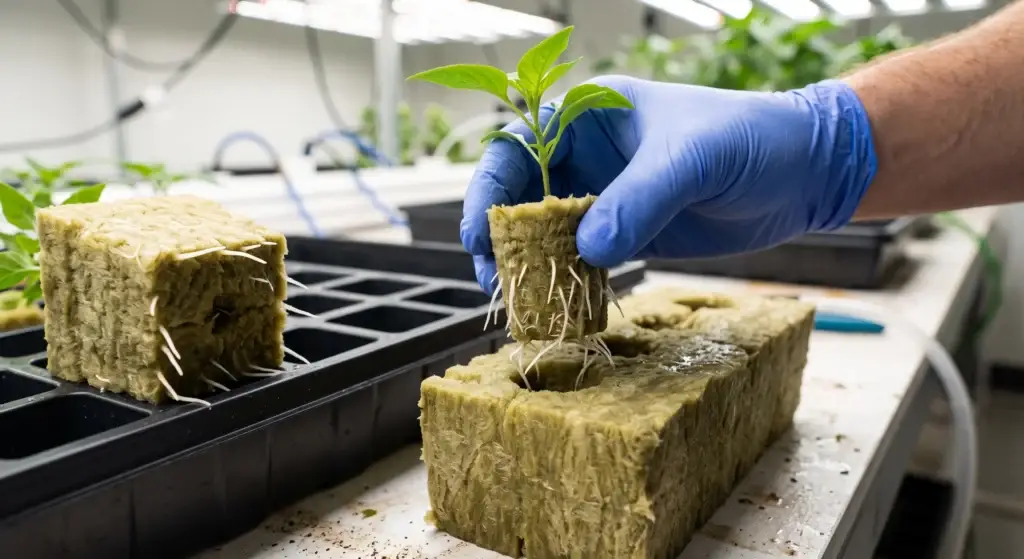
How to Prepare Rockwool Correctly
Never use rockwool straight from the box. The manufacturing process leaves the material with a naturally high pH (often in the 7.5–8.5 range) that will cause nutrient lockout if not addressed. Pre-soak all rockwool in pH-adjusted water at 5.5 for a minimum of 12 hours before use. This drives the pH down to the target range (5.5–6.2) and allows the fiber structure to fully saturate.
The target moisture level during the grow cycle: moist, not saturated. Think of a well-wrung sponge — water present throughout the matrix, but air pockets still intact. Overwatering rockwool is one of the most common causes of root rot in indoor cultivation when irrigation frequency and volume are not matched to plant size and environmental conditions.
For a comprehensive rockwool management guide including slab culture protocols, EC targeting by stage, and commercial crop steering applications, see our dedicated rockwool growing guide.
Best for: Intermediate to advanced growers; commercial greenhouse production; any setup requiring precise root zone control from propagation through harvest
System compatibility: Drip-to-slab systems, flood-and-drain, NFT (plugs/blocks), ebb-and-flow
pH range to maintain: 5.5–6.2
VidaWool is Hydrobuilder’s rockwool partner and a standard recommendation for commercial-scale work. The full lineup includes VidaWool Starter Plugs for propagation, VidaWool Rockwool Blocks for vegetative development, and VidaWool Rockwool Slabs for production beds — a complete system from clone to harvest. For growers who prefer Grodan’s long-established commercial specs, Grodan Gro-Blocks and Grodan A-OK Starter Plugs are both great options.
Perlite
Perlite is a lightweight, porous volcanic glass that has been superheated to expand into millions of tiny air pockets. It contributes no nutrients to the root zone, has a near-neutral pH around 7.0, and offers excellent drainage and aeration when added to other media.
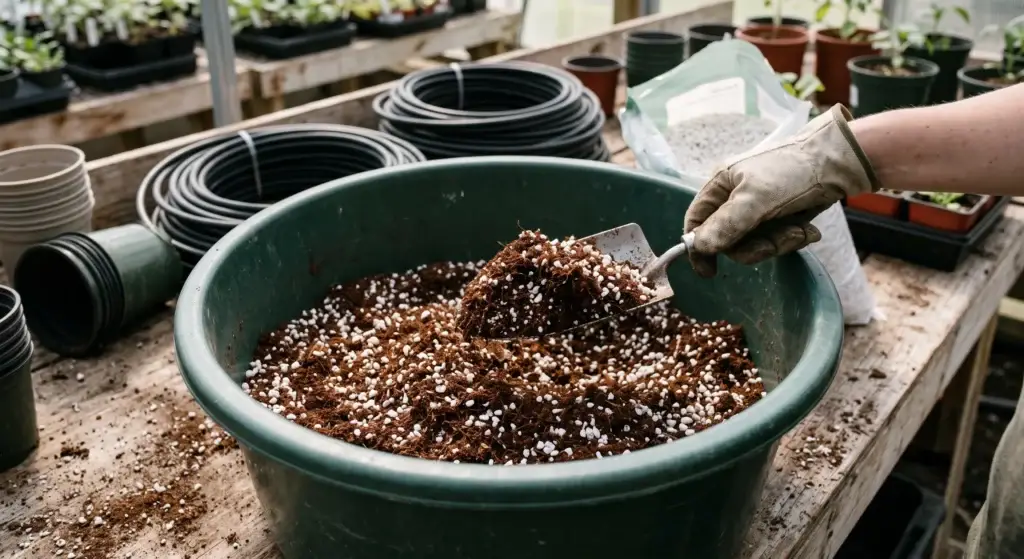
In most grow programs, perlite is used as an amendment rather than a standalone media. Mixed into coco coir at 30–40% by volume, it increases drainage rate and oxygen availability between irrigation events. In soil grows, 15–20% perlite addition helps prevent compaction and improves drainage in heavier mixes.
Perlite can be used as a standalone media in wick systems and some soilless container programs, where its wicking action moves water efficiently through the root zone. On its own in systems with infrequent watering or high VPD, though, it dries out too quickly for most plants.
Perlite grades matter for different applications: #3 (medium) is standard for soil amendment; #4 (coarse) is preferred for coco blending and standalone container use where drainage needs to be maximized.
Best for: Amendment in soil or coco mixes; aeroponics propagation; standalone media in wick systems only
System compatibility: All systems when used as amendment; wick systems standalone
pH range to maintain: Neutral — takes on pH of the surrounding mix GROW!T #4 Perlite (coarse grade) and Mother Earth Perlite #3 are both available in pallet quantities.
Grow Media for Clones and Seedlings
Standard grow media — soil, coco, clay pebbles — are not ideal for propagation. The goal during propagation is to maintain consistent humidity at the stem base, keep oxygen available to nascent root sites, and avoid any nutrient load that could burn undeveloped roots before a root zone has established.
Dedicated propagation media solve all three: starter plugs, rockwool cubes, and peat-based root plugs maintain optimal moisture and porosity for cuttings when used with proper dome and venting practices. As the plant roots out and hardens off, the plug transplants directly into the next media stage without disturbing the root system.
Rockwool starter plugs (VidaWool and Grodan) transition seamlessly into rockwool grow blocks. Peat and coco-based root plugs are inert enough to plant directly into soil, coco, or hydro systems. Neither requires transplanting out of the propagation media — they integrate into the next substrate in place.
Organic Soil Amendments
Amendments give you targeted control over what goes into your root zone — whether that’s improving drainage, adding slow-release nutrition, or building soil biology. For organic growers, amendments are the primary nutrient delivery mechanism rather than liquid feed programs.
Common amendment types and what they contribute:
- Bone meal delivers slow-release phosphorus and calcium, making it valuable at transplant and during early flower development. Down To Earth Bone Meal is OMRI listed for certified organic production.
- Kelp meal provides a broad spectrum of trace minerals and naturally occurring growth hormones that support cell division and development. Down To Earth Kelp Meal works in both top-dress and compost tea applications.
- Bat guano and seabird guano are high-analysis organic nitrogen-phosphorus-potassium sources. Seabird guano typically carries higher NPK ratios than bat guano and is particularly effective during early vegetative development when used appropriately.
- Mycorrhizal inoculants establish symbiotic fungal networks that extend the effective surface area of plant root systems, improving water and mineral uptake across the full grow cycle. Plant Success Great White and Impello Biosciences Tribus are two established options in this category.
- Perlite (see above) rounds out the amendment toolkit, improving drainage and aeration in any mix that tends toward compaction.
For organic gardeners, look for the OMRI Certified label to help ensure inputs qualify for certified organic production from germination through harvest, where applicable to your certification scheme.


Buying Grow Media in Bulk
High-volume operations — whether a multi-light indoor facility or an outdoor acreage — should source grow media in pallet or bulk quantities to control input costs. All major substrate categories at Hydrobuilder are available in pallet pricing, and custom bulk quotes are available for large-volume orders.
Bulk media can be black-wrapped for security and shipped on pallet. For large or irregular orders, call our team directly at 888-815-9763 for a custom quote that reflects your volume and frequency requirements.
Do you have a Hydrobuilder commercial account? Commercial customers receive dedicated pricing and access to a grower support team throughout the production cycle.
For Commercial Operations: Choosing Media at Scale
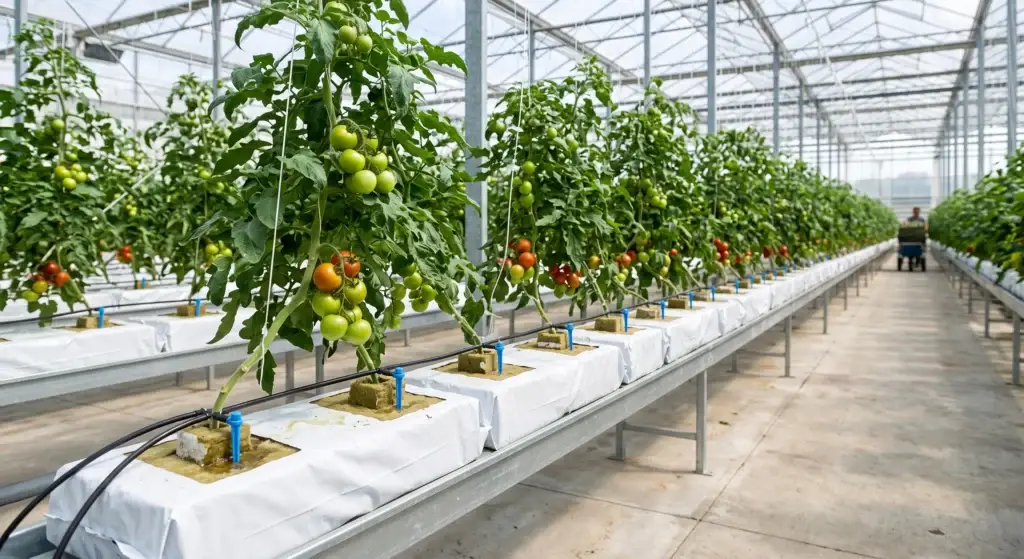
At the facility scale, media selection is no longer just about root zone performance — it becomes a logistics and cost-per-run decision that affects labor, waste handling, and system compatibility across thousands of square feet.
Coco grow bags remain a dominant commercial format for drip-to-waste and recirculating coco programs. Pre-filled, disposable bags eliminate prep labor, reduce cross-contamination risk between cycles, and standardize root zone volume across the facility. Coirgro EZ Open Top Coco Bags and RxGreen Clean Coco Grow Bags both offer pre-buffered options with certified specs.
Rockwool slab culture is a standard format for high-wire vegetable and herb production and is widely used in cannabis as well. Slabs are placed on raised gutters or benches with drip stakes delivering solution at precisely timed intervals — a system optimized for the kind of crop steering that commercial operations require. VidaWool Rockwool Slabs are available case-packed for facility-scale runs.
Substrate steering in rockwool vs. coco: Rockwool gives operators more precise control over generative and vegetative steering because its air:water ratio is easier to manage through irrigation volume and frequency than coco. Coco’s higher CEC (cation exchange capacity) creates more buffering — an advantage for teams that can’t monitor root zone EC as closely but a limitation for operations targeting tight steering windows. For a deep dive on steering technique, see our crop steering guide for coco and rockwool.
Drainage and waste: Coco generates more organic waste per cycle than rockwool but composts relatively easily. Rockwool slabs are durable and can be reused if sterilized between cycles, but most large-scale operations still dispose of slabs after each run or at least annually because long-term reuse and disposal require careful handling at commercial scale.
Hydrobuilder’s commercial account program includes volume pricing on all substrate categories, dedicated grower support, and pallet-level stocking for facilities that can’t afford substrate delays mid-cycle.
Grow Media Quick-Reference Chart
| Media | Inert? | Best System Type | Watering Frequency | Skill Level |
|---|---|---|---|---|
| Potting soil | No | Hand water, passive drip | Every 2–3 days | Beginner |
| Coco coir | Yes | Active drip, hand water | 1–4x daily (frequency increases with plant size) | Intermediate–Advanced |
| Coco + Perlite mix | Yes | High-frequency drip | 2–6x daily | Intermediate–Advanced |
| Clay pebbles (LECA) | Yes | DWC/RDWC, ebb-and-flow | Continuous or timed flood | Advanced |
| Rockwool (blocks/slabs) | Yes | Drip-to-slab, flood | 1–6x daily depending on stage | Intermediate–Advanced |
| Perlite (standalone) | Yes | Wick, aeroponic propagation | Continuous or high-frequency | Intermediate |
| Perlite (amendment) | Yes | Any (blended) | Inherits from primary media | All levels |
Why Shop at Hydrobuilder
Hydrobuilder stocks the full range of grow media formats — from single bags to pallet quantities — across every major substrate category. Our inventory includes co-op partners VidaWool and RxGreen for rockwool and coco, Grodan for commercial slab culture, and Coirgro for pre-filled bag programs. Commercial accounts receive volume pricing, dedicated grower support, and pallet stocking for facilities that can’t wait on substrate restocks. For custom quotes on large or bulk purchases, call us at 888-815-9763.
Example: FAQs
Q: What is grow media and why does it matter?
A: Grow media is the substrate that physically supports plant roots and conditions how they access water, nutrients, and oxygen. Unlike outdoor soil, indoor grow media can be precisely matched to your irrigation system and feed program. The choice directly affects how often you water, how you manage nutrients, and how much margin for error you have when conditions drift. Coco coir, rockwool, clay pebbles, and soil each behave very differently in practice — selecting the wrong one for your system type is one of the most common causes of root zone problems.
Q: What is the best grow media for beginners?
A: Soil or a high-quality potting mix is the best starting point for most beginners. Soil buffers pH and nutrient fluctuations, retains moisture longer, and is far more forgiving of imprecise watering schedules than inert media like coco or rockwool. As you gain confidence managing feed programs and irrigation timing, transitioning to coco — which offers more control and often faster vegetative growth under optimized conditions — is the most common next step. Start with a pre-amended mix like FoxFarm Ocean Forest or FoxFarm Happy Frog, where the nutrients and biological life are already established.
Q: What is the difference between coco coir and soil?
A: Coco coir is an inert media made from coconut husk fiber — it supplies no meaningful nutrients of its own and requires a full liquid feed program from day one. Soil contains organic matter, pre-loaded nutrients, and microbial populations that can buffer the root zone and feed plants with less frequent liquid fertilization. Coco dries faster than soil, supports more frequent watering cycles, and gives growers direct control over what enters the root zone. Soil is more forgiving but harder to steer aggressively. Most experienced indoor cultivators prefer coco for the control it provides; beginners tend to have better early results with soil.
Q: Does coco coir need to be pH buffered before use?
A: Yes. Raw coco coir can have residual salts and calcium/magnesium imbalances from the manufacturing process that compete with your nutrient solution. Pre-buffering involves saturating the coco with a cal-mag-adjusted solution at pH roughly 5.8–6.0, then allowing it to drain before use. RHP-certified coco products (including RxGreen and Coirgro) are buffered at the factory, but even these benefit from a final pre-soak in your working solution before introducing plants. For detailed buffering protocols, see our coco growing guide.
Q: How do you prepare rockwool before using it?
A: Soak rockwool in water adjusted to pH 5.5 for a minimum of 12 hours before use. This drives down the naturally high pH of the manufacturing process (often around 7.5–8.5) to the target range for nutrient availability (roughly 5.5–6.2). After soaking, allow the rockwool to drain until it reaches proper moisture level — moist throughout but not dripping. Never use dry, unbuffered rockwool directly with seedlings or cuttings. See our complete rockwool guide for pre-soak, EC targeting, and stage-by-stage management protocols.
Q: What is the best grow media for hydroponic systems?
A: It depends on the system type. DWC and RDWC systems work best with clay pebbles in net pots — the low moisture retention keeps root crowns oxygenated while the recirculating solution handles all nutrient delivery. Ebb-and-flow systems work well with clay pebbles, coco, or perlite in containers. Drip systems pair best with coco coir (typically 30–40% perlite by volume) in containers or pre-filled grow bags. Rockwool is ideal for drip-to-slab programs and commercial slab culture. There is no single best hydroponic media — the correct choice is always relative to your system type and irrigation schedule.
Q: Can you reuse grow media between cycles?
A: Clay pebbles can be rinsed, sterilized (hydrogen peroxide solution or bleach flush), and reused multiple times. Rockwool slabs can be reused if thoroughly sterilized between cycles, but most large-scale growers replace them annually or every run to minimize disease risk and variability. Coco coir grow bags and most potting soils are not recommended for reuse in commercial cannabis production — the fiber breaks down over time, salt and organic matter accumulate, and disease pressure increases. Perlite used as a standalone media can be sterilized and reused, though it’s inexpensive enough that replacement is often preferred.
Q: What grow media do commercial indoor facilities use?
A: Commercial greenhouse and indoor cannabis operations predominantly use either coco coir grow bags or rockwool slab culture. Rockwool is preferred in facilities where precision crop steering through generative and vegetative phases is critical — it’s easier to control the air:water ratio in rockwool than coco at scale. Coco grow bags are common in drip-to-waste programs where disposal simplicity and consistent substrate specs matter more than steering precision. For facility-scale sourcing, Hydrobuilder carries VidaWool rockwool, RxGreen and Coirgro coco bags, and Grodan slab systems with commercial account pricing available.
Q: Is perlite a grow media on its own?
A: Perlite can be used as a standalone grow media in wick systems and some aeroponic propagation applications, but it is far more commonly used as an amendment mixed into coco (30–40%) or soil (15–20%) to improve drainage and aeration. By itself, perlite dries too quickly for most active irrigation programs and provides little moisture buffer for plants in between watering events under typical indoor VPD. As an amendment, though, it meaningfully improves root zone performance in almost any substrate it’s added to.