On this page
- Level
- All levels
- Read time
- 10 min
- Sections
- 7
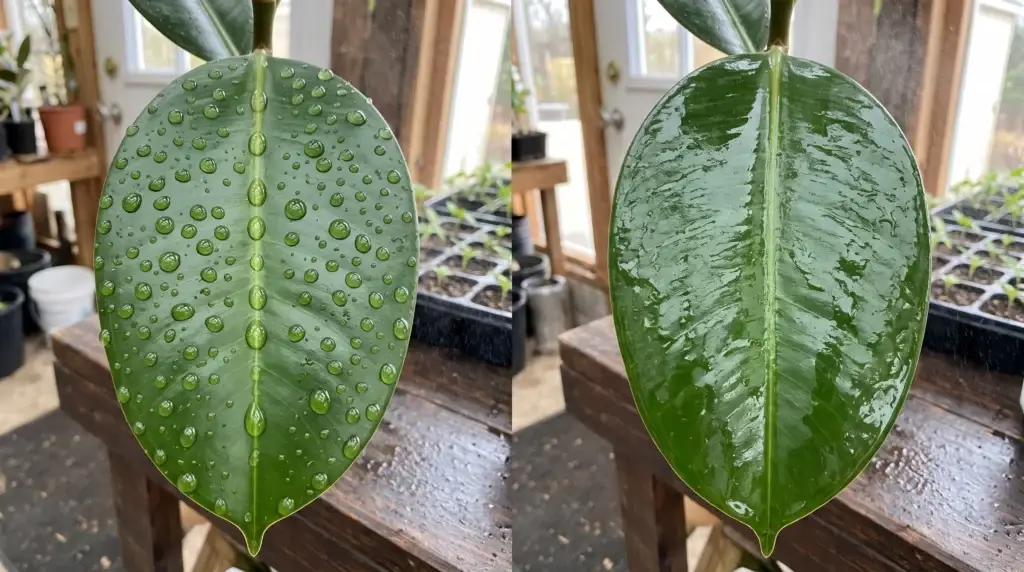
A wetting agent for plants lowers the surface tension of water so it spreads out instead of beading up. Most growers buy one for foliar sprays, our sales team says, to get even coverage instead of droplets sitting on a waxy leaf. The same property has a second job in the root zone, where it helps a dry peat or bark mix take water instead of shedding it down the side of the pot. The products for those jobs are labeled differently, used at different rates and governed by different rules, so the first decision is which problem you actually have. Get that wrong and you can burn foliage or leave the center of a root ball dry while the pot drains like it's full.
Two Problems That Share a Chemistry

Surfactant is the ingredient class. In a spray tank, a surfactant is one type of adjuvant, meaning anything added to change how a pesticide or foliar product behaves. A spray wetting agent decreases the surface tension of the mix so more of each droplet touches the leaf, as UF/IFAS Extension's Adjuvants publication (SS-AGR-109) puts it.
Media surfactants are a separate category. They're blended into peat, bark or other soilless mixes at the time of mixing, or applied through the irrigation water, so the substrate absorbs water evenly. A bottle labeled for one job isn't automatically labeled for the other, and a rate written for one never transfers to the other.
On Leaves: The Spray Label Decides
Add a surfactant to a foliar spray only when the label of the product you're spraying calls for one. Many pesticides already carry their own adjuvants in the formulation. Surfactants flatten and spread droplets so the product can reach the leaf, and the pesticide label may name which adjuvants to use (NPIC adjuvant fact page). If it names a specific type or brand, a substitute violates the label (Penn State Extension).
The wrong surfactant isn't just wasted money. It can make the pesticide work worse and raise the risk of plant injury. Better-looking coverage also isn't a reason to cut the pesticide rate. Follow the full spraying process in our guide on how to foliar spray, and if your current sprayer leaves streaks or drips, choosing a garden sprayer covers nozzle and pressure options.
When the label does allow a spreader-sticker, Performance Nutrition Argosy RF is an in-stock polymer adjuvant sold to help spray spread across the leaf and hold on through irrigation. Its product page lists 1 pint to 1 gallon per 100 gallons of spray. Confirm that against the current label and your pesticide label before you mix. Spray-N-Grow Coco-Wet, sold as a nonionic wetter for foliar sprays, is one of the two products customers ask our sales team for most.
Why nonionic is the usual pick
Surfactants are grouped by their electrical charge in water: anionic, cationic, nonionic and amphoteric. Most herbicide labels that call for a surfactant specify a nonionic type, and nonionic is the type most commonly recommended with registered pesticides. Anionic and cationic types generally aren't used with them. Only nonionic products sold specifically for pesticide use belong in the tank (UF/IFAS).
Organosilicone surfactants are a strong-spreading family that cut surface tension dramatically at very low concentrations. UF/IFAS gives their typical range as 0.10 to 0.25% by volume, roughly 0.8 to 2 pints per 100 gallons of spray. Treat that as a reference point, not a rate, and check your label.
Running a jar test before you fill the tank

Leaf burn from a wetting agent is rare, in our sales team's experience. When it does happen, it's usually from mixing products that can't be mixed, such as oils and alcohols. A jar test catches that kind of physical incompatibility before it clogs a nozzle or coats a canopy. Penn State describes a version of it, and your pesticide label may describe its own. Use the label's procedure when it has one:
- Wear the gloves and eye protection the most restrictive label in the mix requires.
- Pour 1 pint of the same water you'll spray into a clear quart jar. Add the products at the same proportions as the tank, in the order the labels give. If no label gives an order, add dry products (wettable powders, dry flowables, water-dispersible granules) first, then flowables and liquids, then solutions, then surfactants or oils, and emulsifiable concentrates last.
- Close it, shake it, and let it stand at least 15 minutes.
- Look for scum, layers, clumps, gels, sludge, a strong odor or the jar warming up. Any of those means don't mix it. Dispose of the test mix as the pesticide label directs, and never reuse the jar or measuring tools for anything else.
A clean jar shows the products stay mixed. It doesn't show the combination is legal, effective or gentle on your crop. For that, spray a small area or a few plants first and watch them for several days before treating the room.
Handling Concentrates: Hazards and Precautions
Surfactants change how liquids move across surfaces, and skin is one of those surfaces. Some surfactants can increase how much of a product is absorbed through the skin (NPIC). Wear the gloves, eye protection and clothing the label lists, and when a surfactant goes into a pesticide mix, follow whichever label in the tank is most protective.
Two regulatory points are easy to miss. Most adjuvants don't have to be listed on pesticide labels, so a product may already contain a surfactant without naming it. Tank-mix adjuvants also aren't registered with the federal EPA, though some states require registration or reporting. Commercial operations should confirm their own state's rules.
In the Root Zone: Peat, Coco and Dry Media
Dry pockets in media come up less often than spray questions for our sales team, because most growers now run proper irrigation systems or watering schedules. When they do, peat-based mixes are the classic case. Peat takes water readily when it's moist, but as it dries the surface of the fibers turns water-repellent, so the next irrigation channels down the pot wall or through cracks and runs out the bottom. Durand, Jackson, Fonteno and Michel measured this in "The Use of Wood Fiber for Reducing Risks of Hydrophobicity in Peat-Based Substrates" (Agronomy, 2021): peat grew more hydrophobic and harder to rewet the harder it was dried, while wood fiber stayed easy to wet.
Signs a mix isn't taking water

These point toward a wetting problem, but each one has other possible causes:
- Water pools on the surface or beads on dry mix before soaking in.
- Runoff shows up almost immediately after you start watering.
- The pot feels light right after irrigation.
- The root ball has a gap around the edge, or the center stays dry when you check it.
- Pots on the same schedule dry back at very different rates.
Rule out a clogged emitter, a misplaced dripper, compaction and a rootbound pot before adding anything. A surfactant won't fix any of those. That's how our sales team handles these calls: find the root cause of the problem first, rather than just swapping in another product.
Pre-treated mix, rewetting and maintenance doses
Many commercial bagged mixes already contain a media surfactant. Check the bag. Labels for media products such as Aquatrols AquaGro L separate three situations: blending the surfactant into the mix as it's prepared, drenching an untreated mix during production, and applying a lower maintenance rate through irrigation injection. The same label sets different rates depending on whether the mix was already treated.
If a pot has already gone hydrophobic, work through it in order:
- Confirm it's a wetting problem using the signs above, not an emitter or root issue.
- Drench with a product labeled for media use, at the label's rate for untreated or hard-to-wet mix, wearing the protection that label lists.
- About 10 minutes after the next irrigation, slip the pot off and check whether the whole root zone is moist. Paul Fisher (University of Florida) and Bill Argo recommend this check, and note that patchy drying can signal poor rewetting.
- Reapply only if the mix still needs heavy leaching to wet through. Repeat doses of some chemistries can backfire, as the next section explains.
Prevention beats rescue: keep the mix from drying hard in the first place.
For a botanical option, Roots Organics Rain is a yucca and quillaja blend marketed for both root-zone and foliar use, so the botanical caveats below apply to it.
Coco is a judgment call
Coco coir behaves differently from peat, and growers don't agree on whether it needs a wetting agent at all. In coco, an uneven pot is more often a dryback or irrigation-volume problem, which managing irrigation in coco walks through.
When a Wetting Agent Makes Things Worse
More surfactant is not more benefit. The wrong one raises the risk of plant injury, and when a label doesn't mention an adjuvant, the manufacturer's research may have found no benefit, or even harm, from adding one (Penn State). Never treat plants under drought stress, in excessive humidity or in heat above 90F with soaps (UF/IFAS Gardening Solutions). Follow any additional limits on the specific product label.
Repeat media treatments can backfire with some chemistries. Song and colleagues (Nanomaterials, 2021) applied two commercial wetting agents to hydrophobic sand three times in a lab study. One product, a polyoxyalkylene polymer, made the sand more water-repellent after repeated use; the other improved wetting. That was sand, not peat or coco, with only two products, but the authors' conclusion is worth carrying over: certain wetting agents may increase hydrophobicity if used repeatedly. Check whether the mix is actually wetting better before you reapply.
Skip the dish soap. It's a common shortcut and a well-documented cause of crispy leaves. Dish soaps are synthetic detergents built to be powerful cleaners, and even watered down they strip the leaf's protective coating, often leaving damaged, dry foliage (UF/IFAS, soaps, detergents and pest management). Registered insecticidal soap is a pest-control product with its own label and is typically only 1 to 2% soap by volume. It isn't a spray additive. Oil sprays raise the same question, and whether a neem product needs an emulsifier depends on its formulation, as covered in using neem oil on plants.
Yucca and Quillaja: The Botanical Options
Yucca and quillaja extracts contain saponins, plant compounds that foam and lower surface tension much like a synthetic surfactant. Retailers and manufacturers market them for both foliar and root-zone use. No extension trial on yucca or quillaja in peat or coco turned up in research for this article, so their claims rest on manufacturer data, not independent testing. A "natural" source doesn't settle the rate, crop tolerance or organic status. Label rates for botanical wetters vary widely between brands because saponin content differs, so a rate from one product can't be applied to another.
Two in-stock options show how different the formats are. American Extracts Therm X-70 is a liquid extract from Yucca schidigera that's simple to measure into a sprayer or feed tank. NPK Industries RAW Dry Yucca is a dry powder that has to be fully dissolved before it goes near a nozzle or emitter. Kalix yucca, the other product customers ask our sales team for most, is also a soluble powder its maker says to dissolve in water before use. Read each label for what it's approved for and how much to use, and if you're spraying it alongside a pesticide, the pesticide label still controls whether any adjuvant is allowed.
Compare labels across our wetting agents and surfactants to match a product to the job.


Frequently Asked Questions
Is a wetting agent the same as a sticker?
No. A wetting agent helps a spray spread across the leaf. A sticker is a different adjuvant meant to help residue hold on and resist wash-off from rain or overhead watering. Some products combine both and are sold as spreader-stickers, but no adjuvant makes a spray fully rainproof. If your pesticide label calls for a sticker or a spreader-sticker specifically, use that type and not a substitute.
Can I add a wetting agent to my nutrient reservoir?
Only if the product's label gives directions for root-zone or fertigation use, and only at the rate it lists for that use. A foliar rate doesn't carry over. Saponin-based products foam, so expect bubbles in a reservoir with air stones or a return line. Watch plants for a few days after the first dose, and check that drippers and filters stay clear if you're using a powdered product.
Are yucca wetting agents automatically approved for organic growing?
No. A botanical ingredient doesn't establish organic status by itself, since carriers, preservatives and processing all count. If you grow under an organic certification program, check the exact product's current listing or documentation with your certifier before using it.

Garrett is a data team member at Hydrobuilder with 8 years on the team, working across product catalog and data operations. His deep familiarity with growing products across every major category informs the vegetable and food crop content he contributes to the Learning Center.
All guides by Garrett → Dustin Davis