


Perlite and vermiculite are both lightweight soil amendments that improve aeration and structure, but they do opposite things with water — and choosing the wrong one can stall germination, cause root rot, or dry out moisture-sensitive plants. If you’re working with a soil mix, soilless medium, or coco blend and wondering which to reach for, this guide breaks down the real difference between perlite and vermiculite so you can match the right amendment to your specific plants and system.
Both are useful. Neither is universally better. The correct answer depends on drainage, water retention, and what stage your plants are in.
For commercial cultivators: Perlite and vermiculite decisions scale quickly at the facility level — amendment ratios, grade selection, and how these interact with your substrate choice all affect uniformity across rooms. See the For Commercial Operations section below.
What Is Perlite?
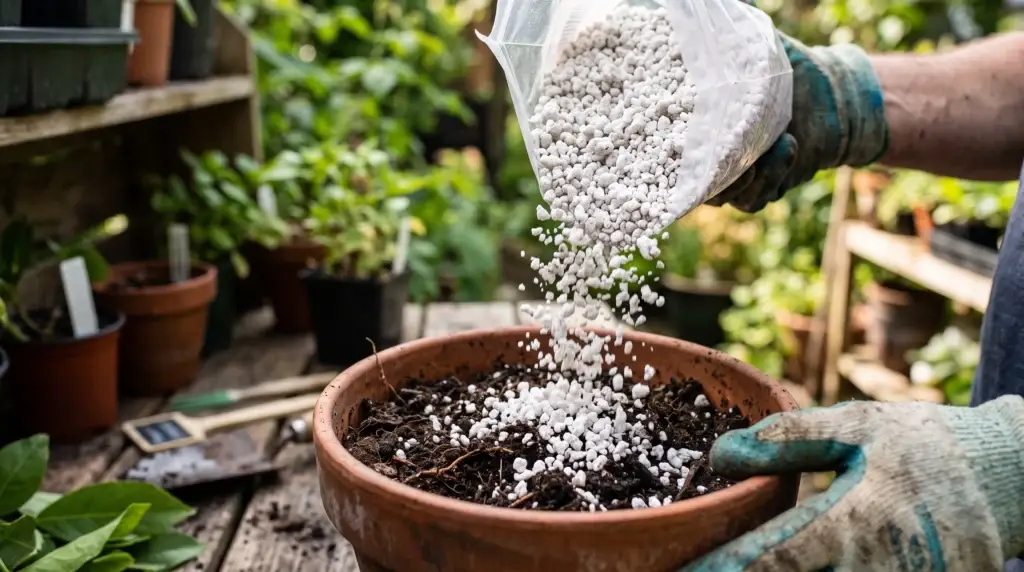
Perlite is a volcanic glass that has been superheated until it expands into lightweight, porous white particles. Its primary function is drainage and aeration — not water retention.
Made from naturally occurring volcanic glass (perlite ore) heated to around 1,600°F (871°C), perlite pops like popcorn into a highly porous structure. The result is a near-sterile, pH-neutral amendment (typically 7.0–7.5) that resists compaction, doesn’t rot or harbor disease, and is light enough to float to the surface of containers if not incorporated evenly.
What Perlite Is Good For
Perlite’s porous structure holds air in the spaces between particles rather than holding water tightly. This makes it ideal for:
- Improving drainage in heavy or clay-dense soils
- Preventing compaction in long-term container grows
- Rooting cuttings where excess moisture causes rot at the stem base
- Growing drought-tolerant plants (succulents, cacti, lavender, rosemary, rhododendrons) that need fast-draining substrate
- Soilless and coco blends where you want precise water-to-air ratios
When used in coco coir, perlite is particularly valuable — it counteracts coco’s natural tendency to compact over time and helps maintain oxygen levels at the root zone throughout a grow cycle. A 70/30 coco-to-perlite ratio is standard for cannabis and high-output vegetable cultivation. Root Royale Cocolite 70/30 Coco Coir & Perlite is available pre-blended and RHP certified for growers who want consistency without mixing by hand.
Choosing the Right Perlite Grade
Not all perlite is the same. Graded perlite is sized by particle diameter, and the grade you use affects drainage rate, air pocket size, and how well it stays mixed in your medium:
| Grade | Particle Size | Best For |
|---|---|---|
| #2 Super Coarse | Largest particles | Standalone hydroponic media, very high drainage |
| #3 / Coarse | Medium-large | Soil blends, coco mixes, most indoor growing |
| #4 / Super Coarse | Larger than #3 | High-drainage hydroponic media, coarse soilless blends |
For most indoor and container growers, a #3 or coarse grade hits the right balance. GROW!T #4 Perlite is available in 4 cubic foot pallets and suits both amending existing soil and building soilless mixes from scratch. For coarser drainage applications, Mother Earth offers both Perlite #3 and Coarse Perlite in pallet quantities.
Can You Grow Plants in 100% Perlite?
Yes, with caveats. Some growers successfully grow in straight perlite as a soilless hydroponic medium — it drains fast, stays aerated, and is easy to manage with fertigation. However, plants in 100% perlite are entirely dependent on your nutrient and watering schedule. There is very little buffering capacity, and dehydration stress can occur quickly if irrigation is interrupted. For most growers, blending perlite 20–50% into a soil or coco base is more forgiving than running it straight.
What Is Vermiculite?
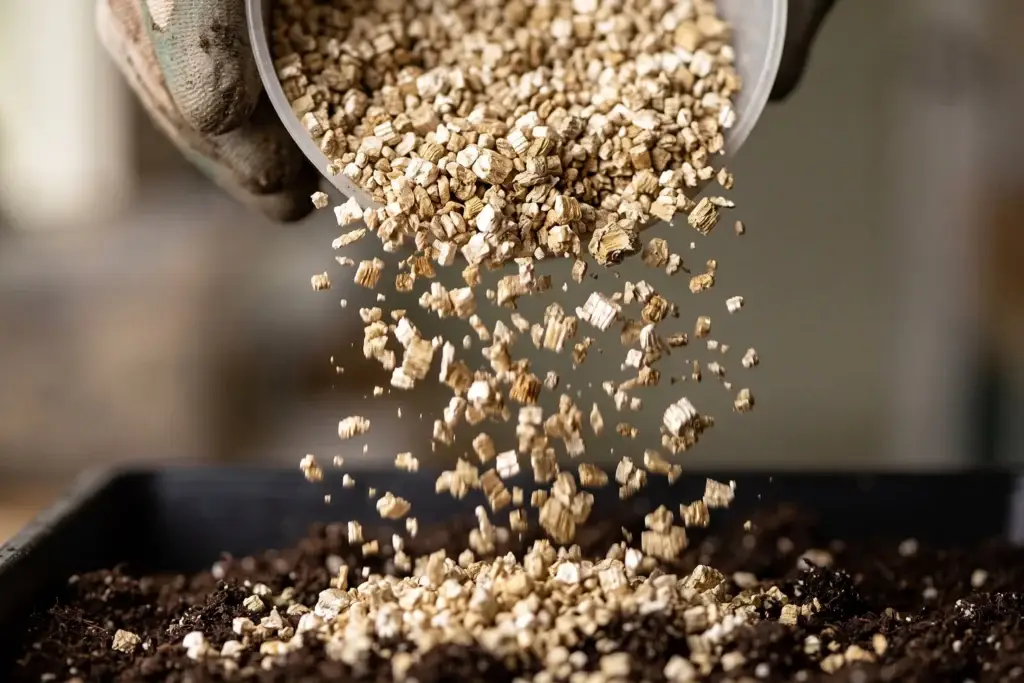
Vermiculite is a hydrated magnesium-iron-aluminum mineral that expands when heated into accordion-like, plate-layered pellets. Its primary function is moisture and nutrient retention — the opposite of perlite.
Unlike perlite, which holds air between particles, vermiculite holds water within its layered structure. It can absorb up to four to six times its weight in water and releases it slowly as the root zone dries — a behavior called buffering. This makes vermiculite exceptionally useful in situations where consistent moisture matters more than drainage.
Vermiculite is also sterile, odorless, non-toxic, and will not decompose or compact over time. Its pH hovers near neutral (7.0), making it compatible with a wider range of crops than perlite in pH-sensitive applications.
What Vermiculite Is Good For
- Seed germination and propagation — vermiculite’s moisture buffering protects against the erratic wet/dry cycles that cause damping-off in seedlings
- Water-loving plants — irises, ferns, forget-me-nots, tropical houseplants, and similar species that need sustained moisture in the root zone
- Cuttings in propagation — when combined with peat or coco, vermiculite speeds root development while preventing desiccation
- Lightening dense soil — vermiculite breaks up compaction in houseplant containers and raised beds without sacrificing moisture retention
- Mushroom cultivation — vermiculite is widely used as a casing layer and substrate component in mycology
When germinating seeds, a 50/50 mix of vermiculite and perlite or a straight vermiculite fill keeps the moisture level high and steady — critical for uniform germination rates.
Ultra Tech Premium Horticultural Vermiculite, Medium Grade is OMRI listed, CDFA certified, and available in multiple sizes from single bag to full pallet — suitable for both home gardeners and production-scale operations.
Perlite vs. Vermiculite: The Key Differences
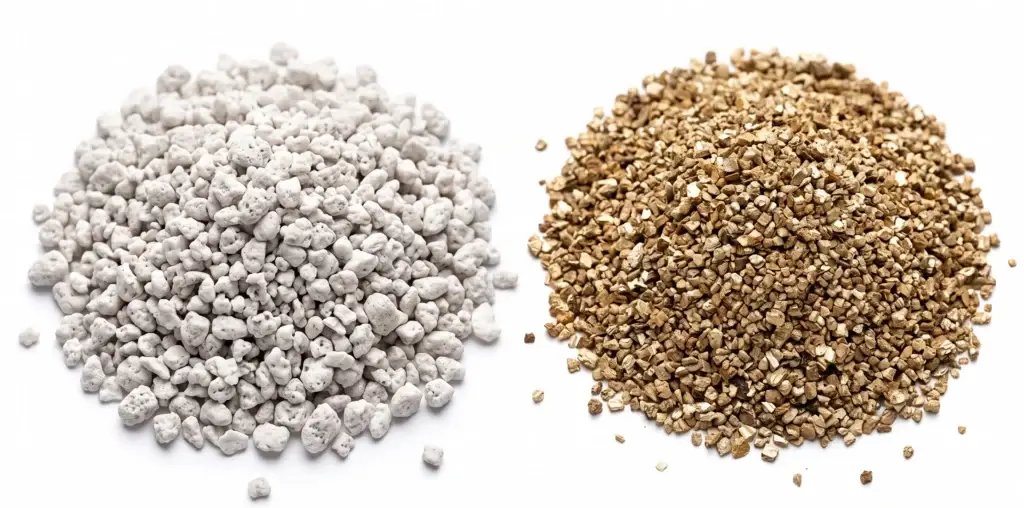
The core difference is moisture behavior. Everything else flows from that.
| Property | Perlite | Vermiculite |
|---|---|---|
| Primary function | Drainage and aeration | Moisture and nutrient retention |
| Water behavior | Releases water quickly | Holds and slowly releases water |
| pH | Near-neutral (7.0–7.5) | Near-neutral (7.0) |
| Best for | Drought-tolerant plants, cuttings, coco blends | Seed starting, moisture-loving plants, propagation |
| Avoid for | Water-loving plants (too dry) | Succulents, cacti, plants prone to rot |
| Particle weight | Very light, may float | Slightly denser, stays in mix better |
| Nutrient holding | Minimal CEC | Moderate CEC (buffers some nutrient ions) |
Drainage vs. Retention: The Decision Framework
Use perlite when:
- Your plants are drought-tolerant or susceptible to root rot
- You’re growing in coco and need to maintain air porosity throughout the cycle
- You’re rooting cuttings and need the stem base to stay relatively dry
- Your mix already retains too much water
- You’re blending a soilless or hydroponic substrate that will run frequent short irrigation cycles
Use vermiculite when:
- You’re germinating seeds and need consistent moisture
- You’re working with moisture-loving plants that struggle in fast-draining media
- You want to slow the drying rate of a medium without compacting it
- You’re propagating cuttings from cuttings that need high ambient humidity
- Your medium is too lean and dries out between waterings
The pH Difference
Both amendments are close to neutral, but perlite skews slightly alkaline (up to 7.5 depending on source), while vermiculite sits closer to true neutral. For crops sensitive to alkalinity — blueberries, azaleas, acid-loving herbs — this distinction matters. If you’re already adjusting pH routinely in a controlled system, the difference is minor. In an unmanaged outdoor or container bed, it can push the pH enough to affect micronutrient availability.
Mixing Perlite and Vermiculite Together
Some growers ask about combining the two. It can work in specific contexts — notably a 50/50 perlite-vermiculite blend is a recognized medium for drip hydroponic systems and ebb-and-flow tables, where the paired effects of aeration and moisture buffering are both useful. But for most garden or container applications, picking the one that matches your crop’s moisture needs is more effective than diluting both.
If you want to cover both scenarios, the more practical approach is to keep both on hand and match the amendment to the plant. Seed starts and propagation trays get vermiculite; established drought-tolerant plants in containers get perlite. Coco-based systems get perlite blended in from the start.
Pre-Mixed Options: Saving the Amendment Math
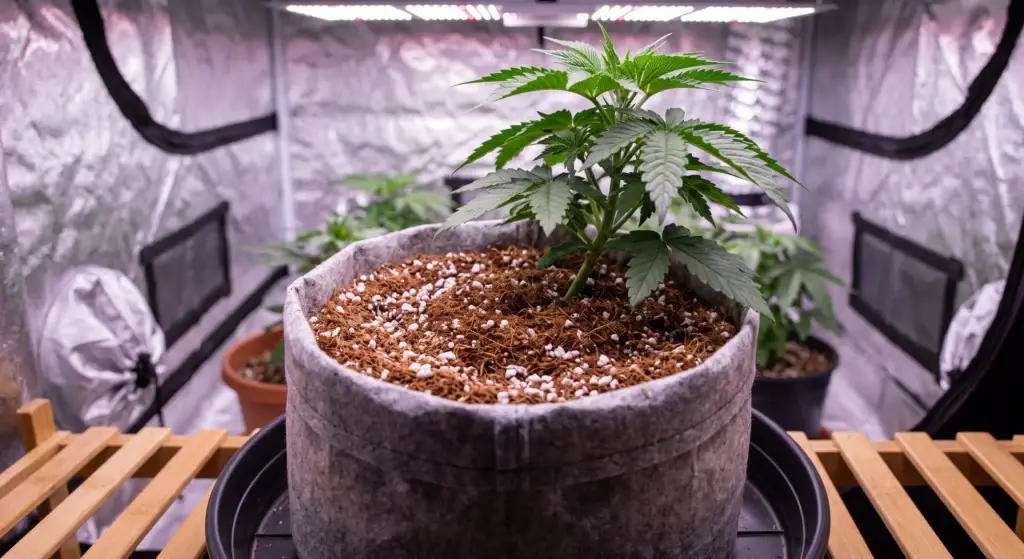
If you want the drainage benefits of perlite without hand-blending, several pre-mixed options are available:
- Root Royale Cocolite 70/30 Coco Coir & Perlite — RHP certified, consistent blend, built for high-frequency irrigation systems
- Mother Earth Coco + Perlite Soilless Mix — ready-to-use, available in commercial pallet quantities
For a quality potting soil with perlite already incorporated, Mother Earth Groundswell Performance Potting Soil is a well-regarded option with organic inputs and good drainage characteristics.


For Commercial Operations
At facility scale, the choice between perlite and vermiculite (and the grade and ratio used) has direct impact on crop uniformity, irrigation scheduling, and labor costs.
Perlite Grade Selection at Scale
Commercial cultivators running coco or soilless substrate in bag or slab systems should standardize on a single perlite grade across all rooms. Mixing grades (e.g., #3 in some rooms, #4 in others) creates different drainage rates and water-holding profiles that make unified crop steering impossible. Most facilities running high-frequency drip irrigation in coco target 20–30% perlite by volume. Operations running hand-watering or longer dry-back cycles may reduce to 15%.
GROW!T and Mother Earth both offer commercial pallet pricing on coarse and super-coarse grades — appropriate for facilities receiving multiple pallets per cycle. Confirm current pallet pricing with the commercial accounts team.
Vermiculite in Commercial Propagation
Propagation rooms are where vermiculite earns its place at the commercial level. Seed germination uniformity and cutting success rates are both improved by consistent moisture management in propagation trays — the exact condition vermiculite provides. A standard commercial propagation protocol uses a blend of vermiculite, perlite, and either peat or coco in the starting cell or plug.
For commercial propagation equipment and supplies, explore what’s available through Hydrobuilder’s commercial accounts page.
Why Shop at Hydrobuilder for Grow Media
HydroBuilder carries perlite, vermiculite, coco/perlite blends, and potting soils in both single-bag and pallet quantities — the same SKUs available to home gardeners and commercial facilities. Ordering in pallet quantities for a commercial grow is handled through the same platform, with options to request quotes for large volume pricing. The grow diagnostics service is also available for facilities troubleshooting root zone issues where substrate choice may be a contributing factor.
FAQs
Q: What is the main difference between perlite and vermiculite?
A: The primary difference is moisture behavior. Perlite drains water rapidly and improves aeration; vermiculite absorbs and slowly releases water, retaining moisture in the root zone. Both are sterile, pH-neutral soil amendments — but they produce opposite effects on how quickly a medium dries out.
Q: When should I use vermiculite instead of perlite?
A: Use vermiculite for seed germination, moisture-loving plants, and propagation — situations where consistent moisture matters more than drainage. Perlite is the better choice for drought-tolerant plants, cuttings prone to stem rot, and coco or soilless systems running frequent irrigation cycles.
Q: Is perlite or vermiculite better for starting seeds?
A: Vermiculite is generally better for seed starting because it retains moisture evenly, which helps prevent the dry-out that stalls germination. A 50/50 mix of vermiculite and perlite is also effective, giving some drainage while maintaining adequate moisture. Perlite alone dries out too quickly for reliable germination.
Q: Can you use perlite and vermiculite together?
A: Yes. A 50/50 blend is actually a recognized hydroponic substrate for drip and ebb-and-flow systems. For most garden applications, though, it’s more effective to choose based on your plant’s moisture needs — mixed media is most useful when you need both aeration and buffering in the same system.
Q: What ratio of perlite should I add to coco coir?
A: The most common ratio for indoor cannabis and vegetable cultivation is 70% coco to 30% perlite by volume. Growers running high-frequency automated irrigation may drop to 20% perlite; those hand-watering with longer dry-back cycles may increase to 40%. Pre-blended options like Root Royale Cocolite 70/30 eliminate the guesswork.
Q: How much perlite should I add to potting soil?
A: For most container plants, 10–25% perlite by volume is sufficient to improve drainage without drying out the mix too fast. For plants that need sharp drainage — succulents, cacti, lavender, Mediterranean herbs — go 30–50%. Standard potting soils already include some perlite; check the bag before adding more.
Q: Does perlite affect pH?
A: Perlite is slightly alkaline, typically testing between 7.0 and 7.5 depending on the source and batch. In managed hydroponic systems where pH is adjusted regularly, this effect is negligible. In unmanaged containers or outdoor beds, high perlite ratios can slightly raise the medium’s pH over time — worth monitoring with acid-loving crops.
Q: Can I substitute vermiculite for perlite?
A: They can be swapped in a pinch, but they produce opposite outcomes — so substituting one for the other will change how quickly your medium drains. If you’re substituting vermiculite for perlite in a dry-preferring plant’s mix, you risk root rot from excess moisture retention. The more reliable approach is to choose based on your plant’s actual needs.
Q: What is the best perlite for commercial growing?
A: Commercial operations generally want a coarse grade (#3 or #4) in pallet quantities for consistency across rooms. GROW!T #4 Perlite and Mother Earth Perlite #3 are both available in pallet format and commonly used in commercial coco and soilless systems. Grade uniformity across all rooms is more important than brand.
Q: Is vermiculite safe to use in hydroponics?
A: Yes. Vermiculite is sterile, inert, and pH-neutral, making it safe for hydroponic applications. A 50/50 vermiculite-perlite blend is a recognized medium for small-scale drip and ebb-and-flow systems. It is also commonly used in propagation plugs and seed-starting cells within hydroponic operations.