

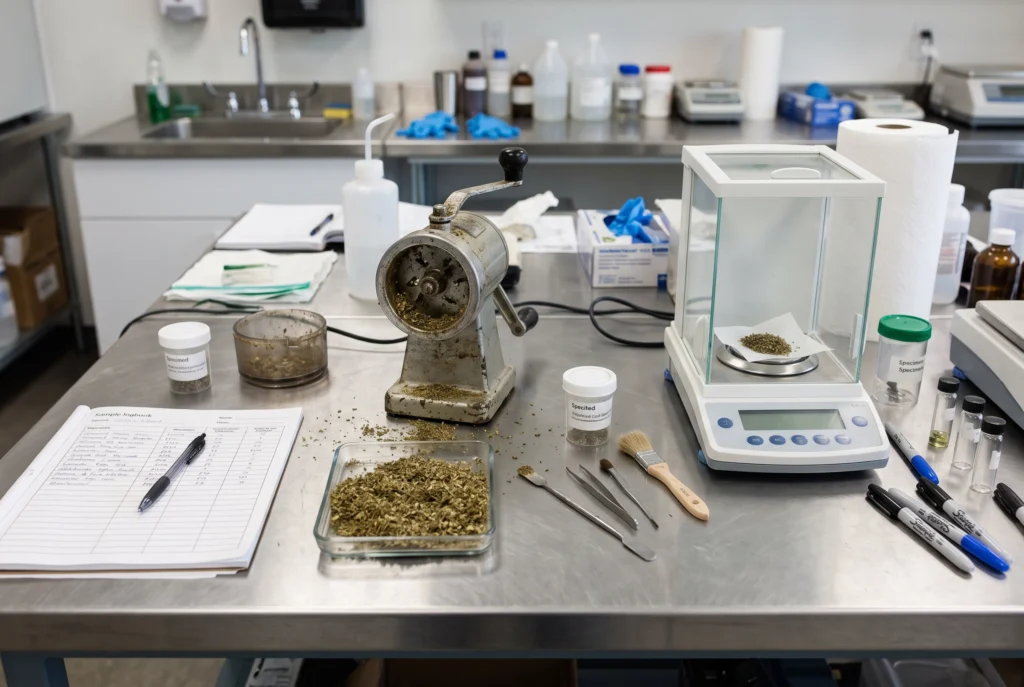
The right way to test cannabis potency depends on what you’re testing and what you’ll do with the number. A reagent kit or portable tester can help you compare your own flower samples. Only a laboratory gives you a result you can use for compliance or sale. Between those two sit five methods that work differently and can’t be swapped for one another: color-reaction kits, thin-layer chromatography, near-infrared (NIR) testers, UV optical testers, and HPLC lab analysis.
One limit applies to all of them. A potency result is a cannabinoid number and nothing else. It tells you nothing about mold, pesticides, heavy metals or residual solvents.
Start With What You Need the Number For
Pick the method after you’ve decided what question you’re answering. A tool that’s right for one of these jobs can be wrong for the next.
| What you need | What to look for | Where it stops |
|---|---|---|
| Compare dried-flower samples from your own grow | A portable flower-testing workflow with a published sample prep | Stay inside the model’s supported sample type and range |
| Check an infused oil or butter | A method the maker explicitly validates for that base | Testing the infusion is not the same as testing every finished edible |
| Measure a concentrate | A method validated for that specific concentrate type | A tester built for flower isn’t automatically valid for extracts |
| Get results for regulated sale or compliance | A licensed or approved laboratory | An in-house reading isn’t a regulated test |
| Screen for contaminants | Separate contaminant analyses | Potency testing doesn’t cover them |
Five Ways to Test Potency, Compared
| Method | How it works | Where it gets tricky |
|---|---|---|
| Colorimetric reagent kit | A chemical reaction changes color, and you compare it to a reference | Sample weight, dilution and your color judgment all move the result |
| Thin-layer chromatography (TLC) | Compounds separate along a plate so you can compare them | Takes practice to read, and the kit instructions set how quantitative it is |
| NIR tester | Light is shone on a prepared sample and the returned spectrum is run through a prediction model | The model only covers the samples and ranges it was calibrated for |
| UV optical tester | A prepared liquid extract is read for light absorbance and matched to a calibration curve | Extraction, dilution and filtering all happen before the reading |
| HPLC laboratory analysis | Cannabinoids are separated first, then detected and quantified against reference standards | Needs a full analytical workflow, not a quick scan |
Don’t sort portable devices into one bucket. Size and location say nothing about the method inside. Some portable units use NIR, some read UV light through a liquid extract, and some run a small chromatography workflow. The difference shows up in prep. An NIR flower tester scans ground flower, while a UV tester needs an extraction step before it reads anything. Compare the prep time and consumables before you compare price.
HPLC is also the reference method behind many of the others. NIR testers are generally calibrated against HPLC results, which is why a lab report is the usual yardstick when you want to know how far off a portable reading runs.

What the Number on the Screen Means

THC, THCA and total THC. Raw flower carries most of its potential THC as THCA, which converts to THC when heated. Labs and regulators often report total THC, calculated as delta-9 THC plus 0.877 times THCA. Take a sample at 1.0% THC and 24.0% THCA. Total THC works out to about 22.0%, not 25.0%. Before you compare any two readings, check which of these your device reports.
Units and basis. Percent and milligrams per gram are the same data in different clothes (1% equals 10 mg/g), but mg/mL is a different thing and applies to liquids. Reports can also be on a dry-weight basis or an as-received basis. Flower that has dried further since the last test will read higher on an as-received basis even if its cannabinoid content hasn’t changed. A dry-weight result corrects for that moisture loss, which is why hemp compliance results are reported on a dry-weight basis.
Accurate versus repeatable. Three readings that agree with each other show repeatability. They don’t show the reading is right. The only way to know how close a portable tester runs is to test a well-mixed sample on the device and send a split of the same sample to a lab. Manufacturers’ accuracy figures also need their context. Purpl’s own support documentation, for example, describes its error figure as an average across samples and not a promise for every single reading. The same caution applies to any maker’s number.
Inconsistent Readings Usually Start With the Sample
Cannabinoid levels vary within a single plant and differ between cultivars, according to published plant-architecture and hemp cultivar studies. A bud from the top of one plant doesn’t stand in for the whole plant, and one plant doesn’t stand in for the batch.
A few habits keep a sample representative. These are general sampling practice, and your device’s manual always overrides them:
- Pull material from several plants and several heights, not one convenient bud.
- Combine and mix it before you take your test portion.
- Test at the same dryness every time so moisture isn’t a hidden variable.
- Use the sample amount and loading method in the manual, and clean between samples the way it says.
- Log the cultivar, batch, where on the plant the sample came from, its condition, the device and the date.
Prep requirements really do differ by device. Purpl’s flower guidance calls for ground, cured flower with seeds and stems removed, while the tCheck flower workflow involves extracting and filtering a liquid. Don’t carry one tool’s routine over to another. For sample condition, see our guides on storing flower after drying and curing and drying and curing methods.

When Only a Lab Will Do
A portable tester is a screening and comparison tool for your own decisions: which phenotype to keep, whether a dry-down changed things, whether two rooms are producing similar flower. It isn’t a regulated test.
Compliance rules vary by state and country, so check yours. California is a useful example. Licensed labs there run cannabinoid testing alongside separate panels for contaminants such as pesticides and residual solvents, and a product’s results come from that licensed process. If a buyer, a regulator or a label needs the number, send it to a lab that’s approved where you operate.
Choosing a Portable Tester
If screening in-house makes sense for your operation, run any candidate through this list:
- Does it support your sample type (dried flower, extract, infusion), per the maker’s own documentation?
- Which values does it report: THC, THCA, total THC, CBD?
- What’s its stated measurement range, and does it cover the potency you actually grow?
- What validation data does the maker publish, and against what reference method?
- How long does prep take, and what equipment or consumables does it need?
- Are any features, such as moisture readings, sold as add-on subscriptions?
- How is it calibrated and cleaned, and can you export results for your sample log?
The Purpl PRO is one example of the NIR route for flower. According to its product page, it uses near-infrared spectroscopy and was calibrated against HPLC measurements from multiple state-certified labs. The kit includes a bench unit, sample holder, grinder, calibration cartridge and a smartphone app. Moisture and water-activity testing is sold as an optional subscription, so confirm current terms before you count on it. Check the Purpl PRO potency measurement system page for current specifications. The limits covered above apply to it the same way they apply to any other tester.
To see what’s in stock, browse our THC and CBD potency testers.
Example: FAQs
Q: Can one tester measure both THC and CBD?
A: Many can, but it depends on the model and its calibration. Check the datasheet for which cannabinoids are reported and the range for each. A model can list a different range for CBD than for THC, so don’t assume the two match, and don’t assume every sample type is covered.
Q: Do potency testers need calibration?
A: It varies by device. Some ship with a calibration cartridge or reference standard, others rely on a calibration curve built into the app or the reagent. Follow the maker’s schedule and cleaning steps, and if readings start to drift from what you expect, check the manual or contact the manufacturer before trusting them.
Q: Can I use a portable tester to check hemp for the 0.3% limit?
A: Be careful here. Federal hemp compliance is based on total THC, on a dry-weight basis, measured by a laboratory. The Purpl PRO’s published minimum detection threshold for THC in flower is 2%, well above 0.3%, so it can’t confirm that line. Use an approved lab for compliance, and check your regulator’s rules.
Q: Is a potency tester worth it for a small grow?
A: It depends on how often you’ll test. If you want to compare several cultivars or batches across the year, in-house screening can make sense. If you harvest once or twice a year and only need a number occasionally, sending split samples to a lab may be simpler. Count your real testing frequency before you decide.