

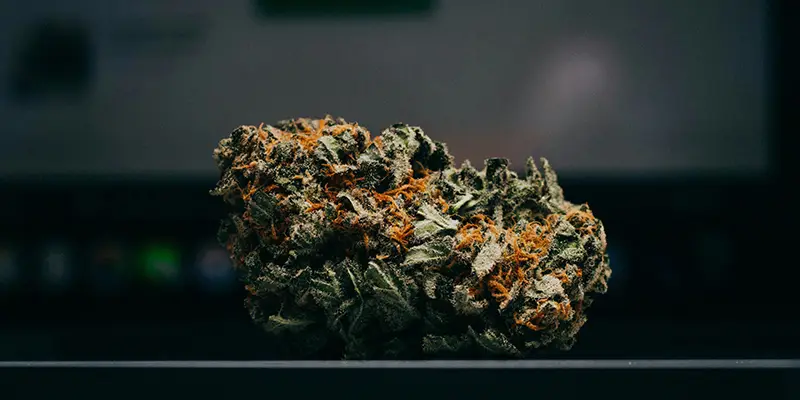
Proper cannabis flower storage is the last decision in a long harvest sequence — and the one that determines how much of your work you actually get to keep. Get it right and flower you cured today can still be excellent twelve months from now. Get it wrong and terpenes go flat in weeks, potency drifts, and structure collapses well before you’re ready to use or sell it.
The four variables that drive degradation — light, heat, oxygen, and humidity — are all controllable. But knowing which containers, humidity tools, and long-term methods actually hold up takes more than the standard advice to “use glass jars and keep it cool.” This guide covers what really happens to flower over time, how to match your storage approach to how long you’re actually holding, and what commercial operations do differently when the stakes are measured in pounds.
Whether you’re preserving a few ounces from a personal grow or managing inventory across multiple harvest cycles at a licensed facility, the chemistry of degradation is identical. The methods and margins are where home and commercial storage diverge — and this guide addresses both.
Why Your Cure Sets the Storage Ceiling
The single most common storage mistake is expecting a container to compensate for an incomplete cure. It won’t.
A proper drying and curing process — slow drying at 60–70°F and 55–65% RH over 10–14 days, followed by 2–4 weeks of sealed jar curing with regular burping in the first week — produces flower with stable, consistent moisture distribution and a fully expressed terpene profile. That flower is a candidate for long-term storage. Flower that went into jars undercured carries residual moisture that will feed mold inside a sealed container. Flower that was overdried has already lost terpene volume and structural integrity before it ever touched a storage vessel.
If the cure was right, storage is maintenance. If the cure was off, storage is just slower degradation — and no container or humidity pack reverses that.
If you haven’t nailed your dry and cure yet, start there. There’s a full guide at the link above.
What Breaks Down Flower — and How Fast
Four environmental factors govern the rate of degradation. Controlling all four is what separates flower that holds for a year from flower that’s gone in six weeks.
Light is the most aggressive and least forgiven variable. UV radiation directly breaks down cannabinoids — measurably, even from ambient indoor exposure over weeks. Opaque containers or complete darkness (drawers, cabinets, sealed storage rooms) are non-negotiable. Setting glass jars on a shelf in a lit room, even away from direct sun, is a real and ongoing source of quality loss.
Heat accelerates every other breakdown process simultaneously. Terpenes volatilize faster. THC conversion to CBN speeds up. Moisture distribution inside containers shifts. The target is 60–70°F, consistent. Storage near HVAC vents, electronics, exterior walls with seasonal temperature swings, or any heat-generating equipment creates conditions that shorten shelf life regardless of what container you’re using.
Oxygen drives oxidation — the slow, continuous conversion of THC into CBN, the sedating compound that dominates old or poorly stored flower. CBN isn’t nothing, but it’s not the strain you grew. Airtight seals and proper headspace management limit this; vacuum sealing for longer holds eliminates it almost entirely.
Humidity is the variable with the smallest margin and the most consequence. Below 55% RH, trichomes become brittle, terpenes volatilize faster, and flower structure deteriorates. Above 65% RH, mold and mildew become active risks. The target for stored flower is 58–62% relative humidity — a range narrow enough that it requires active management through the right containers and humidity control tools, not just a sealed jar and good intentions.
How Long Does Flower Actually Last?
Under proper conditions — airtight container, 60–70°F, 58–62% RH, complete darkness — most well-cured flower maintains the bulk of its potency and terpene profile for 6–12 months. Research on stored cannabis — most frequently citing University of Mississippi (Ross and ElSohly) analyses — estimates an average THC potency loss of roughly 16–17% after one year and 25–27% after two years under controlled, room-temperature conditions. Terpene degradation precedes potency loss by several months, which is why carefully stored flower begins to smell flat before it begins to feel weaker.
The honest implication: plan your storage around when you actually intend to use or sell, not around theoretical maximums. Flower stored at 6 months under good conditions is consistently still excellent. Flower stored at 18 months under excellent conditions is genuinely different from what went in — still functional, but the full terpene expression of harvest is behind it.
One nuance: bud rot can develop in stored flower if moisture wasn’t fully stabilized during cure, even in airtight containers. If you see any white or gray fuzz at any point, stop there and handle it — it doesn’t improve with time.
Choosing a Storage Method for Your Hold Timeline
The right storage approach depends less on any single product and more on how long you need to hold. Shorter timelines tolerate simpler setups; longer holds demand more deliberate atmosphere management.
Short-Term Access: Days to a Few Weeks
For flower you’re actively using or will access frequently within a few weeks, an airtight container in a dark location at stable temperature is enough. You don’t need humidity packs for very short holds, and the container choice matters less — the timeline is simply too short for the differences to compound meaningfully.
HBX Multiuse Turkey Bags are the go-to bag for this stage. Food-safe, static-free construction protects trichome integrity during handling and staging. At 18″ × 24″ they’re practical for any harvest quantity from a few ounces to several pounds, and they’re available in packs of 25 and 100 for facility-level stocking. For home growers deciding what container to use before making final packaging decisions, they’re the right interim vessel.
What doesn’t work for even short-term storage: plastic sandwich bags, non-food-grade bags, and dispensary snap-top plastic containers. The static charge in most consumer plastics strips trichomes off flower on contact. They’re also not oxygen barriers. Use them for a day or two of portability at most — not for anything you care about preserving.


Medium-Term Preservation: One to Six Months
Holds in the one-to-six month range require deliberate setup: an airtight container, a two-way humidity pack, and consistent temperature and darkness. This is the range where storage conditions start to visibly differentiate product quality.
Glass jars with proper gasket seals are the standard choice for home storage at this range. Fill to roughly three-quarters capacity — enough headspace for humidity regulation, not so much that oxygen-to-flower ratio becomes an issue. The humidity pack manages the RH inside the container; the darkness and temperature are your responsibility.
For licensed operators or growers who want retail-formatted storage that functions as both preservation and packaging, Grove Bags TerpLoc bags use Modified Atmosphere Packaging technology that, when used per manufacturer instructions, passively supports equilibrium humidity inside the bag without a separate pack — though a precise 58–62% RH isn’t guaranteed under every condition of use. The multi-layer UV-barrier film and static-free construction protect trichome integrity, and consumer-size window pouch formats (1/4 oz through 1/4 lb) let you cure, store, and present product in a single vessel.


Long-Term Holds: Six Months and Beyond
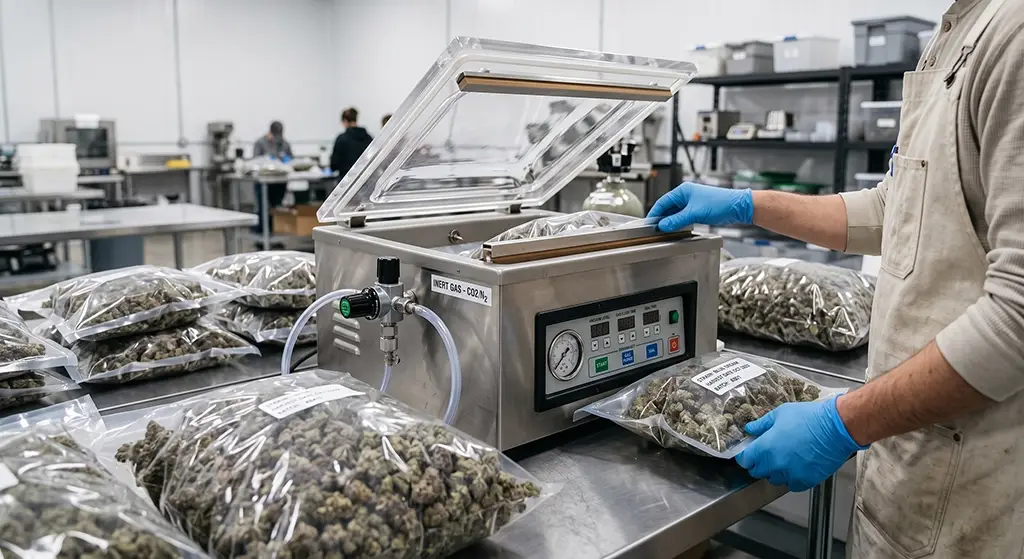
Beyond six months, passive storage in a well-sealed container starts showing its limits. Oxygen accumulation and humidity drift become meaningful even in quality containers over this timeline. Vacuum sealing addresses both.
Vacuum sealing removes oxygen almost entirely, which is the primary driver of cannabinoid degradation during extended holds. Properly vacuum-sealed, dark, and temperature-controlled flower can hold quality into the second year. The practical risk is mechanical: excessive compression during sealing damages trichomes. Dense nugs in a hard vacuum can lose significant trichome structure.
The AmeriVacS AVN Series Retractable Nozzle Vacuum Sealer with Gas Purge solves this directly. The retractable nozzle seals from the bag opening rather than pressing flat against the bag walls, substantially reducing the mechanical compression that can damage flower during a standard bar seal cycle. The gas purge function replaces oxygen with inert nitrogen before the final seal — atmosphere protection without compression risk. The 20″ sealing bar handles commercial throughput volumes; bag formats range from small consumer pouches to large bulk sizes.
For operations targeting maximum shelf stability beyond what vacuum sealing alone provides, freeze drying removes moisture through sublimation — no heat, no liquid phase — producing flower stable enough for extended holds that conventionally dried product can’t reliably match. See our full guide to curing machines and freeze dryers for a detailed breakdown of methods and equipment.
Humidity Management: The Variable Most Growers Underestimate
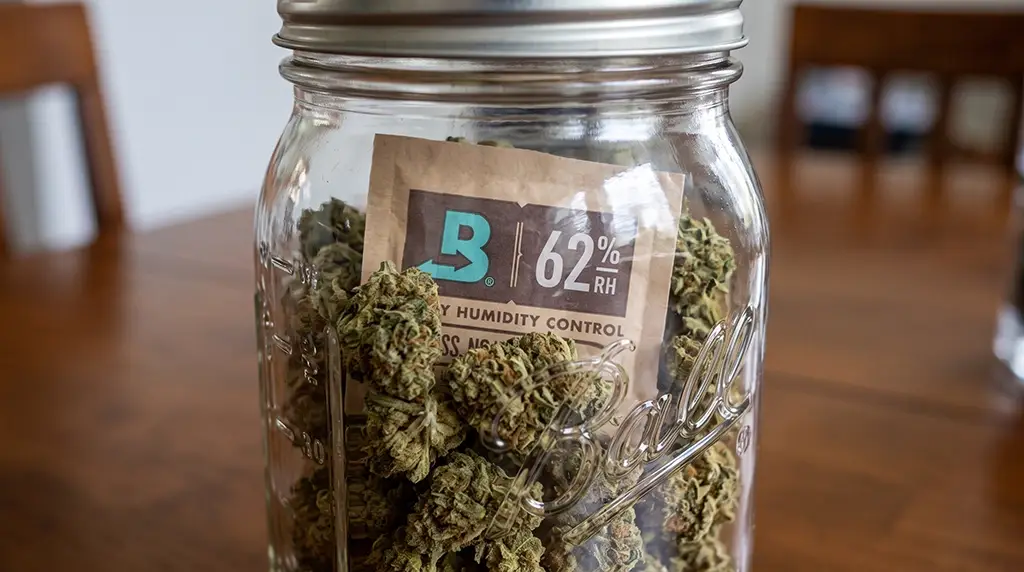
Humidity inside a sealed container doesn’t stay fixed — it shifts with temperature changes, and it’s the most frequently mismanaged variable in long-term flower storage. Standard silica desiccant packets (common in food packaging) only absorb moisture. Given enough time, they’ll overdry your flower completely. Two-way humidity packs both absorb and release moisture to hold a target RH level regardless of ambient conditions. That distinction is not trivial for any hold beyond a few weeks.
Boveda 2-Way Humidity Control Packs, 58% are the most widely used option in the cannabis market, and for good reason: the 58% target is appropriate for humid climates or growers who prefer a slightly drier flower texture, the packs are flavor-neutral and won’t interact with terpene profiles, and they regulate passively with no monitoring required. The 62% variant suits arid climates or growers who prefer a moister, stickier flower texture. Size to container volume — an 8-gram pack handles a standard quart jar, while a 67-gram pack is sized for larger containers holding up to a pound; scale proportionally for larger vessels.
Integra Boost Humidiccant Packs use a salt-free, glycerin-based two-way mechanism as an alternative and are available in bulk pack quantities — practical for commercial operations stocking multiple storage rooms or staging large quantities of finished product.
Replace packs when they feel firm and rigid — the salt or clay matrix has reached capacity and is no longer actively regulating. For a 6-month hold, plan on at least one pack replacement midway through.
What to Avoid — and How to Spot Storage Failure Early
The refrigerator. A common misconception. Refrigerator humidity fluctuates every time the door opens, frequently pushing above 65% RH — the threshold where mold becomes an active risk. The temperature reduction doesn’t offset the humidity instability. Room-temperature storage with a two-way humidity pack outperforms the refrigerator for flower.
The freezer. Works only with strict handling protocol. Trichomes at freezing temperatures are extremely brittle; any physical disturbance shatters them. If you freeze, containers must reach full room temperature before opening — condensation from a cold jar opened at room temperature drops moisture directly onto flower. For most home growers, the risk-to-benefit ratio on freezer storage isn’t worth it compared to properly managed room-temperature vacuum-sealed storage.
Overpacking and underfilling. Fill containers to about three-quarters capacity. Overpacked jars trap moisture without room for circulation; near-empty jars have too much oxygen relative to flower mass for a humidity pack to regulate effectively.
Signs your storage is failing:
- Flat or hay-like smell: Terpene volatilization has progressed significantly; the cultivar’s aromatic profile is mostly gone. Quality is declining but the flower may still be usable.
- Musty or ammonia scent: Mold is present. Do not consume.
- White, gray, or green fuzz: Active mold contamination. Discard the entire batch — mycotoxins permeate beyond the visible growth. See the guide to harvest waste disposal for compliant disposal procedures.
- Crumbles at light pressure: Overdried in storage; trichomes and structure are damaged.
- Brown or dull coloration, trichomes absent: Significant age and degradation. Potency is meaningfully reduced from harvest levels.
If you notice flat aroma and crumbly texture but no mold, flower may be partially recoverable — a two-way humidity pack in a freshly sealed container can restore some moisture over a few days. It won’t bring back lost terpenes and flavonoids, but it can improve the physical quality of flower that’s been overdried.
For Commercial Operations: Storage at Scale
Commercial cannabis storage introduces variables that personal storage doesn’t face: regulatory compliance, per-batch traceability, FIFO rotation across multiple harvest cycles, and the direct cost implications of quality loss at volume. The right infrastructure makes these manageable rather than reactive.
Bags and liners for post-harvest staging and bulk holds
HBX Multiuse Turkey Bags are the standard harvest-floor collection and staging bag for commercial operations. Food-safe, static-free, 18″ × 24″, available in packs of 25 and 100 for facility stocking. They cover the entire post-harvest sequence from initial collection through interim holds before vacuum sealing or final packaging.
For large-format bulk holds — totes, drums, and bins holding multiple pounds — 454 Bags Tote Liners are purpose-built for commercial cannabis: large-format, high-barrier construction that maintains atmosphere inside standard tote containers and prevents contamination during extended holds. For operations requiring FDA-approved, food-safe documentation, True Liberty Bags are widely used across licensed facilities for both interim storage and compliance documentation workflows.
Freeze drying for maximum shelf life
The Harvest Right Pharmaceutical Freeze Dryer is the facility-grade option for operations targeting maximum shelf stability. Pharmaceutical-grade sublimation removes moisture without heat exposure, producing product stable enough for extended holds that conventionally dried flower cannot reliably match. The pharmaceutical model uses stainless steel trays and is purpose-built for oils, concentrates, and hash rather than whole flower — its tighter shelf spacing gives it more capacity for lab-scale batches, while the standard Home Pro freeze dryer’s greater headroom between shelves makes it the better-suited option for curing whole bud.
Automated curing for batch consistency
The Cure Puck Gen 2 monitors and actively manages the internal atmosphere of your curing environment in real time, with WiFi-enabled data logging through its companion app that lets you track humidity curves across the full cure cycle. For operations running multiple rooms or multiple racks per room, it removes the variability of manual burping and creates auditable cure records — a meaningful advantage when trying to replicate successful batches consistently.
Commercial operations managing multiple harvest cycles should build storage planning into the broader post-harvest workflow from the start. Our harvest automation guide covers how storage integrates with trimming, sorting, and packaging systems at scale.
Cannabis Flower Storage: FAQs
How long does cannabis flower stay good in storage?
Under proper conditions — airtight container, 60–70°F, 58–62% RH, complete darkness — well-cured flower maintains most of its potency and terpene profile for 6–12 months. Research data — most frequently citing University of Mississippi (Ross and ElSohly) analyses — puts average THC potency loss at approximately 16–17% after one year and 25–27% after two years. Terpene degradation typically precedes potency loss, so flower begins to smell flat before it begins to feel weaker. Vacuum sealing and freeze drying extend these timelines meaningfully.
What is the best way to store cannabis flower?
For most growers, the most reliable combination is an airtight glass or food-safe container filled three-quarters full, a 58% two-way humidity pack, and storage in total darkness at 60–70°F. For holds beyond 3–4 months, vacuum sealing before storing adds significant protection by removing the oxygen that drives cannabinoid conversion. For commercial operations holding pounds of product, purpose-built harvest storage bags and commercial vacuum sealers with gas purge capability are the standard.
Should I store cannabis in the freezer?
Freezing is not recommended for most growers. Trichomes become extremely brittle at freezing temperatures and shatter with any physical disturbance — opening the container, touching the buds, even vibration. If you do freeze, let the sealed container return fully to room temperature before opening. Condensation from a cold jar opened at room temperature deposits moisture directly onto flower. For most growers, properly vacuum-sealed room-temperature storage outperforms freezing without the handling risk.
Why is the refrigerator bad for cannabis storage?
Refrigerators fluctuate in humidity every time the door opens, frequently pushing above 65% RH — the threshold where mold becomes active. The temperature reduction doesn’t compensate for that humidity instability. Room-temperature storage with an active two-way humidity pack is more reliable for flower than refrigerator storage, and significantly simpler to manage.
What humidity level should I store cannabis at?
The target is 58–62% relative humidity. Below 55%, trichomes become brittle and terpenes volatilize faster. Above 65%, mold risk becomes real. Two-way humidity packs — Boveda at 58% or 62%, Integra Boost at 55% or 62% — maintain this range passively inside sealed containers without monitoring. Size the pack to your container volume; an 8-gram Boveda pack handles a standard quart jar, while a 67-gram pack is sized for larger containers holding up to a pound.
Can you store cannabis in plastic bags?
Not for anything beyond very short-term portability. The static charge in most plastics — including zipper storage bags and dispensary snap-top containers — actively strips trichomes from flower on contact. They’re also not meaningful oxygen barriers. For anything you’re actually trying to preserve, use glass, stainless steel, or purpose-built food-safe harvest bags.
What is the difference between curing and storing cannabis?
Curing is an active process — the 2–4 weeks of controlled jar time after initial drying where residual chlorophyll breaks down, moisture equilibrates throughout each bud, and terpene profiles fully develop. Storage follows a successful cure and is a passive process — maintaining the quality you’ve already achieved over a longer timeline. The cure determines the ceiling; storage determines how long you hold near it.
How do I rehydrate flower that dried out in storage?
A two-way humidity pack in a freshly sealed container can restore some moisture to overdried flower over several days. It will improve texture and smoking quality. What it won’t restore is terpene volume that has already volatilized — once terpenes are gone, they’re gone. This is why hitting the 58–62% RH target during storage matters more than rehydration after the fact.
Does vacuum sealing damage cannabis trichomes?
It can, if done incorrectly. The risk is mechanical compression — a standard impulse bar sealer pulls a full vacuum against the bag walls, which presses flat against dense nugs and physically fractures trichomes. A retractable nozzle vacuum sealer avoids this by sealing from the bag opening rather than pressing against the flower. The AmeriVacS AVN Series with gas purge uses this approach, and the nitrogen purge option further reduces oxygen without requiring full compression vacuum.
What does bad cannabis look and smell like in storage?
Fresh, properly stored flower retains a distinct aromatic profile specific to its cultivar — pungent, identifiable, full. Degraded flower smells flat, hay-like, or papery. A musty or ammonia scent is a mold indicator. Visually: any white, gray, or green fuzz is active mold growth and the batch should be discarded. Flower that crumbles at light touch has been overdried. Significant browning and absent trichomes indicate advanced age-related degradation with meaningful potency loss.