

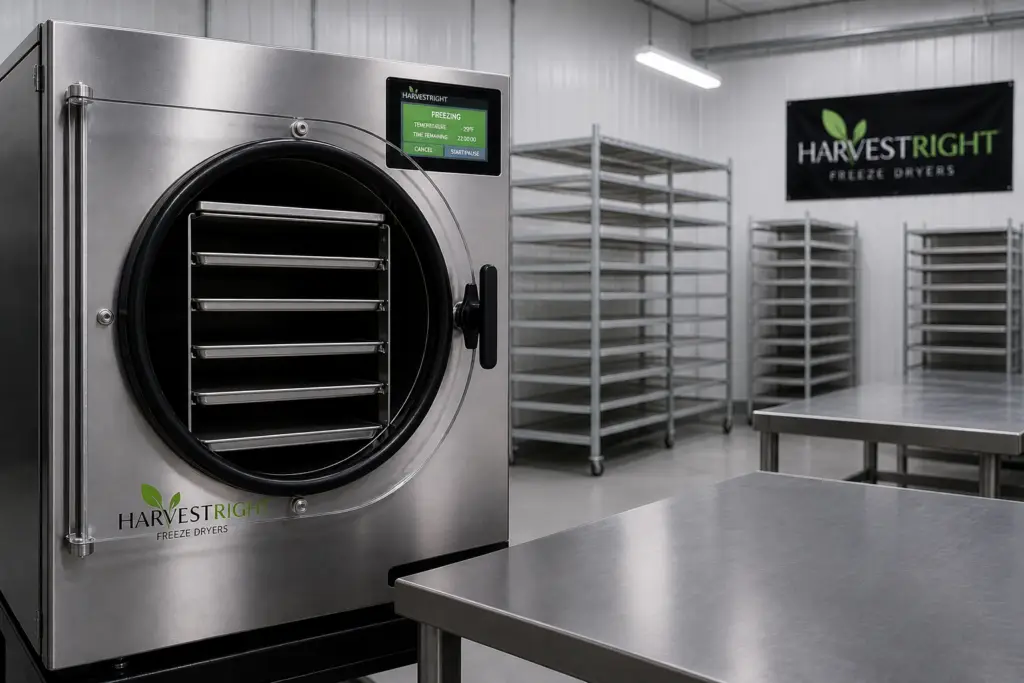
Freeze dryers and curing machines are among the fastest reliable ways to dry and cure your harvest while preserving the terpenes, potency, and flavor your grow worked months to produce. Where traditional drying and curing can take two to four weeks depending on conditions and product density, a quality freeze dryer can complete the drying phase in roughly 24–48 hours per appropriately sized cycle — and automated curing machines dramatically reduce the inconsistency that manual monitoring and jar burping often introduce.
Whether you tend a single tent or manage a multi-room commercial facility, this guide breaks down how each technology works, what separates them, and how to choose the right approach for your scale and goals.
For commercial facilities: Skip to the Commercial Post-Harvest Processing section for ROI considerations, throughput planning, and equipment specifications scaled to professional operations.
Why Post-Harvest Processing Determines Product Quality
You can execute a perfect grow and still lose at the final stage. The drying and curing process is where terpene profiles are preserved or destroyed, where potency is locked in or degraded, and where mold either takes hold or gets shut out. For commercial growers, post-harvest processing is also where labor costs, throughput speed, and consistency directly determine profitability.
The traditional approach — hanging product in a controlled room at 60°F/60% RH for 10–14 days, then transferring to sealed containers for additional curing — works, but it requires significant square footage, precise environmental control, constant monitoring, and time that most operations cannot afford to optimize around. Curing machines and freeze dryers solve different pieces of this problem by automating airflow and moisture removal in repeatable ways.
How Curing Machines Work
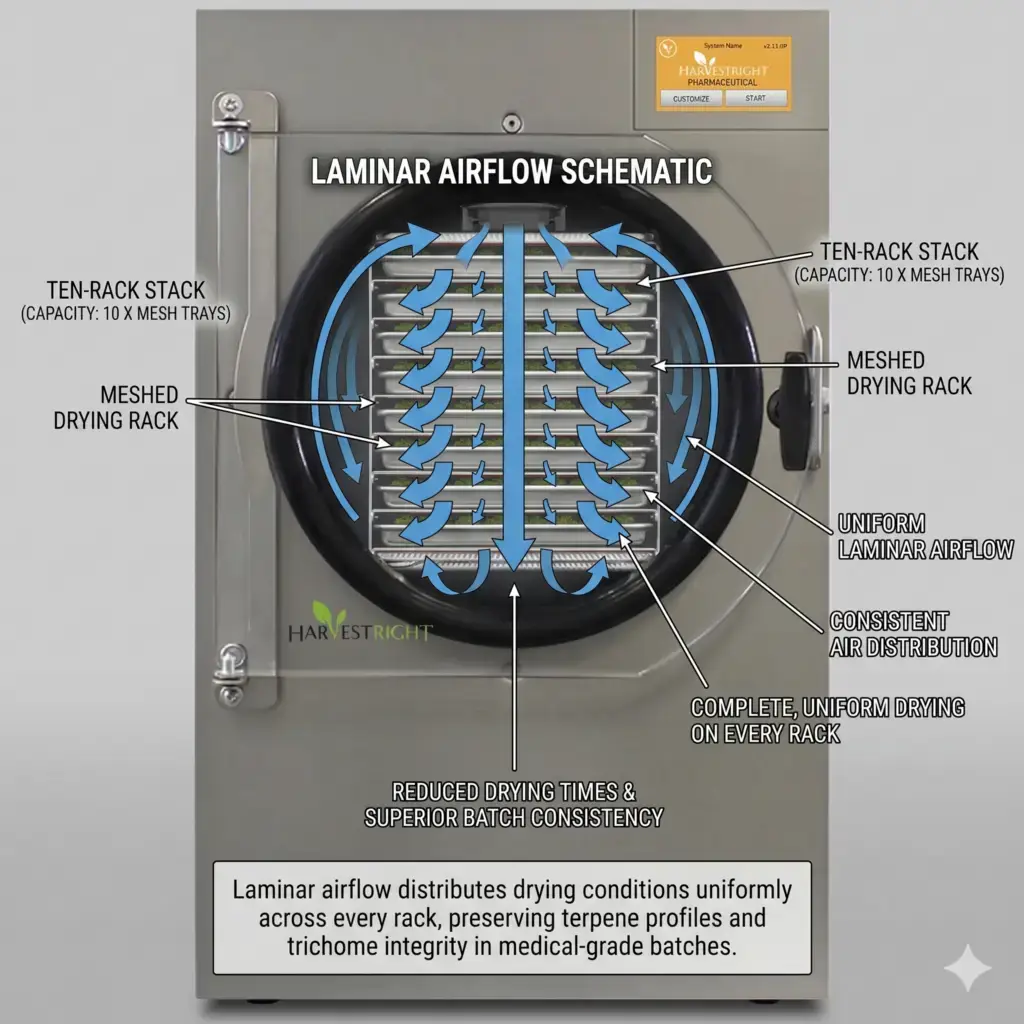
Curing machines automate the uniform airflow that hand-curing can never fully replicate. Inside a curing machine, product rests on meshed racks while the system continuously circulates air through the entire chamber using controlled airflow dynamics — meaning multi-directional flow from top to bottom and side to side to keep conditions as even as possible. An exhaust fan removes moist, stale air on a continuous cycle rather than waiting for manual intervention.
The result is that every gram in the system is designed to experience the same drying conditions at the same time. There are fewer wet pockets, no complex rotation schedules, and less inconsistency introduced by checking product at different intervals. Higher-quality curing machines include dust filters on both the intake and exhaust manifolds, which help protect product quality throughout the process by reducing particulate contamination.
Bud Aerators: Entry-Level Automated Curing
For smaller harvests or hobbyist-scale operations, bud aerators offer the core benefit of automated airflow in a compact, affordable form. These devices mount directly onto a jar or canister and run with minimal hands-on intervention aside from routine checks and power management, cycling fresh air through the container without requiring manual burping. They’re a meaningful upgrade over basic mason jar curing for anyone who wants more consistency without committing to a full curing machine.
Vertical vs. Horizontal Curing Machines
The two primary form factors serve different space and throughput profiles. Vertical curing machines maximize capacity in a smaller footprint and can reduce cure time through more aggressive airflow, making them a standard choice for high-volume commercial operations that need to move a lot of product through a small space. Horizontal curing machines use a drawer-based layout that allows easy visual access and routine checks without disturbing the full batch — a practical design for mid-scale operations where periodic inspection is part of the workflow.
Both designs operate on the same core principle and deliver the same fundamental advantage: greatly reducing human inconsistency during the curing stage by standardizing airflow and environment across batches.
Recommended Curing Equipment
EZTRIM EZ Cure Automated Dry & Cure System
The EZTRIM EZ Cure Automated Dry & Cure System is one of the most capable automated curing solutions in this category — a fully enclosed single-tote system that combines precise environmental control with managed airflow. It is designed to handle both the drying and curing phases in a single unit, greatly reducing or potentially eliminating the need for a separate traditional drying room for the volumes it is sized to handle. For operations looking to standardize their post-harvest process, the EZ Cure helps remove one of the biggest variables in product consistency: the environment during cure.
Cure Puck Gen 2
The Cure Puck Gen 2 brings automated humidity management to many sealed curing containers. Rather than manually burping jars or guessing at humidity levels, the Cure Puck actively helps regulate the internal atmosphere — targeting the 58–62% RH range commonly used to protect terpene integrity without triggering mold, when used in an appropriately sized container and with proper starting moisture. It’s a practical upgrade for growers who cure in jars or CVault-style containers and want more hands-off consistency from harvest to storage.
CureTube 5–10 lb Tube with Easy Burp Lid
The CureTube handles mid-scale curing volumes — roughly 5 to 10 pounds per tube depending on product density — in an airtight, light-blocking format with an integrated burp lid that makes gas exchange a controlled process rather than a guessing game. For operations that bridge the gap between jar curing and dedicated curing machines, the CureTube delivers meaningful capacity and improved consistency at a fraction of the cost of fully automated systems.


How Freeze Dryers Work
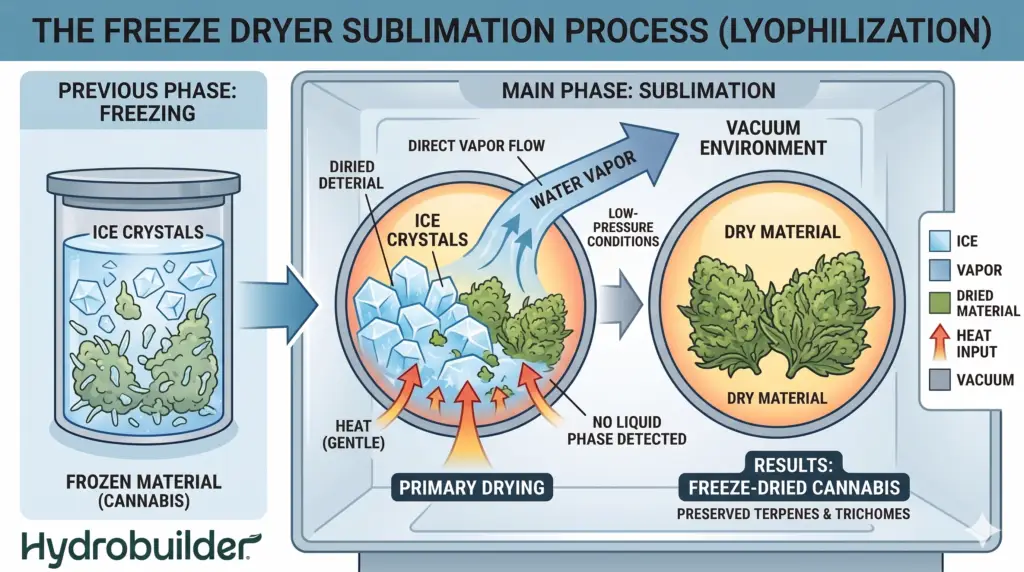
Freeze dryers remove moisture through sublimation — the direct phase transition from frozen solid to vapor, bypassing the liquid phase entirely. In practice, this means product enters the freeze-drying chamber, is rapidly brought to sub-zero temperatures, and then the chamber pressure is lowered so that ice crystals in the material convert directly to water vapor and are evacuated. No liquid water phase is required during the drying step, which greatly reduces cellular damage from heat and limits oxidation from extended warm air exposure.
The result is a highly preserved product that retains its original structure, color, aroma, and a greater share of its terpene and cannabinoid profile than conventional warm-air drying methods, especially for volatile-rich material.
Freeze Dryers for Bubble Hash and Live Rosin
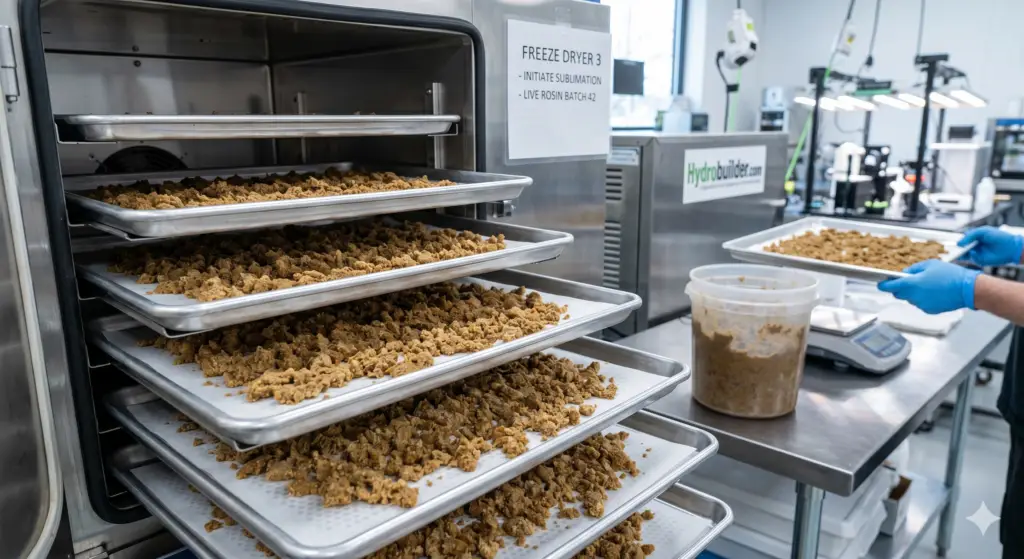
Freeze drying is now standard for high-quality concentrate production. When making live rosin, the process begins with fresh-frozen material — either wet-sifted bubble hash from bubble bags or washed hash from a hash washer at commercial scale. Once you have wet hash, you face a drying problem: conventional drying can take 5–7 days depending on ambient conditions, and every hour of air exposure introduces oxidation that can degrade color, flavor, and overall quality.
A quality freeze dryer processes the same batch in roughly 24–48 hours, in a sealed environment with very low oxygen exposure when operated correctly. This is why freeze drying has become the standard for competition-grade concentrate producers — it’s not just faster, it generally offers superior preservation of color, aroma, and volatile compounds compared to air drying for live hash products.
Freeze Dryers for Whole Flower
Beyond concentrates, freeze drying produces whole flower with strong preservation characteristics: high terpene retention relative to heated drying, maintained trichome structure, minimal shrinkage, and a shelf-stable product with a significantly extended storage life compared to conventionally dried flower when stored properly. For operations processing large harvest volumes where timing and storage logistics are constraints, freeze-dried flower offers a processing window measured in hours rather than weeks, provided upstream trimming and downstream packaging are coordinated.
| Category | Traditional Drying | Freeze Drying |
|---|---|---|
| Time | Typically 10–28 days | Typically 24–48 hours per batch |
| Terpene Retention | Variable — degrades with heat and oxidation over time | Excellent — low-temperature sublimation preserves volatiles more effectively |
| Trichome Integrity | Moderate — handling damage during hang dry and longer exposure | High — structure supported in frozen state with minimal handling |
| Oxidation Risk | Elevated — extended warm air exposure | Minimal — closed vacuum environment with reduced oxygen |
| Mold Risk | Moderate to high — requires precise RH and airflow control throughout | Very low when properly loaded and operated — moisture removed rapidly |
| Labor | High — daily monitoring, rotation, environment management | Low — load, program, and monitor cycles |
Harvest Right Freeze Dryers
Harvest Right is a dominant brand in home-through-commercial freeze drying, offering a full lineup from countertop home units to larger systems. Their machines handle both whole-flower and concentrate applications with the same core sublimation process and are widely used in the cannabis sector for bubble hash and live rosin workflows.
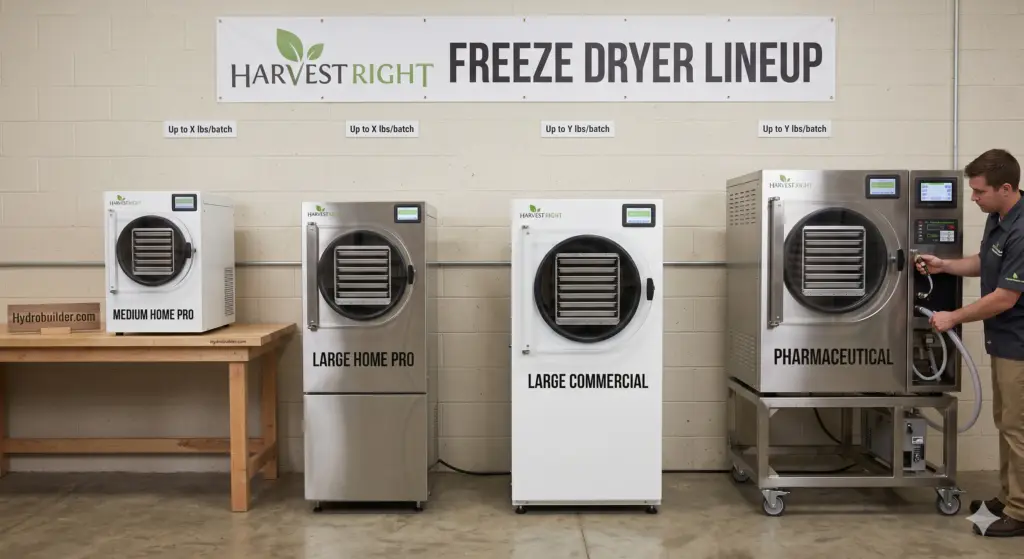
Harvest Right Medium Home Pro Freeze Dryer
The Harvest Right Medium Home Pro Freeze Dryer is an appropriate entry point for home growers and small commercial operations processing several pounds per cycle. Medium units in this class typically process about 8–15 pounds of fresh material per batch and can handle roughly 1,500–3,000 pounds per year when run regularly, while fitting on a cart or countertop and operating from a standard 110 V circuit.
It delivers the full sublimation process in a manageable footprint, handles both flower and concentrate drying, and produces results that conventional drying methods struggle to match at comparable speed and labor cost when processes are dialed in. For operations moving from traditional drying to freeze drying for the first time, the Medium Home Pro is often where that transition begins.
Harvest Right Large Home Pro Freeze Dryer
The Harvest Right Large Home Pro Freeze Dryer scales throughput significantly over the medium unit, making it a practical choice for larger home operations and light commercial use where per-cycle capacity is a primary constraint. Large Pro units are typically rated to process approximately 18–27 pounds of fresh material per batch and up to roughly 3,000–5,000 pounds per year depending on cycle frequency.
The larger tray area accommodates bigger harvest batches without requiring as many sequential runs, and these units still operate on 110 V power with appropriate circuit sizing, which simplifies installation in many facilities.
Harvest Right Pharmaceutical Freeze Dryer (Large)
The Harvest Right Large Pharmaceutical Freeze Dryer is built for commercial-scale concentrate production where precision, throughput, and contamination control are critical. Large pharmaceutical units are commonly configured to dry roughly 12–14 pounds of wet hash per cycle (translating to about 3–3.5 pounds of dry hash per run) and feature construction and control packages designed for sensitive botanical and pharmaceutical applications.
Pharmaceutical-oriented construction provides tighter environmental control, increased tray area, and cleanroom-compatible materials and can align better with many licensed facilities’ equipment and processing requirements, but operators should always confirm that any specific model meets their local regulatory standards.


Curing Machine vs. Freeze Dryer: Which Do You Need?
These are complementary technologies, not inherently competing ones. Understanding which problem each solves makes the decision more straightforward.
Choose a curing machine when your primary goal is consistent, automated post-harvest curing of whole flower at a cost that scales with your operation. Curing machines replace much of the manual monitoring and environmental management of traditional jar or room curing with a controlled, repeatable process and are usually the right tool for the flower side of most operations that are not chasing live-style concentrates.
Choose a freeze dryer when processing speed, maximum practical terpene preservation, or concentrate production (particularly live hash and live rosin) is the priority. Freeze dryers cost more upfront but compress weeks of processing into hours and, when tuned correctly, provide superior preservation of volatile compounds in sensitive products compared to conventional drying.
Use both when you’re running a full commercial operation where flower and concentrate production happen simultaneously and where time-to-market on every product category matters. In these facilities, curing machines can handle bulk flower while freeze dryers run parallel on hash and select premium SKUs.
Supporting Your Post-Harvest Process
Getting the most from your drying and curing equipment requires the right surrounding tools.
For storage, HBX Turkey Bags are a harvest staple for bulk flower storage between processing stages — available in case quantities for full-facility needs. The CVault 8 Liter Humidity Curing Storage Container provides an airtight, light-proof curing environment for finished product, maintaining the humidity stability that protects terpene profiles during long-term storage when paired with appropriate humidity packs.
Monitoring your post-harvest environment is equally important. The HBX Thermo-Hygrometer gives you a real-time read on temperature and humidity in your drying and curing space — essential for verifying that your equipment is producing the environment it’s supposed to and for catching any deviation before it affects product quality.
For Commercial Operations
Commercial Post-Harvest Processing: ROI and Throughput Planning
For licensed cannabis facilities, the economics of post-harvest processing are straightforward: labor is often the largest variable cost in the harvest-to-storage workflow, and time-to-market directly affects cash flow in seasonal or batch-harvest operations. Freeze drying and automated curing address both by reducing labor touchpoints and compressing cycle times.
Labor reduction is immediate when automation is correctly implemented. A traditional drying room for 50+ lbs of wet flower can require daily monitoring, rotation, and environmental adjustment — often adding 20–40 labor hours per harvest cycle. An automated curing system or freeze dryer runs that same cycle with brief check-in monitoring rather than constant hands-on management, though operators still need to perform loading, unloading, cleaning, and verification.
Throughput compression matters most for facilities with predictable harvest schedules. Moving from 14–21 days of conventional drying/curing to roughly 36–48 hours of freeze drying and subsequent conditioning frees the same square footage for the next cycle weeks earlier — a direct impact on annual production capacity without expanding facility footprint, assuming adequate upstream trimming and downstream packaging capacity.
Consistency at scale is the third commercial argument. Manual curing introduces batch-to-batch variation that affects both shelf price and repeat purchase behavior. Automated systems produce repeatable environmental conditions on every cycle, which translates directly to more consistent product quality across harvests when processes are documented and maintained.
For commercial harvest workflow planning and full-facility equipment sourcing, HydroBuilder’s commercial team can provide volume pricing guidance and operational consultation tailored to your throughput targets and facility constraints.
Freeze Dryer Sizing for Commercial Concentrate Operations
Commercial concentrate producers running regular live rosin or live hash processing should plan freeze dryer capacity around their weekly wet hash volume, not just their total harvest weight. A general planning benchmark is to size capacity so that each freeze dryer can process roughly one-third of your total wet hash volume per cycle, allowing for staggered runs without bottlenecking downstream pressing.
For facilities processing more than about 20 lbs of wet hash per week, multiple Harvest Right Large or Pharmaceutical units running in parallel are a common configuration. Each unit operates independently, so a three-unit setup provides continuous throughput without scheduling conflicts between drying and pressing operations, and offers redundancy if one unit is offline.
See our guide to making live rosin for the full workflow from fresh-frozen harvest through freeze drying to press, including pre-freeze, wash, drain, and tray-loading best practices.
Final Thoughts
Post-harvest processing is where the quality you built during the grow is either preserved or lost. Curing machines and freeze dryers are not just luxury equipment — they are the infrastructure of consistent, scalable, profitable harvest management once your operation grows beyond a purely hobby scale.
Both technologies can pay for themselves through improved product quality, reduced labor, and faster time-to-market when they are properly sized, fully utilized, and integrated into a well-designed workflow. Explore the full lineup at HydroBuilder:
Example: FAQs
Q: What are the main advantages of freeze drying over traditional drying and curing?
A: Freeze drying compresses the drying portion of the process from the roughly 2–4 weeks typical of conventional dry-and-cure workflows to about 24–48 hours per cycle while preserving terpenes, cannabinoids, and trichome structure more effectively than heat-assisted or extended warm-air drying. It also significantly reduces mold risk and oxidation by processing in a sealed, low-oxygen vacuum environment when units are correctly loaded, sanitized, and operated.
Q: How do curing machines work to improve consistency?
A: Curing machines use controlled airflow to circulate air uniformly across the product surfaces in the chamber. This multidirectional flow — combined with continuous exhaust of moist air and filtered air intake — is designed to ensure every gram experiences similar drying conditions without constant manual rotation or monitoring, which reduces variation between jars or racks.
Q: What is the process by which a freeze dryer removes moisture?
A: Freeze dryers use sublimation: the product is frozen, then the chamber pressure is lowered so that ice crystals transition directly from solid to vapor without passing through a liquid phase. This approach preserves volatile compounds — terpenes especially — far better than high-heat drying and limits degradation associated with prolonged warm-air exposure.
Q: How quickly can freeze drying complete the process compared to traditional methods?
A: Traditional drying and curing often takes anywhere from about 14 to 28 days depending on environmental conditions, cultivar, and bud density. Freeze drying typically achieves target moisture content in roughly 24–48 hours per batch under standard operating parameters, after which a shorter conditioning or curing phase may still be used to fine-tune texture and aroma.
Q: Can freeze drying increase potency and preserve terpenes?
A: Freeze drying preserves terpene and cannabinoid content more effectively than conventional drying because sublimation removes moisture without relying on high heat and within a low-oxygen environment. Studies and industry experience have shown higher retention of cannabinoids and terpenes compared with heated or extended air-drying methods, though actual results vary by starting material, trim style, and freeze dryer parameters.
Q: What is the difference between a vertical and a horizontal curing machine?
A: Vertical curing machines maximize volume capacity and throughput speed in a compact footprint — practical for high-volume commercial operations where floor space is limited. Horizontal curing machines use a drawer-based layout that allows visual inspection of individual batches without disturbing the full load, which is useful for mid-scale operations running staggered cures or making frequent QC checks.
Q: Is a freeze dryer or curing machine better for bubble hash and live rosin?
A: A freeze dryer is the correct tool for drying bubble hash prior to pressing live rosin. Hash requires thorough moisture removal in a controlled, low-oxygen environment to prevent oxidation and microbial issues — a curing machine designed primarily for whole flower does not provide the same combination of vacuum, temperature, and pressure control needed for premium live hash products. See our live rosin guide for the full workflow.
Q: What humidity level should I maintain during curing?
A: A commonly used curing humidity target is 58–62% RH at 60–65°F for most flower, which allows chlorophyll to continue breaking down while moisture redistributes evenly through the bud and terpene profiles stabilize. The Cure Puck Gen 2 helps automate this target range in many sealed containers, and the HBX Thermo-Hygrometer lets you monitor ambient conditions in your curing environment so you can adjust as needed.
Q: How much does a commercial freeze dryer cost, and what's the ROI?
A: Commercial-oriented Harvest Right units generally range from under $2,000 for smaller home and small-operation models to $10,000+ for large pharmaceutical-grade units, depending on configuration and pump selection. ROI is driven primarily by labor reduction, improved quality-driven pricing, and throughput compression — facilities processing 20+ lbs per week can often recover equipment cost within roughly two to four harvest cycles when units are run frequently and higher sale prices and reduced labor hours are realized.
Q: Do I need both a curing machine and a freeze dryer?
A: For whole-flower-only operations, a quality curing machine can cover the full post-harvest workflow from dry to finished cure. For operations that also produce concentrates — especially live hash or live rosin — a freeze dryer is necessary for the hash-drying step, and larger commercial facilities producing both flower and concentrate at scale typically run both systems simultaneously on separate product streams to avoid bottlenecks.