

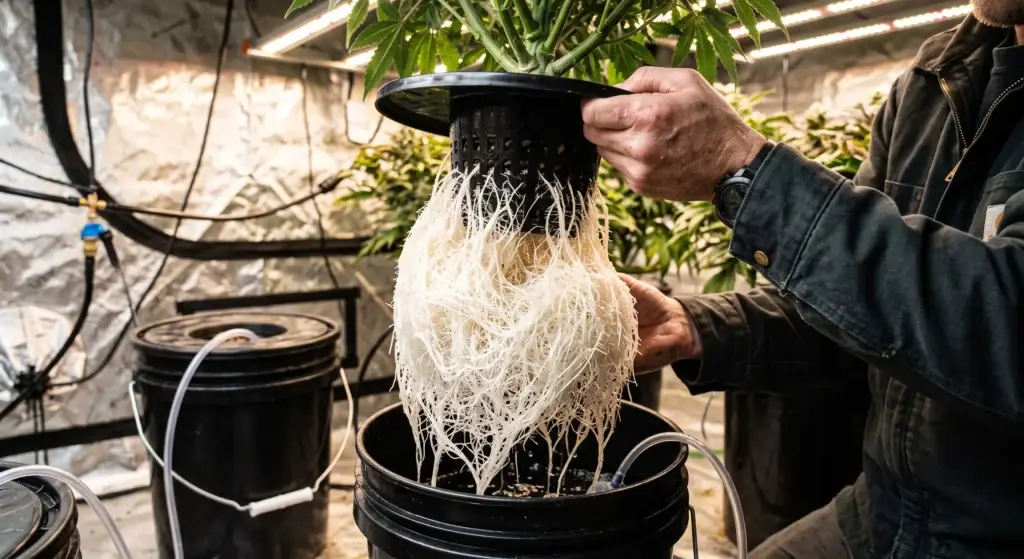
Root pruning is the practice of trimming excess root growth to prevent root binding, restore nutrient uptake, and maintain system performance in hydroponic setups and container media. Done correctly — with the right tool, at the right stage, within safe removal limits — it can turn a struggling, root-congested plant back into a healthy, productive one while protecting system reliability. Done poorly, it stresses the plant at the worst possible time and can compromise yield or plant survival.
Whether you’re growing in soil, coco, or a hydroponic system, this guide covers when root pruning is actually necessary, how much you can safely remove at each growth stage, and when an air-pruning container is a better long-term solution for preventing root binding in the first place.
If you grow hydroponically, root management is likely to be a more routine part of your workflow than you’d expect, because root mass directly interacts with pumps, drains, and dissolved oxygen levels. Soil and coco growers will encounter it less often — but when root binding hits, the difference between acting correctly and acting too aggressively can mean losing a plant.
What Is Root Pruning?
Root pruning is the deliberate trimming of a plant’s roots to promote healthier, more efficient growth and to correct structural or system problems caused by excessive root mass. Just as pruning the canopy above ground redirects energy and encourages new branching, pruning roots below the surface stimulates new lateral root development and helps prevent the structural problems that come from unchecked root growth in confined containers or recirculating systems.
The underlying mechanism is similar to canopy pruning: removing dominant growth (in this case, apical or runner roots) redirects the plant’s energy to develop a denser, more fibrous root network. That fibrous root mass — with greater surface area — absorbs nutrients and water far more efficiently than a small number of long, dominant roots, and is more stable in containers.
There are two situations where root pruning becomes relevant:
Root-bound soil and coco plants: The roots have grown to the point where they’ve circled the container, formed a solid mat, or are restricting water and nutrient absorption. Left unaddressed, these plants stall in growth, develop yellowing leaves, and dry out abnormally fast because the root structure can no longer use the media volume efficiently.
Hydroponic systems with excessive root mass: The root ball has grown large enough to physically block flow — impeding pump intake, blocking net pot drainage, or competing for dissolved oxygen in the nutrient solution. In DWC, RDWC, and ebb-and-flow systems, this is a genuine operational concern, not just an aesthetic one, because flow restriction and low DO can rapidly destabilize a crop.
In both cases, the goal is the same: preserve enough root mass to sustain the plant while carefully removing what is causing the problem so that growth and system performance recover rather than deteriorate further.
When Do Plants Need Root Pruning?
Root pruning is not a routine maintenance task for most soil and coco growers. It is best treated as a corrective action — triggered by specific signs that roots have become a limiting factor in plant performance or system function.
Signs your plant needs root pruning:
- Roots visibly circling the bottom or sides of the pot when removed
- Soil drying out abnormally fast despite adequate watering and appropriate environmental conditions
- Stunted vegetative growth despite correct nutrition and light
- Yellowing or browning of lower leaves without a clear nutrient or pest cause, especially in obviously root-bound plants
- In hydroponics: roots visibly tangling around pump intakes, blocking flow paths, or forming dense mats that threaten dissolved oxygen levels
For a more detailed look at diagnosing root-bound plants — including symptom progression and how to check without uprooting — the Learning Center has a dedicated guide worth reading before you act.
Root Pruning in Hydroponic Systems
Root pruning in hydroponic systems is both a preventive maintenance procedure and, when necessary, an emergency intervention when root growth begins to interfere with pumps, drains, or oxygenation. Because the root system is fully exposed and accessible in DWC, RDWC, aeroponic, and ebb-and-flow setups, you can prune without fully disrupting the plant — making this a far less invasive process than in soil as long as you work within conservative removal limits.
That said, the stakes are also higher in hydroponics. When roots become too dense, they reduce dissolved oxygen uptake in the root zone, compete with each other for nutrients, and can physically obstruct system hardware. In larger systems running multiple sites, one unchecked root mass can reduce flow across the entire recirculating loop, stressing multiple plants at once if not addressed promptly.

Stage-by-Stage Hydroponic Root Pruning Protocol
Early growth — first signs of root development:
Once roots have developed a modest root mass, begin monitoring for apical “runner” roots that have grown significantly longer than the rest. These dominant roots can suppress lateral root development and create uneven mats in net pots. Snip runner roots back to approximately the same length as the surrounding root mass, keeping cuts clean and conservative. No more than about 5% of total mass should be removed at this stage to avoid slowing early establishment.
Vegetative growth — ongoing maintenance:
During veg, periodically inspect and trim the most obtrusive roots to maintain an even, roughly spherical root ball that does not obstruct pumps or emitters. This is the window where root pruning is most forgiving and most effective: the plant has strong regenerative capacity, and you’re working with growth momentum rather than against it. As a practical guideline, keep removal to up to 10–15% of total root mass per session, which stays well below the “no more than one‑third” rule commonly used in root pruning while still regaining control of dense root zones.
Flowering — minimize or avoid:
Once you’ve transitioned to flower, root pruning should generally stop. The plant is directing energy toward bud development, and root stress at this stage competes directly with that process. If trimming is absolutely necessary — for example, to prevent pump blockage in a recirculating system or to restore critical flow — limit removal to outer roots only, taking no more than about 5–10% of total mass and focusing on the most problematic tangles. Always sterilize tools before any cut and monitor plants closely afterward for signs of stress.
Inspecting root health while you prune:
Healthy hydroponic roots are white or off-white and slightly fuzzy from root hairs. Brown, slimy, or foul-smelling roots are a sign of bacterial or fungal infection — root rot — not just overgrowth. Root pruning alone will not resolve root rot; you’ll need a root zone treatment and sanitation protocol, and in some cases plant replacement. See the Learning Center’s guide on how to get rid of root rot before pruning an infected system.
Keeping Your Root Zone Clean in Hydroponics
Whenever you’re working in an active hydroponic system — trimming roots, cleaning hardware, or adjusting plant sites — sterilizing your tools is non-negotiable. A contaminated cut is a direct infection pathway into the root zone and can rapidly spread pathogens through a shared reservoir.
HGV Condition – Clear is a hypochlorous acid solution designed to support clean irrigation lines and root zones by controlling biofilm and microbes, and it is labeled as safe for continuous use during all growth stages when used as directed and in conjunction with the HGV nutrient program. Used proactively as part of your nutrient cycle, it helps maintain a cleaner root-zone environment and irrigation system, which in turn reduces overall pathogen pressure on trimmed roots after pruning.


Root Pruning Soil and Coco Plants
In soil and coco, root pruning is a more involved process — and a more consequential one — because you are working with a root system you cannot see until you remove the plant from its container. The recovery window is narrower than in hydroponics, and the margin for error is smaller, especially with large, mature plants.
The process should be reserved for plants that are genuinely root-bound — not as a scheduled preventive action for otherwise healthy, properly sized container plants.
Step-by-Step: Pruning Roots in Soil or Coco
Step 1: Remove the plant from its container. Tip the container on its side and slide the plant out gently. If the root ball is severely bound, it may not slide easily — do not force it, as that can tear roots at the crown. Squeeze flexible containers to loosen the root ball from the walls and break the seal before lifting.
Step 2: Inspect the root mass. A mildly root-bound plant will show some circling at the bottom. Severely root-bound plants will have a solid mat of roots with little visible grow media remaining, especially around the container perimeter.
Step 3: Remove excess media and identify the cuts. Gently remove as much of the old growing media as practical to expose the root structure without excessively shaking the crown. You’re looking for circling roots at the bottom, densely tangled sections, and any visibly dead, dark, or mushy roots that should be removed.
Step 4: Make your cuts. Using clean, sterilized scissors or pruning shears, remove up to the lower third of the root ball by cutting across the bottom in a controlled, even pass. For circling roots along the sides, make multiple vertical slices into the root ball to sever the circles without cutting directly into the crown area. Work from the outside in — don’t cut into the core root structure near the crown where most uptake occurs.
Step 5: Detangle and loosen the remaining roots. Use your fingers to gently loosen and spread the remaining root structure away from the tight circles you just cut. This gives them space to expand into fresh media instead of reforming a dense mat against the new container wall.
Step 6: Transplant into a fresh container with new grow media. A root-bound plant almost always indicates an undersized pot or a container that was kept too long. Move up at least one size. See the guide on how to transplant a plant for sizing and post-transplant care recommendations specific to your crop.
Step 7: Water thoroughly and give a light, diluted feeding. The plant will be under mild stress. A well-calibrated watering routine in the first week post-pruning helps the remaining root mass re-establish before full-strength feeding resumes, reducing the risk of overwatering or nutrient burn while roots are recovering.
Important: Never remove more than one-third of the total root mass at once in soil or coco. Unlike hydroponics, where roots are already well-oxygenated and directly bathed in solution, soil and coco plants rely heavily on the existing root structure to sustain the canopy while new roots develop. Aggressive pruning beyond this threshold is likely to cause severe transplant shock, prolonged growth stall, and potentially irreversible damage to the plant’s ability to take up water and nutrients.
Air Pruning: Prevention Instead of Intervention
The most effective root pruning strategy is one you don’t have to perform manually at all whenever you can design it into your container choice. Air pruning is a passive process that occurs when roots reach the wall of a breathable container — fabric pots, smart pots, and purpose-built air-pruning pots — and encounter air. Contact with air desiccates the root tip, naturally terminating that root’s elongation and signaling the plant to develop new lateral root branches instead. The result is a dense, fibrous root structure that fills the available volume far more evenly and with greatly reduced circling, binding, or self-strangling compared to smooth, non-porous plastic.
This is why many growers using fabric pots and air-pruning containers report healthier, more fibrous root zones than those using rigid plastic containers of the same size, provided watering and media management are tuned correctly for the increased aeration.

Covert Fabric Pots
Covert Fabric Pots are a straightforward way to build air pruning into your setup from the start. The breathable fabric sidewalls allow constant air exchange, passively pruning roots at the perimeter while the interior root mass develops dense lateral branching rather than circling. Available in sizes from 1 gallon through 15 gallon in single units, and in packs of 100 for commercial runs, they scale from hobby to facility applications.
Grow1 Prune-Air Pot
For growers who want a semi-rigid option with more structure than a fabric bag, the Grow1 Prune-Air Plastic Grow Pot uses a grid of perforated sidewalls to deliver similar air-pruning mechanics in a more durable form. The rigid walls make stacking and transport easier, while the perforation pattern allows the same passive root-tip termination as fabric containers by exposing tips to air at multiple points. Sold in packs of 12.
When you grow in air-pruning containers, manual root pruning in soil and coco becomes much less frequent — usually reserved for genuinely exceptional circumstances such as plants kept far longer than planned — rather than a routine correction at every transplant. In hydroponic systems, however, you will still need a root management plan because roots interact directly with system plumbing regardless of container wall design.
Root Pruning Mother Plants
Mother plants are a distinct use case that deserves its own treatment. If you’re running a perpetual harvest or clone-heavy operation, your mother plant is likely living in the same container for months — sometimes far longer. Over time, even in a large container, the root mass will fill the available volume and begin to impact vigor and cutting quality if not managed.

Signs that your mother plant needs root attention:
- Reduced vigor and slower new shoot development despite consistent feeding
- Significantly faster dry-down between waterings
- Roots visible at drainage holes or emerging at the media surface
- Overall decline in the quality or rooting success of cuttings despite stable environmental and nutritional conditions
The approach for mother plant root pruning mirrors the soil plant protocol above: remove the plant, cut up to the lower third of the root ball, loosen and untangle the remaining mass, then transplant into a fresh container with fresh media and closely monitor recovery. The difference is frequency — if you’re keeping mothers for 3–6 months or longer, build this into your rotation as a scheduled event rather than waiting until obvious decline or severe binding appears.
Some perpetual harvest growers prefer to keep mothers in large hydroponic systems specifically because root access is easier and pruning in solution is less mechanically disruptive to the media. If root management is a consistent challenge in your mother plant workflow, it may be worth considering this kind of system change and designing in root inspection intervals.
For more on structuring a perpetual grow, the sea-of-green method and perpetual harvest articles in the Learning Center are worth reading alongside this one.
Tools for Root Pruning
Clean, sharp tools are a non-negotiable part of root pruning. A ragged or torn cut is more susceptible to infection than a clean one, and using the same unsterilized tool across multiple plants is an easy way to spread root pathogens through a room or system.
The HBX Precision Garden Trimming Scissors are purpose-built for this kind of work — stainless steel blades with a fine point that gives you control over root tip removal and lateral root trimming in tight spaces around net pots and within dense soil balls. Wipe the blades with isopropyl alcohol or a diluted hypochlorous acid solution between each plant to minimize cross-contamination risk.
For a deeper look at how canopy pruning above ground pairs with the root management work below it, see the Learning Center guides on plant training and pruning to increase yield.


For Commercial Operations
At commercial scale, root zone management shifts from a reactive correction to a designed-in protocol that considers container choice, system design, and scheduled maintenance together.
Container selection: Fabric pots and air-pruning containers are the default choice for many commercial cannabis and specialty crop operations running soil and coco. The passive air-pruning mechanism greatly reduces the manual intervention cycle that scales poorly when you are managing hundreds or thousands of plants. Commercial-scale fabric pots from Covert are available in 100-packs in 7, 10, and 15 gallon sizes, making cost-per-container economics viable across large bay configurations.
Hydroponic systems and root management: In RDWC and large ebb-and-flow systems, root mass management is a maintenance protocol, not an exception. Build inspection intervals into your weekly workflow — especially during the transition from late vegetative to early flower, when root growth is most aggressive. Document root condition per site alongside EC, pH, and DO readings; a declining DO reading in a site with a healthy solution temperature is often an early indicator of excessive root mass competing for oxygen before visual signs appear.
Mother plant programs: Commercial mother plant programs with 10+ plants benefit from staggered rotation schedules — rather than maintaining all mothers indefinitely, retiring and replacing mothers on a 4–6 month cycle can be more operationally reliable than repeated root pruning at scale, especially when combined with air-pruning containers and careful irrigation management.
Root zone sanitation: In any recirculating system, a continuous root zone sanitation regimen reduces pathogen pressure on trimmed roots and prevents biofilm accumulation in lines and reservoirs. HGV Condition – Clear, used as part of the regular nutrient cycle and within label directions, maintains hypochlorous acid levels that help control biofilm and microbial populations in irrigation lines and root zones without disrupting the nutrient program when applied correctly.
Why Shop at Hydrobuilder.com
Hydrobuilder carries the full range of air-pruning containers, fabric pots, hydroponic systems, and root zone management products you need across every scale of operation. We work directly with leading brands to help ensure consistent availability and technical product knowledge our team can actually stand behind — from 1-gallon fabric pots for a home grow to commercial pallet quantities for a facility run.
Our Commercial Accounts team is available for bulk pricing, volume orders, and facility sourcing support to help you match containers, systems, and sanitation products to your specific cultivation model.
FAQ: Root Pruning
Q: How much root can you safely remove when pruning?
A: For hydroponic plants, keep pruning conservative: as a working guideline, remove no more than about 10–15% of the total root mass during vegetative growth, or 5–10% during flowering, focusing on the most obstructive roots rather than thinning evenly. For soil and coco plants, the commonly used safe limit is one-third of the total root ball at any one time. Removing more than these guidelines stresses the plant faster than it can regenerate root mass, causing visible growth stall and potentially irreversible damage to the plant’s vascular uptake capacity.
Q: Can root pruning kill a plant?
A: Yes, if done incorrectly. Removing too much root mass, using unsterilized tools that introduce pathogens, or pruning during late flower when the plant has limited capacity to recover can cause severe stress or plant death. Root pruning is low-risk when it’s performed conservatively — within the percentage limits above, with clean tools, during the correct growth stage, and on otherwise healthy plants.
Q: Is it OK to cut the roots of a plant that is already stressed?
A: Generally, no. Root pruning should only be performed on plants that are otherwise healthy. A plant showing signs of nutrient deficiency, pest infestation, disease, or heat stress does not have the physiological reserves to recover from additional root disturbance. Stabilize the plant’s other stressors first, then address root issues if they persist and you confirm that binding or excessive mass is a limiting factor.
Q: What is air pruning and does it replace manual root pruning?
A: Air pruning is a passive process in which root tips that reach the breathable wall of a fabric pot or air-pruning container encounter air, causing the tip to desiccate and terminate growth. The plant responds by branching new lateral roots from behind the terminated tip, building a denser root structure that better fills the container without heavy circling. For most growers in soil and coco, air-pruning containers greatly reduce, and often effectively eliminate, the need for routine manual root pruning. They do not replace root management in hydroponic systems, where root mass interacts with pumps, drains, and other mechanical components regardless of container type.
Q: Do fabric pots air prune roots automatically?
A: Yes, when used correctly and when roots actually reach the pot walls. The porous sidewalls of fabric pots allow air contact with the root mass at the perimeter, passively terminating elongating root tips and encouraging lateral branching throughout the root ball. This is why plants in fabric pots tend to develop denser, more fibrous root systems than those grown in rigid plastic containers of the same size. The key is using the right size container and irrigation strategy for the plant — an oversized fabric pot or chronically overwatered media will not trigger effective air pruning until the roots reach adequately aerated walls.
Q: Should you root prune before transplanting?
A: For severely root-bound plants, yes — it’s often better to prune root circles and cut the bottom of the root ball before transplanting rather than simply moving the bound mass into a larger container. Circling roots left intact will continue to girdle the root ball even in a larger pot, eventually restricting vascular flow as the plant grows. That said, mild root binding can often be addressed by loosening and spreading the root ball without cutting. The more aggressive the binding, the more aggressive — and carefully controlled — the intervention required.
Q: When should you stop root pruning hydroponic plants?
A: Root pruning should be suspended once plants enter the flowering stage, unless roots are actively blocking system hardware or severely disrupting DO and flow. At that point, limit removal to the absolute minimum — outer fringe roots only, no more than about 5–10% of total mass — and only to restore system function. The plant is in energy-intensive reproductive growth, and root stress at this stage diverts resources from bud development, so it is far better to build your root management protocol during veg so you arrive at flower transition with a balanced, well-maintained root zone.
Q: How do commercial growers manage root mass at scale?
A: Commercial operations typically address root management through container selection (air-pruning containers or fabric pots for soil/coco runs), hydroponic system design (systems with accessible root zones and adequate flow capacity), and scheduled maintenance intervals rather than purely reactive pruning. Mother plant programs in commercial settings often rotate mothers on a 4–6 month cycle rather than pruning indefinitely, and many recirculating systems run hypochlorous acid–based products continuously at low rates to maintain cleaner root zones and irrigation lines for pruned plants.