Launching a Controlled Environment Agriculture (CEA) business is more than just building a farm—it’s about designing a system that combines technology, efficiency, and market strategy to grow crops profitably year-round. As consumer demand for fresh, local, and sustainably grown produce continues to rise, opportunities in CEA are expanding for entrepreneurs, investors, and experienced growers alike.
But turning that opportunity into a profitable business requires more than enthusiasm. From choosing whether to build a vertical farm or greenhouse, to selecting the right crops, planning for energy use, and running accurate cost models, every decision shapes your path to success. A single misstep—such as underestimating labor costs or oversizing climate control equipment—can set back profitability by months or even years.
This is where Agritecture Consulting becomes an invaluable partner. Their team helps future farm operators analyze options and test scenarios before investing—combining real-world data, vendor insights, and years of hands-on experience. By working with Agritecture, you can make informed choices that reduce risk and set your farm on a path to profitability.
Whether you’re exploring your first indoor farm or expanding an existing operation, this step-by-step CEA startup guide will walk you through the critical phases—from concept development and crop research to scenario modeling, facility design, and launch. Each stage is designed to help you minimize costly mistakes, optimize your resources, and build a clear path to success.
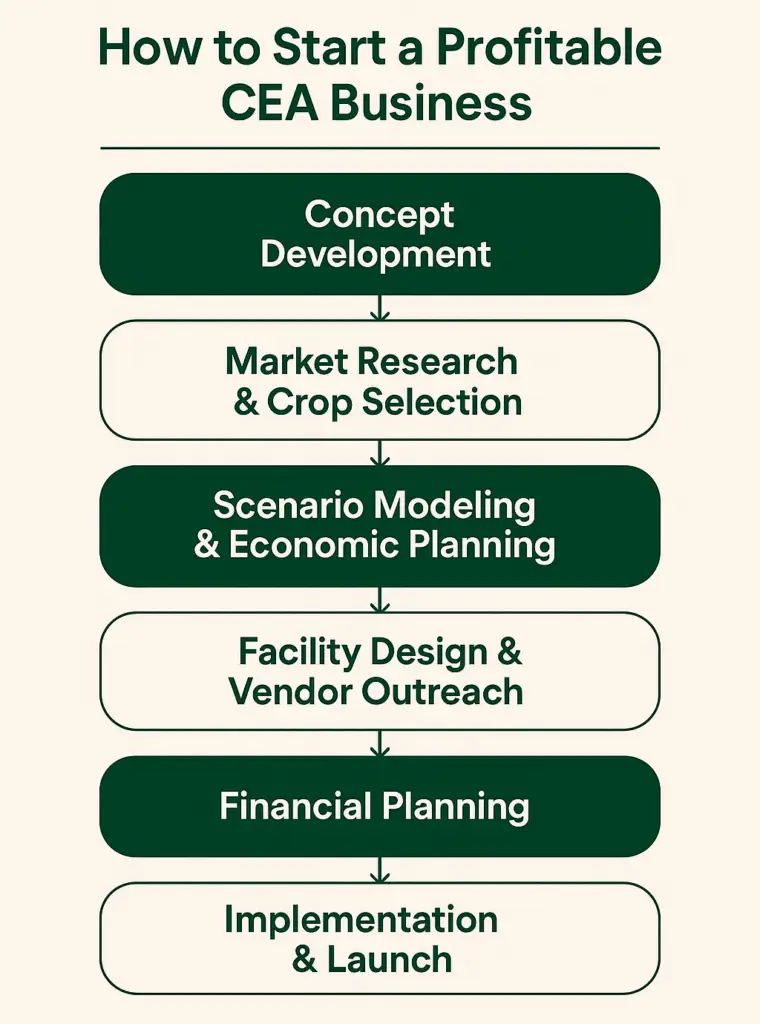
Step 1: Develop Your CEA Concept
Before anything is built or bought, you need a clear business concept. This foundation shapes every part of your indoor farming profit model.
Start by deciding which type of CEA operation best fits your resources and vision:
Next, determine which crops align with your market and facility. Leafy greens and microgreens are beginner-friendly and high-margin, while vine crops like tomatoes or strawberries require more space and investment.
Why this step matters: Concept development defines your CAPEX and OPEX structure, labor needs, and environmental controls. Without clarity here, it’s easy to overspend or overdesign.
Step 2: Research the Market & Validate Your Crops
Your growing strategy is only viable if there’s a market for your harvest. Market research is where your concept meets reality.
Look into:
Agritecture helps operators identify opportunities, validate crops against local demand, and avoid oversaturated markets. Their insights into trends—like pesticide-free or specialty produce—can help you differentiate your farm.
Why this step matters: Even the most advanced system can fail if you grow the wrong crop or face too much competition. Market validation ensures your farm has a customer base from day one.
Step 3: Run Scenario Modeling & Build an Economic Plan
Now it’s time to translate your concept into numbers. This step involves financial modeling, performance forecasting, and stress testing your assumptions.
Agritecture Consulting provides comprehensive economic models that include:
Partnering with advisors or consultants can help you build an economic plan grounded in real data—not assumptions.
Why this step matters: Many CEA ventures fail not because of bad technology, but due to unrealistic financial expectations. Agritecture helps ensure your model is based on data, not guesswork.
Step 4: Design Your Facility & Choose the Right Vendors
Now that you’ve confirmed your numbers, it’s time to design the farm that brings your plan to life.
Agritecture provides:
Use this stage to gather quotes from vendors, compare technologies, and understand long-term reliability. Whether it’s LED lighting, dehumidification, or environmental automation, you’ll want to select solutions that match your forecasted scale and performance goals.
Why this step matters: Inefficient layout or mismatched equipment choices can lead to high utility bills, bottlenecks, or underperforming crops.
Step 5: Finalize Your Financial Strategy
With design and vendor details in hand, you need a clear plan for funding and capital management.
Agritecture helps growers with:
If you’re raising funds or applying for loans or grants, package your modeling and scenario planning into a compelling pitch. Show investors a clear path to profitability and risk mitigation.
Why this step matters: Cash flow challenges are the #1 reason new farms fail. You need financial discipline, data-driven projections, and a clear use-of-funds roadmap to stay on track.
Step 6: Build, Launch & Operate Your Farm
This is where plans turn into a functioning farm.
Agritecture supports operators during implementation with:
Why this step matters: Launching with expert guidance reduces costly mistakes and sets your farm on a trajectory for long-term success.
Final Thoughts: Plan Smarter, Grow Stronger
Starting a CEA business is as much about planning and strategy as it is about plants and lights. Every decision—crop choice, facility design, vendor selection, financial model—can either unlock long-term growth or derail your vision.
Too often, new indoor farmers jump into construction or equipment purchases without a clear plan, only to discover hidden expenses, mismatched technology, or market challenges. By working with Agritecture Consulting and leveraging Hydrobuilder’s trusted products and resources, you give yourself the best chance to:
CEA ROI Calculator — Estimate Your Indoor Farm Profitability
Launching a Controlled Environment Agriculture (CEA) business means balancing yield potential with real operating costs. One of the biggest mistakes new growers make is underestimating expenses or overestimating revenue. To help you plan smarter, we’ve built the Hydrobuilder CEA ROI Calculator — a free tool that models your canopy size, yield, crop cycles, and costs to give you:
- Annual production in pounds (sellable weight)
- Revenue forecasts based on market price and shrinkage
- Operating costs (electricity, labor, nutrients, rent, etc.)
- Cost per pound and break-even price
- ROI % and payback period on your initial investment
Whether you’re planning a single flower room, scaling to a multi-room facility, or considering a greenhouse, this calculator gives you a realistic picture of profitability before you spend a dollar on equipment. Adjust the presets to match your own crop, pricing, and cost assumptions — then fine-tune as you gather real data from your operation.
Validate Your ROI With Experts
Our calculator gives you a solid first look at costs and profitability. But every CEA facility is unique — crop selection, workflow, and vendor choices can make or break your margins.
👉 That’s where Hydrobuilder + Agritecture come in. We’ll:
- Refine your financial model with real vendor quotes and utility rates
- Stress-test your plan with best- and worst-case scenarios
- Design a facility that aligns with your yield and ROI goals
- Support your launch and operations with ongoing expertise