

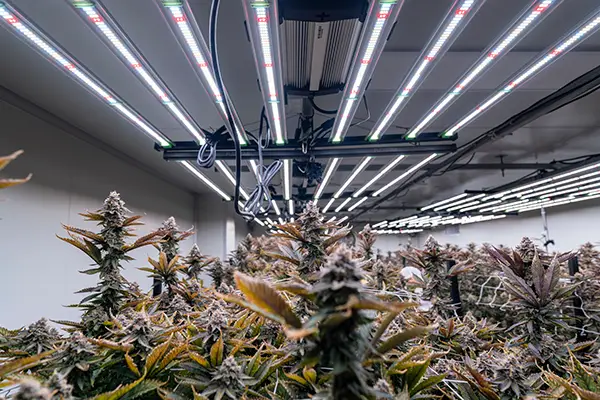
The best LED grow lights in 2026 aren’t defined by a single “best overall” fixture — they’re defined by what problem you’re solving. The technology has matured well past the point where one recommendation fits all growers. Whether you’re running a 3×3 tent, managing a 20,000-square-foot commercial canopy, or looking to wring more yield out of a room you’ve already built, there’s a purpose-built LED solution for your specific situation.
This guide covers every meaningful category of
LED grow light technology — from full-spectrum bar fixtures and tunable multi-channel systems to under-canopy lighting, HPS transition fixtures, compact tent lights, and purpose-built clone/propagation bars. We’ve also folded in a direct LED vs. HPS comparison so you can make the technology decision before the product decision.
Jump to what you need: All-Around LED | Tunable Spectrum | Under-Canopy | HPS Transition | Compact/Tent | Clone & Propagation | LED vs. HPS
What Makes a Great LED Grow Light in 2026?
The conversation has moved past wattage and “blurple vs. white.” Here’s what actually separates high-performance LEDs from marketing noise in 2026:
Efficacy (µmol/J): This is the miles-per-gallon of grow lighting — how many usable photons you get per watt of electricity. 2.5+ µmol/J is high-efficiency; 3.0+ µmol/J is elite; 3.1+ µmol/J is where the best modern fixtures sit. Always compare by efficacy, not wattage.
Spectrum quality and tunability: Full-spectrum white (3000K–5000K blend) with deep red (660 nm), far-red (730 nm), and ideally independent UV and far-red channels is the 2026 standard. The best fixtures let you adjust spectrum ratios across growth stages — not just dim overall intensity.
PPFD uniformity: How evenly light lands across your canopy matters as much as peak intensity. A fixture hitting 1,000 µmol/m²/s in the center and 400 at the edges wastes half your plants’ potential. Ask for the PPFD map, not just the peak number.
Build quality: IP65 water resistance minimum, passive cooling (no fans to fail), and a meaningful warranty from a brand with commercial track record.
System compatibility: Can this fixture integrate with your existing automation? TrolMaster Hydro-X, Growers Choice Master Controller, Matrix MC5, 0–10V dimming — verify before you buy.
Use our grow room electricity cost calculator to model operating costs across fixtures before committing.
LED vs. HPS: Making the Technology Decision First
Before choosing a specific fixture, you need to know whether LED is right for your situation. Here’s the honest comparison.
| Factor | LED | HPS |
|---|---|---|
| Upfront cost | Higher | Lower — 1,000W DE HPS starts around $300 |
| Electricity | 30–40% lower operating cost | Higher |
| Spectrum | Full-spectrum, tunable, UV/IR capable | Red-dominant; requires MH for veg |
| Canopy uniformity | Excellent (bar-style) | Center-heavy, edge falloff |
| Heat output | Lower radiant heat | Higher — can be useful for VPD management |
| Lifespan | 50,000+ hours, no consumables | 10,000–15,000 hours, bulb replacement required |
| DLC rebate eligible | Yes (most commercial fixtures) | No |
The HPS case: If startup capital is constrained, HPS grow lights remain a legitimate entry point. The Iluminar 1000W DE HPS delivers serious output at an accessible price point. Just size your electricity costs over 2–3 years, not just at purchase.
The transition case: If you’re converting an existing HPS facility, a full LED swap means recalibrating your entire environment — particularly dehumidification, since LED’s lower radiant heat raises canopy humidity. The Matrix Hybrid 1000W was engineered specifically for this scenario. More below.
The LED case: For new builds, energy-constrained facilities, or operations maximizing yield per watt, modern LED is the clear long-term choice. Use the electricity calculator to model your payback period.
Best All-Around Full-Spectrum Bar LED
The anchor pick: one fixture that works from a tent to a commercial room.
Iluminar iLogic MS Plus 700 — Best All-Around
The Iluminar iLogic MS Plus 700W is our top overall pick — a full life-cycle fixture that punches well above its wattage class with genuine multi-channel spectrum control. At 700W, it produces 2,030 µmol/s PPF at 2.9 µmol/J using Samsung LM281B+ Pro full-spectrum diodes with independently controlled far-red (730nm), UV-A (385nm), and deep red (660nm) channels. Growers can precisely time and adjust each channel across the photoperiod — accelerating vegetative-to-flower transitions, boosting secondary metabolite production at finishing, or running pure full-spectrum for the bulk of the cycle. Control is via the Iluminar PAD controller or smartphone app; the fixture daisy-chains up to 256 units for commercial scalability. IP65 rated, 50,000+ hour lifespan, 0–100% dimming via RS485.
Key specs:
- 700W | 2,030 µmol/s PPF | 2.9 µmol/J
- Samsung LM281B + Pro + 192 * Honglitronic SMD3535
- 0-100% dimming via RS485
- Daisy-chain up to 256 fixtures
- Full automation via ILUMINAR Touch+ Controller
Now growers can precisely and independently specify the timing and intensity of far-red, UV-A, and full-spectrum light output during the light cycle. This fine-tuning functionality is ideal for cultivators looking to reduce transition time between vegetative growth and flowering as well as boost the production of secondary metabolites.
Also Outstanding
Growers Choice ROI-E720 — Honorable Mention
The Growers Choice ROI-E720 has been one of our best-selling LEDs for good reason. Developed with TSL Horti Tech, it delivers 2,080 µmol/s at 2.6 µmol/J using top-bin Osram diodes in Growers Choice’s GC-3K full spectrum with 660nm deep red. Onboard dimming (100/75/50/25%), a fanless bar design, IP65 rating, and DLC Horticulture certification make it a straightforward, well-supported choice for tents, dedicated grow rooms, and smaller commercial facilities. If you want proven performance without multi-channel complexity, this is the light.
Key specs:
- 720W | 2,080 µmol/s PPF | 2.6 µmol/J
- GC-3k full spectrum with Osram top-bin 660 nm deep red
- Onboard dimming: 25 / 50 / 75 / 100%
- Fanless passive cooling | IP65 | Horti DLC, UL1598, UL880
- Bloom footprint: 4×4 ft | Veg footprint: 5×5 ft
- Full automation via Growers Choice Master Lighting Controller
The ROI-E720’s multi-bar format achieves the kind of PPFD uniformity across a 4×4 footprint that panel fixtures can’t match — consistent photon delivery from the center to the edge, so every plant in your canopy is working as hard as the one directly below the fixture. Fanless design, IP65 rating, and DLC certification make it genuinely commercial-grade. DLC listing opens utility rebate programs in eligible markets that can meaningfully offset acquisition cost.
If you want to add UV enhancement and supplemental bloom spectrum without buying a separate fixture, the ROI-E720 with Bloom Boost UV-R light bars pairs UV-R bars alongside the base fixture — addressing UV and far-red spectrum within a single purchase.


Best Tunable Spectrum LED
For growers running lighting recipes — the fastest-growing technology category in commercial cultivation.
The 2025 State of Cannabis Lighting research found 70% of growers exploring tunable spectrum cite “enhanced flowering quality or yield” as their primary motivation. Spectrum tunability lets you shift from blue-heavy vegetative lighting to red-dominant flowering ratios, trigger far-red-driven responses at specific stages, and run End-of-Day far-red protocols that accelerate flowering transitions — all from a single fixture rather than switching rooms or swapping out hardware.
Matrix M6 Dyna Spectrum Tunable 760W — Best Tunable Fixture
The Matrix M6 Dyna Spectrum Tunable 760W delivers 4-channel independent spectrum control at up to 3.2 µmol/J — a combination that puts it among the most capable tunable platforms at its price point ($739).
Key specs:
- 760W | 4-channel tunable spectrum | up to 3.2 µmol/J
- Dimming down to 25% | All-stage growth
- Universal 0–10V dimming (compatible with all major controllers)
- Unistrut mounting compatible
- Excellent passive heat dissipation
The four independently adjustable channels give you genuine control over spectral balance at every growth stage: a blue-weighted veg recipe early on, a full balanced spectrum for bulking, a high-red finish, and independent far-red or UV triggering at critical windows. The 0–10V compatibility means it integrates with whatever controller you’re already running — TrolMaster, Matrix MC5, Growers Choice, Growflux, or custom 0–10V automation.
Also in this category:
- Matrix M8 Dyna 1000W, 4-Channel — scales up the Dyna platform to 1,000W for larger footprints at $892; same up to 3.2 µmol/J, same 4-channel architecture
- Matrix Vega Dyna 1000W — 1:1 HPS-replacement form factor with tunable spectrum, designed for facilities measuring HPS footprints and wanting a direct dimensional swap; up to 3.2 µmol/J, $865
- Growers Choice ROI-E720 with Bloom Boost UV-R— if you prefer the ROI platform but want UV-R spectrum enhancement added, this variant pairs the base fixture with supplemental UV-R bars for a single-purchase spectrum upgrade
For controller integration: The Matrix MC5 Grow Light Controller unlocks the full dimming, spectrum scheduling, and far-red timing capabilities of Matrix fixtures. For multi-brand rooms, the TrolMaster Hydro-X Lighting Control Adapter integrates compatible fixtures into centralized room automation.
Best Under-Canopy Lighting
The single fastest-growing adoption category in commercial cannabis lighting — and the easiest ROI-positive upgrade for an established room.
In 2022, roughly half of commercial cannabis growers cited interest in supplemental lighting. By 2025, that number hit 78% — a 27-point gain in three years. The reason is straightforward: toplighting alone cannot fully penetrate a dense mid-to-late-flower cannabis canopy. The result is a familiar problem: excellent top colas, mediocre lower bud sites, significant “larf” trim that never makes the premium shelf.
Under-canopy lighting directly addresses this. By delivering photons horizontally through the plant — targeting the shaded bud sites that toplight can’t reach — it transforms lower B- and C-grade sites into marketable A-grade flower. The research behind this is substantial: Fluence’s published data shows an increase from 37% to 50% A-grade bud and a reduction in trim waste from 35% to 26%. Multiple independent trials report 20–30% yield increases under optimized CO₂, VPD, and feed protocols. The ROI typically pays back within two harvest cycles under commercial wholesale pricing assumptions.
It’s important to note: adding photon energy to a room means increasing demand on everything else. When you add under-canopy bars, increase CO₂ targeting, bump your feed schedule, and monitor VPD at canopy level — not just above it. Don’t fire up under-canopy bars at full intensity on day one of flower; ramp up through the first two weeks as the canopy fills in.
Faven Chroma 120W with Far Red — Best Under-Canopy Bar
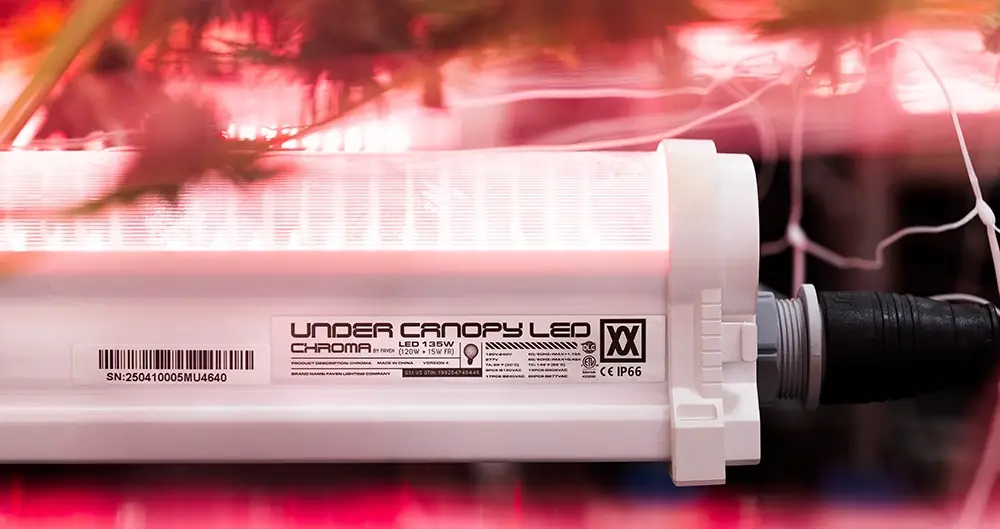
The Faven Chroma with Far Red, 46-inch, 120–277V is the most technically sophisticated under-canopy bar available at Hydrobuilder, and one of the most interesting products in the category period.
Where most under-canopy bars are simple fixed-spectrum red or red-heavy bars, the Chroma gives you two separate levers: a main channel with an adjustable R4–R9 spectrum range (ranging from 40% red on the cooler end to 90% red on the warmer end), plus an independent 15W far-red channel that can be run separately from — or in addition to — the main channel at any point in the cycle.
Key specs:
- 120W main channel + 15W independent far-red channel
- Adjustable spectrum: R4 (cooler, ~40% red) through R9 (warmer, ~90% red)
- 120–277V | IP66 rated | 5-year warranty
- Daisy-chain up to 20 bars together
- 46-inch bar format | $199.99 per bar
Why the Chroma’s spectrum range matters in practice: The R4–R5 cooler spectrums suppress stretch and tighten node spacing during early flower — particularly relevant when you’re adding under-canopy light in weeks 1–3 and don’t want to drive elongation. R6–R7 balanced spectrums support healthy bud site development during bulk weeks 4–7. R8–R9 warmer spectrums drive anthocyanin production and quality enhancement during finishing in weeks 8–9. This is the spectrum-balancing principle: you’re not just adding raw photons to the bottom of your plant, you’re delivering the right spectrum at the right growth stage.
The independent far-red channel enables End-of-Day (EOD) far-red protocols — running 15W of 730 nm for 5–15 minutes at lights-off to trigger accelerated flowering transitions — without any impact on your main lighting schedule. This is the kind of precision tool that was previously only available in top-tier commercial setups; the Chroma puts it in reach of anyone running a 46-inch bar.
Faven’s Spectrum Balancing concept deserves its own explanation. The principle is that your under-canopy bars shouldn’t duplicate what your toplight is already doing — they should complement it. If your toplight is a neutral full-spectrum white, an R8 (80% red) bar below adds what the white toplight underdelivers. If you’re already running a high-red toplight, an R6 (60% red) bar adds a cooler balance. Faven provides specific pairing recommendations on this, and it’s why they offer two main spectrum variants.
Faven R6/R8 Under-Canopy Bars — Entry-Level and Multi-Pack Options
For operations that want a proven, simpler under-canopy system without the Chroma’s tunability premium, the Faven Under-Canopy LED Grow Lights (R6/R8) offer the same 46-inch form factor, daisy-chain architecture, and spectrum-balancing approach in a fixed-spectrum format.
Single bars start at $149 for R6 (60% red, better for neutral or high-red toplights) and $159 for R8 (80% red, better for full-spectrum or white-dominant toplights). Multi-packs in 2-, 4-, and 8-bar configurations with extension cords make facility-scale deployments practical — an 8-bar pack covers a 4×8 row at under $1,300.
Setup: Install bars 8–12 inches above the substrate level — not at the bottom of the pot, but elevated to deliver light horizontally through the mid-canopy. The Faven Adjustable Stands (8-, 10-, 12-inch height options, pack of 2) position bars at the right height without requiring creative rigging. For dimming control, the Faven Dimming Mini-Controller lets you ramp intensity independently of your toplight schedule.
For a deeper dive on the under-canopy strategy, see our guide to under-canopy lighting.


Best HPS-to-LED Transition Fixture
For facilities converting from legacy HPS who want LED performance without a full environmental overhaul.
The most common barrier to HPS-to-LED conversion in established facilities isn’t cost or conviction — it’s the thermal disruption. Modern LEDs produce meaningfully less radiant heat than HPS, and in rooms calibrated around that heat load, switching entirely to LED means the canopy runs cooler and drier, raising relative humidity at the leaf surface and often requiring upgraded dehumidification infrastructure to compensate.
The Matrix Hybrid was engineered specifically to solve this.
Matrix Hybrid 1000W HPS/LED — Best Transition Fixture
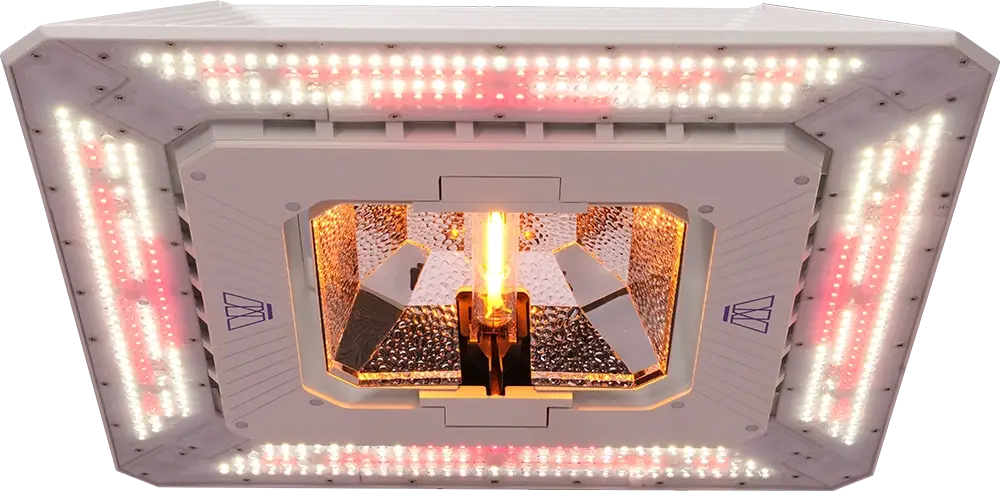
The Matrix Hybrid 1000W is the world’s first true HPS/LED hybrid fixture — combining 560W of LED, 400W of HPS, and 40W of independent Far-Red in a single low-profile unit with tri-channel control.
Key specs:
- 560W LED + 400W HPS + 40W Far-Red = 1,000W total
- Tri-channel independent control: LED, HPS, Far-Red operated separately
- LED channel: Liquid Optics enclosed design, IP66
- Operates on 208–277V
- Published April 2026 — newest fixture in this guide
- Pairs with Matrix MC5 Controller (required for dimming, spectrum, far-red scheduling)
Why this approach works for transitions: The HPS component maintains the radiant heat profile your room was sized for, preserving the canopy VPD dynamics your environmental systems are calibrated around. The LED channels add the spectral precision, efficiency, and far-red capability that pure HPS can’t deliver. You get a phased conversion: in week one you can run the HPS-dominant mode while your team learns the LED channels, then gradually shift the balance as you dial in your environment.
For commercial operations at MJBizCon 2025, Matrix presented data showing the hybrid system delivers higher overall PPF efficacy than full HPS, lower cooling demand versus full HPS, while avoiding the humidity disruption of a full LED conversion. Clients using the approach report shorter cultivation cycles and stronger flowering performance.
Critical note: Without the Matrix MC5 Controller, the Hybrid operates only at 100% ON or full OFF — no dimming, no spectrum tuning, no far-red scheduling. For a commercial installation, the MC5 is not optional.
This fixture also makes compelling sense for new builds where operators want the proven flowering performance of HPS combined with LED efficiency and spectrum control — not just as a transition device but as a deliberate long-term hybrid strategy.
Best Compact LED for Tents and Small Spaces
For 4×4 spaces: high efficiency without full commercial overhead.
AC Infinity IONFRAME EVO4 300W — Best Compact
The AC Infinity IONFRAME EVO4 300W is the clearest value proposition in the compact LED category — 3.14 µmol/J efficacy from Samsung LM301H EVO diodes, with a fully integrated smart controller handling dimming, scheduling, and sunrise/sunset simulation in a single fixture.
Key specs:
- 300W | Samsung LM301H EVO diodes | 3.14 µmol/J
- 3×3 bloom footprint | 4×4 veg footprint
- Built-in smart controller (brightness, schedule, sunrise/sunset)
- IP-65 chassis | Removable driver | ETL certified
3.14 µmol/J puts this fixture’s efficiency above products costing significantly more. The integrated controller eliminates the need for a separate timer or dimmer — a meaningful simplification for anyone setting up a first tent. For more on managing heat in a tent environment, see our ventilation guide.
Also in this category:
- Matrix M4 400W — Matrix’s compact entry point; 400W full-spectrum bar fixture for 3×3 to 4×4 bloom at a competitive price; same Samsung diode quality as the M6 platform
- Growers Choice ROI-E420 — 400–500W bloom footprint with Osram top-bin diodes; strong choice for 3×3 to 4×4 growers who want the ROI-series platform at a lower entry cost
For a properly equipped growing environment, pair your fixture with a Covert grow tent sized to match your light’s bloom footprint.
Best Clone and Propagation Lighting
An underserved category — purpose-built propagation lighting drives faster rooting, stronger starts, and cleaner hand-offs to your veg room.
Cloning and propagation need a fundamentally different lighting approach than veg or flower. Young cuttings and seedlings can’t handle the intensity that mature plants thrive under — but they do need a quality full-spectrum source, particularly blue wavelengths for root development and compact early-stage morphology. Dedicated clone bars let you run propagation zones efficiently without stealing overhead lighting resources from your veg or flower rooms.
Matrix 18W LED Clone Light — Best Clone Bar
The Matrix 18W LED Clone Light (Pack of 2) is purpose-designed for propagation, with a full spectrum weighted toward the blue-enriched output that Matrix’s own research shows produces superior cloning results. Built around the same quality diodes and thermal management as the M-series grow lights, these are low-profile clone bars sized to fit propagation areas, clone trays, and nursery shelving.
At 18W per bar, intensity is calibrated specifically for the cloning stage — bright enough to support active photosynthesis in cuttings and support rooting, without the intensity stress that pushes unrooted cuttings into photorespiration. Run them at 18–24 hours photoperiod during cloning to maximize rooting speed.
Gavita LED Clone Bar (Pack of 2) — Commercial-Scale Propagation
The Gavita LED Clone Bar, Pack of 2 brings Gavita’s commercial horticulture credibility to propagation. These bars are widely used in licensed commercial facilities running dedicated clone rooms and are proven across tens of thousands of clone cycles. The Gavita Clone Bar is IP66 rated for humidity-rich propagation environments, daisy-chainable for scaling across large clone benches, and engineered for multi-tier vertical propagation racks.
Setup guidance: Position clone bars 4–8 inches above propagation trays. Start at low intensity (50–60% if dimmable) the first 48–72 hours after cutting, then ramp to full intensity as cuttings show signs of rooting. Pair with the HBX 50 Site Seedling Starter Kit for a complete propagation setup.


Supporting Your Lighting System: What Else You Need
Every great lighting setup needs the right supporting infrastructure.
Environmental monitoring: The HBX Thermo-Hygrometer with LCD Display stores Min/Max temperature and humidity values — essential when you’re running under-canopy bars or tunable fixtures that shift your room’s heat signature between growth stages. Monitor at canopy level, not above.
Light positioning: The AC Infinity Heavy-Duty Adjustable Rope Clip Hangers (6-pair pack) handle height adjustments for overhead fixtures as plants move through growth stages. For under-canopy bars, Faven Adjustable Stands position bars precisely at mid-canopy height.
Light measurement: If you’re running tunable fixtures or optimizing PPFD targets, a quantum PAR meter is essential — sensor placement at canopy level, not above. The Apogee MQ-500 is the reference standard for this.
For Commercial Operations
Scaling up requires more than choosing the right fixture — it requires the right system.
Electrical infrastructure: All high-output commercial LEDs (700W+) operate on 208–277V. The Matrix Hybrid runs on 208–277V; the Photontek XT 1000W requires 240V; the Dyna series supports universal 0–10V control. Verify panel capacity before specifying any fixture at scale.
DLC rebates: DLC-listed fixtures including the ROI-E720, ROI-E420, and Photontek XT 1000W are eligible for utility rebate programs that can offset 10–40% of fixture cost in participating utility programs — contact your utility to confirm eligibility. Contact your utility and the HydroBuilder commercial team for program guidance.
Under-canopy at scale: 78% of commercial cannabis growers are now exploring supplemental lighting. If you’re running 20+ top lights without under-canopy bars, you are almost certainly leaving yield on the table. A Faven bar deployment at 4 bars per 4×8 row is a straightforward ROI calculation: approximately $800 in fixture cost per row, with yield increases that typically pay back in fewer than two full harvest cycles under commercial wholesale pricing assumptions.
Centralized control: The TrolMaster Hydro-X Lighting Control Adapter integrates LED fixture control into the full Hydro-X ecosystem alongside HVAC, CO₂, and irrigation — the control architecture of choice for commercial operations beyond 10 lights.
Why Shop LED Grow Lights at HydroBuilder
HydroBuilder carries the full commercial LED lighting stack — from top lights and tunable systems to under-canopy bars, clone lights, and the Matrix Hybrid that bridges the HPS-to-LED transition. Our commercial team supports fixture specification, DLC rebate documentation, and facility-scale layout planning.
Contact us — this is what we do every day.
Best LED Grow Lights 2026: FAQs
What is the best LED grow light for a 4×4 tent in 2026?
For a 4×4 bloom footprint, the Iluminar iLogic MS Plus 700W is our top pick. For a simpler full-spectrum option, the Growers Choice ROI-E720 covers the same footprint reliably.
What is tunable spectrum LED lighting and do I need it?
Tunable spectrum LEDs let you independently adjust the ratio of blue, white, red, and far-red channels across growth stages — rather than dimming a fixed-spectrum fixture. You need it if you want to run blue-heavy vegetative recipes that keep internodes tight, shift to high-red bloom protocols, trigger end-of-day far-red responses, or experiment with lighting recipes to optimize cannabinoid and terpene expression. The Matrix M6 Dyna 760W offers 4-channel independent control at up to 3.2 µmol/J.
Does under-canopy lighting actually increase yield?
Yes — with substantial evidence. Multiple independent studies show 20–30% yield increases from under-canopy LED supplementation under optimized CO₂, VPD, and feed protocols. Fluence’s published data shows A-grade bud fraction increasing from 37% to 50% while trim waste drops from 35% to 26%. The mechanism is straightforward: toplighting alone can’t fully penetrate a dense mid-to-late-flower cannabis canopy, leaving lower bud sites starved for light. Under-canopy bars like the Faven Chroma deliver targeted photons to those shaded sites — transforming B-grade lower flower into marketable A-grade product.
What is the difference between the Faven R6 and R8 spectrums?
R6 means 60% red content in the spectrum; R8 means 80% red content. Faven recommends choosing based on your toplight: if your overhead fixture is a neutral white or full-spectrum LED, pair it with R8 (80% red) to add what white light underdelivers. If your toplight already runs high-red output, R6 (60% red) provides a more balanced complement. The Faven Chroma goes further — its R4–R9 adjustable range and independent far-red channel let you dial in spectrum balance for each week of flowering rather than committing to a fixed output.
Is it worth switching from HPS to LED mid-operation?
It depends on your infrastructure. The electricity savings are real — 30–40% lower operating cost — but a full LED conversion requires recalibrating your environment, particularly dehumidification. LED produces less radiant heat than HPS, which raises canopy humidity in rooms that were sized for HPS’s thermal profile. If your HVAC and dehumidification are already sized for LED’s lower heat load, the switch pays off cleanly. If not, the Matrix Hybrid 1000W is engineered for exactly this scenario — its combined HPS+LED output maintains the thermal profile your room is calibrated for while adding LED spectral precision.
What is the best LED for cloning and propagation?
The Matrix 18W LED Clone Light is calibrated specifically for propagation — blue-enriched spectrum, low intensity, purpose-built for clone trays and nursery shelving. For commercial-scale dedicated clone rooms, the Gavita LED Clone Bar is IP66 rated, daisy-chainable, and proven across large licensed cultivation operations.
How do I calculate DLI for my grow room?
DLI (Daily Light Integral) is the total amount of light delivered to your canopy in a day, measured in mol/m²/day. Calculate it as: PPFD (µmol/m²/s) × photoperiod (hours) × 3.6. Cannabis in flower typically targets 35–55 mol/m²/day — this target reflects the combined DLI from both toplight and any supplemental under-canopy bars. When adding under-canopy bars, track the combined DLI from both sources and adjust CO₂, water, and nutrient delivery accordingly — increasing total DLI without adjusting these inputs will create bottlenecks that limit your returns.
What does µmol/J mean and why does it matter?
µmol/J (micromoles per joule) is the efficacy rating for grow lights — how many photosynthetically active photons you get per watt of electricity consumed. Think of it as miles per gallon for your lighting system. 2.5 µmol/J is high efficiency; 3.0+ µmol/J is elite. A 700W fixture at 3.0 µmol/J produces more usable photons — and therefore more yield potential — than a 1,000W fixture at 2.1 µmol/J, while drawing 300 fewer watts. This single number is the most important efficiency metric when comparing fixtures at any price point.
Can I use the same LED for vegetative and flowering growth?
Yes. All modern full-spectrum LEDs in this guide are designed for seed-to-harvest use. The practical management is intensity, not fixture swapping: run fixtures at 40–60% during veg to encourage compact growth, then ramp to 80–100% for flower. If you’re running a tunable fixture like the Matrix Dyna, you can also shift spectrum ratios by stage — more blue during veg for tighter nodes, more red during flower for bud development.
How many Faven bars do I need per light?
A common starting point for a 4×4 canopy is 2–4 Faven bars depending on your toplight intensity and plant density. For a 1,000W toplight running a 4×4 bloom footprint, 4 bars at R8 (one per row of plants) positioned 8–12 inches above substrate level is a solid baseline. Scale up for denser canopies or higher-intensity finishing protocols. Faven offers bars in single units and 2-, 4-, and 8-bar packs with extension cords to simplify multi-bar daisy-chain setups.