Choosing the right grow tent can make or break your indoor garden – it controls your light, temperature, humidity, and airflow from day one. But with so many sizes, materials, and brands available, knowing where to start isn’t always easy.
In this buying guide, we break down everything you need: how to size your tent for your plant count and light footprint, what canvas denier ratings mean for durability, and how Covert and Gorilla Grow Tent compare. Plus, ventilation sizing, multi-chamber setups for perpetual harvests, and complete kits for first-time growers.
Whether you’re fitting a 2′ x 4′ into a closet or scaling up to a commercial 10′ x 10′, this guide gives you the knowledge to buy with confidence – and grow with results.
Choosing the right grow tent is one of the most important decisions you’ll make when setting up an indoor garden, because it determines how easily you can control light, temperature, humidity, and airflow from day one. The right tent gives you consistent environmental control and room to work, while a poor match in size or build quality can bottleneck your plants from the start.
Whether you’re fitting a 2′ x 2′ tent into a closet or building out a perpetual harvest system with multiple tents, this buying guide walks you through every key decision: size, material quality, brand, style, and the equipment you’ll need inside. If you’re new to indoor growing altogether, start with our Definitive Guide To Indoor Growing for a complete overview of what goes into a successful grow.
What Is a Grow Tent and Why Use One?
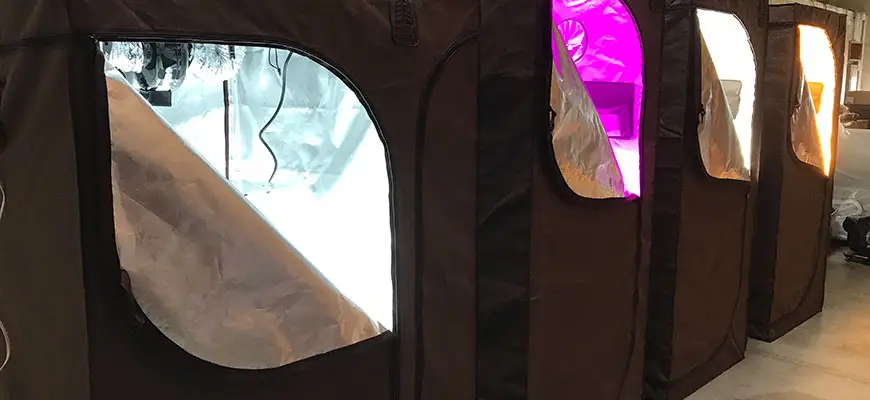
A grow tent is a portable, enclosed growing space built on a rigid metal frame with a reflective fabric outer cover. Tents keep your garden contained, allow full environmental control, and protect plants from outside contaminants without the cost and permanence of constructing a dedicated grow room.
Key advantages over building a grow room from scratch:
Reflective interior: Mylar-lined walls bounce light back onto the plant canopy, improving light-use efficiency at any wattage.
Light-proof design: An all-black exterior and sealed seams prevent light leaks in both directions—keeping light in during “day” and blocking outside light during “night” cycles.
Contained mess: Spill-proof bases and removable trays help contain water, soil, and nutrient runoff for easier cleanup.
Portability: Most quality tents assemble and disassemble without tools, making them ideal for renters or temporary spaces.
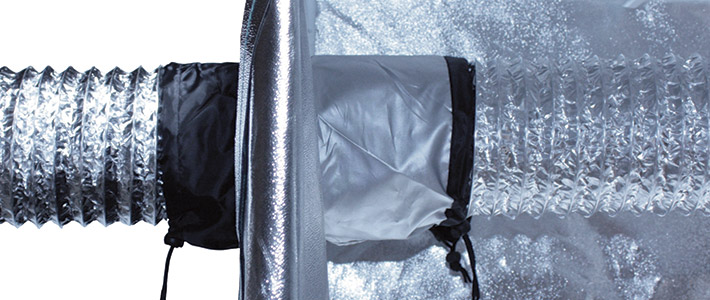
Pest and contamination barrier: Mesh pre-filter vents and sealed ducting ports reduce the risk of pests, dust, and mold spores entering the grow space when properly managed.
Unlike grow cabinets, which are solid, lockable, and extremely stealthy, grow tents generally offer more volume per dollar and are far easier to scale as your canopy grows. If security and total stealth are priorities, see our Grow Tents vs Grow Cabinets comparison for a full breakdown.
Step 1: Choose Your Grow Tent Size
Tent size is determined by three factors: available space, plant count, and grow light footprint. Measure your available floor space carefully before purchasing; the tent should be slightly smaller than the room or area it occupies so you have room to open doors, access ducting ports, and work around the tent comfortably.
Measure Your Space First
Before settling on a size:
Measure length, width, and height of the intended area, including any baseboards, obstructions, or sloped ceilings.
Account for nearby doors, windows, and electrical outlets so the tent doors and ports remain usable.
Leave at least several inches of clearance around the tent for ventilation ducting, power cords, and safe movement.
If you’re working in a tight space such as a closet, under-stair nook, or attic, be especially mindful of ceiling height and any angled surfaces.
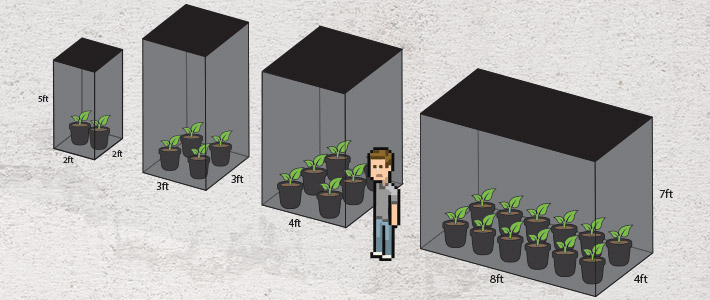
Recommended Plant Counts by Tent Size
Plant count varies based on training method, container size, and strain. The figures below assume standard container spacing with minimal plant training and medium-sized plants; SOG and ScrOG methods can increase or decrease plant counts significantly within the same footprint.
Grow Tent Size Guide
Tent Size
Plants (Full Cycle, Typical)
Typical Light
Ventilation CFM (Baseline Target)
2' x 2'
1–2
200–315W LED equivalent
60+ CFM (after filters/ducting)
2' x 4'
2–4
200–400W LED equivalent
150+ CFM
3' x 3'
2–4
315–400W LED/CMH equivalent
200+ CFM
4' x 4'
4–6
600–720W LED equivalent
300–350+ CFM in most setups
5' x 5'
4–9
600–1000W LED/HID equivalent
400+ CFM
4' x 8'
8–12
Dual 600W LED/HID equivalent
500+ CFM
8' x 8'
16–25
Multiple fixtures
800+ CFM
10' x 10'
25–36
Multiple fixtures
1,000+ CFM
These are recommendations, not hard rules. If you’re growing very small plants or using aggressive training techniques like sea of green (SOG), you may fit more plants in a given footprint; if you want large, tall plants, you’ll run fewer plants per tent and need more vertical clearance.
What About Height?
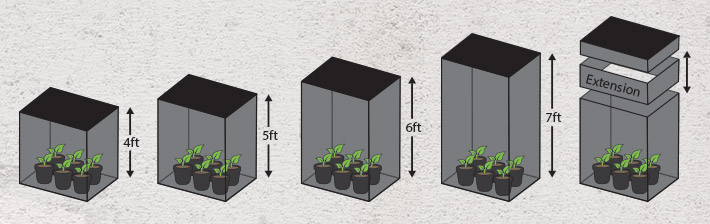
Tent height determines what you can grow and how you can light it. Most standard tents stand 6–7′ tall, which is sufficient for many compact or moderately tall strains under modern low-profile LEDs.
For gardeners working with tall strains, fixtures that need to be positioned 12–18″ above the canopy, and overhead ducting or carbon filters, you’ll want every inch of vertical space you can get. For height-restricted spaces—basements, attics, under-stair closets—look for tents in the 5′ range, which is purpose-built for low-ceiling environments.
If you have generous ceiling height, consider tents with optional extension kits so you can raise the roof later and give plants more headroom, improve light spread, and make it easier to work inside.
Step 2: Understand Tent Materials and Construction
Material quality directly affects light-proofing, durability, and insulation, with canvas thickness measured in denier (D). Denier is a measure of the linear mass density of fabric fibers—higher denier numbers generally indicate denser, heavier, more durable fabric.
Here’s how the major tiers stack up:
1680D canvas: The benchmark for premium grow tents, found on
Gorilla Grow Tent Heavy-Duty models: Up to several times denser than standard 200D–600D alternatives, providing maximum light-proofing and long-term durability for tents that see heavy, continuous use.
600D–800D Oxford fabric: Mid-range construction used in many quality value tents. Durable enough for years of continuous indoor use and suitable for most hobby and prosumer applications.
210D–600D: Budget–entry level tents. Adequate for early grows in controlled indoor environments, but more susceptible to light pinholes, wear, and accidental damage over time.
Reflectivity: The interior of all quality grow tents is lined with Mylar or similarly reflective material that redirects light back onto the plant canopy rather than allowing it to be absorbed by the tent walls. This improves light-use efficiency regardless of the light fixture you’re running, especially at the edges and corners of the canopy.
Frame Strength: Look for tents with all-steel poles and steel interlocking pins. Cheap tent frames use thin, hollow poles that can bend or fail under the weight of heavy LED fixtures, carbon filters, and inline fans – all of which are typically hung from the overhead crossbars.
Reinforced corners and high-quality zippers also matter; these are the stress points that see the most wear over the life of the tent.
Step 3: Choose Your Grow Tent Brand
Once you know the size and basic construction quality you need, it’s time to choose a brand. At Hydrobuilder, we focus on reliable, proven grow tent brands that are compatible with modern LED lighting and ventilation systems.
Covert Grow Tents: Best Value for Most Growers
The Covert 4′ x 4′ Grow Tent is our top recommendation for growers at any experience level who want a premium-style tent without a premium price tag. Covert tents are built from quality materials with reinforced corner connectors, heavy-duty zippers, reflective Mylar interiors, and a spill-proof removable base tray.
They include a convenient tool pouch inside the tent, a carrying bag for portability, and easy-access viewing windows so you can inspect your canopy without fully opening the tent and disrupting your environment. For smaller spaces, the
Covert 2′ x 4′ Grow Tent is an excellent entry point—it fits neatly in a standard closet and supports 4–6 small to medium plants full cycle with the right training and container sizes.
For larger setups, the Covert 5′ x 5′ Grow Tent provides space to run 4–9 plants under a 600W–1000W equivalent light footprint, depending on your growing style and pot size. You can
Gorilla Grow Tent is the industry benchmark for maximum durability and structural strength. The Heavy-Duty line uses 1680D canvas—significantly thicker than typical 200D–600D grow tent fabric and among the thickest options available—along with all-steel poles and steel interlocking pins that are rated stronger than standard tent frames.
Gorilla tents also come with a height extension kit (on most models), with additional extensions available to take your tent up to about 9′ tall, and some configurations reaching approximately 10′ with optional kits; always confirm the height options on the specific model you’re considering. Diamond-pattern interior reflection technology is designed to redistribute more light toward the canopy compared to standard flat Mylar, improving edge and corner coverage when paired with quality lighting.
For growers who expect to move their tent frequently, run particularly heavy lighting rigs, or simply want a tent designed for long-term use, Gorilla is often the right choice. The
Gorilla Grow Tent 2′ x 4′ is the entry-level footprint with the same construction quality as larger models, and the Gorilla Grow Tent 4′ x 4′ is ideal for 4–9 plants under a 600W-class LED or equivalent lighting.
Bug-resistant micro-mesh pre-filters, double-cinched ducting ports, and a flood pool base round out the feature set and help maintain a clean, controlled environment over many grow cycles.
Other Brands to Consider
Secret Jardin offers a distinctive aesthetic with several multi-chamber configurations and specialized propagation tents. Their DF16 frame system is modular and well-regarded among experienced growers who want a custom-feeling setup without building a room from scratch.
You can browse our full Grow Tent Size Collectionto compare all available brands and dimensions side by side, filtering by height, footprint, and feature set.
If you want to harvest more frequently, a multi-chamber tent can eliminate the need for multiple separate tents. A standard grow tent houses plants in one shared environment, which means all plants move through vegetative and flowering stages together; this works well for growers running a single strain or growing in distinct cycles.
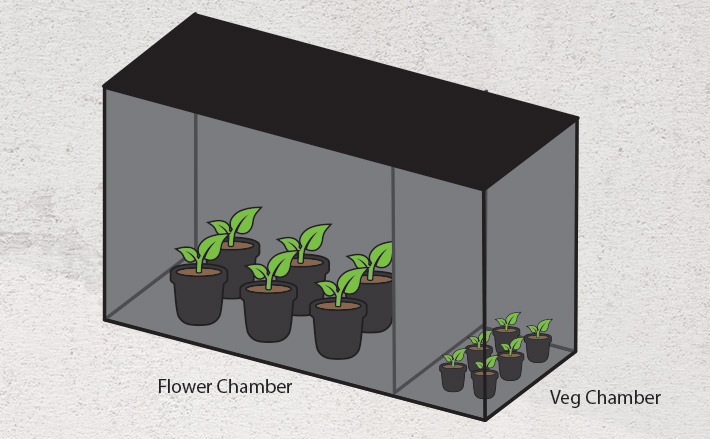
Multi-chamber grow tents divide the internal space into two or more separate environments. The larger chamber is used for flowering, and the smaller chamber is used for vegetative growth or propagation and cloning.
This layout allows a perpetual harvest system where plants are always in rotation: once flowering plants are harvested, vegging plants are moved to the flower chamber, and fresh clones or seedlings move into veg. With fast-flowering cultivars, shorter veg times, and a well-managed environment, this can reduce the time between harvests from 3–4 months down to roughly 8 weeks or less once the system is fully dialed in.
The Covert 4′ x 5′ Multi-Chamber Grow Tent is purpose-built for this workflow and is one of our most popular tent configurations for growers who want consistent, repeating harvests on a tight schedule.
Step 5: Ventilation – Calculating CFM for Your Tent
Ventilation is not optional—it’s the system that keeps your environment alive inside the tent. Inline fans pull warm, humid, odor-laden air out of the tent while drawing fresh CO₂-rich air in from outside, helping control temperature, humidity, and negative pressure.
A common baseline rule for sizing your inline fan is that it should be able to exchange all the air in the tent volume roughly once every 1–3 minutes. Calculate tent volume in cubic feet (length × width × height), then use that number as a minimum starting point in CFM; increase the rating by 25–100% to account for carbon filter resistance, ducting friction, and heat load from lighting and ambient conditions.
For example, a 4′ x 4′ x 7′ tent has 112 cubic feet of volume, so the absolute minimum baseline would be around 110–120 CFM. In practice, many growers target roughly 1.5–2× tent volume (around 170–225 CFM or more for this tent) to maintain stable temperatures and humidity once a carbon filter and ducting are added, with 300–350+ CFM used in hotter rooms, higher-wattage setups, or more restrictive duct runs.
Pair your inline fan with a carbon filter sized to match or slightly exceed the fan’s CFM. Carbon filters should be rated for the same diameter as your inline fan—4″, 6″, or 8″ are most common—and are typically mounted at the highest point inside the tent, where heat and vapor accumulate.
Step 6: Environmental Monitoring
You cannot manage what you cannot measure. Before your first plant goes in, mount the HBX Thermo-Hygrometer inside the tent at canopy height.
This LCD monitor tracks temperature and relative humidity in real time, stores Min/Max readings across your full lights-on and lights-off cycle, and gives you the data to identify and correct environmental swings before they impact plant health. Most tent-related problems—stretching, humidity spikes, nutrient uptake issues—can be traced back to unmonitored or unstable environmental conditions, and a thermo-hygrometer is one of the lowest-cost diagnostic tools you have.
Step 7: Skip the Build – Shop a Complete Grow Tent Kit
If this is your first grow or you want a guaranteed compatible setup, a complete grow tent kit removes most of the guesswork. Complete grow tent kits from Hydrobuilder include the tent, a grow light with hangers and timer, an inline fan and carbon filter ventilation package, a clip fan, and an environmental monitor, all sized to work together for the chosen footprint.
Larger-scale cultivators using tent-based grows typically run multiple tents in dedicated rooms, with one tent per growth stage. A typical three-tent commercial protocol for a 200–400 sq ft warehouse space might look like this:
Propagation tent: 2′ x 4′ – clones and seedlings under T5 fluorescent or low-wattage LED, targeting ~72–80°F and 70–80% RH.
Veg tent: 4′ x 4′ or 5′ x 5′ – plants under 18/6 light cycle at 400–600W equivalent, targeting ~68–78°F and 50–70% RH depending on plant size.
Flower tent: 5′ x 5′, 4′ x 8′, or 8′ x 8′ – 12/12 light cycle at full wattage, targeting ~65–77°F and 40–60% RH, with inline fans on automated humidity/temperature controllers to maintain negative pressure.
For commercial operations running 8′ x 8′ or larger tents, the Gorilla Grow Tent 10′ x 10′ with a High CFM Kit provides structural strength to support multiple LED fixtures and heavy ventilation equipment. The Goliath 10′ x 20′ Grow Tent is one of the largest tent options available for production-scale tent growing without moving to a full buildout.
Hydrobuilder stocks the full lineup of Covert and Gorilla Grow Tent in sizes from 2′ x 2′ to 10′ x 20′, along with matching accessories, extension kits, and complete tent packages. Our expert growing staff is available at 888-815-9763 to help match you with the right tent, lighting, and ventilation for your specific space and production goals.
With over 2,000 five-star Google reviews, we’ve helped thousands of growers set up their first tent and scale to advanced multi-room systems. Visit our Grow Room Setup and Design Guide for layout blueprints ranging from single-tent closet setups to multi-room perpetual harvests.
Example: FAQs
Q: What size grow tent should a beginner buy?
A: Start with a 2′ x 4′ or 4′ x 4′ tent for your first grow. A 2′ x 4′ fits in most closets and supports roughly 2–4 medium plants full cycle—small enough to manage easily and large enough to produce a meaningful harvest with modern LEDs.
A 4′ x 4′ is the most popular size because it comfortably accommodates 4–6 full-cycle plants under a single quality LED fixture and leaves enough room to move around and work on training and maintenance. Avoid starting with a 10′ x 10’—the environmental management demands, equipment costs, and learning curve scale significantly with tent size.
Q: How do I calculate what CFM inline fan I need for my grow tent?
A: Multiply your tent’s length × width × height in feet to get cubic footage, then use that number as your minimum baseline CFM. For example, a 4′ x 4′ x 7′ tent has 112 cubic feet of volume, so you should target at least ~110–120 CFM as an absolute minimum for basic air exchange.
However, carbon filter resistance, ducting friction, and hot or humid ambient conditions all reduce effective airflow, so most growers aim for roughly 1.5–2× the tent’s volume in CFM. For a 4′ x 4′ tent, that often means selecting a fan rated in the ~175–225+ CFM range or higher, with many choosing 300–350+ CFM when using long duct runs, high-wattage lighting, or operating in warmer climates.
For smart fans with integrated temperature and humidity controllers, you can set the fan to ramp up automatically when conditions rise above your setpoints and slow down when the tent is within range.
Q: What does the denier number mean on a grow tent?
A: Denier (D) measures fabric density; the higher the number, the thicker and more durable the canvas. Standard entry-level tents often use 210D–600D fabric, while premium tents like Gorilla Grow Tent use 1680D canvas for maximum durability.
Thicker canvas improves light-proofing, reduces heat transfer to the surrounding room, adds some noise dampening, and offers far more resistance to tears and punctures over years of use. For permanent grows in garages, sheds, or other harsher environments, thicker material is usually worth the investment.
Q: Can you grow in a tent in a garage or shed?
A: Yes, but temperature and humidity management become more demanding compared to a climate-controlled interior room. Garages and sheds often experience wider temperature swings, which means your inline fan and any supplemental heating or cooling will need to work harder to keep the tent in the ideal range.
If ambient temperatures outside the tent routinely drop below ~50°F or exceed ~90°F, the tent alone won’t maintain an ideal growing environment—you’ll likely need a mini-split or portable AC and, in colder climates, a safe space heater to keep conditions in range. Thicker-fabric tents (600D and above) provide better insulation and are generally recommended for these locations.
Q: What’s the difference between a standard and multi-chamber grow tent?
A: A standard tent houses all plants in one shared environment, so every plant follows the same veg and flower schedule under a single light cycle. A multi-chamber tent, by contrast, creates two or more independent zones inside one footprint—typically a larger flowering chamber and a smaller veg/propagation chamber.
Multi-chamber tents are designed for perpetual harvest workflows: the large chamber runs a 12/12 flowering light cycle while the smaller chamber runs an 18/6 cycle for vegetative growth. This setup means you’re always cycling fresh plants into flower as harvested plants come out, which can significantly reduce time between harvests with the right strains and scheduling.
Q: How many plants can I grow in a 4' x 4' tent?
A: A 4′ x 4′ tent comfortably supports about 4–6 full-cycle plants under standard training, or more with SOG methods and smaller containers. The actual number depends on container size, strain (autoflower vs photoperiod, indica vs sativa growth pattern), and how aggressively you train your plants.
For example, growing four plants in 5-gallon containers with low-stress training (LST) gives each plant plenty of room to spread, while packing nine smaller plants into 1–3-gallon pots in a SOG can fill the same footprint with a different workflow. A 4′ x 4′ tent pairs best with a single 600–720W LED fixture or equivalent for even canopy coverage.
Q: Do I need a carbon filter in my grow tent?
A: If odor control matters in your space, yes—a carbon filter is strongly recommended. Carbon filters scrub volatile organic compounds (VOCs) from the air before it exhausts outside the tent, significantly reducing plant-related odors.
They’re typically mounted inside the tent at the top, where heat and vapor accumulate, and connected directly to the intake side of your inline fan via ducting. Match the carbon filter diameter and CFM rating to your inline fan, and use a pre-filter sleeve to extend the life of the carbon media by capturing dust and larger particulates.
Q: What is the best grow tent brand?
A: For value and quality, Covert is our top overall recommendation. Covert tents offer all the essential features—reflective Mylar interior, metal frame, sealed ducting ports, viewing windows—at a price point accessible to beginners and experienced growers alike.
For maximum durability and customization, Gorilla Grow Tent is widely regarded as a category leader. Gorilla’s 1680D canvas and all-steel frame are unmatched in construction quality at their price point, and their optional height extension kits, High CFM Kits, and accessory ecosystem make them the choice for growers who want maximum flexibility and plan to use the same tent for many years.
Q: How do I know if my grow tent is the right temperature and humidity?
Mount a thermo-hygrometer at canopy height and check Min/Max values across both lights-on and lights-off periods. The HBX Thermo-Hygrometer stores Min/Max readings so you can identify environmental swings even when you’re not present.
During vegetative growth, most indoor gardens perform well around 68–78°F and 50–70% RH, depending on plant size and airflow. During flowering, tighten the range to roughly 65–77°F and 40–60% RH, reducing humidity progressively in late flower to reduce disease pressure; consistent readings and minimal swings matter more than occasionally hitting a “perfect” number.
Jacob is a data team member at Hydrobuilder with 7 years on the team, working across product data, content, and web development. A tent grower himself, he brings hands-on indoor growing experience and a technical eye to the systems, equipment, and cultivation content he writes for the Learning Center.