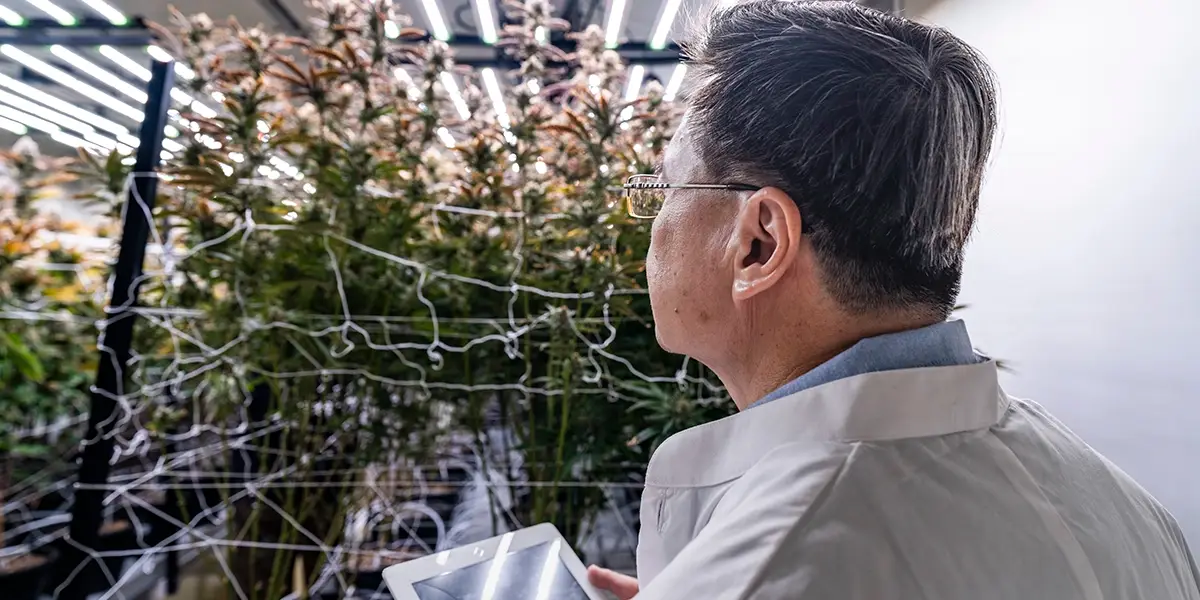
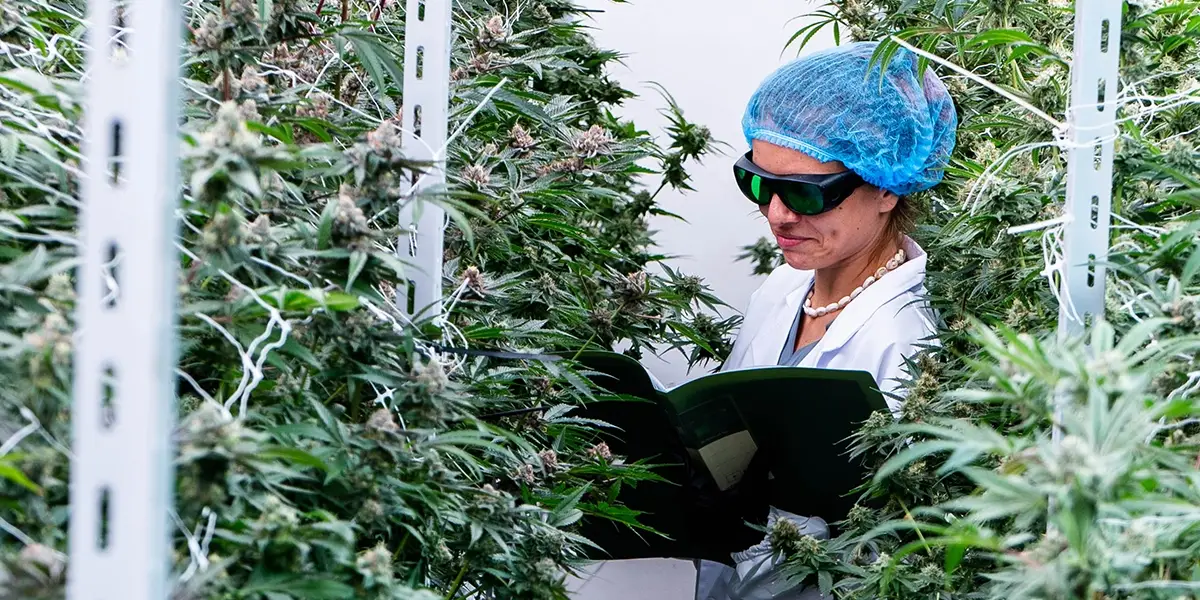
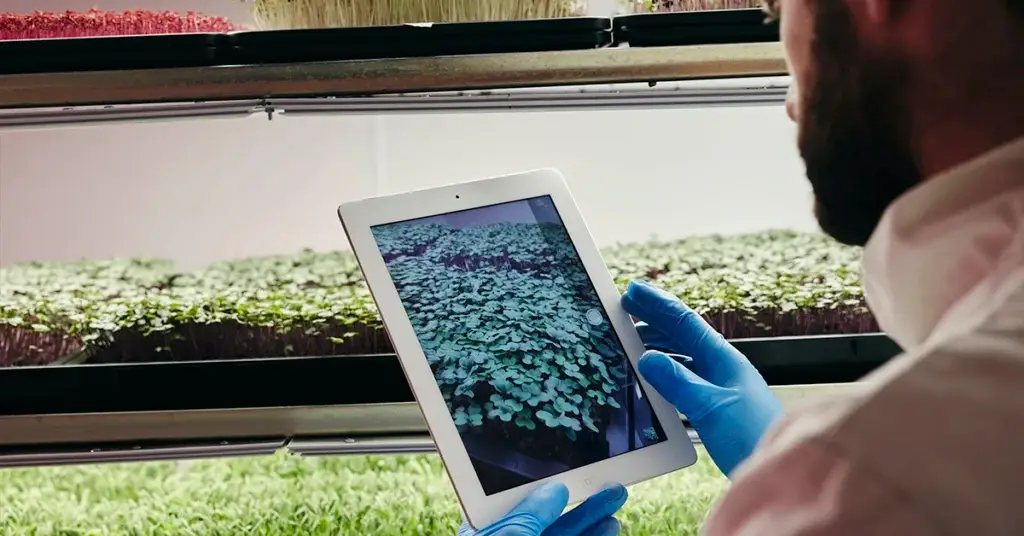
Grow room AI is the next step after timers and smart controllers. It learns from your room’s data—temperature, humidity, CO₂ (VPD), light, irrigation, and sometimes camera images—to make useful alerts and predictions. You still use a controller to run lights, HVAC, humidifiers/dehumidifiers, CO₂, and pumps; AI sits on top to keep conditions steadier and catch problems earlier. The core grow room technology is the same for cannabis and other crops: accurate sensors, reliable control, and clean data.
In practice, the workflow is simple: sensors measure → controller acts → app/cloud logs → AI analyzes. From there, you’ll see value in four places: computer-vision scouting, predictive irrigation, short-term VPD forecasting, and anomaly alerts. Those are real, working use cases already showing up across cannabis and greenhouse operations today.
Why This Matters Now
- Costs are up, margins are tight. AI tools help reduce labor and energy and improve consistency—top reasons cultivators adopt them.
- Greenhouse ops are proving it. Vision-based scouting, zone-by-zone irrigation timing, and inventory/grading are delivering measurable wins in real facilities.
- Early studies point to energy gains. Reviews of AI in controlled agriculture report significant heating-energy reductions when AI informs climate control. (Results vary by facility and setup.)
The Smart Grow Room Technology Stack (foundation before AI)
- Sensors: T/RH/CO₂ (derive VPD), plus media moisture/EC if you crop-steer.
- Controller: Switches/dims devices (lights, HVAC, humidifier/dehu, CO₂, pumps), logs data, sends alarms.
- App/Cloud: Your dashboard for graphs, history, and remote notifications.
- (Optional) Cameras: Fixed angles or mobile capture for canopy checks and computer vision.
AI is only as good as your data. Calibrate probes, standardize sensor placement, and keep power/network stable.
What AI Already Does Well (and why growers care)
1) Computer-vision scouting
AI inspects canopy images to flag pests, disease, stress, or uneven growth so you can act early. Cannabis facilities report labor savings and more consistent decisions after adopting vision systems to scan microclimates and highlight priority zones.
2) Predictive irrigation & fertigation
Models learn your dry-down patterns from moisture/EC and climate logs to recommend pulse timing and volume. That tightens steering (especially in rockwool/coco), reduces overshoot, and smooths runoff EC. Greenhouse coverage identifies irrigation as a leading AI target because it’s high-impact and quantifiable.
3) Short-term climate/VPD forecasts
Near-term VPD predictions let you nudge RH or dim lights before a spike, cutting alarms and overshoot—like cruise control for transpiration. Research in ag environments shows ML can forecast VPD reliably at useful horizons.
4) Anomaly detection
Instead of rigid thresholds, AI learns your normal and flags drifting sensors, sticky relays, failing fans, or patterns that precede trouble. Industry reporting calls this one of the most practical day-one wins.
5) Post-harvest grading
Vision systems can help grade buds and spot visible mold/mildew more consistently at scale—especially useful in large ops.
Cannabis vs. Other Crops
The playbook is the same. Cannabis needs tight VPD and media WC/EC to reduce outliers; leafy greens, herbs, vine crops benefit from steadier irrigation and earlier scouting. Many AI tools are crop-agnostic, already used across greenhouse categories.
What To Expect Next for Grow Room Technology (12–24 months)
- Camera-light workflows: quick mobile capture + AI analysis for pests and yield readiness (less special hardware).
- Smarter irrigation orchestration: zone-level predictions that prevent pressure drops and water waste.
- Energy-aware climate control: algorithms that balance setpoints/dimming vs. kWh. Early research shows promise for energy reductions in climate-controlled ag and buildings.
- Cleaner UX: fewer dashboards, more actionable suggestions inside grower apps.
Brand Guide: AI-Ready Gear We Trust
TrolMaster — Pro-grade control, irrigation & CO₂ safety
Why it’s great for AI: rich, reliable data (room + media) and a large ecosystem—ideal for anomaly alerts, VPD nudges, and predictive irrigation.
- Hydro-X Pro (HCS-2): single-room controller; connect up to 50 sensors and 50 control modules; link specific sensors to specific outputs for sub-zones. New 4-in-1 sensor with on-sensor LCD.
- Hydro-X / Hydro-X Plus: broad device control and lighting channels (auto-dimming/high-temp dim).
- Aqua-X / Aqua-X Pro: irrigation scheduling with optional WCS-2 moisture/EC/temp sensors; logging and flow meters available.
- Carbon-X: multi-zone CO₂ safety monitoring and interlocks, up to 13 zones. Non-negotiable for sealed rooms that dose CO₂.
Best fit: sealed rooms → small facilities that want modular growth.
ClimateIQ — Fast, wireless, VPD-smart climate control
Why it’s great for AI: clean, high-rate climate data and VPD-aware setpoints when HVAC and RH controllers work together.
- IQ-HVAC Controller: for standard 5-wire HVAC/heat pumps; app control; needs at least one IQ sensor; requires UniFi Wi-Fi; not compatible with mini-splits.
- IQ-RH% Controller: stabilizes RH swings and can target VPD when paired with HVAC control.
- IQ Sensor: streams precise T/RH/CO₂ and VPD to the app.
Best fit: tents → single rooms that need quick installs and dependable climate data.
Growlink — Cloud-first workflows, best-in-class lighting control
Why it’s great for AI: excellent lighting automation (sunrise/sunset, stage-based intensity) and cloud dashboards for trend analysis & alerts.
- 4-Channel lightLINK (0–10V): dim up to 15 fixtures per channel; integrates with Growlink OS.
- hvacLINK: smart thermostat module designed to slot into the LINKS platform.
- powerLINK / relayLINK / valveLINK + HUB: modular device control; single-outlet or zone-level add-ons; Wi-Fi/app workflows; irrigation bundle options.
- Agrowtek Integration HUB: bridge Agrowtek sensors/devices into Growlink for mixed stacks.
Best fit: rooms that want lighting-led control and a smooth cloud experience, with simple add-as-you-go modules.
Check out our Growlink Automated Controllers Review here
Agrowtek (light mention) — Enterprise PLC-style control & dosing
Why it’s great for AI: deep I/O, nutrient dosing, and facility-wide logic create rich datasets for forecasting and anomaly detection; remote access via VNC is built in.
- GCX / GCX+: manage climate, irrigation, CO₂, and nutrient dosing; ~100 devices (GCX) or ~200 devices (GCX+) via GrowNET.
- GCXmini: smaller single-room controller with the same philosophy.
- Ecosystem: dosing pumps, flow/level, motor/curtain controllers; MODBUS/GrowNET expanders.
Best fit: multi-room/commercial sites with integrators or in-house engineering.
Quick Comparison of Grow Room Technology (2025)
Brand | Best for | AI-ready strengths | Limits to note |
TrolMaster | Sealed rooms → small facilities | Many sensors/modules; room + media data; CO₂ safety | Single-room design on HCS-2 (sub-zones OK) |
ClimateIQ | Fast installs, VPD-aware climate | Clean wireless data; HVAC+RH pairing for VPD | Standard HVAC only; not mini-splits; UniFi Wi-Fi required |
Growlink | Cloud workflows, lighting control | lightLINK recipes; modular LINKS + HUB; app dashboards | Lighter on built-in fertigation/dosing; some LINKS in rollout |
Agrowtek | Enterprise PLC + dosing | 100–200 device scale; VNC remote; deep I/O | Heavier setup; overkill for small rooms |
Starter Blueprints
Small tent (4×4–5×5)
- ClimateIQ sensor + HVAC + RH controllers for steady VPD; turn on app alerts. Add simple anomaly alerts from your data.
Single sealed room
- TrolMaster Hydro-X Pro + Aqua-X + Carbon-X (environment, irrigation, CO₂ safety). Layer VPD forecasting and predictive irrigation as your logs accumulate.
Multi-room/commercial
Agrowtek GCX/GCX+ for climate + irrigation + dosing; optionally add Growlink lightLINK for lighting zones and cloud workflows.
Practical Tips To Make AI Actually Work
- Calibrate sensors quarterly; replace aging probes.
- Standardize sensor placement (canopy zone, out of direct airflow).
- Log & label events (e.g., “pump 2 clogged 14:10”).
- Start small: anomaly alerts → VPD forecasting → predictive irrigation → (optional) camera scouting.
- CO₂ safety: in sealed rooms, add dedicated alarms/interlocks regardless of your controller.
What We’re Watching
- Vision at scale: Mobile capture + AI to triage scout routes and grade product faster.
- Energy & demand response: AI that balances setpoints, dimming, and utility prices in real time (evidence is strongest from buildings so far, with greenhouse-specific research growing).
FAQs for Grow Room Technology & AI