

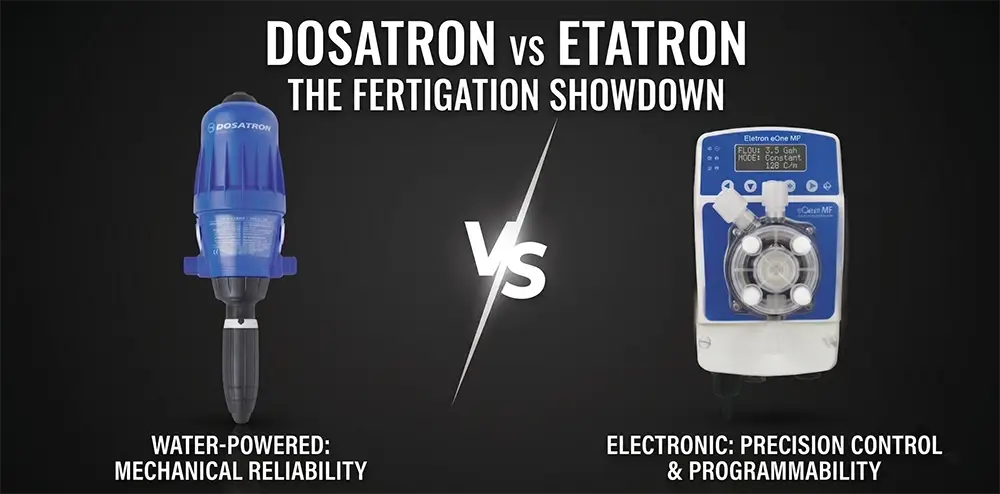
When commercial cultivators compare Dosatron vs Etatron, they’re usually not choosing one over the other — they’re figuring out how to deploy both in the same system. These two technologies solve different dosing problems, and understanding the mechanical difference between them is the fastest way to design a nutrient delivery system that performs consistently across every zone in your facility.
How a Dosatron Water-Powered Injector Works
A Dosatron is a non-electric, water-powered proportional injector that draws concentrate from a stock tank in a fixed volume-to-volume ratio relative to water flow. It requires no electricity, no controller, and no external power source. The water line pressure drives everything.
Here’s the core mechanism: as water enters the Dosatron body, it activates an internal hydraulic motor. On the upstroke, the motor draws concentrate from the stock tank through the suction tube — exactly like a syringe. On the downstroke, that concentrate displaces into a mixing chamber, where it blends with the passing water. The discharge is a homogeneous, fully mixed solution.
The critical operational principle is volumetric proportionality. A Dosatron set at 1:100 delivers 1 part concentrate for every 100 parts of water — whether the irrigation line is running at 2 GPM or 14 GPM. Pressure and flow fluctuations across your zones don’t degrade injection accuracy, because the motor speed scales with water flow by design. This is what makes Dosatrons the dominant choice for drain-to-waste drip systems where line conditions change constantly throughout a fertigation event.
For commercial facilities, this translates to batch-to-batch consistency without a controller, a flow meter, or any software configuration. You set the ratio, connect the stock tank, and the system delivers. Dosatron has manufactured this technology since 1974, and it remains the most widely deployed inline injector in commercial horticulture globally.
Seal selection matters for chemical compatibility. Viton seals handle fertilizers, pesticides, and acidic pH correction products. Aflas seals are required for alkaline pH adjustment products. Kalrez seals are specified for peracetic acid sanitizers like BioSafe ZeroTol.
How an Etatron Electric Micro-Doser Works
The Etatron eOne is an electrically powered, microprocessor-controlled metering pump designed for proportional dosing of super-concentrated products at extremely low volumes — down to 0.1 mL per gallon, depending on flow rate.
Unlike the Dosatron, the Etatron does not use water pressure as its energy source. Instead, it operates from line power and uses a flow sensor in the water line to trigger dosing pulses. As water passes the sensor, the Etatron’s microprocessor calculates the proportional dose and fires the pump at up to 300 impulses per minute to deliver the precise micro-volume required.
The backlit digital display allows you to configure dosing parameters directly on the unit. Additionally, the Etatron eOne supports 4-20 mA proportional control for integration with external automation systems. Because it is an active electric pump rather than a passive hydraulic injector, it can achieve injection ratios far below what a standard Dosatron can reach — critical when you’re dosing products like concentrated pH adjusters, plant health additives, or water treatment agents where a small overdose carries real consequences.
The Dosatron Etatron eOne Ultrasonic Micro-Doser Kit includes the eOne MF 0110 pump, a polyethylene panel, water meter, check valve, pressure relief valve, injection valve, unions, foot filter, and mixing chamber. It is available in 3/4″ and 1.5″ NPT connections and can function either as a standalone doser or in-line with a Dosatron water-powered NDS.
Key Differences: Dosatron vs Etatron Side by Side
The two technologies are complementary by design, but the differences in how they operate determine where each belongs in your fertigation setup.
| Feature | Dosatron | Etatron eOne |
|---|---|---|
| Power source | Water pressure only | Line power (electric) |
| Dosing mechanism | Volumetric proportioning (hydraulic piston) | Microprocessor-controlled solenoid pump |
| Injection ratio range | 1:500 to 1:10 (model-dependent) | Ultra-low volume — down to 0.1 mL/gal |
| Accuracy | Proportionally consistent regardless of flow variation | ±5% dosing accuracy |
| Ideal application | Bulk nutrients, fertilizers, pesticides, multi-stock programs | pH adjusters, concentrates, plant health additives, water treatment |
| Flow sensor required | No — proportioning is mechanical | Yes — included in kit |
| Controller integration | Not required | Supports 4-20 mA input |
| Field installation complexity | Low — plug and play | Moderate — requires power source and panel mounting |
| Can run without electricity | Yes | No |
The core takeaway: Dosatrons excel at delivering bulk nutrient programs precisely and reliably at any flow rate. Etatron micro-dosers excel at delivering ultra-concentrated additives in volumes so small that a standard proportional injector would overshoot its minimum ratio.
When to Use a Dosatron, an Etatron, or Both
Use a Dosatron when:
- You’re delivering the primary nutrient program — A/B stock tanks, base nutrients, or dry-concentrate stock solutions like Athena Pro Line or HGV
- You’re running a drain-to-waste drip system on rockwool, coco coir, or soil
- You need a no-electricity, low-maintenance solution that performs reliably in wet environments
- You’re running multiple stock solutions in series (Dosatrons stack cleanly in-line for two-part programs)
- You’re scaling across multiple rooms or zones and need injection consistency without a controller
Use an Etatron eOne when:
- You need to micro-dose pH adjusters, caustics, or concentrated plant health additives that a Dosatron’s minimum injection ratio would overdose
- You’re injecting super-concentrated products where sub-mL-per-gallon precision is the spec
- You want proportional dosing triggered by a flow sensor rather than passive water pressure
- You’re integrating with an automation controller via 4-20 mA signal
Use both together when:
- Your facility runs a multi-channel nutrient delivery system where bulk nutrients are handled by Dosatron injectors and precise pH correction or additives are handled by the Etatron in the same line
- This is the configuration the Dosatron Nutrient Delivery System (NDS) is designed for — water-powered proportional injection for primary nutrients, with the Etatron added downstream for precision micro-dosing of products that fall outside the Dosatron’s practical injection range
For most commercial cultivators running drain-to-waste drip on rockwool or coco, the answer is both: a Dosatron for the nutrient stack and an Etatron downstream for pH adjustment and additive delivery.
Building a Combined Dosatron + Etatron Nutrient Delivery System
Here is the standard commercial workflow for a combined NDS using Dosatron water-powered injectors and an Etatron eOne micro-doser.
Step 1 — Size your Dosatron to the peak flow demand of your irrigation system.
Calculate total GPM demand at peak zone activation. Match this to a Dosatron model with sufficient flow capacity. The Dosatron D14MZ2 handles up to 14 GPM and covers most small-to-mid commercial operations running A/B stock programs with Athena Pro Line, HGV concentrate, or General Hydroponics. For larger rooms at peak demand, the Dosatron D40MZ2 handles up to 40 GPM with the same 1:500–1:50 injection range and a 1.5″ bypass connection for high-flow commercial irrigation.
Step 2 — Configure your stock tanks and injection ratios.
Each Dosatron connects to an independent stock tank. For a two-part nutrient program, install two Dosatrons in series — one for Part A and one for Part B. Set each to the appropriate ratio for your concentrate. The Dosatron Lo-Flo HGV Nutrients 2-Doser Kit is a pre-configured two-injector setup specifically built for HGV concentrate programs, including all hardware for a complete inline installation.
Step 3 — Install the Etatron eOne downstream of the Dosatron units.
Mount the Etatron panel and connect it to line power. Install the inline water meter in the main supply line — the Etatron uses this flow sensor to calculate proportional dosing. Position the injection valve downstream of the Dosatron injectors so the Etatron adds pH correction or additives to the already-nutrient-loaded solution before it reaches the emitters.
Step 4 — Configure dosing parameters on the Etatron display.
Set the dose volume using the backlit digital display. For pH adjustment using concentrated acid, start conservative — the Etatron’s minimum resolution of 0.1 mL/gal means you have fine control that a Dosatron cannot achieve at this concentration level. Log your baseline EC and pH readings at the emitter with your monitoring tools before final calibration.
Step 5 — Verify accuracy at the emitter, not the injector.
Run your system through a full fertigation event. Measure EC and pH at multiple emitter points across zones. Compare against your target solution recipe. Adjust Dosatron ratios and Etatron dose settings until emitter readings are consistent across your canopy.
Choosing the Right Dosatron Model for Your Flow Rate
The most common sizing mistake is installing a Dosatron rated below the peak flow demand of the irrigation system. When water flow exceeds the Dosatron’s rated maximum, injection accuracy degrades and the unit can be damaged over time.
D14MZ2 (14 GPM max, 1:500–1:50): The most widely deployed model for commercial CEA operations. Ideal for small-to-mid commercial rooms — typically operations running 500–2,000 emitters at standard flow rates. The standard pairing for Athena Pro Line two-part programs and HGV concentrate delivery.
D40MZ2 (40 GPM max, 1:500–1:50): The step-up for larger rooms or multi-zone systems that push past 14 GPM at peak demand. Same ratio range as the D14, so switching between models in different rooms doesn’t require reprogramming your stock concentrations.
D14MZ3000 (14 GPM max, 1:3000–1:333): Use this model when your nutrient concentrate is formulated for very high dilution ratios — liquid concentrates that require 1:1000 or higher dilution are outside the D14MZ2’s range but within the Dosatron D14MZ3000‘s operating range.
For additional sizing guidance, see our full guide to choosing a Dosatron system and our Dosatron maintenance and best practice SOPs.
Next Steps for Your Fertigation Setup
If you’re running a standard two-part commercial nutrient program, start with the D14MZ2 and two stock tanks. Add the Etatron eOne when you move to a pH-correction workflow that requires sub-mL precision or when you start integrating super-concentrated plant health additives that fall below the Dosatron’s minimum injection range.
If you’re building from scratch or adding a second room, the pre-configured Dosatron Lo-Flo HGV 2-Doser Kit gets you to a complete two-part inline fertigation system faster than sourcing components separately. Call our team at 888-815-9763 for help sizing and configuring a Dosatron + Etatron NDS for your specific facility.
Dosatron vs Etatron: FAQs
Q: What is the main difference between a Dosatron and an Etatron eOne?
A: A Dosatron is a non-electric, water-powered injector that delivers nutrients proportionally based on water flow — no power source or controller required. The Etatron eOne is an electrically powered micro-doser that uses a flow sensor and microprocessor to deliver ultra-low dose volumes of super-concentrated products, down to 0.1 mL per gallon. They are designed to complement each other in a single nutrient delivery system rather than replace one another.
Q: Does a Dosatron need electricity to operate?
A: No. A Dosatron uses water line pressure as its only energy source. The hydraulic motor inside the unit is driven entirely by water flow. This makes Dosatrons particularly reliable in commercial grow environments — they operate with no wiring, no motor to fail, and no software to configure or maintain.
Q: How accurate is a Dosatron injector?
A: Dosatron’s volumetric proportioning mechanism maintains injection accuracy regardless of pressure and flow fluctuations in the irrigation line. Accuracy is proportionally consistent by mechanical design — unlike electric dosing pumps that require flow sensors and active correction to compensate for variable conditions. The Etatron eOne achieves ±5% dosing accuracy through microprocessor control and flow-sensor triggering.
Q: What is the difference between a Dosatron and a peristaltic pump?
A: A Dosatron is a passive, water-powered proportional injector — it doses a fixed volume per unit of water flowing through it, automatically maintaining the set ratio as flow conditions change. A peristaltic pump is an electrically driven doser that pumps a fixed volume per unit of time regardless of water flow — it requires a controller and sensor feedback loop to maintain accurate concentration when flow rates vary. Dosatrons are simpler and more reliable for drain-to-waste drip fertigation. Peristaltic systems offer more active control for recirculating setups that require constant setpoint monitoring.
Q: Can the Etatron eOne work without a Dosatron?
A: Yes. The Etatron eOne kit can function as a standalone micro-dosing solution. However, it is most commonly deployed in combination with a Dosatron Nutrient Delivery System — the Dosatron handles bulk nutrient injection while the Etatron handles precision micro-dosing of products that fall below the Dosatron’s practical injection range, such as pH adjusters or concentrated plant health additives.
Q: What products can the Etatron eOne inject that a Dosatron cannot handle accurately?
A: The Etatron eOne is specifically designed for super-concentrated products requiring sub-mL per gallon dosing — including concentrated pH down acids, caustic pH up solutions, plant health additives, and water treatment products. These products require injection precision below the minimum ratio a standard Dosatron can deliver without overdosing.
Q: How do I know if I need the D14MZ2 or the D40MZ2 for my grow room?
A: Calculate your system’s total GPM demand at peak zone activation — multiply total emitter count by the per-emitter flow rate in GPH, then divide by 60 to convert to GPM. If your peak demand is under 14 GPM, the D14MZ2 covers your system. If you’re exceeding 14 GPM at peak, step up to the D40MZ2. Running a Dosatron above its rated maximum degrades injection accuracy and shortens service life.
Q: How often does a Dosatron need to be serviced in a commercial facility?
A: Dosatron recommends a full service every 3–4 years under continuous commercial use. Annual seal maintenance using Dosatron’s rebuild kits keeps injection accuracy and sealing integrity between full services. Facilities running aggressive chemicals like peracetic acid sanitizers should inspect seals more frequently and confirm Kalrez seal compatibility before use. For full service intervals and in-field procedures, see our Dosatron maintenance SOP guide.