
If you want to unlock the full potential of your indoor garden, you need to understand Vapor Pressure Deficit (VPD). It’s one of the most important—and most misunderstood—factors in plant growth.
Even with the best lights, nutrients, and genetics, your plants won’t thrive unless your temperature and humidity are dialed in. That’s where VPD comes in. By managing it, you can keep stomata open, maximize nutrient uptake, and dramatically boost yields.
👉 Use Our VPD Calculator Now to instantly check if your grow room is in the ideal zone.
Vapor Pressure Deficit (VPD) Calculator
Dial in temperature and humidity for healthier transpiration and faster growth. Use Simple for quick checks — Advanced adds leaf temp offset and growth-stage targets. Need help? Talk to a Grow Expert.
VPD Calculator
Enter your canopy air temperature and relative humidity. Switch to Advanced to include leaf temperature offset and get growth-stage targets.
How to use this calculator
- Enter air temperature (°F) at canopy height.
- Enter relative humidity (%) at canopy level.
- Advanced: add a leaf temp offset and select your growth stage for target comparison.
- Tap Calculate VPD — your result appears instantly.
- Adjust your environment with humidifiers, dehumidifiers, fans, or AC until VPD is in range.
Target bands: Propagation 0.4–0.8 kPa · Vegetative 0.8–1.2 kPa · Flowering 1.2–1.6 kPa
Frequently Asked Questions
What is VPD and why does it matter for my grow?
Should I use leaf temperature or air temperature?
What VPD should I target at each growth stage?
How do I raise or lower VPD in my grow room?
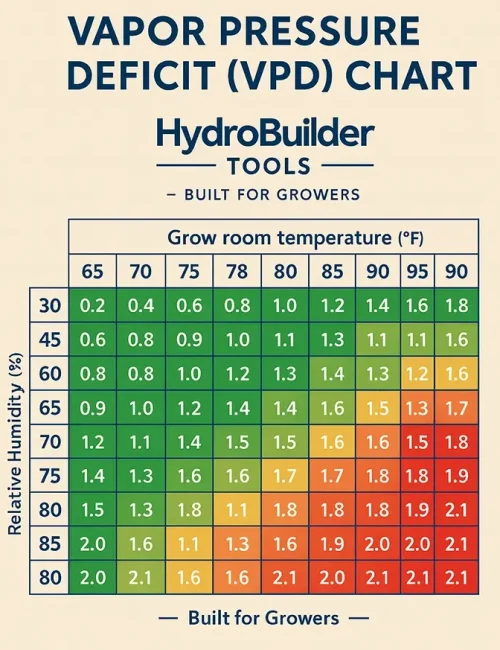
📊 Interactive VPD Heatmap — See Where You Land Visual ▾
Chart shows VPD across all temperature & humidity combinations.
Your current reading is plotted as a dot — it updates live as you change inputs above.
Hover or tap any cell to see the exact VPD value.
Targets: Propagation 0.4–0.8 · Vegetative 0.8–1.2 · Flowering 1.2–1.6 kPa.
Need help dialing in your environment?
Our grow experts can recommend the right monitors, humidifiers, and controllers for your setup.What is Vapor Pressure Deficit (VPD)?
At first glance, VPD sounds technical. But at its core, it’s simply a measure of how your plants “feel” the balance between temperature, humidity, and leaf moisture.
- Definition: VPD is the difference (in pressure) between the amount of moisture the air can hold at saturation and the actual amount of water vapor present.
- In practice: VPD tells us how easily plants can move water from their leaves into the surrounding air.
Think of it like this:
- In hot, dry air, plants lose water quickly to the environment.
- In humid air, plants slow down transpiration because the air is already full of moisture.
Both extremes cause problems. The “sweet spot” is where plants can transpire efficiently, keeping stomata open and driving nutrient uptake.
Why VPD Matters for Plant Growth
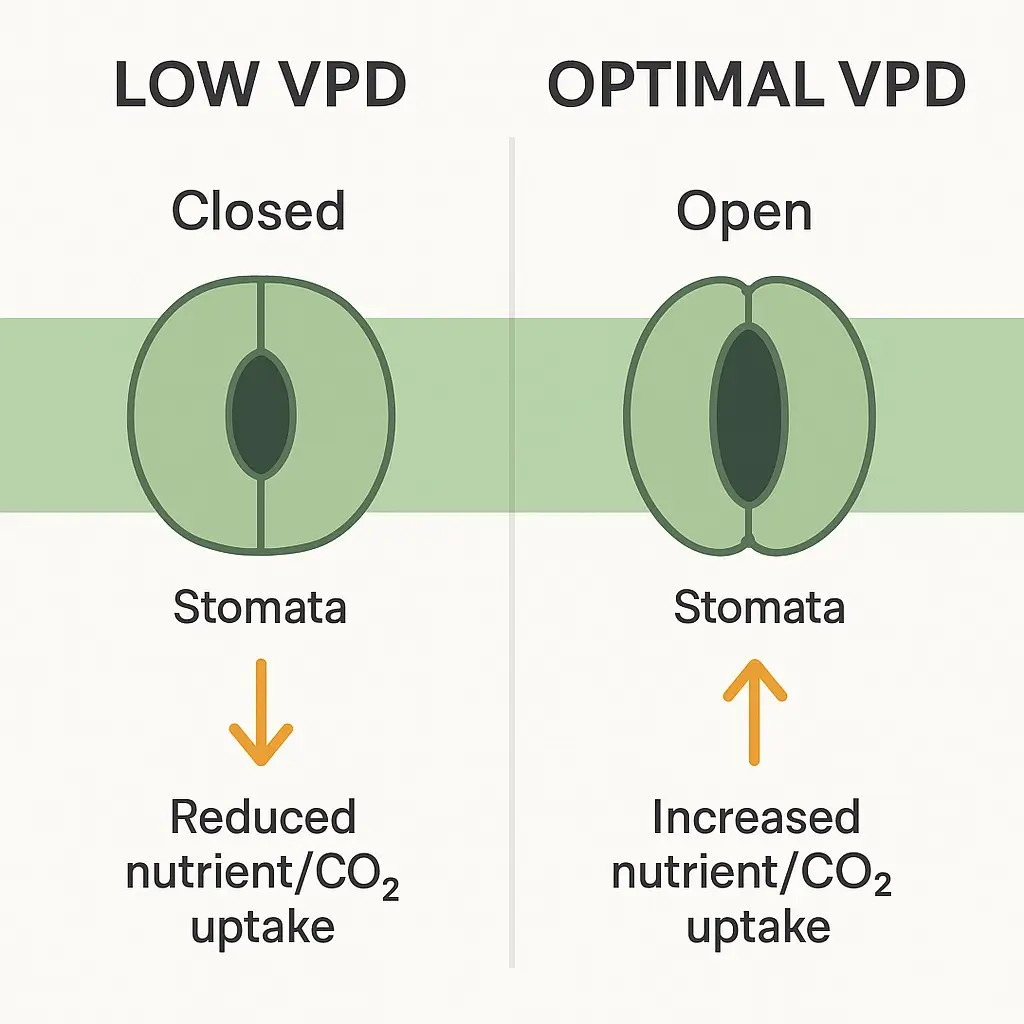
VPD directly affects stomata behavior—the tiny pores on leaves that control gas exchange.
- If VPD is too high → Plants transpire too quickly, pulling in excess nutrients and risking toxicity, leaf burn, or wilt stress.
- If VPD is too low → Stomata close, transpiration slows, and plants struggle to absorb water and nutrients, leading to deficiencies and stunted growth.
When you keep VPD in the optimal range, your plants:
- Uptake nutrients more efficiently
- Maintain steady growth throughout veg and flower
- Resist disease and environmental stress
- Produce heavier, higher-quality yields
👉 Pro tip: VPD isn’t just about preventing problems—it’s about maximizing genetic potential.
VPD, CO₂ Uptake, and Yield
VPD doesn’t just affect water movement. It also impacts CO₂ uptake.
- When stomata are open under ideal VPD, plants can absorb CO₂ more readily.
- This makes CO₂ supplementation far more effective, especially in sealed rooms with strong lighting.
- Without proper VPD, CO₂ enrichment is wasted—plants simply can’t take it in.
In short: dialing in VPD amplifies everything else you do, from feeding to lighting to CO₂ supplementation.
Instantly Calculate VPD with Our Tool
You don’t have to crunch numbers or memorize formulas. Our Hydrobuilder VPD Calculator makes it easy:
👉 Try the VPD Calculator – just enter your:
- Air temperature (°F) at canopy height
- Relative humidity (%)
- Optional: Leaf temperature offset (°F)
The calculator instantly shows your VPD in kPa, highlights whether you’re in range, and compares your result against the recommended zone for propagation, veg, or flower.
Ideal VPD Ranges for Each Growth Stage
Different stages of growth require different VPD targets. Here’s a quick reference:
Growth Stage |
Temp (°F) |
RH (%) |
Target VPD (kPa) |
|
Propagation / Seedling |
72–78 |
70–80% |
0.4–0.8 |
|
Vegetative |
75–82 |
55–70% |
0.8–1.2 |
|
Flowering |
70–78 |
40–55% |
1.2–1.6 |
✅ Keep your environment in these ranges and you’ll consistently hit the “green zone” on the VPD chart.
What Happens When VPD Is Off?
Condition |
Symptoms |
Risks |
VPD Too Low (<0.4 kPa) |
Stomata close, poor nutrient uptake, slow growth |
Deficiencies, weak plants |
VPD Too High (>1.6 kPa) |
Rapid transpiration, excessive water & nutrient uptake |
Nutrient burn, wilt stress, reduced yields |
The goal is balance—enough transpiration to drive nutrient flow, but not so much that plants are stressed.
How to Adjust VPD in Your Grow Room
Once you know your VPD reading, you can fine-tune your environment:
- If VPD is too low (air too humid):
- Add a Dehumidifier
- Increase temperature slightly
- Boost airflow/exhaust cycles
- Add a Dehumidifier
- If VPD is too high (air too dry):
- Add a Humidifier
- Lower room temperature
- Reduce exhaust/intake cycles
- Add a Humidifier
👉 For precise control, pair sensors with an Environmental Controller to automate adjustments.
Troubleshooting Example
Grow room conditions:
- Air Temp: 77 °F
- Leaf Temp: 73.5 °F (offset -3.5 °F)
- RH: 50%
VPD Result: ~1.2 kPa → Perfect for late veg or early flower.
If RH drops to 35% at the same temperature, VPD jumps to ~1.8 kPa → Too high. Plants would transpire too aggressively, leading to stress.
VPD Charts vs Calculators
- Charts: Show the relationship between temperature, RH, and VPD. Great for quick reference but harder to read in real time.
- Calculators: Instant, accurate, and stage-specific. Perfect for daily monitoring and fine-tuning.
👉 Use the VPD Calculator to make quick, accurate decisions without guesswork.
Final Thoughts on VPD
Vapor Pressure Deficit is one of the most powerful tools for growers. By keeping your environment in the ideal VPD range, you can:
- Encourage constant nutrient and CO₂ uptake
- Keep plants healthier and more resilient
- Produce bigger, denser, higher-quality yields
Stop guessing with just temperature and humidity. Start managing VPD—the metric that truly tells you how your plants feel.
FAQs on VPD
Q: What’s the ideal VPD for cannabis seedlings?
A: 0.4–0.8 kPa with high RH (70–80%) and moderate temps.
Q: Do I need to measure leaf temperature for VPD?
A: It’s more accurate with a leaf temp reading, but you can use air temp + offset for estimates.
Q: Why is VPD better than just tracking humidity?
A: Because humidity alone doesn’t factor in temperature. VPD combines both for a true picture of plant stress and transpiration.
Q: Can I use CO₂ without dialing in VPD?
A: You can, but plants won’t benefit much unless stomata are open—something only possible in the right VPD zone.