

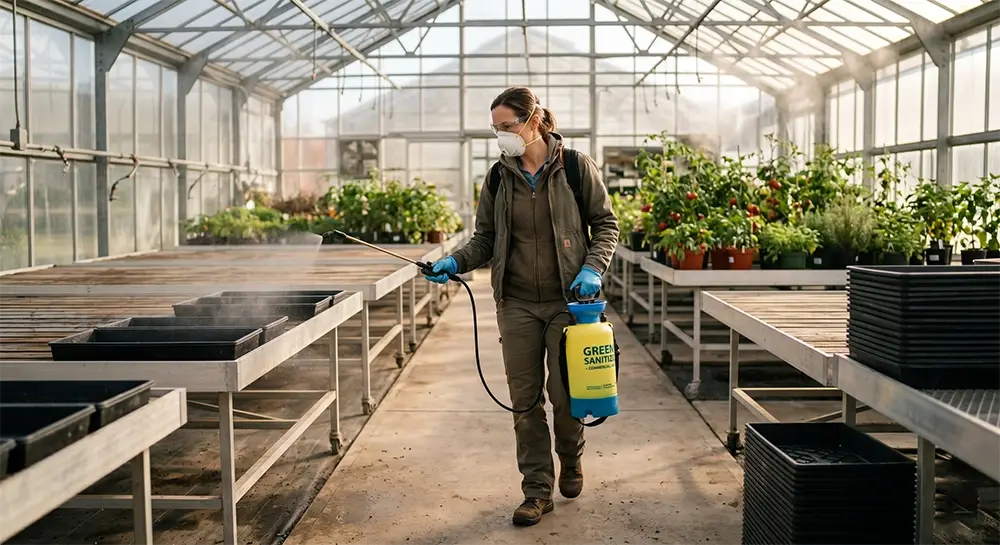
Many pathogen problems in a new crop starts with an incompletely cleaned room from the last one. For commercial cultivators managing tight harvest schedules, between-cycle sanitation is not optional maintenance — it is the primary mechanism by which facility managers control pathogen pressure, prevent reinfection, and protect their capital investment in each new crop.
This protocol covers the complete grow room reset: mechanical pre-cleaning, surface disinfection, irrigation line sanitation, whole-room gas treatment with chlorine dioxide, and extended ambient protection through the next cycle. It is designed for indoor cultivation facilities of any footprint, from single-room operations to multi-room staggered production schedules.
Why Between-Cycle Sanitation Is Non-Negotiable
Pathogens that survive a harvest do not disappear between cycles. Botrytis spores, powdery mildew propagules, fusarium, and pythium persist on walls, benches, growing containers, irrigation emitters, and HVAC components — surfaces that look clean but harbor viable inocula. When new plants enter an insufficiently sanitized room, they encounter that same pathogen load within the first few days of the cycle, often before symptoms are visible.
At commercial scale, the cost calculus is unambiguous. A single contaminated flower room running a ten-week cycle at mid-tier production density represents tens of thousands of dollars in crop exposure. The labor, chemistry, and downtime cost of a proper room reset — typically 24 to 48 hours between cycles — is a fraction of the cost of a single crop loss.
The most common sanitation failures at the facility level:
- Surface disinfection without pre-cleaning (disinfectants cannot penetrate organic residue)
- Skipping irrigation lines and reservoirs (biofilm in lines reseeds the root zone immediately)
- No ambient gas treatment (surfaces miss contact with liquid disinfectant — corners, HVAC baffles, porous walls, light fixtures)
- Reintroducing plants before the environment has been verified (temp, RH, CO2 confirmed stable)
A complete protocol addresses all four failure points in sequence.
The Grow Room Sanitation Checklist
Before beginning the step-by-step protocol, confirm all of the following are staged and ready:
PPE & Safety
- Nitrile gloves and eye protection
- Full-face acid gas respirator (NIOSH-approved) for gas treatment phase; N95 minimum for liquid disinfectant application
- Dedicated room-entry footwear or disposable shoe covers
Equipment
- Shop vac with HEPA filter
- Pressure washer or hose (for floor/bench pre-rinse)
- HBX Pump Sprayer – 8 Liter (for ProKure V liquid application)
- Clean microfiber cloths or mop
Chemistry — ProKure Protocol
- Prokure V — mixed per packet size to yield per directions (surface and line disinfection)
- Prokure G — sized to room cubic footage (fast-release gas treatment)
- Prokure D — sized to room cubic footage (extended ambient protection)
Pre-Clean (mechanical)
- BioSafe GreenClean Acid Cleaner — mineral scale and salt deposits from growing containers, benches, and reservoirs
Line Cleaning
- Hygrozyme Hyclean — enzymatic irrigation line cleaner for biofilm and organic buildup


Step-by-Step Grow Room Sanitation Protocol
This is the complete between-cycle reset sequence for an indoor cultivation room. Steps must be completed in order — sequence matters. Disinfectants applied over organic residue are significantly less effective; gas treatment in a dirty room does not replace surface contact.
Step 1: Remove All Plant Material and Growing Media
Strip the room completely. Remove all plants, containers, growing media (rockwool, coco, soil), trellising, and any single-use items. Do not leave spent media in the room — it is a primary inoculum reservoir.
Dispose of growing media per your facility’s waste protocol. If reusing hard containers (pots, trays, net cups), move them to a staging area for separate cleaning before they return to the room.
Step 2: Dry Debris Removal
Run a HEPA-filtered shop vac across all surfaces — floor, benches, walls, racking, and light fixtures. Pay particular attention to corners, drain covers, and cable runs where leaf debris, root fragments, and pest eggs accumulate. Do not sweep — sweeping aerosolizes spores.
Step 3: Pre-Clean All Hard Surfaces and Equipment
Apply BioSafe GreenClean Acid Cleaner to surfaces with mineral scale, salt deposits, or organic buildup — growing containers, bench tops, reservoir walls, and drain channels. GreenClean Acid Cleaner is formulated to dissolve the substrate deposits and biofilm layers that prevent disinfectants from reaching the surface beneath.
Allow the prescribed dwell time per label, then rinse thoroughly with clean water. This mechanical pre-cleaning step is what separates an effective disinfection from a surface-coating exercise.
Step 4: Surface Disinfection with Prokure V
Prokure V is an EPA-registered, pharmaceutical-grade chlorine dioxide liquid disinfectant. Mix the appropriate packet size to the target volume per label directions, then load into the HBX Pump Sprayer – 8 Liter for application.
Apply to all hard surfaces: walls, floors, bench tops, posts and racking, fan housings, light fixtures, drain covers, and any equipment that stays in the room. Wet the surface — do not mist. Allow the dwell time specified on the label before wiping or rinsing.
Prokure V requires no rinse on most surfaces when used per label and leaves no residue that creates phytotoxicity risk for the next crop. Confirm your specific surface materials are compatible per the product data sheet.
Step 5: Sanitize Irrigation Lines and Reservoirs
Biofilm is the most consistently overlooked reservoir of pathogens between cycles. It forms rapidly in recirculating lines, drip tubing, emitters, and reservoir walls — and standard surface disinfection does not reach it.
Run Hygrozyme Hyclean through the irrigation system at the labeled dilution rate. Hyclean’s enzymatic formulation breaks down root material, organic scale, and biofilm matrix from the inside of lines and fittings without chemical aggression to system components.
Flush sequence:
- Drain and rinse the reservoir with clean water
- Fill reservoir to working volume and dose with Hyclean per label
- Circulate for the recommended contact time (typically 30–60 minutes)
- Drain and flush lines with clean water until effluent runs clear
- Follow with a Prokure V soak for terminal disinfection: mix Prokure V to label spec, fill lines, hold 15–30 minutes, then flush completely with clean water
For drip systems, run disinfectant solution through all zones to confirm emitter-level contact.
Step 6: Fast-Release Gas Treatment with Prokure G
Once all surfaces and lines are cleaned and liquid disinfection is complete, the room is ready for gas treatment — the step that reaches every surface liquid application cannot.
Prokure G generates chlorine dioxide gas that penetrates air spaces, reaches porous materials, and contacts surfaces that sprayer-applied liquid misses: the back faces of racking, inside ductwork baffles, the underside of bench frames, HVAC intake surfaces, and light fixture interiors.
Sizing: Prokure G is available in 10-gram packets (1,000 cu. ft. coverage) and 25-gram packets (2,250 cu. ft. coverage). Calculate your room’s cubic footage (length × width × height) and select the packet size and count accordingly.
Application protocol:
- Confirm all personnel are out of the room
- Turn off all lights before activating packets
- Shut down HVAC air circulation and exhaust fans — the gas must dwell, not be exhausted
- Close all air gaps and door seals
- Place ProKure Cultivator Gas Dispersion Cups in the room and activate packets per label directions
- Seal the room and allow the full dwell time (minimum 4–6 hours per label; overnight between cycles is standard practice)
- Ventilate fully before re-entry — run exhaust fans and turn on lights to clear the room for a minimum of 60 minutes before entering
Step 7: Post-Treatment Environment Verification
Before any new plants or growing media enter the room, verify environmental conditions are within range for the incoming cultivar and stage:
- Temperature target for your strain and growth stage
- RH within 45–55% for early veg (adjust per stage and cultivar)
- CO2 confirmed stable (ambient or supplemented)
- Irrigation system flushed and flowing — confirm emitter output at each zone
Logging these readings before crop introduction creates an audit trail that is increasingly required for compliance documentation in licensed facilities.
Step 8: Deploy Prokure D for Ongoing Ambient Protection
The final step of the reset protocol — and the first step of the next cycle’s protection.
Prokure D is a humidity-activated extended-release chlorine dioxide gas that provides continuous ambient protection for up to 30 days. Where Prokure G delivers an intensive fast-release treatment between cycles, Prokure D maintains low-level ClO2 concentration in the air throughout the growing cycle — providing ongoing airborne protection and improving air quality.
Sizing: Available in 10g (1,000 cu. ft.), 50g (4,000 cu. ft.), and 95g (8,000 cu. ft.) packet sizes.
Place Prokure D packets in the room after ventilation is restored and before new plants are introduced. Prokure D is safe for use in occupied grow spaces at its rated release concentrations and per label directions — the extended-release mechanism maintains concentrations well below exposure thresholds for plants and personnel.


Chlorine Dioxide vs. Other Grow Room Disinfectants
Chlorine dioxide (ClO2) is not bleach. It is a distinct chemical compound with a fundamentally different mode of action, safety profile, and application range — one that makes it particularly well-suited to cultivation environments.
Why ClO2 outperforms conventional disinfectants in grow rooms:
| Property | Chlorine Dioxide | Bleach (Sodium Hypochlorite) | Hydrogen Peroxide | Quaternary Ammonium |
|---|---|---|---|---|
| Residue after application | None | Chlorine residue | Residual oxidizer | Surface film |
| Biofilm penetration | Yes | Limited | Limited | No |
| Effective pH range | 4–10 | Narrow (alkaline) | Narrow | Moderate |
| Plant-safe when diluted | Yes | No | Low concentrations only | No |
| Gas phase available | Yes | No | Specialty equipment required | No |
| EPA registration | Yes | Yes | Yes | Yes |
The specific advantages that matter most in a cultivation context:
No rinsing required (liquid form): Prokure V leaves no chemical residue that creates phytotoxicity risk for the next crop — unlike bleach, which requires thorough rinsing to prevent chlorine damage to plant tissue and root systems.
Biofilm penetration: ClO2 oxidizes the polysaccharide matrix of biofilm, destroying it from within. Bleach and quaternary ammonium compounds disinfect biofilm surfaces but do not penetrate the matrix — leaving viable pathogens protected underneath.
Both liquid and gas phases: The ProKure system uses ClO2 in liquid form (Prokure V) for surfaces and lines, and in gas form (Prokure G, Prokure D) for ambient treatment and ongoing protection — a complete system no single-chemistry approach can match.
Resistance is not a viable pathway: Chlorine dioxide kills by oxidation, which is non-specific to pathogen cell structure. Unlike antibiotics or single-mode fungicides, pathogens cannot develop resistance to oxidative chemistry.
Sanitizing Irrigation Lines and Reservoirs
Irrigation infrastructure deserves its own section because it represents the most reliable route for pathogen reintroduction between cycles — and the one most commonly skipped.
Biofilm forms on the interior walls of any surface in contact with nutrient solution: reservoir walls, main lines, sub-mains, laterals, and emitters. Once established, biofilm harbors bacteria, fungi, and algae in a protected matrix that resists disinfection and continuously seeds the root zone with low-level contamination. Pythium and fusarium are particularly associated with biofilm reservoirs in recirculating systems.
The complete irrigation sanitation sequence:
- Flush with clean water — remove residual nutrient solution from all lines
- Enzymatic cleaning with Hygrozyme Hyclean — break down root material, organic scale, and biofilm matrix; circulate for 30–60 minutes; drain and flush
- Prokure V disinfection soak — fill lines with mixed Prokure V solution; hold 15–30 minutes; drain and flush to clear
- Emitter inspection — check all emitters and drip stakes for clogging; replace any that don’t flow freely
- Final flush with clean water — confirm clear effluent before refilling with nutrient solution
For systems with mineral scale accumulation (hard water, long cycles), run BioSafe GreenClean Acid Cleaner through lines before the enzymatic step. GreenClean Acid Cleaner dissolves calcium and mineral deposits that reduce flow rates and provide surface area for biofilm to colonize.
Reservoir protocol: Drain completely, wipe walls with Prokure V solution, allow 15-minute contact time, rinse with clean water. Do not refill until the room has been ventilated post-gas treatment.
Commercial Facility Considerations
Multi-Room and Staggered Production Schedules
In facilities running staggered room turnover — flipping one room while others are in active production — the gas treatment phase requires particular attention to air management. Seal off HVAC connections between the treatment room and active production rooms to prevent any cross-contamination of ClO2 gas to occupied growing spaces.
For facilities with shared air handling, schedule Prokure G treatments during low-pressure periods (overnight) and confirm positive pressure is maintained in active rooms during the treatment window.
Prokure D Placement in Multi-Room Facilities
Run Prokure D continuously in all active production rooms, not just the room that was just reset. Ambient ClO2 from Prokure D suppresses pathogen pressure facility-wide — it is most effective as a systemic practice rather than a room-specific reactive tool.
Staff Safety and Ventilation Requirements
- Prokure G fast-release gas: room must be evacuated; use a NIOSH-approved full-face acid gas respirator if re-entering before full ventilation is confirmed; re-entry only after full ventilation (minimum 60 minutes exhaust fan operation)
- Prokure D extended release: safe for occupied spaces at rated concentrations
- Prokure V liquid: wear nitrile gloves and eye protection during mixing and application; the solution is plant-safe when used per label
- Maintain SDS documentation for all ProKure products on-site per your facility’s chemical management requirements
Documentation for Compliance
Licensed cultivation facilities increasingly face audit requirements for sanitation documentation. The step-by-step protocol in this article maps directly to a written SOP. Log each room reset with: date, products used (lot numbers for ProKure products), coverage area, dwell times, and technician sign-off. This log becomes your compliance artifact and also your internal diagnostic when pathogen pressure varies between rooms.
Scaling the Protocol: Coverage Area Reference
| Room Size | Prokure G (Fast Release) | Prokure D (Extended) |
|---|---|---|
| Up to 1,000 cu. ft. | 10g packet | 10g packet |
| Up to 2,250 cu. ft. | 25g packet | One 50g packet |
| Up to 4,000 cu. ft. | Two 25g packets | 50g packet |
| Up to 8,000 cu. ft. | Three–four 25g packets | 95g packet |
Actual coverage depends on room air-tightness, ambient temperature, and relative humidity. In rooms with significant air infiltration, increase packet count or extend dwell time. Consult the ProKure label and technical documentation for your specific application.
Setting Up for a Clean Cycle
A proper room reset is a 24–48 hour process when done correctly. The time investment is front-loaded — it protects the full duration of the next cycle. Facilities that routinely skip or abbreviate the reset protocol will find themselves managing pathogen pressure reactively, with increasing chemistry spend and declining crop consistency as the cumulative inoculum load builds room by room.
The ProKure system — Prokure V for surfaces and lines, Prokure G for between-cycle gas treatment, Prokure D for ongoing ambient protection — is the most complete chlorine dioxide protocol available for indoor cultivation, combining EPA registration, residue-free chemistry, and both liquid and gas-phase application in a single product family.
Grow Room Cleaning & Sanitization: FAQs
Q: What is the best disinfectant for a grow room?
Chlorine dioxide (ClO2) is the most effective disinfectant for cultivation environments because it works in both liquid and gas phases, penetrates biofilm, leaves no phytotoxic residue, and remains active across a wide pH range. Prokure V (liquid) handles surface and irrigation line disinfection; Prokure G (fast-release gas) treats the full room volume between cycles. Unlike bleach or hydrogen peroxide, ClO2 requires no rinse and does not degrade at typical grow room pH ranges.
For commercial facilities, the combination of a liquid surface disinfectant and a gas-phase treatment is considered best practice — liquid alone cannot reach every surface in a complex room environment.
Q: How do I clean my grow room between harvests?
The complete between-harvest protocol follows this sequence: (1) remove all plant material and media, (2) HEPA-vacuum all surfaces, (3) pre-clean with an acid cleaner to remove mineral scale and organic buildup, (4) apply Prokure V liquid disinfectant to all surfaces with adequate dwell time, (5) run Hygrozyme Hyclean through irrigation lines followed by a Prokure V disinfection soak, (6) seal the room and run Prokure G for a full-room gas treatment, (7) ventilate thoroughly before reentry, and (8) deploy Prokure D for ongoing ambient protection through the next cycle.
This full sequence typically takes 24–48 hours including ventilation time. Skipping steps — particularly the gas treatment and irrigation line sanitation — are the most common reasons facilities experience repeated pathogen pressure across cycles.
Q: Why does mold keep coming back in my grow room?
Recurrent mold most commonly traces back to one of four sources: incomplete surface cleaning (disinfectant applied over unremoved organic residue), untreated irrigation lines and reservoirs (biofilm harbors viable spores between cycles), HVAC and ductwork surfaces that were never reached by liquid disinfectant, or reintroduction via incoming plant material, staff clothing, or contaminated inputs.
A gas-phase treatment with Prokure G eliminates the ambient reservoir problem — surfaces unreachable with sprayer-applied liquid are contacted by ClO2 gas, which penetrates into ductwork, behind racking, and across porous surfaces. Combine with Prokure D for ongoing suppression during the active cycle.
Q: What is the difference between Prokure G and Prokure V?
Prokure V is a liquid chlorine dioxide solution used to disinfect surfaces, equipment, and irrigation lines. You mix it from packets, apply it with a sprayer, and allow it to dwell on contact surfaces. Prokure G is a dry-activated fast-release gas that generates ClO2 in vapor form, treating the entire air volume and all surfaces within a sealed room simultaneously.
They serve different functions in the protocol: Prokure V handles direct contact disinfection of surfaces and lines; Prokure G handles the ambient, whole-room treatment that liquid application cannot achieve. Used together between cycles, they address both the contact surface and the air volume as pathogen reservoirs.
Q: How long does it take to turn over a grow room?
A thorough commercial room reset — mechanical cleaning, surface disinfection, irrigation line sanitation, gas treatment, and ventilation — typically requires 24–48 hours of total downtime when Prokure G is used at full dwell time (4–6 hours minimum; overnight is standard). Adding Prokure D deployment before new plants enter adds no additional downtime.
Facilities that budget adequate reset time between cycles consistently outperform those that rush the process. The downtime cost of a proper reset is fixed; the cost of an infected crop is open-ended.
Q: How do you sanitize a multi-room grow facility?
Stagger resets so that gas treatment phases in one room do not overlap with active growing in adjacent rooms sharing the same air handling. Seal HVAC connections to the treatment room before activating Prokure G, and maintain positive pressure in active rooms during the treatment window. Run Prokure D continuously in all production rooms regardless of cycle stage — ambient protection works most effectively as a facility-wide systemic practice.
Q: Is chlorine dioxide safe to use in a grow room with plants?
Prokure V (liquid) is plant-safe when mixed and applied at labeled concentrations and does not require rinsing — there is no chlorine residue that carries phytotoxicity risk. Prokure D (extended release gas) is designed for use in occupied spaces, including rooms with active crops, at its rated release concentrations. Prokure G (fast-release gas) must only be used in evacuated rooms with no plants present; re-entry and crop introduction follow full ventilation of at least 60 minutes, as it generates a high ClO2 concentration for whole-room disinfection
Q: Do I need to clean irrigation lines between every grow cycle?
Yes. Biofilm establishes in irrigation lines within days of nutrient solution introduction and persists between cycles unless specifically addressed. Surface disinfection of the room does not reach biofilm inside lines and emitters. Enzymatic cleaning (Hygrozyme Hyclean) breaks down the biofilm matrix; a follow-up Prokure V soak provides terminal disinfection. This two-step line sanitation process, completed every cycle, is one of the highest-leverage interventions available for preventing recurring root zone pathogen pressure.