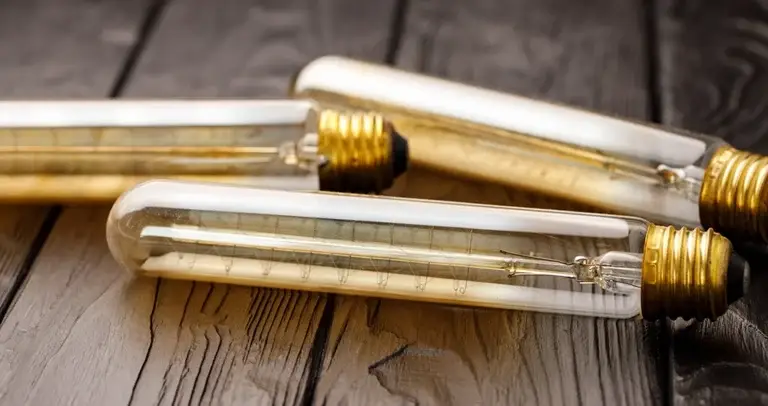
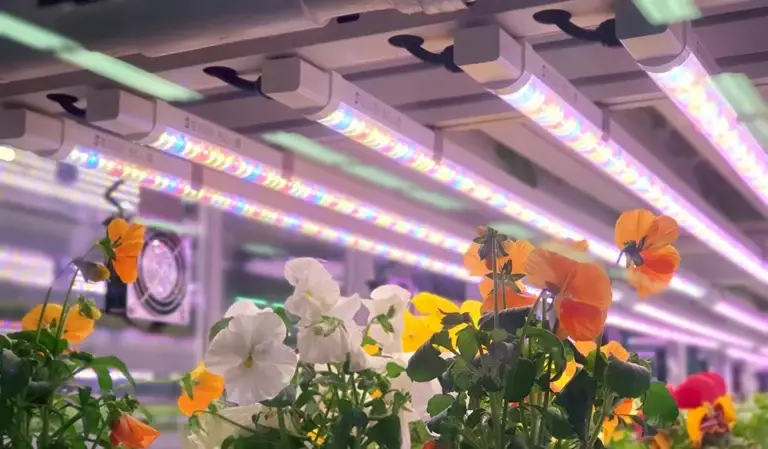
A green grow room light lets you see the canopy during lights-off without switching on the room. It works because plants respond far less to dim green light than to white, red or blue, not because they can't detect it at all. Keep it dim and brief: with only the green light on, the canopy should read as close to zero as your PAR meter can resolve, and any job longer than a few minutes belongs in lights-on. Exit signs and egress lighting are a separate question: those are life-safety equipment, and your local building and fire officials decide what goes on the wall, not the crop schedule.
This guide covers both halves of the shelf: the work lights you carry or mount for dark-period tasks, and the green exit signs and battery-backed fixtures that have to satisfy an inspector.
Plants Notice Green Light, Just Less of It
The idea that plants are blind to green rests on some experiments from the 1900s that later studies disputed. The best controlled data comes from Michigan State University. In their own write-up for Greenhouse Grower (February 2019), researchers Qingwu Meng and Erik Runkle describe giving flowering crops seven hours of green LED light on top of nine-hour natural short days, at 2, 13 and 25 µmol/m²/s.
At only 2 µmol/m²/s, the short-day crops were held back:
- Chrysanthemum 'Cheryl Spicy Orange' flowered 16 days late
- Chrysanthemum 'Cheryl Golden Improved' flowered 19 days late
- Chrysanthemum 'Cheryl Jolly Red' flowered 32 days late
- Marigold 'American Antigua Yellow' flowered 11 days late
Long-day petunias and ageratum went the other way and flowered 9 to 16 days early. The authors' warning was plain: green light used as a work light for several hours can delay flowering in some short-day crops.
Cannabis is a short-day plant too, but none of those crops is cannabis, so don't assume the same day counts carry over. No peer-reviewed study testing green work lights in the dark period of flowering cannabis turned up in the research for this guide. What does exist points the same direction. A 2026 Utah State University dissertation by Madigan Eckels on cannabis flowering concludes that the intensity, color, timing and total photon sum of dark-period light all affect the flowering response. A 2025 University of Connecticut night-break study in Plants reports, citing an earlier study rather than its own trial, that about 1 µmol/m²/s of light for 18 hours or more kept one cannabis cultivar ('Suver Haze') from flowering. That was incandescent day-extension light, which is rich in red and far-red, not a green work light, but it shows how little light a cannabis plant can respond to when the exposure runs long.
Forum accounts disagree, which is what you'd expect from untested setups. One poster on the Growers Network forum said a single green bulb made plants "start to wake up," while others in the same thread run green headlamps every night with no complaints. Growers on THCFarmer draw the same line in their own threads: a brief, low-level look with green is one thing, and working a whole session under it is another. Those are anecdotes, and the difference probably comes down to how bright the light was at the canopy and how long it stayed on.
Brightness and Time Matter More Than the Color
Treat every green light as a small dose and manage the two things you control: how much reaches the canopy and for how long.
Intensity is where most grow rooms go wrong. A headlamp aimed at one plant for a minute is a very different exposure from a ceiling fixture lighting a full bench while a crew trims for two hours. Vendor sites quote "no-effect" limits for dark-period light that differ from each other by more than a hundredfold, and none of the ones checked for this guide traced back to a published cannabis study. Don't plan around them.
Until someone tests green light on flowering cannabis, use the cautious rule from the top of this guide instead of a number: a canopy reading as close to zero as your meter can resolve, and nothing longer than a few minutes in the dark. That's a precaution, not a tested limit. It's based on the MSU result: the lowest dose tested, 2 µmol/m²/s for seven hours, was already enough to delay chrysanthemums.
Spec sheets show how wide the range is. The Iluminar iLW green fixture lists a photosynthetic photon output of 64 µmol/s at about 40 W. If even a quarter of that output landed on a 4×8 bench (roughly 3 square meters), the canopy would sit around 5 µmol/m²/s, more than double the level that delayed chrysanthemums at MSU when given for seven hours a night. That isn't a reason to avoid the fixture. It's a reason to mount it high, aim it at walkways, use it for the job and then shut it off.
Practical limits that follow from the data:
- Light the task, not the room. Aim headlamps at the floor or the plant you're inspecting, not across the canopy.
- Use the lowest setting that lets you work. Many green lights dim, and the bottom setting is usually plenty once your eyes adjust.
- Keep sessions short in flower. Checking irrigation for ten minutes is a different exposure from a two-hour defoliation session. Schedule long jobs for lights-on.
- Put fixed work lights on a switch, timer or auto-off control so nobody leaves them burning overnight. The grow light timers and controllers guide covers the hardware.
- Measure if you can. A PAR meter at canopy height with only the green light on tells you what the plants actually get. Many handheld meters are built to read hundreds of µmol, so check how low yours can resolve before trusting a zero. The PAR meter guide walks through placement.
Stray light from other sources often adds up to more than the work light, and it does real damage. HydroBuilder's sales team hears about it from growers: mainly hermaphrodites, or flower development problems in the area near the leak. The two sources they hear about most are display and indicator LEDs on equipment, and cracks around doors and walls. A grower on the Growers Network forum recommended black tape over indicator LEDs. Walk the room at lights-off with your work light switched off, wait a few minutes for your eyes to adjust, and check the equipment first, then every door and wall seam. Cover or relocate any glowing controller screen, power-strip LED or display, and seal any crack where you can see light coming through.
Choosing a Green Work Light by Job
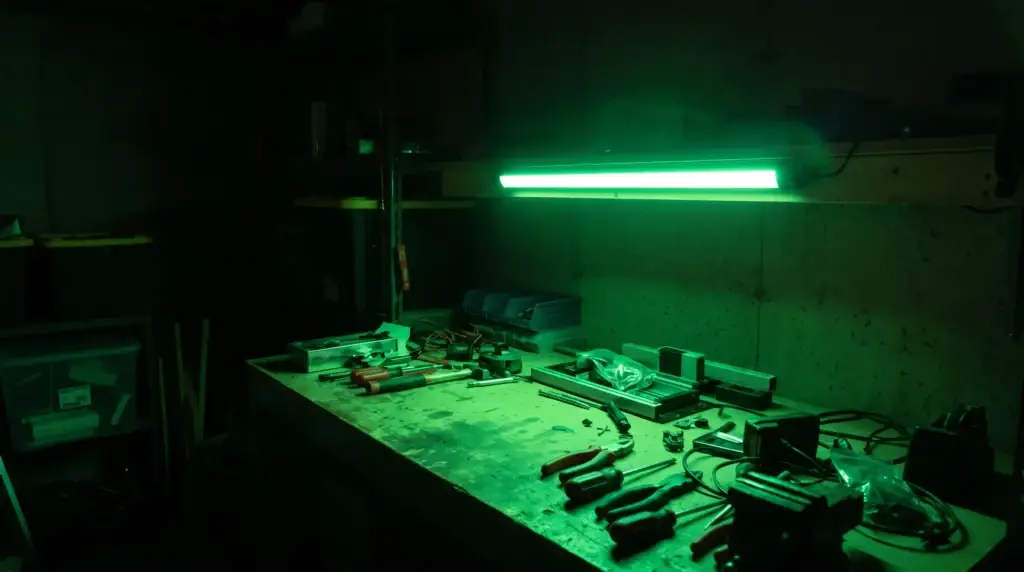
Pick the form factor by what you're doing in the dark and how long you'll be doing it. Our sales team says there's no single favorite green light; what customers mostly buy them for is dark-period checks and harvesting during the dark period. A headlamp is enough for checking a tent. A crew harvesting a flower room needs fixed, wet-rated fixtures, and if other plants in that room are still flowering, the brightness and time limits above still apply to them. Options in this category are limited, so the team's focus is making sure buyers know what to expect from each one. We checked the category for an HGV or HBX option and found none, so every pick below is a third-party brand.
Headlamps for checking plants
For a tent or a single room, a headlamp covers most lights-off jobs: checking a drip line, looking for a leak, pulling a dead leaf. The Active Eye green LED head lamp keeps both hands free and has a 50% setting, which is the one to use near the canopy. It points where you look, so the beam lands on the task instead of washing the room. The downside is that a headlamp tempts you to look straight at the tops; tilt it down.
A magnetic bar that shuts itself off
The AC Infinity IONBEAM green work light is a 16-inch bar that sticks to tent poles and light frames. AC Infinity lists a 525 nm spectrum, four brightness levels and an auto-off timer in 5, 10, 15 and 20 minute steps. The auto-off answers the most common complaint about fixed green lights: someone forgets to turn it off. AC Infinity's listing says to keep it under "10 nmol/s," a unit that doesn't match how canopy light is normally measured, so treat that as a maker's claim rather than a tested limit. It also isn't listed as emergency lighting, so it's a task light only.
When a flower room needs fixed lighting
For permanent task lighting in a commercial flower room, the Growlite vaportight soft green LED work light is built for wet rooms: IP65, wet location, magnet mounts, 1-10V dimming. The 120 V cord-and-plug and 277 V blunt-end versions are in stock. Growlite also makes a battery backup version listed as UL 924, but it's out of stock, so the in-stock versions are task lights, not egress lighting.
If you need a battery-backed green fixture now, the Iluminar iLW green LED work light is in stock in its battery backup configuration, with a listed 1.5 hour emergency function time. The listing doesn't state a UL 924 listing, so ask for the certification paperwork before counting it toward required emergency lighting. Its 64 µmol/s output is the only plant-light (PPF) rating listed for this group, so mount it over aisles rather than directly over the canopy. Dimming isn't mentioned either, so confirm with Iluminar before planning on it.
For bigger rooms where crews need real visibility, the Grow Pros Solutions 4-foot green light puts out 3355 lumens from 40 W and carries IP66 and IK10 ratings. Only the no-battery version is in stock, so despite "Emergency" in the name, what you can buy today is a task light.
Hallways that leak into grow rooms
In a perpetual harvest layout, a veg room on 18 hours and a flower room on 12 often share a corridor, and that corridor's white light hits the flower room every time someone opens the door. The Growlite soft green LED retrofit kit swaps green strips into existing troffer fixtures so the hallway stays usable without a white-light flash. If those hallway fixtures are also part of your required egress lighting, check with your inspector before converting them.
Green Exit Signs and Egress Lighting Are a Code Decision
A grow room is still a workplace and a building. Exit signs and emergency lights exist to get people out in a fire or power failure, and the rules that govern them don't change because there's a crop on the other side of the door.
What federal workplace rules say
For general-industry workplaces under federal OSHA, 29 CFR 1910.37 sets the baseline for exit routes (text checked October 2026). OSHA's agriculture rule, 29 CFR 1928.21(b), says 1910 Subparts B through T, including these exit-route rules, don't apply to agricultural operations, so whether 1910.37 covers a given cultivation room depends on how the operation is classified. Building and fire codes apply either way. Where 1910.37 applies:
- Exit lighting and other emergency safeguards must be "in proper working order at all times," per 1910.37(a)(4).
- Each exit route must be lit well enough that someone with normal vision can see along it, per (b)(1).
- Each exit must be clearly visible and marked with a sign reading "Exit," per (b)(2).
- The line of sight to an exit sign must be clearly visible at all times, per (b)(4).
- Each sign must be lit to at least 5 foot-candles (54 lux) by a reliable light source and be "distinctive in color," or be self-luminous at 0.06 footlamberts or more, per (b)(6).
- The letters must be at least 6 inches high with strokes at least 3/4 inch wide, per (b)(7).
The rule doesn't name a color. It says "distinctive," which leaves green versus red to the codes your state and city have adopted. States that run their own OSHA plans can set different rules, and building and fire codes add their own requirements for emergency lighting run time, illumination levels and sign color. Those vary by jurisdiction and code edition, and some jurisdictions have rules written for cannabis facilities. Your authority having jurisdiction (AHJ), usually the local fire marshal or building official, makes the call. HydroBuilder's sales team sees this from the buying side: commercial customers ask for exit signs and emergency lighting to satisfy fire marshals and inspectors, and what those officials want varies from state to state.
What 1910.37 rules out clearly: taping over an exit sign, unplugging emergency lights for the dark period, or letting black plastic block the view of an exit. If a red sign is a problem for your crop, the fix is a sign your AHJ accepts that suits the crop, not a covered sign.
Green exit signs
Green exit signs are the most common request our sales team gets from those commercial customers. The Growlite exit sign (GLE-S series) is UL 924 Listed, per its listing, with a 90-minute emergency run time and 24-hour recharge. It takes 120 to 277 VAC. Most variants are in stock: single or double face, NiMH battery, optional self-diagnostics, damp-location-rated versions, and versions with two soft green LED lamps that light the path below the sign. The single-face AC-only version is out of stock. Growlite's sell sheet lists the sign's green at about 530 nm.
The damp-location and self-diagnostic options are worth the money in a flower room. Humidity is hard on electronics, and self-diagnostics flag a failed battery before an inspector or an emergency does.
What a UL 924 listing does and doesn't mean
UL 924 is the product standard for emergency lighting and power equipment. A listed sign or fixture has been tested as a product. That doesn't mean your installation passes: placement, circuiting, run time, illumination along the path and sign color are all judged on site. A battery inside a fixture or an IP rating on its label doesn't make it emergency lighting either. Only buy toward egress requirements with the listing in writing and the AHJ's approval of the plan.
Have a licensed electrician install hardwired exit signs and emergency fixtures. These run on building circuits, often at 277 V in commercial spaces, in rooms that stay wet. The grow light setup guide covers circuit planning for the main lights, and the same discipline applies here.
Questions to bring to your inspector
- Which building and fire code editions has this jurisdiction adopted, and what occupancy classification applies to the grow rooms?
- Do you accept green exit signs, or do you require red?
- How long must emergency lighting run on battery, and what illumination is required along the egress path?
- Will a green battery-backed fixture count toward emergency lighting, and what listing do you need to see?
- Do you allow photoluminescent or self-luminous signs in these rooms?
- Are there cannabis-facility rules that apply on top of the general code?
Ask before you buy. Replacing a wall of signs after a failed inspection costs more than the conversation.
For green headlamps, work bars, vaportight fixtures and exit signs in one place, browse the green emergency and work lighting collection.




 Garrett Dupree
 Jacob Rodowick