


Dry organic amendments are one of the most practical tools in soil-based growing. Mix them into your soil, top-dress between waterings, or steep them into compost tea — each method delivers a slow, steady supply of nutrients while building the soil biology that makes plants thrive. Unlike liquid fertilizers, dry amendments work by feeding the microbes first, which then make nutrients available to roots on the plant’s schedule rather than yours.
This guide covers how to select the right amendments for each growth stage, how to apply them without burning plants, and how to layer methods for consistent results across an entire season.
Whether you’re running a backyard garden or a multi-light commercial room, the fundamentals are the same: healthy soil feeds healthy plants. The difference at scale is volume, consistency, and the amendments you reach for.
What Are Dry Organic Amendments?
Dry organic amendments are nutrient-dense materials derived from plant, animal, or mineral sources that are incorporated into or applied on top of soil to feed plants over time. Common options include alfalfa meal, kelp meal, bone meal, fish meal, and mineral inputs like langbeinite. Unlike synthetic fertilizers, which deliver soluble nutrients directly to roots, dry amendments must first be broken down by microbial activity — which is what makes them slower to act and longer-lasting.
This biological mechanism is the core advantage. You’re not feeding the plant directly; you’re feeding the soil, which feeds the plant. The result is a more stable nutrient supply, improved soil structure, better water retention, and a living rhizosphere that makes plants more resilient to stress and disease.
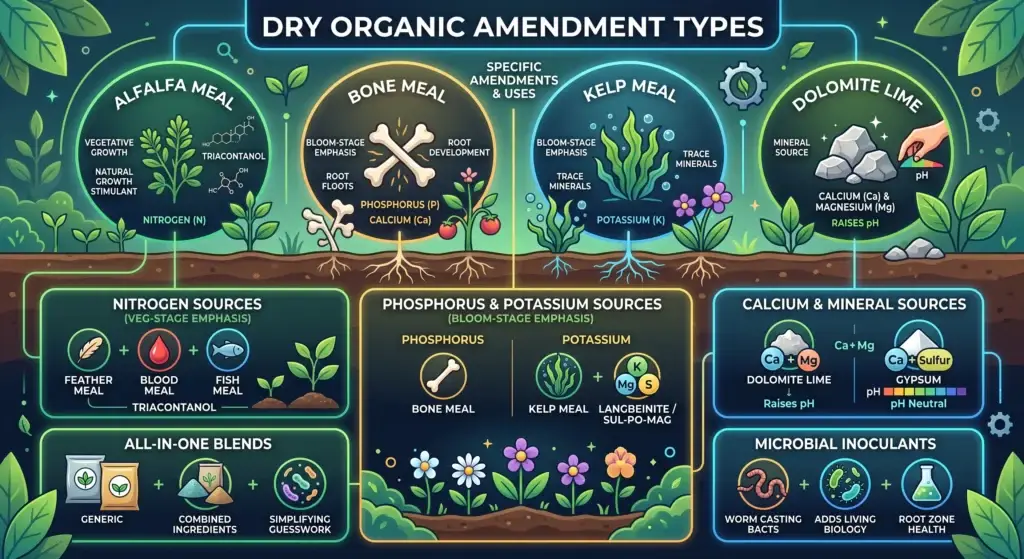
Key categories:
- Nitrogen sources (veg-stage emphasis): Alfalfa meal, feather meal, blood meal, fish meal. Alfalfa also contains triacontanol, a natural plant growth stimulant.
- Phosphorus and potassium sources (bloom-stage emphasis): Bone meal (phosphorus), kelp meal (potassium + trace minerals), langbeinite/Sul-Po-Mag (potassium, magnesium, sulfur).
- Calcium and mineral sources: Dolomite lime (calcium + magnesium, raises pH), gypsum (calcium + sulfur, pH-neutral).
- All-in-one blends: Formulas like Down To Earth Bio-Live combine multiple amendment types with beneficial microbes, simplifying the guesswork for growers who want a single-product starting point.
- Microbial inoculants: Worm castings and products like FoxFarm BushDoctor Microbe Brew add living biology that activates other amendments and supports root zone health.
Looking for guidance on what deficiencies dry amendments address? See our guide to diagnosing nutrient deficiencies.
Choosing Amendments for Each Growth Stage
The right amendment depends on what your plants need most at each stage — and on what’s already in your soil. Before adding anything, a soil nutrient test can tell you where you’re starting from.
Vegetative Stage: Building Structure
During veg, plants prioritize stem and leaf growth. Nitrogen drives this phase, with phosphorus supporting root development. A grow-focused blend or a combination of alfalfa meal and kelp meal covers both needs while delivering trace minerals that synthetic formulas typically skip.
Down To Earth Alfalfa Meal is a reliable nitrogen source for vegetative growth, with a 2-0-1 NPK and the added benefit of triacontanol for natural growth stimulation. Pair it with Down To Earth Kelp Meal for potassium, micronutrients, and growth hormones that support root and cell development.
For an all-in-one option that removes the need to mix multiple amendments, Down To Earth Bio-Live provides a balanced blend with added mycorrhizae and beneficial bacteria — a strong choice for growers setting up new soil or recooking an existing batch.
Bloom Stage: Driving Flower Development
As plants shift to flower, nitrogen demand drops and phosphorus/potassium needs increase. Bone meal is the classic phosphorus source for this phase.
Down To Earth Bone Meal runs a 3-15-0 NPK — high phosphorus with minimal nitrogen to avoid encouraging unnecessary vegetative growth late in the cycle.
Kelp meal continues to be useful into early bloom for its potassium and trace mineral content. For a dedicated bloom amendment in a single product, FoxFarm Happy Frog Fruit & Flower Organic Fertilizer is formulated specifically for the fruiting and flowering phase, with phosphorus, potassium, and soil microbes included.
How to Apply Dry Organic Amendments
There are three core application methods. The one you choose depends on whether you’re starting fresh soil or feeding established plants.
Method 1: Blending Into Soil Before Planting
Pre-plant blending is the most thorough approach. Mix amendments directly into your soil at a rate of 2–4 cups per cubic foot, then let the amended soil rest — ideally 2–4 weeks — before planting. During this rest period, microbial activity ramps up and begins breaking down the amendments, so nutrients are available from the moment roots arrive.
Adding compost tea during the cooking period accelerates this process and supercharges microbial density. See our full guide on making and using compost tea for brewing options.
If you’re working with a pre-amended commercial soil like FoxFarm Ocean Forest Potting Soil or FoxFarm Happy Frog Potting Soil, that soil already contains a starter charge. Add amendments conservatively and test as you go rather than piling on inputs.
Method 2: Top Dressing

Top dressing is the go-to method for feeding established plants without disrupting roots. Sprinkle amendments evenly on the soil surface, then cover with 1–2 inches of fresh soil or a light layer of mulch to keep the amendment moist and prevent breakdown from light exposure.
Vegetative-stage top dressing rate: Apply your veg blend at 2–4 cups per cubic foot every 3–4 weeks, or as your plants show signs of slowing growth. Water in well after each application.
Bloom-stage top dressing rate: Apply bloom amendments at 2¼–4½ cups per cubic foot, cover lightly, and water in. Repeat every 2–3 weeks through mid-flower. Ease off in the final 2 weeks before harvest to allow the soil to flush naturally.
At transplant: If moving from a 5-gallon to a 10-gallon container at the flip to flower, split the dose — mix half into the new soil and top-dress the other half onto the existing root zone. This ensures balanced coverage through the transition.
Method 3: Spoon Feeding
Spoon feeding means applying smaller amounts more frequently — useful for fine-tuning nutrition without risking spikes. Start with 1–2 cups per cubic foot at the beginning of a cycle, then supplement with ½–¾ cup per cubic foot weekly as plants grow. Always cover the amendment after application to maintain moisture and microbial activity.
This method requires more attention than top dressing but gives you more control, particularly during bloom when a nitrogen spike from over-application can stall flower development.
Layering Dry Amendments With Compost Tea
Compost tea activates dry amendments. Brewing a simple aerated tea extracts beneficial microbes and humic acids into liquid form, then delivering them directly to the root zone as a drench. Applied after a top dressing, compost tea accelerates the breakdown of dry inputs and builds microbial density in the soil — which compounds over time if you’re recycling and re-amending the same soil batch.
FoxFarm BushDoctor Microbe Brew provides a ready-to-use microbial concentrate for growers who want the biological benefit without a full DIY brew setup.
For a full breakdown of aerated compost tea ratios, timing, and equipment, see our compost tea guide.
Recooking and Reusing Amended Soil
One of the long-term advantages of a dry amendment approach is that your soil gets better over time. After harvest, re-amend your existing soil at roughly half the original rate, re-wet it, and let it cook for 2–4 weeks before replanting. Each cycle builds organic matter, microbial diversity, and structure that makes subsequent runs more stable and forgiving.
If you’re working with raised beds or large outdoor plots, fall is a good time to work amendments in so they have the winter to break down before spring planting. Kelp meal and alfalfa meal break down relatively quickly; bone meal and mineral amendments like dolomite lime or Down To Earth Langbeinite are slower-release and benefit from extended breakdown time.
For a broader look at improving your soil foundation, see our guide to how to amend soil.
A Note on Rates: More Is Not Better
Every amendment type has a ceiling. High-nitrogen amendments like alfalfa meal or fish meal can lock up other nutrients and create toxicity if over-applied — especially in containers where the nutrient load can’t dissipate into surrounding soil. The listed rates above (2–4 cups per cubic foot for pre-blending; ⅓–¾ cup per cubic foot for spoon feeding) are guidelines derived from common practice. Starting at the lower end and observing plant response over a week before adding more is the right approach for any new soil setup or unfamiliar amendment blend. Learn more about reading your plants’ signals in our guide to how often to give plants nutrients.
Shop Dry Organic Amendments at Hydrobuilder
Hydrobuilder carries a full selection of dry amendments and organic fertilizers — including Down To Earth, FoxFarm, and more — for every stage of growth.
For Commercial Operations: Scaling Dry Amendment Programs
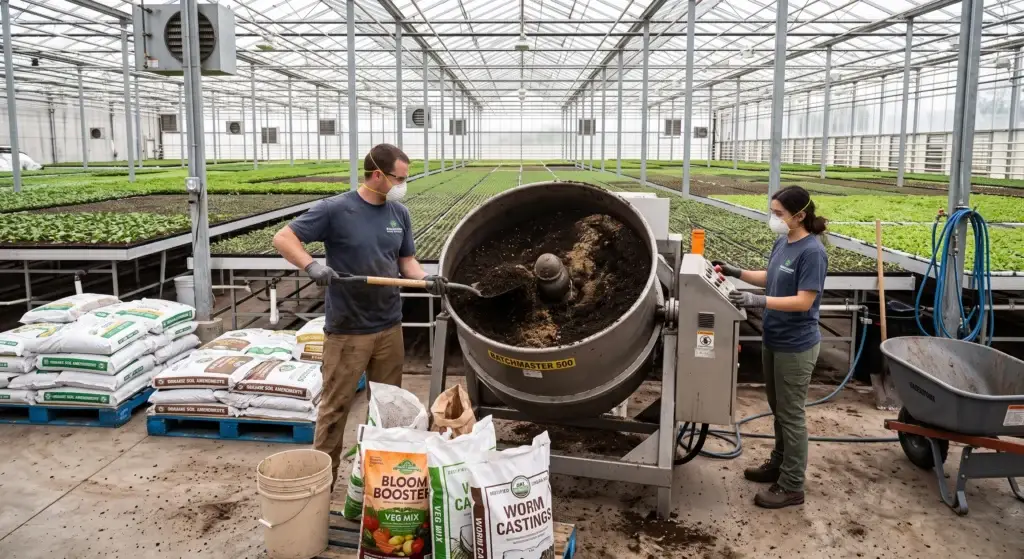
Commercial soil-based production presents specific challenges that hobby-scale amendment programs don’t surface: input costs, labor for top-dressing large canopies, consistency across multiple rooms or beds, and integration with irrigation.
Volume and cost. Dry amendments purchased in bulk (50 lb. bags or greater) reduce per-pound cost significantly compared to small retail bags. For operations managing hundreds of cubic feet of soil per cycle, pre-blending becomes more practical than frequent top dressing — it concentrates labor into a single soil-prep event rather than distributing it across the grow cycle.
Blend standardization. Commercial soil programs benefit from a fixed amendment formula applied consistently across every batch. Documenting your ratios and sticking to them removes the variability that causes inconsistent plant performance across rooms or harvests.
Integrating with fertigation. Dry amendments and liquid fertigation aren’t mutually exclusive. Many commercial operators use dry amendments for baseline soil nutrition and lean on a liquid program — such as HGV Dry Grow during veg and HGV Dry Flower during bloom — to deliver precision-dosed supplemental nutrition through drip or flood-and-drain systems. This hybrid approach gives you the soil health benefits of organic inputs with the control and consistency of a dialed-in water-soluble nutrient program.
Re-amending at scale. For high-throughput facilities running back-to-back cycles in the same soil, re-amendment becomes a critical operation, not an afterthought. Plan re-amendment into your harvest-to-replant timeline and allow adequate cooking time before new plants go in — minimum two weeks, ideally four.
Dry Organic Amendments FAQs
Q: What are dry organic amendments?
A: Dry organic amendments are natural materials — derived from plant, animal, or mineral sources — added to soil to build fertility and support microbial life. Common types include alfalfa meal, kelp meal, bone meal, and fish meal. They release nutrients slowly through biological breakdown, delivering a more stable, longer-lasting feed than soluble fertilizers. For established soil programs, they’re the backbone of a sustainable grow.
Q: How do you apply dry organic amendments?
A: There are three main methods. Pre-plant blending mixes amendments directly into soil at 2–4 cups per cubic foot, then lets the soil “cook” 2–4 weeks before planting. Top dressing applies amendments to the soil surface during the grow, covered lightly with fresh soil, every 3–4 weeks. Spoon feeding delivers smaller amounts more frequently — ½–¾ cup per cubic foot weekly — for more precise control. All three methods require watering in after application.
Q: When should I switch from veg to bloom amendments?
A: Switch when you flip photoperiod to 12/12, or when plants enter the pre-flower stretch. At this transition, nitrogen demand drops and phosphorus/potassium needs rise. Phase out nitrogen-heavy amendments like alfalfa meal and transition to bloom-focused inputs like bone meal or a dedicated bloom blend. If top dressing, one final veg application at flip, then switch inputs for the next top dressing 2–3 weeks later.
Q: Can dry organic amendments burn plants?
A: Yes, at excessive rates. High-nitrogen amendments like blood meal, feather meal, and alfalfa meal are the most likely to cause burns in containers, particularly when applied heavily without adequate watering. Starting at the lower end of recommended rates and covering amendments to keep them moist (rather than hot and dry) reduces burn risk significantly. Seedlings and freshly rooted clones should not be dry-amended — wait until plants are established in at least a 1-gallon container.
Q: How often should I top dress with dry amendments?
A: Every 3–4 weeks is the standard cadence during active vegetative and early flower growth. Slower-release mineral amendments like langbeinite or dolomite lime may only need one or two applications per season. Fast-acting nitrogen sources like alfalfa meal can be applied more frequently in smaller doses. Watch your plants rather than the calendar — yellowing lower leaves and slowing growth are the clearest signals that a top dressing is due.
Q: Are dry organic amendments better than liquid fertilizers?
A: They serve different roles. Dry amendments build long-term soil health, support microbial life, and deliver sustained nutrition across weeks to months. Liquid fertilizers provide quick, precise, immediately available nutrition — useful for correcting deficiencies fast or fine-tuning at specific growth stages. Many experienced growers use both: dry amendments as the foundation and liquid feeding for targeted supplementation. Neither replaces the other entirely.
Q: Do dry organic amendments work in containers?
A: Yes, but container growing requires tighter rate control than ground beds. The limited soil volume in containers concentrates nutrient inputs, making over-application more likely to cause problems. Start conservative — at or below the lower end of recommended rates — and monitor for signs of excess before adding more. Pot size matters: a 5-gallon container requires much less total amendment than a 20-gallon fabric pot, even at the same per-cubic-foot rate.
Q: What's the best way to activate dry amendments faster?
A: Two things accelerate microbial breakdown and nutrient availability: moisture and warmth. Keeping amended soil consistently moist (not waterlogged) and at a temperature above 60°F creates ideal conditions for microbial activity. Inoculating with a microbial product or compost tea after amending jumpstarts the biology. In cold environments or unheated spaces, dry amendments may take significantly longer to activate — plan pre-plant cooking time accordingly.
Q: Can I combine multiple dry amendments?
A: Yes, and most experienced soil growers do. The key is understanding the NPK contribution of each amendment so you’re not stacking too much nitrogen or phosphorus from multiple sources. An all-purpose veg blend plus kelp meal plus bone meal at standard rates is fine; adding blood meal on top of a high-nitrogen veg blend at the same time is where problems start. When in doubt, choose fewer inputs applied correctly over many inputs applied guesswork-style.
Q: How do commercial operations use dry amendments differently than hobby growers?
A: Scale changes the economics and logistics more than the biology. Commercial operations typically pre-blend large soil batches at fixed amendment ratios for consistency across rooms, integrate dry amendments with precision liquid nutrient programs for hybrid nutritional control, and systematize re-amendment as a scheduled facility operation rather than a reactive feeding. The plants’ needs are the same; the management systems around them are more structured.