

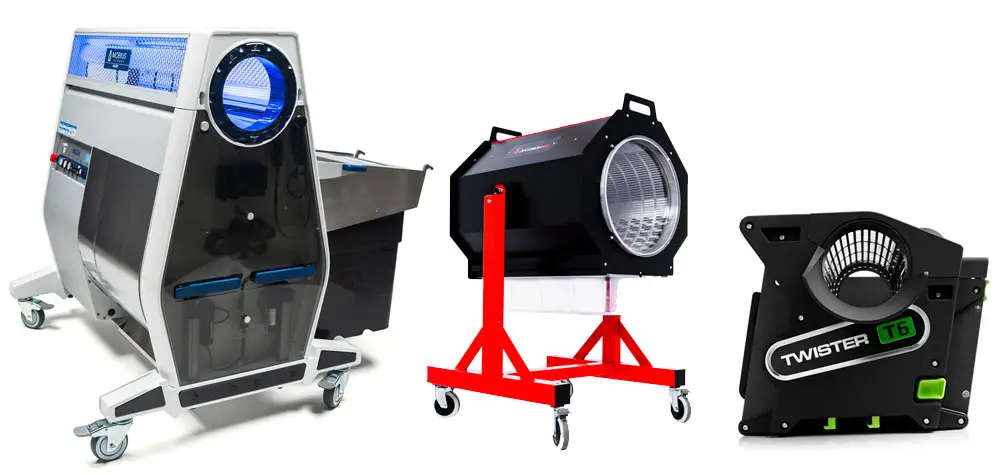
Choosing the best trimming machine comes down to three decisions: whether you trim wet or dry, how much you’re harvesting per cycle, and what trim quality your market demands. Get those three things right, and the machine practically selects itself. Get them wrong, and you’ll spend more time fighting your equipment than finishing your harvest.
Whether you’re a hobby grower looking to cut hours off a few-pound harvest or a commercial operation processing hundreds of pounds a week, there’s a machine built for exactly what you’re doing. This guide walks through every tier — with verified specs, realistic tradeoffs, and picks that are actually in stock.
Not sure whether to trim wet or dry first? The method you choose affects which machine you buy. Our wet trim vs. dry trim guide breaks down the tradeoffs in detail.
Should You Even Buy a Trimming Machine?
Hand trimming made sense when harvests were small and trimmer-friends were plentiful. As grows have scaled — even at the hobby level — that math has shifted. A single mid-range electric trimmer can do in an hour what takes a skilled hand trimmer most of a day. Beyond throughput, modern machines have closed the quality gap dramatically: features like soft tumble technology, variable speed control, and non-stick tumblers now produce results that are genuinely difficult to distinguish from careful hand work when properly set up.
If you’re consistently harvesting more than 2–3 lbs per cycle and spending more than a few evenings trimming, a machine can pay for itself within a harvest or two in recaptured labor time for many operations, depending on labor rates and harvest frequency. If you’re a once-a-year hobby grower with a handful of plants, a quality manual bowl trimmer or a well-stocked HBX hand trimming kit may be everything you need.
Wet vs. Dry: The Decision That Shapes Everything
The most important trimming decision you make isn’t which machine to buy — it’s when you trim.
Wet trimming happens right after chop, while plants are still fresh. Sugar leaves are turgid and easy to remove. Wet trimmers process material faster (commonly delivering significantly higher throughput than dry trimming on the same machine, often up to several times more under optimal conditions) and produce a tight, manicured look quickly. The tradeoff: trimmed wet material often takes longer to dry evenly, and wet resin creates significant cleanup work.
Dry trimming happens after the drying period (typically 7–14 days). Trichomes are more fragile, so machines running dry material need gentler mechanics — softer tumble speed, wider slot tolerances, and more precise blade adjustment. The payoff is a superior cure and, on the right machine, noticeably better bag appeal. Most premium commercial operations have shifted toward dry trim for these reasons.
Hybrid machines (like the Triminator Hybrid and CenturionPro’s Tabletop and Original lines with wet and dry tumblers included) handle both, giving smaller operations flexibility without buying two machines.
For a deeper dive on the method decision, read our wet trim vs. dry trim comparison.
How to Size a Trimming Machine to Your Operation
Before shopping by price, calculate your actual throughput need:
Throughput formula: lbs per harvest ÷ hours available to trim = required lbs/hr
For example, a 30 lb dry harvest with a 4-hour trim window requires a machine rated for at least 8–10 lbs/hr dry. Factor in setup, cleaning, and natural workflow breaks, and you’ll typically want a machine rated at least 20–30% above your calculated minimum, with many commercial operations adding even more buffer.
| Operation Scale | Harvest Volume | Recommended Dry Throughput |
|---|---|---|
| Hobby / Small | < 5 lbs/cycle | 2–5 lbs/hr |
| Small Commercial | 5–30 lbs/cycle | 8–20 lbs/hr |
| Mid Commercial | 30–100 lbs/cycle | 20–60 lbs/hr |
| Large Commercial | 100+ lbs/cycle | 60+ lbs/hr (or tandem systems) |
Best Trimming Machines for Hobby and Small-Scale Growers
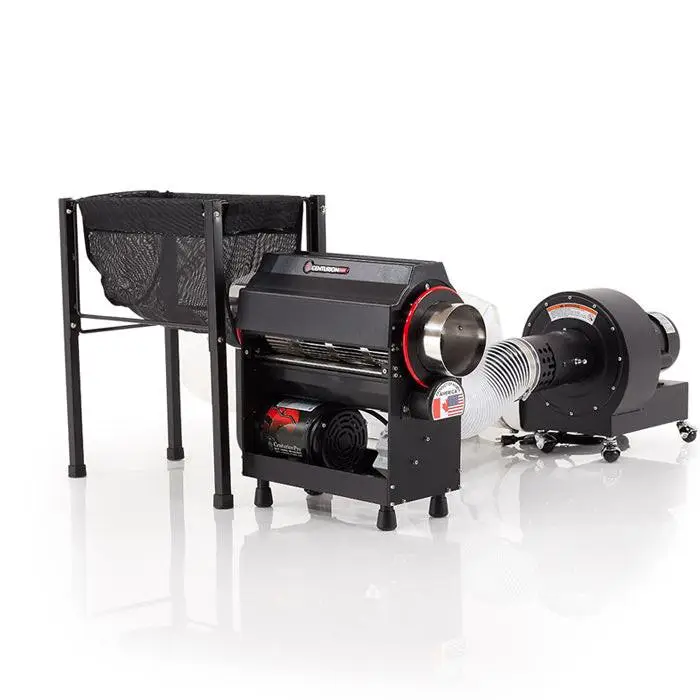
CenturionPro Tabletop Trimming Machine
The CenturionPro Tabletop is the entry point into professional continuous-feed trimming, and it earns its place at the top of this tier. At approximately 35 lbs, it’s one of the most portable dedicated electric trimmers, and it is one of the only machines at this price point that handles both wet and dry material using dedicated Quantanium-coated wet and dry tumblers included with the machine.
Throughput: Typically up to 3–4 lbs/hr dry and 15–20 lbs/hr wet (strain- and operator-dependent)
Best for: Hobby growers with 3–15 lb harvests; small commercial growers trimming both wet and dry
What separates it: The Quantanium non-stick coating is CenturionPro’s proprietary technology — no other manufacturer offers this specific coating. The result is improved trichome preservation when paired with correct operating parameters and a tight, consistent cut. Five-year warranty.
Available in multiple tumbler configurations. If you’re ready to pair with a bucking machine, CenturionPro’s Tabletop and Bucking Machine Bundle adds serious efficiency at harvest time.
Twister T6 Trimming Machine
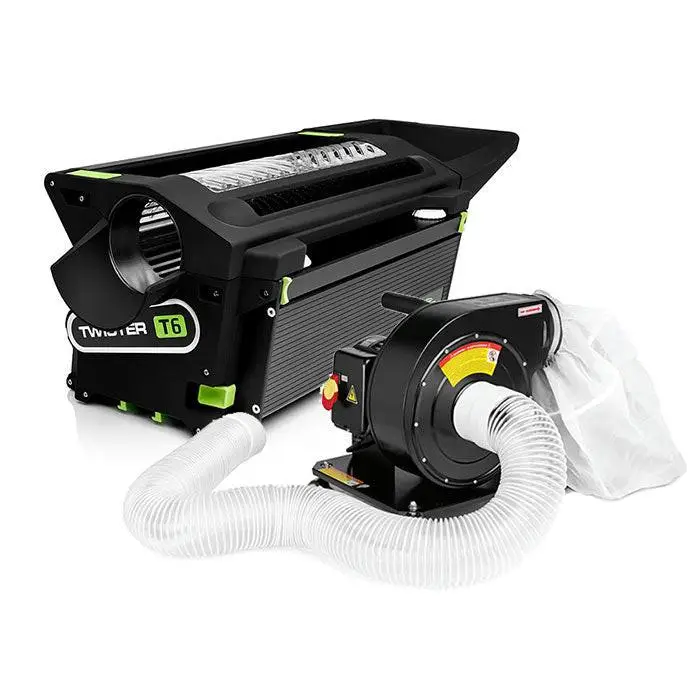
For growers who want Twister’s engineering pedigree in a compact package, the T6 is purpose-built for small batches. Where the Tabletop is a continuous-feed machine, the T6 handles both wet and dry material with a single tumbler design, and it is rated for up to 4 lbs/hr dry and 20 lbs/hr wet under ideal conditions, making it genuinely versatile.
Throughput: Up to about 4 lbs/hr dry, 20 lbs/hr wet (strain and moisture dependent)
Best for: Hobby growers who prefer flexibility over maximum throughput; anyone who wants the Twister ecosystem at entry level
What separates it: Ballistic-grade plastics, 304 stainless steel construction, and the T6 Extreme Tumbler’s broad moisture handling make this one of the most durable small-format trimmers available when operated within spec.
AC Infinity Bud Bowl Trimming Machine, 19 Inch
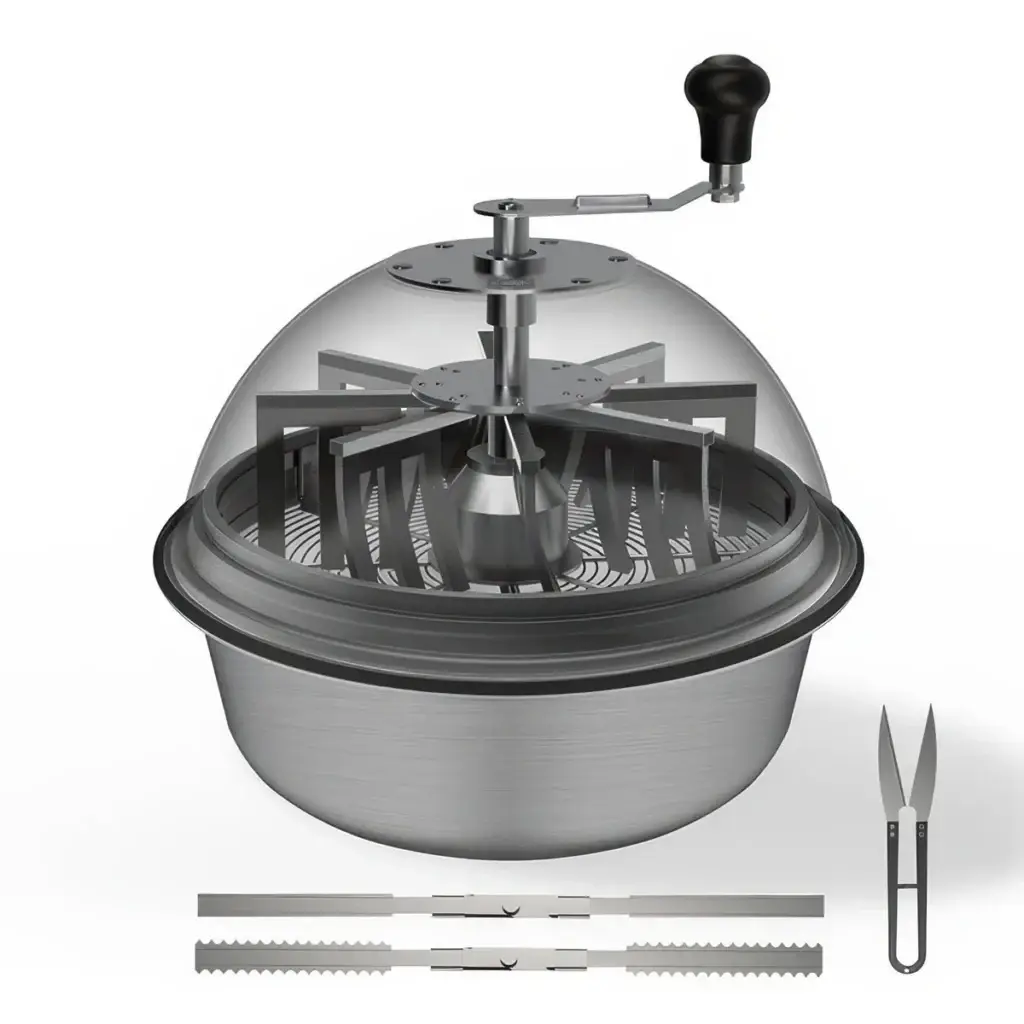
For hobby growers who want a step up from scissors without the cost of an electric machine, the AC Infinity Bowl Trimmer is a practical budget option. It includes both straight-edge (wet) and serrated (dry) blades, handles decent volume with a hand crank, and weighs under 20 lbs (AC Infinity lists the 19″ unit at approximately this range).
Throughput: Manual/variable (limited by crank speed and operator endurance)
Best for: Hobbyists with 1–3 lb harvests; anyone who wants a portable, no-electricity option
Note: This is a hand-crank machine. It significantly outpaces scissors for most users, but it’s not in the same productivity class as electric trimmers.
Already have an electric trimmer? Round out your harvest station with an HBX Premium Hand Trimming Kit for touch-up work, cleanup passes on larger buds, and hand-trimming the material your machine doesn’t handle.
Best Trimming Machines for Mid-Scale and Growing Commercial Operations
Mobius M108S Trimming Machine
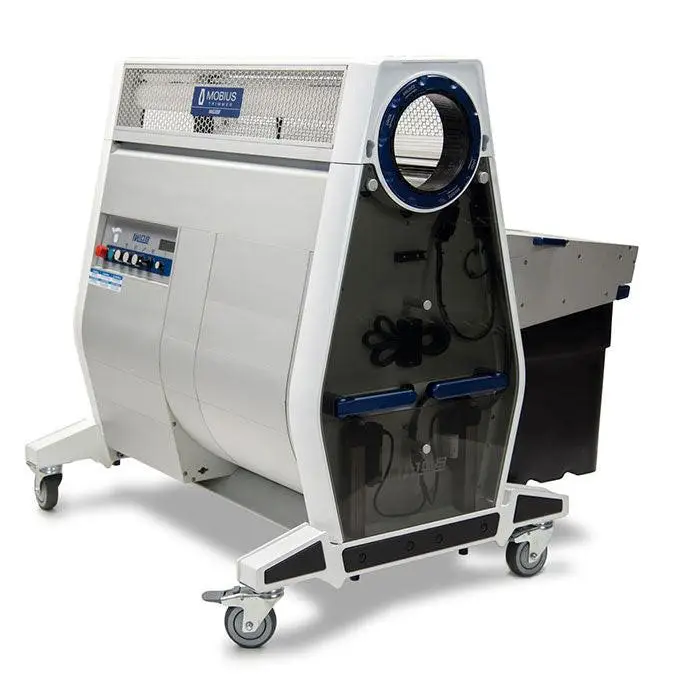
The Mobius M108S is one of the most technologically advanced trimmers in this guide and a clear choice for operations that demand automation and output simultaneously. This is not an entry-level machine — it’s designed for growers who have grown past the Tabletop tier and need a machine that can run production.
Throughput: Typically 30–60 lbs/hr dry and 66–120 lbs/hr wet, according to Mobius feed-rate guidance and depending on cultivar, moisture, and settings
Best for: Mid-to-large commercial operations; perpetual harvest facilities; anyone processing 30+ lbs/cycle dry
What separates it:
- AirThread Tension Tumbler — resists rust and denting, cleans faster, and provides significantly more cutting blade access than conventional tumblers.
- TriFlex Blade System — three self-sharpening blades trim quickly with minimal impact damage when setup is correct.
- Integrated Separation System — trim separator is built in (not a separate vacuum add-on), reducing footprint and simplifying cleanup.
- Variable Function System — full operator control to optimize by strain, moisture content, density, and end-product requirements.
Two M108S units running in tandem with conveyors create a highly efficient manual-input harvest workflow at commercial scale.
Twister T4 PRO VSC Stainless Steel Trimming Machine
The T4 PRO VSC is Twister’s updated production workhorse — the fully stainless steel evolution of the classic T4, now shipping with Variable Speed Control and Airflow Adjustment as standard. It bridges hobby and commercial trimming with all-day durability and a trim quality that holds up under extended runs.
Throughput: Up to 7–11 lbs/hr dry and 23 lbs/hr wet, depending on cultivar, moisture content, and operator settings
Best for: Small commercial operations; perpetual growers needing a reliable daily-driver trimmer
What separates it: Full 304 stainless steel construction (no painted or anodized surfaces to chip or contaminate product), polished non-stick tumbler surface, and cyclonic Trim Saver vacuum integration for capturing trim material for concentrate processing.
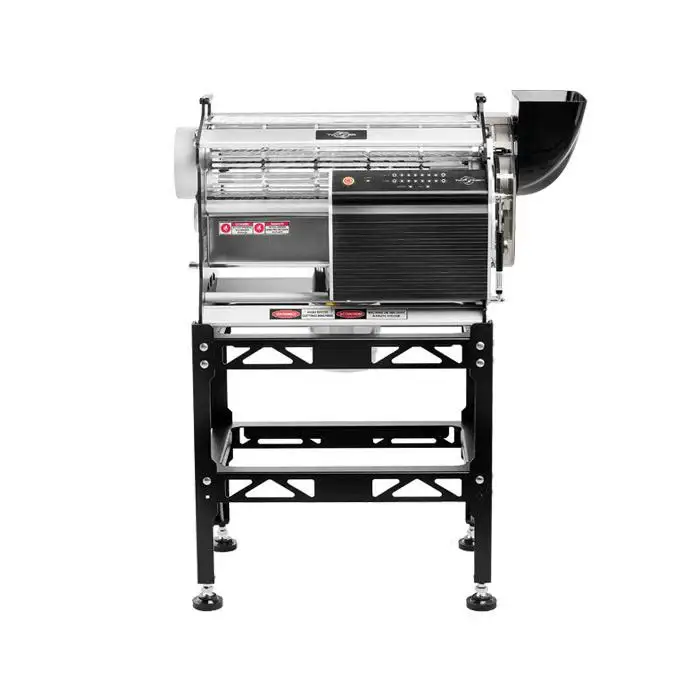
CenturionPro Dry Batch Trimming Machines
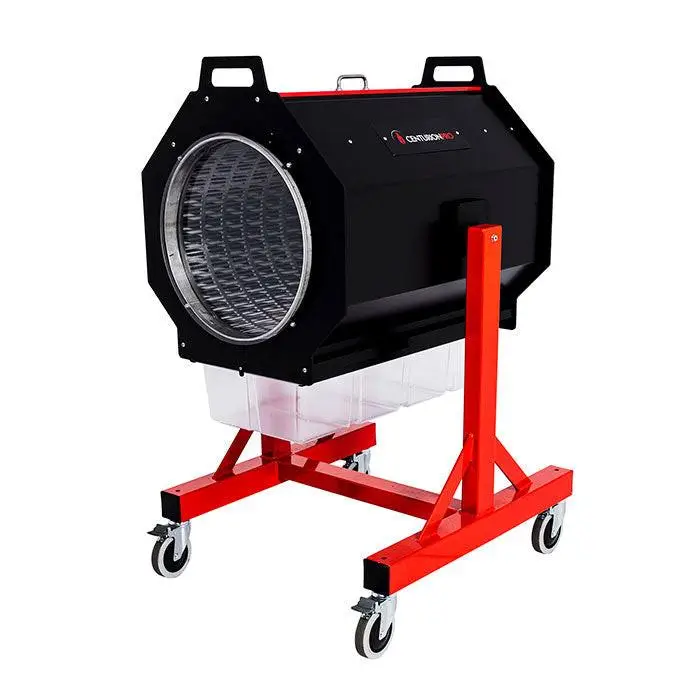
If you trim exclusively dry and want CenturionPro’s quality across a range of budgets and throughputs, the Dry Batch (DBT) line is the right place to shop. Available in multiple models from small to very large capacities (Model 0 through Model 5), this is one of the most scalable dry-trim lineups available. Soft Tumble Technology on all models keeps flower handling gentle, and optional Kief Filter Screen upgrades on Models 0–3 help capture valuable resin.
Throughput: Approximately 7–216 lbs/hr dry across the line (model-dependent and strain-conditional)
Best for: Any operation that trims exclusively dry; growers scaling output without switching platforms
What separates it: Speed Control is standard on Models 2–5; a Timer Dial on Models 4 and 5; and an adjustable angle stand on Models 3–5 simplifies loading and unloading during long runs.
Individual models are also available: Model 0, Model 1, Model 2, Model 3.
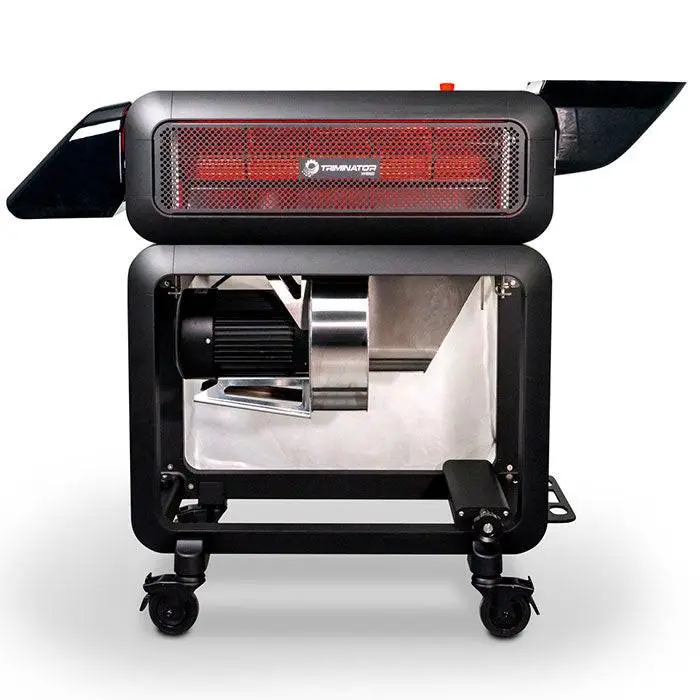
Triminator Hybrid Trimming Machine
The Triminator Hybrid earns its name: it’s a continuous-throughput trimmer at this price point that uses a stainless steel helical blade, a feature previously more common on higher-priced commercial machines. It handles wet and dry material, adapts to a wide range of strains, and its tool-free assembly and tandem coupling make it practical for real harvest floor use.
Throughput: Manufacturer-rated up to 15 lbs/hr dry and 40 lbs/hr wet under ideal conditions (moisture content and strain dependent)
Best for: Small commercial growers who trim both wet and dry; anyone who wants commercial-grade blade technology without full large-scale pricing
What separates it: Flexible bed knife, all-in-one design, and compatibility with tandem coupling for added throughput — all features typically found only on higher-end machines.
Best Trimming Machines for Large Commercial Operations
CenturionPro 3.0+ Trimming Machine
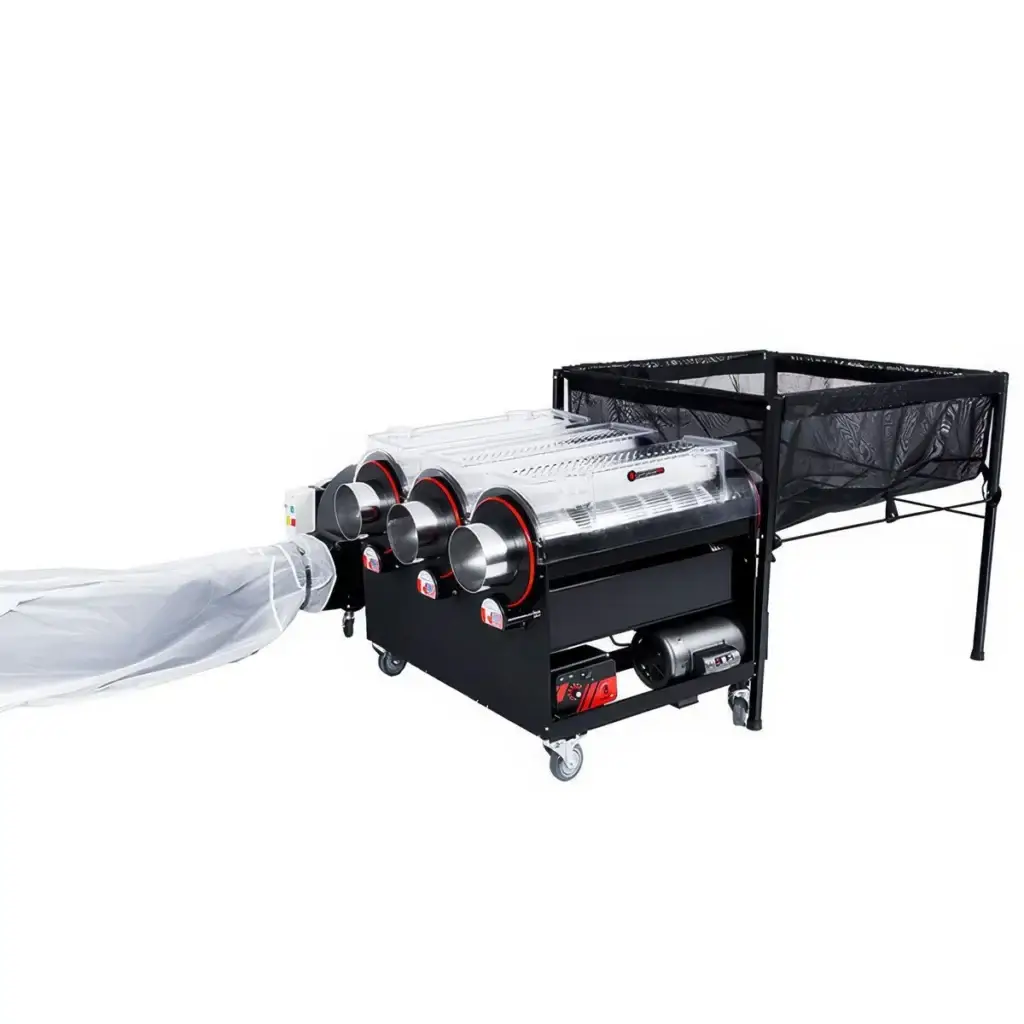
The 3.0+ is CenturionPro’s flagship production machine and one of the most capable commercial trimmers available. It combines a 10-year warranty with serious throughput specs and a triple-bag kief filtration system that makes every harvest profitable down to the last gram of trim when trim is collected and processed effectively.
Throughput: Up to 25 lbs/hr dry, 125 lbs/hr wet under manufacturer test conditions
Best for: Large-scale commercial operations; multi-light facilities; operations where trim collection for extraction is part of the revenue model
What separates it: 8-horsepower leaf collector with 7,108 CFM airflow; one of the largest hoppers in its class; dual-purpose hybrid tumbler handles wet and dry without configuration changes; Speed Control standard; finely tuned diverter for customizing airflow and helping prevent small bud loss into the impeller.
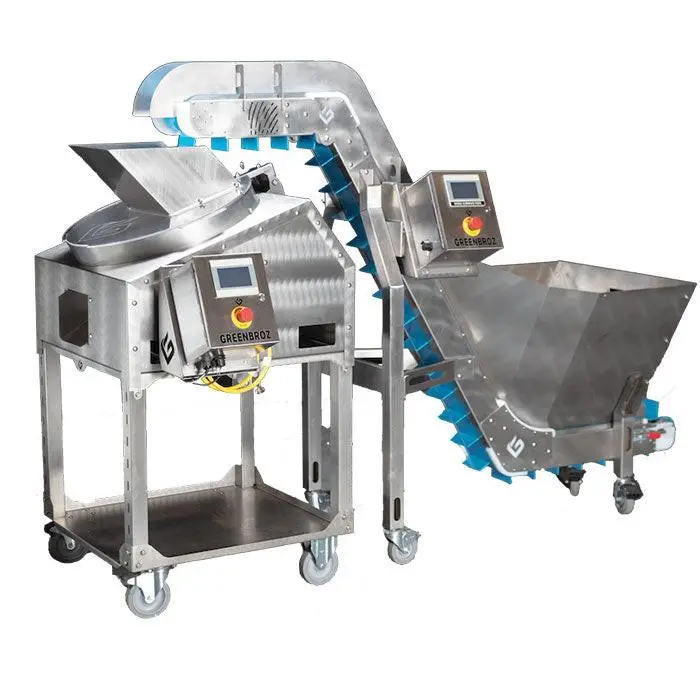
GreenBroz M+ Trimming Machine System
The GreenBroz M+ pairs the company’s patented rolling blade technology (which is designed to reduce the trichome loss common with some vacuum-based systems) with an automated Rise Conveyor that can roughly double throughput without adding labor when used as intended. It’s the right call for operations that prioritize a verifiable quality standard — GMP-oriented design, surgical-grade stainless steel construction, and food-safe conveyor belts are increasingly non-negotiable in licensed facility environments.
Throughput: Up to about 30 lbs/hr dry with the Rise Conveyor (around 15 lbs/hr without), based on manufacturer guidance
Best for: Licensed commercial facilities; operations that market a quality guarantee; grows where regulatory compliance matters
What separates it: Made in the USA; surgical-grade stainless steel throughout; patented rolling blade design (not vacuum-based); GMP-focused construction; single operator required; trim recipes can be saved and replicated across units for multi-site consistency.
Twister BatchOne Dry Trimming Machine
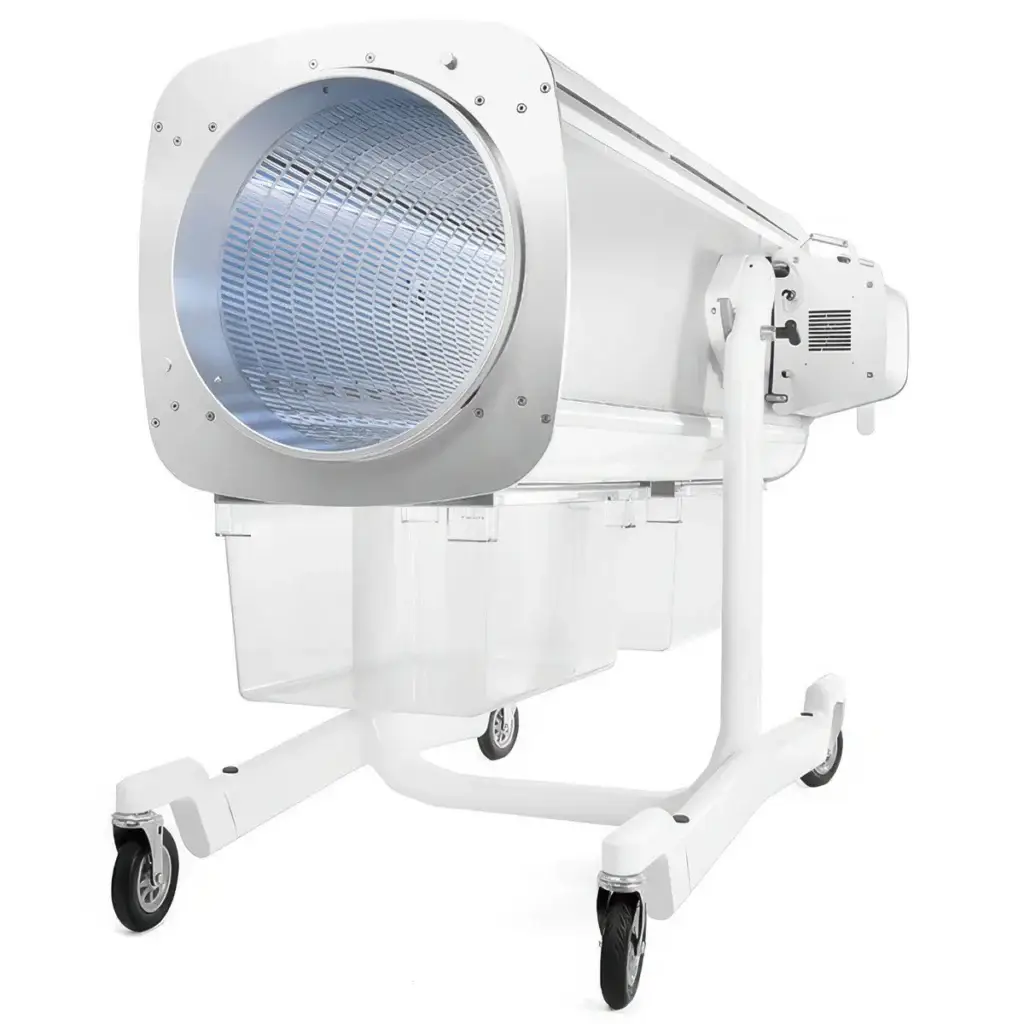
The BatchOne is designed for operations that trim exclusively dry and prefer a batch-style workflow over continuous feed. Its roughly 40% larger batch capacity than several comparable competitors and five-position pivoting design (loading and unloading from both sides) make long trim days significantly less fatiguing. Ultrafine saddle adjustments let you dial in the trim precisely for each cultivar.
Throughput: Up to 88 lbs/hr dry under ideal conditions and proper operation
Best for: Commercial dry-trim operations; multi-cultivar harvests where per-strain optimization matters; operations with extract processing as part of the workflow
What separates it: Strong stall mitigation, FDA-compliant food-grade components, stackable/nestable trim bins, and a design rated for full pressure washer cleandown.
| Machine | Wet/Dry | Max Dry (lbs/hr) | Best For |
|---|---|---|---|
| AC Infinity Bowl Trimmer | Both | Manual | Hobby, budget |
| CenturionPro Tabletop | Both | 3–4 | Hobby to small commercial |
| Twister T6 | Both | 4 | Hobby, flexible moisture |
| Twister T4 PRO VSC | Both | 7–11 | Small commercial |
| Triminator Hybrid | Both | 15 | Small-mid commercial |
| CenturionPro Original | Both | 15–18 | Small-mid commercial |
| Twister BatchOne | Dry only | 88 | Commercial dry-trim |
| Mobius M108S | Both | 60 | Mid-large commercial |
| CenturionPro Dry Batch (M0–M5) | Dry only | 7–216 | Scalable dry-trim |
| CenturionPro 3.0+ | Both | 25 | Large commercial |
| GreenBroz M+ | Dry | 30 | Licensed/GMP commercial |
Don't Skip Your Bucking Step
If you’re bringing whole branches to a trimming machine, you’re creating unnecessary work for yourself and more wear on your equipment. A dedicated bucking machine strips flowers from stalks before trimming — dramatically reducing the load on your trimmer and improving throughput. CenturionPro’s High Performance Bucking Machine and Gentle Cut Bucking Machine are matched to their trimmer lineup, and the Tabletop + Bucking Machine Bundle is an efficient starting configuration for small commercial operations. Learn more in our guide to choosing the right bucking machine.
Trimming Machine Maintenance: Protecting Your Investment
Machine maintenance isn’t optional — it’s the single biggest factor in long-term trim quality and machine lifespan. Resin buildup on blades and tumblers degrades cut quality progressively, often before operators notice. Key habits after every run: wipe down blades and tumblers immediately after use while resin is still soft, inspect blade alignment, and check belt tension on continuous-feed machines.
For full cleaning protocols, replacement part schedules, and brand-specific guidance, see our trimming machine care and maintenance guide.
For Commercial Operations: Building a Full Harvest Workflow
Large-scale operations don’t just need a trimmer — they need a trimming system. The components:
Upstream (before the trimmer):
- Bucking machine to strip stalks efficiently
- Feed conveyors to maintain continuous material input (Twister and CenturionPro both offer conveyor systems for their commercial lines)
Trimming:
- Match machine throughput to your realistic harvest rate (see sizing formula above)
- Consider tandem systems (two M108S units, CenturionPro multi-rail systems) when single-machine throughput is the bottleneck
Downstream (after the trimmer):
- Trim collection and processing: machines with integrated Trim Saver systems (Twister T4 PRO VSC, BatchOne) or CenturionPro’s triple-bag kief filtration capture material for extract production — this is often meaningful revenue that untrained operations leave on the table.
- Quality control conveyors (Twister offers stainless steel QC conveyor options for the T4 system) allow visual inspection between trimming and packaging.
- Harvest sorting machines for sizing and grading finished flower.
Post-trim processing:
- Proper drying and curing conditions determine final product quality as much as trim quality. Review our beginners guide to harvest, drying, and curing for the environmental parameters that matter.
At commercial scale, optimizing each step of the harvest chain — not just the trimmer — is what separates a good harvest from a strong ROI.
Why Shop at HydroBuilder for Trimming Equipment
HydroBuilder carries the full trimming machine lineup from CenturionPro, Twister, Mobius, Triminator, and GreenBroz — including commercial-scale equipment that many grow shops don’t stock. Our team has hands-on experience with these machines across real cultivation setups, and we can help match your operation’s harvest volume, trim method, and budget to the right equipment.
Example: FAQs
Q: What is the best trimming machine for cannabis?
A: The best trimming machine depends on your operation size, trim method, and throughput need. For hobby growers, the CenturionPro Tabletop or Twister T6 offer professional quality in compact form factors. Small commercial operations should look at the Twister T4 PRO VSC or Triminator Hybrid. Large commercial facilities processing 50+ lbs/day should evaluate the Mobius M108S, CenturionPro 3.0+, or Twister BatchOne based on whether they trim wet, dry, or both.
No single machine is universally “best” — the right machine is the one sized correctly for your operation. Use the throughput formula (lbs per harvest ÷ hours to trim = required lbs/hr) to narrow down your options before comparing features.
Commercial application: Large facilities should also factor in extract revenue from trim collection. Machines with integrated trim separation (Mobius M108S) or kief filtration (CenturionPro 3.0+) turn trim into a meaningful secondary revenue stream.
Q: Should I trim wet or dry?
A: Wet trimming happens immediately after harvest while material is fresh — it’s faster, produces a clean-cut look, and is easier on machines (higher throughput rates). Dry trimming happens after the drying period, is gentler on trichomes, and generally produces better bag appeal and cure quality for premium flower.
Most commercial operations growing for the high-end market have shifted toward dry trimming. Wet trimming remains common for extract-destined material where trim quality matters less than throughput.
The decision affects which machine you buy: wet-focused machines prioritize throughput; dry-focused machines (like the CenturionPro Dry Batch series and Twister BatchOne) prioritize gentle handling. Hybrid machines (CenturionPro Tabletop and Original, Triminator Hybrid) handle both without a full machine swap, relying on appropriate tumblers or setup.
Commercial application: Large facilities often run separate machines for wet and dry material, optimizing each for its specific use case.
Q: Are trimming machines worth it for small growers?
A: Yes — for many growers harvesting more than 2–3 lbs per cycle, an electric trimmer pays for itself relatively quickly through saved labor time, especially where trim labor is expensive or hard to schedule. Even compact machines like the CenturionPro Tabletop or Twister T6 eliminate what typically takes multiple evenings of hand trimming, finishing the same volume in a fraction of the time with more consistent results.
For very small hobby grows (1–2 plants, under 1 lb per harvest), a manual bowl trimmer or quality hand scissors may be more practical. The HBX hand trimming kits provide everything needed for hand trim without the machine investment.
Q: Do trimming machines damage trichomes?
A: Modern machines are designed to minimize trichome loss, but the result depends heavily on machine selection and operator settings. Vacuum-based systems that pull flower through a turbine can create more trichome damage than gentler systems if operated aggressively. Rolling blade systems (GreenBroz), soft tumble technology (CenturionPro), and variable speed control (Twister T4 PRO VSC) significantly reduce impact on resin quality when used correctly.
Key factors that affect trichome preservation: machine speed, moisture content of flower, tumble duration, and whether you trim wet or dry. Drier material is more fragile — when trimming dry, slow the machine down, shorten exposure time, and use the widest slot setting your quality standard allows.
Q: How much can trimming machines process per hour?
A: Throughput varies widely across machine tiers. Manual bowl trimmers (AC Infinity 16″ or 19″) are limited by hand-crank speed — practical for under 1 lb per session for most users. Entry-level electric machines like the Twister T6 and CenturionPro Tabletop commonly handle around 3–4 lbs/hr dry or 15–20 lbs/hr wet under favorable conditions. Mid-tier commercial machines (Twister T4 PRO VSC, Triminator Hybrid) process roughly 7–15 lbs/hr dry. Large commercial machines — Mobius M108S, Twister BatchOne, CenturionPro 3.0+ — reach approximately 25–88+ lbs/hr dry.
Always use dry throughput figures when comparing machines, as wet throughput rates are consistently and significantly higher and can obscure the real performance difference.
Q: What's the difference between a batch trimmer and a continuous-feed trimmer?
A: A continuous-feed trimmer accepts material constantly — you load from one end while trimmed flower exits the other. This suits operations that run their trimmer for hours at a stretch and want uninterrupted throughput. CenturionPro’s Original and 3.0+ are continuous-feed; so is the Mobius M108S.
A batch trimmer accepts a set load, runs a trim cycle, and then requires unloading before the next batch. Batch trimmers like the CenturionPro Dry Batch series and Twister BatchOne are often preferred for dry material because batch control allows more precise tumble time, which translates to more consistent results across different density cultivars.
Q: Can trimming machines handle hemp as well as cannabis?
A: Yes — all commercial-grade machines on this list are appropriate for hemp as well as cannabis. The primary difference at commercial scale is volume: hemp harvests are typically much larger than cannabis, pushing most mid-range machines to their throughput limits quickly. Hemp processors generally need continuous-feed machines with throughput of 50+ lbs/hr dry for efficient operation. The Twister BatchOne (88 lbs/hr dry), Mobius M108S (up to about 60 lbs/hr dry), and CenturionPro 3.0+ (25 lbs/hr dry) are the most relevant options at that scale.
Q: What accessories improve trimming efficiency?
A: The most impactful accessories, in order: (1) A bucking machine upstream — stripping flower from stalks before trimming dramatically reduces machine load and speeds up the whole process. (2) Conveyors (Twister T4/T2 rail systems; CenturionPro dual and triple rail systems) for continuous material flow in multi-machine setups. (3) Trim collection systems — Trim Saver vacuums (Twister), kief filter screens (CenturionPro DBT), and the M108S’s integrated separation system all capture extract-grade trim that would otherwise be lost. (4) Quality control conveyors for visual inspection before packaging.
Q: How do I maintain a trimming machine to keep it running efficiently?
A: Clean blades, tumblers, and collection components after every use — not just after every harvest. Resin hardens quickly on stainless steel and becomes significantly more difficult to remove once it cures. Most machines can be cleaned with isopropyl alcohol, food-safe solvents, or pressure washing (where rated — check your machine’s manual). Check blade alignment and belt tension before each run, and inspect for worn bearings or bushings after every 10–15 hours of operation. For brand-specific protocols and replacement part schedules, see our trimming machine maintenance guide.
Q: What's the ROI on investing in a trimming machine?
A: ROI depends primarily on your labor rate and harvest frequency. At typical seasonal trim labor rates, a machine processing around 10 lbs/hr that replaces several hand trimmers can recover its cost within roughly 1–3 harvests for many commercial operations. Beyond direct labor savings, machine trimming reduces staffing complexity, improves consistency (directly affecting retail price), and speeds time-to-market — all of which compound across harvests.
For commercial operations, include trim collection value in the ROI calculation. A machine that captures extract-grade material on every run adds incremental revenue that can meaningfully shorten the payback period.