

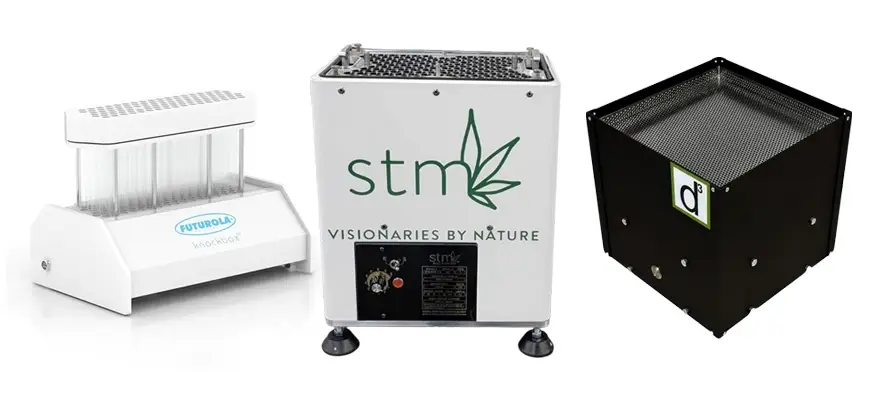
If your operation is still filling cones by hand, you’re likely losing money on every shift compared to a well-implemented cone filling workflow, especially as volumes climb beyond a few hundred pre-rolls per day. The best pre-roll machines can fill 100 to over 450 cones per cycle when configured and operated correctly, turning a labor-intensive bottleneck into a scalable production line. But choosing the wrong machine for your throughput requirements is an expensive mistake, because under- or over-sizing equipment affects both ROI and day-to-day staffing.
This guide matches major cone filling machines to the production scale they realistically serve and explains what to pair them with upstream for a complete pre-roll workflow.
Quick reference: Looking for trimming equipment for the harvest that feeds your pre-roll line? See our trimming machine guide and wet vs. dry trim breakdown before building your workflow.
How to Choose a Pre-Roll Machine Before You Buy
The right pre-roll machine is determined by three variables: your daily cone target, your cone size range, and whether you have grinding infrastructure already in place.
A machine that underfills your shift requirement forces overtime, double-cycling, or manual top-offs, which erodes the ROI on automation. A machine that vastly exceeds your output needs creates unnecessary capital expense and maintenance overhead. Before evaluating any machine, calculate your target: cones per shift × shifts per day × days per week, and match equipment to throughput and workflow rather than brand alone.
Three questions to answer before reading specs:
- How many cones do you need per shift — and what size?
- Do you have a grinder/shredder, or do you need that in the same budget?
- Are you running one cone size consistently, or rotating SKUs?
Pre-Roll Machine Comparison by Scale
| Machine | Output (per cycle) | Best For | Cone Sizes |
|---|---|---|---|
| Doob Cube | Up to ~250 cones (plate dependent) | Entry-level / compact | 98mm, 109mm (common plates) |
| King Kone 169 | 169 cones | Small craft / dispensary | 70–109mm |
| Futurola Knockbox 100 | 100 cones | Boutique / retail-ready | 0.5g–2.0g |
| Futurola Knockbox 300 | 300 cones | Mid-volume operations | 0.5g–2.0g |
| Futurola Knockbox 500 | 500 cones | High-volume, multi-SKU | 0.5g–2.0g |
| STM Canna Mini-RocketBox PLUS+ | 143 cones | Craft to mid-scale | 0.25g–1.2g |
| STM Canna RocketBox 2.0 | Up to 453 cones | High-output commercial | Multiple sizes |
| STM Canna RocketBox Pro | Variable (enterprise) | Enterprise / flagship | Multiple sizes |
Entry Level: Doob Cube
The Doob Cube is a compact, cost-effective automated cone filler designed for small operations that want consistency without a large capital outlay, provided you match its cone plate configuration to your actual production targets.
Doob Cube-style machines use a vibrating motor and sifter-style plate to fill dozens to roughly a couple hundred cones per cycle, depending on the specific plate, cone size, and vendor configuration, and are typically set up for common formats like 98mm or 109mm cones after the operator loads them. At roughly tabletop size and weight, these systems move easily within a facility and fit into constrained spaces.
Because the Doob Cube is designed as an entry-level cone filler with fixed plate capacities, it is not a machine that easily scales with rapidly increasing demand; when you outgrow its practical daily throughput, you’ll generally replace it rather than upgrade it. For operations starting their pre-roll program, or dispensaries running limited pre-roll SKUs alongside other revenue streams, it can be a legitimate entry point with a relatively short ROI window when paired with a reasonable production goal.
Optional add-ons such as drop boxes or additional cone plates allow parallel loading and unloading while the machine runs, which helps stretch practical throughput without changing the core machine.
Mid-Entry: King Kone 169
The King Kone 169 fills up to 169 cones per cycle and stands out for its genuine multi-size flexibility — attachments and cartridges accommodate 84mm, 98mm, and 109mm cones without needing a new machine.
Where many entry-level machines lock you into one cone format, the King Kone system uses swappable trays and cartridges so you can rotate between SKUs, including dog walkers, standard 1 g, and king-size cones, within the same shift. This flexibility matters operationally when your pre-roll menu spans multiple sizes and you want to minimize changeover downtime.
The King Kone 169 v2 also offers optional metering trays (such as 0.5 g-focused trays) that help improve dosage consistency for operations selling half-gram cones by distributing material more evenly before vibration. While it is not the absolute highest-throughput machine in its price range, it is one of the most flexible options at the entry-to-mid tier for multi-size programs that value versatility over maximum single-format speed.
The Futurola Knockbox Family
Futurola pioneered the tabletop cone filling format, and the Knockbox line remains a widely used standard for operations producing high-quality, consistently packed pre-rolls at volume.
Three machines in the current Knockbox family serve different scale points: the Knockbox 100 for smaller runs, the Knockbox 300 for mid-volume production, and the Knockbox 500 for high-volume operations, all designed to work with Futurola’s cone and shredder ecosystem.
Futurola Knockbox 100

The Futurola Knockbox 100 is one of the most widely deployed commercial cone fillers in the industry, filling 100 cones per cycle in roughly a couple of minutes under typical operating conditions, when paired with properly ground material. It is designed to handle Futurola-branded cones in sizes from approximately 0.5 g to 2.0 g via different filling kits, and it produces fills consistent enough to significantly reduce the manual touch-up and quality-checking that bogs down hand-filling operations.
This is the machine many dispensaries and boutique producers start with, and a number of operations find they can remain on this platform when volumes stay within its practical range. The accessory ecosystem — including mix trays, unload stations, and spill collectors — expands operational efficiency without requiring a machine upgrade, especially when operators standardize kits and procedures.
Futurola Knockbox 300
For operations consistently running 300 or more cones per cycle, the Knockbox 300 triples per-cycle throughput relative to the 100 while maintaining similar filling quality and Futurola cone compatibility, assuming you use the appropriate filling kits and grind profile. It is the logical step-up when the Knockbox 100 becomes the bottleneck in your line rather than your grinder or packaging workflow.

Futurola Knockbox 500

The largest Knockbox model fills up to 500 cones per cycle, making it appropriate for high-volume producers running multiple shifts or servicing multiple retail accounts, provided upstream grinding and downstream packaging are matched to this capacity. At this scale, feedstock preparation and material staging become the primary constraints, so pairing the Knockbox 500 with a commercial shredder and disciplined workflow is critical.
Shop all Futurola accessories: Knockbox Unload Station and Knockbox Mix Tray
STM Canna: Mini-RocketBox to RocketBox Pro
STM Canna’s pre-roll line spans craft operations to enterprise-scale production, with clear machine-to-scale matching and strong training support for commercial operators.
STM Canna Mini-RocketBox PLUS+
The Mini-RocketBox PLUS+ is a go-to cone filler for craft cultivators, startups, and multi-state operators adding a satellite production location — filling 143 cones per cycle in roughly 30–45 seconds and achieving on the order of 1,250+ cones per hour and around 10,000–11,000 cones per day in an 8-hour shift under optimized, continuous operation.
The PLUS+ upgrade over the original Mini adds an improved bottom tray that better tolerates natural variance in paper cone geometry, which helps reduce jams and double-fills during vibration. The adjustable top tray and lift plate address common operator pain points from the first generation by improving evenness and reducing manual intervention.
The Mini-RocketBox PLUS+ cone size range is approximately 0.25 g to 1.2 g per cone, with bottom tray selection determining the specific size and format. Weight variance can be held within production-grade tolerances (often under 10% or tighter) when operators follow STM’s recommended grinding, staging, and QC procedures.
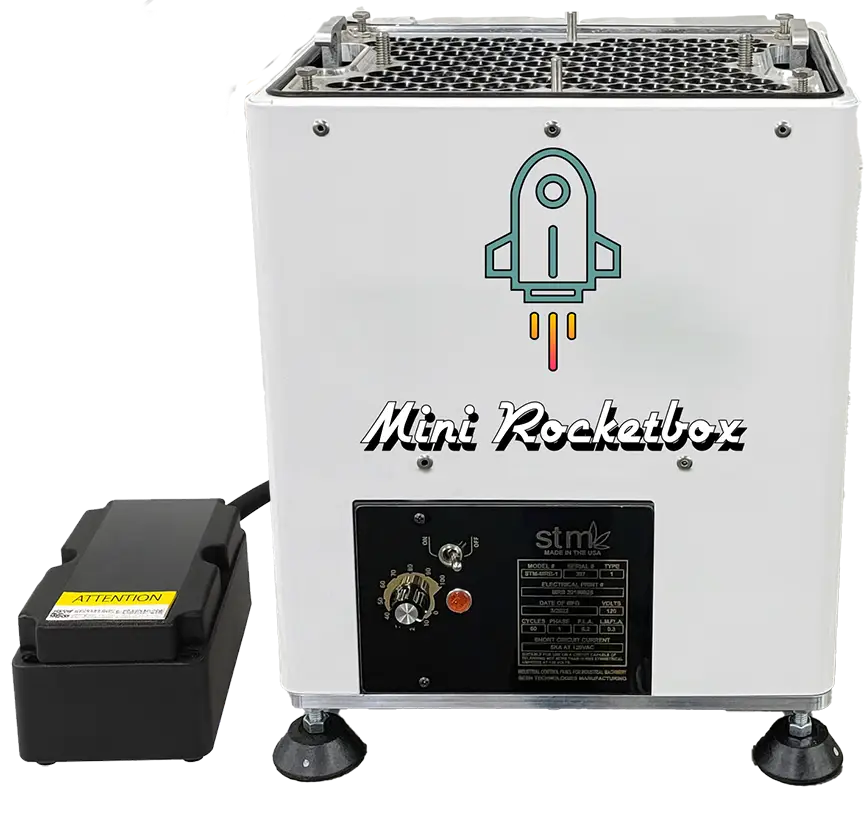
Supporting accessories: Mini-RocketBox Bottom Tray, Mini-RocketBox Top Tray, and LaunchPad Weighing Module
STM Canna RocketBox 2.0

The RocketBox 2.0 can produce up to 453 cones per cycle depending on tray configuration and is engineered for high-volume commercial production where consistent output and built-in training resources matter.
RocketBox 2.0 brings proprietary software for density measurement and weight accuracy, with adjustable settings across stages such as fill, adjust, and pack, a larger touchscreen control panel, and tighter weight parameters than its predecessor when operators follow STM’s process controls. Depending on cycle time and staffing, this translates into thousands of cones per day in commercial workflows rather than a fixed single number, so buyers should model throughput based on their actual shift length and operating cadence.
Every RocketBox 2.0 purchase typically includes access to STM’s training resources, and many deployments include on-site or guided setup from an STM Canna representative, which is a genuine differentiator for operations where employee turnover is high or staff training time is limited.
Supporting accessories: RocketBox Bottom Tray & RocketBox Loading Box
STM Canna RocketBox Pro
The RocketBox Pro is STM Canna’s flagship enterprise-tier pre-roll machine, designed for operations where maximizing throughput per labor-hour and integrating with weighing and closing automation are primary ROI drivers. For operations that have outgrown the RocketBox 2.0’s tray capacity or are consolidating multiple smaller machines into one automated line, the Pro is the natural upgrade path, though exact capacity depends on the chosen configuration and workflow.


Don’t Overlook Your Grinder: The Upstream Bottleneck

Your cone filler is only as fast as your feedstock preparation; if your grinder cannot keep up with your machine’s fill rate, the cone filler sits idle and your labor cost per cone spikes.
This is one of the most commonly overlooked factors when purchasing a pre-roll machine. At 100–300 cones per cycle on machines like smaller Knockbox units or Mini-RocketBox, a mid-capacity grinder usually keeps pace when used properly, but at 400–500 cones per cycle you typically need a shredder rated for commercial throughput and consistent particle size.
Futurola Shredder — The natural pairing for Knockbox operations, purpose-built to produce the flower consistency that Futurola’s cone filling kits expect for even packing and burn. Replacement whips are available to maintain performance: Futurola Replacement Whips.
STM Canna Revolution Grinder 2.0 — Designed to integrate with RocketBox workflows, with output consistency calibrated to STM Canna pre-roll specifications and meant for commercial throughput. For Mini-RocketBox operations, the STM Canna Mini-Revolution Grinder is the appropriately scaled option.
High-Tech Shredder/Grinder — A proven general-purpose workhorse for operations running brand-agnostic workflows or multi-machine setups that need a standalone shredder not tied to a specific cone filler brand.
Mobius Mill M210 Shredder — For operations at enterprise scale, the Mobius M210 is an industrial shredder that matches the throughput demands of high-cycle cone filling systems when sized correctly. The compact M60 is available for smaller footprints and lower throughputs: Mobius Compact Mill M60.
Closing the Loop: Cones, Closing, and Weighing
A complete pre-roll production line includes the cone filler, the grinder, and three additional workflow elements that operators often source as afterthoughts but which strongly influence quality and compliance.
Pre-rolled cones: Custom Cones USA Pre-Rolled Cones and Futurola Pre-Rolled Cones are available in multiple formats and lengths. Matching cone brand and size to machine specifications matters because most machines and filling kits are optimized for specific paper geometry and seam construction.
Pre-roll closing: The STM Canna Atomic Closer Turbo automates the tip-closing step, which often becomes the new bottleneck once filling is automated, especially for high-volume operations.
Weight verification: The STM Canna LaunchPad Weighing Module integrates directly with RocketBox workflows to provide real-time fill weight monitoring, which is critical for compliance markets that require tight per-unit weight tolerances and traceability.
For Commercial Operations: Scaling Your Pre-Roll Line
At commercial scale — think 10,000+ cones per day across multiple SKUs — the machine selection calculus shifts from “which filler” to “how does the entire workflow function under real-world constraints.”
Key considerations for commercial pre-roll operations:
Throughput mapping: Calculate cones per shift and the number of shifts needed to meet weekly order volume, then add a 15–20% buffer for maintenance, cone jams, and size changeovers. For example, a RocketBox 2.0 configured near its upper tray capacity and run across two shifts can produce many thousands of cones per week, but if your target is 60,000 or more weekly, you may need multiple machines or a move to RocketBox Pro-level equipment.
Footprint and flow: Pre-roll production generates significant particulate, so plan your facility layout so grinder-to-filler-to-closing follows a single directional flow rather than a U-shape that increases cross-contamination risk. Coordinating airflow and dust management around this line helps maintain product quality and operator safety.
Multi-SKU changeover time: If you run more than two cone sizes or strains per day, choose a machine with documented changeover practices and realistic changeover timing. The King Kone cartridge system is designed for relatively rapid size swaps, while Knockbox kits and STM trays require more deliberate changeovers but can offer superior consistency within a single format when properly set up.
Tracking and compliance: Markets with per-unit track-and-trace or strict weight requirements often need an integrated weighing module before packaging. The STM LaunchPad is one such solution for RocketBox-based operations, feeding data into a compliant recordkeeping workflow.
Maintenance contracts and local support: At production scale, downtime is measured in dollars per hour, so ask vendors about service SLAs, spare parts availability, and training support before purchasing. STM Canna’s training programs and support resources are a genuine value-add, and similar considerations apply to Futurola, Mobius, and other major vendors.
For a broader view of harvest automation beyond pre-rolls, see our harvest automation guide and essential trimming accessories.
Why Buy Pre-Roll Equipment at HydroBuilder
HydroBuilder stocks the full Futurola and STM Canna lines, along with Doob Cube- and King Kone-style systems, High-Tech shredders, Mobius mills, and the supporting accessories that turn individual machines into cohesive production workflows. Our commercial team works with dispensaries and licensed producers daily, so if you are building out a pre-roll line and need help matching machine selection to throughput targets and budget, you can call us at 888-815-9763 or visit HydroBuilder.com Commercial Accounts.
Shop all pre-roll and cone filling equipment: Pre-Roll Cone Filling Systems, Pre-Roll Grinders & Shredders, and Pre-Rolled Cones & Supplies
Example: FAQs
What is the best pre-roll machine for a small dispensary?
A: For most dispensaries running under roughly 500 cones per shift, the Futurola Knockbox 100 or King Kone 169 are strong starting points when paired with the right grinder and workflow. The Knockbox 100 delivers consistent fills in about 2 minutes per 100-cone cycle under typical conditions and has one of the most complete accessory ecosystems in its tier, which helps dial in efficiency and consistency. The King Kone 169 v2 is often the better choice if you run multiple cone sizes regularly, since its cartridge system and tray options handle format changes without a full machine swap, while the Doob Cube remains a viable option for the smallest operations with limited SKUs.
How many cones per day can a pre-roll machine produce?
A: Output depends on the specific machine, tray or kit configuration, and how many cycles you run per shift. Entry-level machines like Doob Cube configurations (capable of roughly a couple hundred cones per cycle depending on plates) and the Futurola Knockbox 100 (100 cones per cycle) can realistically produce a few thousand cones in an 8-hour shift when you factor in setup, loading, and quality checks. Higher-capacity machines such as the STM Canna Mini-RocketBox PLUS+ and RocketBox 2.0 can produce thousands of cones per day under commercial operating conditions, and enterprise operations running RocketBox Pro or multiple machines can exceed 10,000 daily when staffed and scheduled appropriately.
What’s the difference between the STM Canna RocketBox 2.0 and the Mini-RocketBox PLUS+?
A: Scale, tray capacity, and daily throughput are the primary differences. The RocketBox 2.0 fills up to 453 cones per cycle depending on tray configuration and is built for higher-volume commercial production, including proprietary density-measurement software and a larger touchscreen interface. The Mini-RocketBox PLUS+ fills 143 cones per cycle and is designed for craft cultivators, startups, or operations that need a capable machine with a smaller footprint and investment level, while still achieving over 1,200 cones per hour under optimized use. Both machines include access to STM’s training resources, which help operators maintain consistency and compliance.
Do I need a separate grinder for a pre-roll machine?
A: Yes — and getting this right is as important as selecting the cone filler itself. Pre-roll machines require flower ground to a specific particle size range for consistent fills and proper burn characteristics, and filling cones with improperly prepared flower can cause canoeing, uneven packs, and customer complaints. Most machines have recommended companion grinders: the Futurola Shredder is purpose-built for the Knockbox line; STM’s Revolution Grinder 2.0 pairs with the RocketBox family; and industrial grinders like the Mobius M210 support enterprise-level throughput.
What size cones work with the Futurola Knockbox?
A: Futurola Knockbox machines are compatible with Futurola-brand cones ranging from approximately 0.5 g to 2.0 g across multiple paper formats, as long as you use the appropriate filling kits. Size compatibility is determined by the specific filling kit installed, and multiple kit sizes are available to match your SKU lineup, including various cone lengths and weights. Non-Futurola cones can sometimes be used but are not guaranteed to deliver consistent fills, since paper cone geometry and paper weight can vary significantly between manufacturers.
How much do commercial pre-roll machines cost?
A: Entry-level automated cone fillers like Doob Cube configurations or the King Kone 169 are generally the lowest-cost entry points into automation, but prices vary by configuration and supplier. Mid-tier machines like the Futurola Knockbox 100 and STM Mini-RocketBox PLUS+ represent a mid-range investment aimed at small to mid-scale commercial operations. High-capacity machines such as the STM Canna RocketBox 2.0 and the Knockbox 500 move into higher price tiers, and price should be evaluated against cones-per-labor-hour improvement, reduced waste, and compliance needs; many commercial operations see ROI within one to three harvest cycles depending on volume and utilization.
What is the fastest pre-roll machine available?
A: The STM Canna RocketBox 2.0 is one of the fastest documented tabletop cone filling machines, capable of up to 453 cones per cycle when configured with high-capacity trays and operated correctly. The RocketBox Pro is positioned above the 2.0 for enterprise operations where throughput-per-square-foot and integration with weighing and closing automation are primary requirements, and other industrial systems may offer comparable line-level throughput when you consider full automation. Regardless of manufacturer claims, you should evaluate output at a sustainable production pace — including loading, QC, and changeovers — rather than theoretical single-cycle maximums.
Can I use a pre-roll machine for infused pre-rolls?
A: Some machines support infused pre-roll production as an add-on or optional configuration, but this requires careful process design. The STM Canna Astro Infuser, for example, is designed specifically to integrate concentrate infusion into pre-roll workflows in a controlled way. Standard cone filling machines are generally not designed for infused flower on their own and may require modification or a separate infusion step, so if infused pre-rolls are part of your SKU roadmap, you should plan for compatible equipment and SOPs before choosing your base machine.
Is it worth buying a used pre-roll machine?
A: Used pre-roll machines can offer meaningful cost savings but require careful evaluation before purchase. You should inspect wear on whips, screens, vibratory components, and moving parts because these are common consumables and directly affect performance. Verify cone format compatibility with your current SKUs, confirm parts and service availability, and check whether the original manufacturer’s support, software access, and training resources are still accessible, particularly for STM Canna machines where firmware and portals are part of the value.
What other harvest automation equipment do I need beyond a cone filler?
A: A complete post-harvest production line for cannabis typically includes a bucking machine, trimming machine, grinder or shredder, cone filler, and closing/finishing equipment, plus packaging and labeling. For operations building this out end-to-end, see our guides on choosing the right bucker, best trimming machines, and harvest automation, and pay particular attention to matching grinder capacity and quality to the cone filler you choose. Getting the sequence and sizing right — especially the grinding step that feeds the cone filler — is one of the most common places where operations leave throughput and quality on the table.