

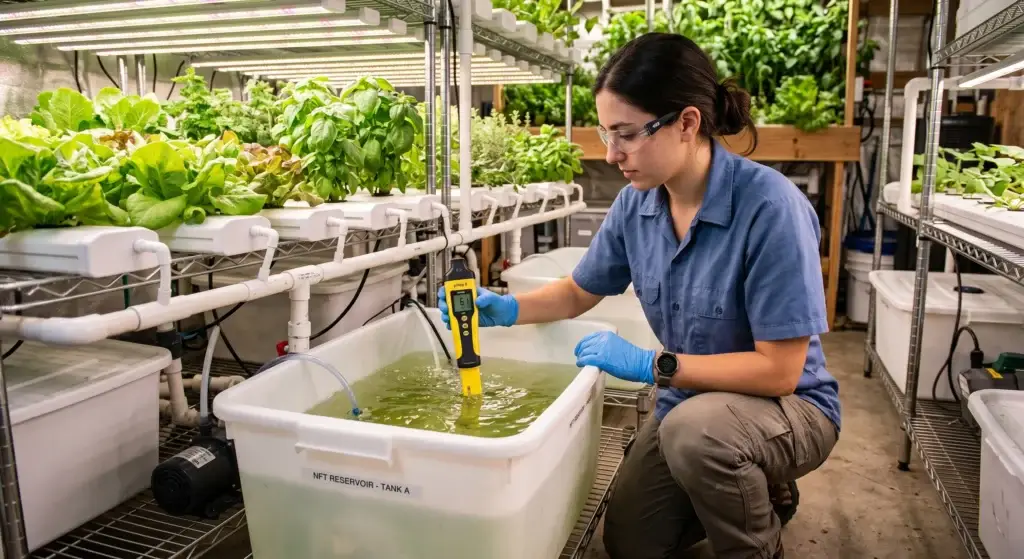
The right pH meter for hydroponics or soil isn’t just about price — it’s about accuracy under real growing conditions, ease of calibration, and whether the tool matches how you actually grow. A $30 pen that needs attentive use and frequent calibration is the right call for some operations, while a continuous in‑line monitor with optional auto‑dosing is the better fit for others that prioritize labor savings and real‑time oversight.
This guide cuts through the noise and helps you choose based on your grow method, your scale, and what you’re actually trying to solve. It focuses on meters and controllers that have proven reliable in commercial cannabis and CEA environments, not just hobby‑grade tools.
Whether you’re a home grower dialing in a tent or a commercial cultivator managing hundreds of gallons of nutrient solution, you’ll find a path to the right tool here.
Why pH Is the Variable Most Growers Underestimate
pH management is one of the most effective — and most often overlooked — ways to protect your nutrient program. When pH drifts outside the optimal window for your system, nutrients become chemically less available even when they’re physically present in the solution or media, a phenomenon growers refer to as nutrient lockout.
The practical result: iron, manganese, and calcium are among the first to become less available on the low pH end, while phosphorus and calcium availability tightens up as pH rises, especially above roughly 6.5 in hydroponic systems and 7.0 in soil. Chasing these symptoms with additional nutrients while ignoring pH almost always makes things worse and can lead to salt buildup and further stress.
Target pH windows by system type:
| System | Optimal pH Range |
|---|---|
| Soil | 6.0–7.0 |
| Coco coir | 5.8–6.3 |
| Hydroponics (DWC, NFT, ebb & flow) | 5.5–6.2 |
| Rockwool | 5.5–6.0 |

These are widely accepted working ranges in which nutrient availability, root health, and microbial activity generally align for cannabis and many other high‑value crops in each system; some cultivars and strategies may run slightly outside them, but drifting far beyond these windows increases the risk of lockout. For more on the relationship between pH and nutrient uptake, read our guide on how to measure and adjust pH for gardening.
What Makes a pH Meter Worth Using
Before picking a specific meter, understand the features that separate tools that work from tools that frustrate. A reliable meter should make it easy to obtain repeatable readings and maintain calibration without constant troubleshooting.
Accuracy and resolution. Most quality digital meters for grow rooms are accurate to about ±0.1 pH units, which is sufficient for nearly all horticultural and cannabis applications where target ranges are typically 0.5–1.0 pH units wide. Lab‑grade meters can reach ±0.01 pH accuracy, but the added precision rarely translates into better crop outcomes unless you are running tightly controlled research or laboratory protocols. Resolution (how many decimal places the display shows) matters more than it sounds: a reading of 5.9 vs. 6.0 is a meaningful difference in hydro when you are managing drift and trend lines over time.
Auto temperature compensation (ATC). pH readings are temperature‑dependent — the same solution tested at 65°F can display a slightly different value than at 75°F because the electrode’s response and the solution equilibria shift with temperature. ATC automatically corrects the reading to account for the measured temperature, removing a major source of error for growers who do not test at a fixed reference temperature or apply manual corrections. Any meter without ATC requires manual temperature correction, which most growers skip, so ATC is effectively a must‑have feature in active grow environments.
Calibration — 1‑point vs. 2‑point vs. 3‑point. A 1‑point calibration zeros the meter at one reference value (usually 7.0), which is not enough to confirm slope accuracy across the working range. A 2‑point calibration (commonly 4.0 and 7.0) is the standard for grow room accuracy and is what most manufacturers recommend for general horticultural use. A 3‑point protocol adds 10.0 for alkaline‑range precision, which matters more for operations that frequently test alkaline water or media. For most hydroponic growers operating in the 5.5–6.5 range, 2‑point calibration at least monthly — and more often for heavy or commercial use — is the practical minimum.
Replaceable probes. Every pH probe ages and degrades due to glass hydration changes and reference junction fouling, regardless of brand. A meter with a replaceable probe can keep working for years because you can swap the sensor when it drifts beyond spec, whereas a meter with a built‑in, non‑replaceable probe is effectively a disposable device once the electrode fails. For any serious grower making a significant investment — especially at commercial scale — replaceable probes significantly extend the meter’s usable life, even though the electronics and housing will still have a finite service life.
Waterproofing. Grow rooms and greenhouses are wet, humid environments. A meter rated around IP67 or better can handle immersion or accidental drops into nutrient solutions, and robust sealing reduces failure from condensation and splashes. For basic pens, at minimum you want splash‑proof construction so that incidental contact with water or nutrient solution does not ruin the unit.
The Three Categories of pH Meters
The right meter category depends on how you grow and how often your reservoirs or media change — not just how much you want to spend. Thinking in terms of workflow and risk tolerance usually leads to a better choice than thinking in terms of price alone.
Portable pH pens and combo meters are the right choice when you’re spot‑checking during waterings, testing runoff, or moving between systems. You pull them out, dip, read, and put them away. They work best for small to mid‑size operations where continuous monitoring isn’t needed or where reservoirs are easy to reach and check manually.
Continuous in‑reservoir monitors stay in your reservoir or nutrient line 24/7 and alert you when pH drifts outside your set parameters. They are a fit for medium to large operations where you need to know immediately when something shifts — without having to physically test each reservoir every time.
Automated pH controllers and dosers monitor and adjust pH automatically, dosing pH Up or Down as needed without any manual intervention once configured correctly. They are best for commercial operations, large RDWC systems, multi‑room setups, or any grow where labor reduction and tighter process control are priorities.
Best Portable pH Meters
Bluelab pH Pen — Best All‑Around Portable Meter
The Bluelab pH Pen is a benchmark for grow room pH testing, delivering quick, reliable pH and temperature readings in a durable, waterproof handheld format suitable for daily use around reservoirs and mixing tanks.
- Resolution: 0.01 pH (displayed to two decimal places for fine control)
- Accuracy: Typically around ±0.1 pH for horticultural use
- ATC: Yes, includes automatic temperature compensation
- Probe: Sealed pen‑style electrode (non‑replaceable; the separate Bluelab Replacement pH Probe is designed for Bluelab controllers and combo meters rather than the pen itself)
- Best for: Hobby to mid‑size operations testing reservoir, feed water, and runoff where a robust, simple pen is preferred
The stabilization indicator on Bluelab pH products lets you know when the reading has settled, reducing guesswork about whether you’ve waited long enough before logging a value. Automatic on/off behavior extends battery life in busy environments. Calibrate at least monthly with 4.0 and 7.0 solutions for light use, and more often in commercial settings or when readings drift. Pair with the Bluelab Conductivity Pen if you also track EC or TDS separately.

Milwaukee PH55 PRO — Strong Alternative at a Different Price Point
The Milwaukee PH55 PRO is a waterproof pH and temperature pen with a replaceable probe, offering similar core functionality to the Bluelab pen but with the long‑term serviceability of a replaceable electrode in a compact form factor.
- Accuracy: About ±0.1 pH in the working range, suitable for horticulture
- ATC: Yes, with automatic temperature compensation
- Probe: Replaceable, which extends the life of the meter body
- Best for: Growers who want replaceable‑probe reliability in a pen‑style device and may already use Milwaukee solutions and accessories
Milwaukee’s calibration and storage solutions are available alongside the meter, making it easy to maintain a complete care kit within one brand ecosystem. Keeping calibration and storage matched to the meter brand simplifies troubleshooting and support if you ever need it.
Best pH/EC/TDS Combo Meters
For growers who want pH, EC, and TDS in a single instrument — eliminating the need to carry a separate conductivity pen — a few strong options serve different priorities. Combo meters are especially useful for dialing in nutrient strength and pH together in recirculating systems.
The Hanna Instruments GroLine Portable Waterproof pH/EC/TDS Meter delivers tight pH accuracy (around ±0.05 pH) with fully waterproof construction and ATC up to high temperatures, making it suitable for warm nutrient solutions and greenhouse environments. Hanna’s Quick Cal solution allows a combined calibration routine that covers both pH and conductivity in under a minute, which is valuable when you have many reservoirs to check. A proven choice for growers who test frequently and want the tightest accuracy spec in a handheld combo.
The Milwaukee MW802 PRO covers the same pH/EC/TDS parameters with an integrated probe and ATC in a straightforward interface that holds up well in commercial environments such as multi‑table rooms or fertigation mixing areas. It is a practical option for operations already working within Milwaukee’s meter ecosystem or for growers who prefer a bench‑style portable unit.
For growers who want all four parameters — pH, EC, TDS, and temperature — in a single waterproof instrument, the Milwaukee MW805 MAX adds an explicit temperature display alongside the full chemistry read, with features like ATC, stability indication, and auto shut‑off.
The Bluelab OnePen remains a strong option in this category — pH, EC, and temperature in a single IP68‑rated probe that can be fully submerged, with 0.01 pH resolution and a replaceable probe — for growers who prioritize Bluelab’s probe longevity, device ecosystem, and Bluelab Connect integration.

Budget Entry Point
If you’re running a small soil or coco grow and want a capable meter without the investment of the options above, the HM Digital COM‑300 covers pH, EC, TDS, and temperature in a straightforward package designed for general water quality and hydroponic applications. It lacks a replaceable probe, so plan to replace the entire unit rather than just the probe when accuracy degrades — but for a hobby grower testing a few pots or a small reservoir, it can do the job if cared for and calibrated regularly.
Dedicated Soil and Media Testing
For growers testing pH directly in soil, coco, or other substrates — rather than only testing solution samples — a probe designed for direct media insertion can provide more convenient, in‑place readings than using a standard liquid‑immersion pen with a slurry prep step. Many agronomy labs still rely on slurry methods for highest accuracy, but direct‑stick probes are extremely useful for rapid in‑situ checks across beds or containers.
The Milwaukee MW101‑SOIL PRO is built specifically for direct measurement in soil and growing media, with an electrode and form factor optimized for pushing into moist substrates and getting stable readings when used according to its instructions.
The Hanna Instruments GroLine Direct Soil pH Tester offers similar direct‑stick capability with a removable sleeve that simplifies cleaning, storage, and probe protection, and is rated to ±0.05 pH with 0.01 pH resolution in soil applications.
The Bluelab Soil pH Pen rounds out the dedicated soil options with Bluelab’s IP67‑rated, double‑junction construction for growers who want to stay within the Bluelab ecosystem across both liquid and media testing.


Best Continuous pH Monitors
Bluelab Guardian Monitor With Wi‑Fi — Best for Medium to Large Operations
The Bluelab Guardian Monitor With Wi‑Fi lives in your reservoir or recirculation loop and continuously tracks pH, EC, and temperature, displaying these values in real time at the tank. It connects to the Bluelab Connect app via Wi‑Fi, letting you monitor your reservoir from anywhere and receive alerts when parameters drift outside your set ranges.
- Readings: pH, EC, and temperature — continuous, 24/7
- Connectivity: Wi‑Fi with app‑based alerts and remote viewing
- Best for: Operations where someone needs to know quickly when pH shifts — without physically walking to the reservoir every time
- Probe: Replaceable, so you can swap sensors as they age without replacing the monitor
Set your high/low alarm thresholds, then let the monitor watch for drift while your team focuses on other tasks. For commercial operations running multiple reservoirs or multi‑room environments, the Guardian scales well as part of a broader monitoring and control stack.
For operations with inline nutrient delivery rather than open reservoirs, the Bluelab Guardian Monitor In‑Line With Wi‑Fi installs directly in‑line with your irrigation system to provide continuous readings in the active fertigation stream.

Best Automated pH Controllers
Bluelab pH Controller & Auto Doser With Wi‑Fi — Best for Automated pH Management
The Bluelab pH Controller & Auto Doser With Wi‑Fi is the step beyond monitoring — it both monitors and adjusts pH automatically using built‑in peristaltic pumps. Connect your pH Up and/or pH Down solutions to its dosing lines, set your target pH and deadband, and it handles corrections within that programmed window.
- Control range: Automated dosing for reservoirs up to roughly 200 gallons per controller under typical mixing and recirculation conditions; very large or complex systems should confirm sizing with the manufacturer
- Connectivity: Wi‑Fi with Bluelab Connect app integration for alerts and remote visibility
- Safety: Dosing lockouts and maximum dosing limits to help prevent overdosing, plus auto‑resume functions after power interruptions when configured appropriately
- Probe: Replaceable pH probe; peristaltic pump cassettes are user‑replaceable components for long‑term serviceability
- Best for: Commercial operations, large RDWC systems, or any grow where manual pH adjustment is a recurring labor cost and a potential point of human error
Milwaukee MC720 PRO — Automated pH Control at Accessible Scale
For operations that want automated pH dosing without adopting the full Bluelab ecosystem, the Milwaukee MC720 PRO pH Controller and Pump Kit delivers single‑pump automated pH dosing with a dedicated controller. It provides continuous pH monitoring with automatic acid or base dosing through the included pump once configured, making it a practical entry point into automated pH management for mid‑size reservoirs.
For operations that need both pH and nutrient control in a single automated unit, the Bluelab IntelliDose Automated pH and Nutrient Controller Kit handles both pH and multiple nutrient channels simultaneously and ties into the Bluelab Connect ecosystem, offering multi‑channel dosing and data logging for advanced fertigation strategies.
Calibration Supplies: Don't Skip This Step
A pH meter is only as accurate as its last calibration. Probes drift over time as the glass and reference junction age or become fouled — this is normal chemistry, not a product flaw — and an uncalibrated meter can give you a false sense of security even if it was accurate out of the box.
Minimum calibration standard: Follow your meter manufacturer’s recommendations, which for many horticultural‑grade meters means 2‑point calibration (4.0 and 7.0) at least every 30 days for light use, and more frequently — weekly or even daily — in heavy‑use commercial environments or when readings begin to diverge from expectations. More frequent calibration is warranted if you test acidic nutrient solutions often, if probes get dirty, or any time you notice readings that seem inconsistent.
Calibration supplies to have on hand:
- Bluelab 4.0 pH Calibration Solution
- Bluelab 7.0 pH Calibration Solution
- Bluelab pH Probe KCI Storage Solution
- — keep your probe hydrated between uses rather than letting it dry out
Always use fresh calibration solution, avoid pouring used solution back into the bottle, and rinse the probe with clean water between buffers to avoid contamination. For the step‑by‑step process, see our guide on how to calibrate a pH pen.

pH Adjustment: Having the Right Products on Hand
Measuring pH is only half the equation. When you need to correct, you need reliable adjustment solutions with predictable strength and behavior in nutrient mixes.
HGV Condition pH Down uses phosphoric acid and is formulated for direct addition to nutrient solutions at label‑specified rates without pre‑dilution in most applications, making it straightforward to dose in small or large reservoirs. Always follow the manufacturer’s instructions for recommended starting doses and safety precautions when handling acids.
HGV Condition pH Up uses potassium hydroxide (KOH) to raise pH quickly. Important: Strong bases like KOH are caustic; follow the product label’s guidance, which may include pre‑dilution in clean water before adding to the reservoir, and always add after all nutrients are fully mixed to prevent localized high‑pH pockets that could interact with nutrient components. The product is available in 1‑gallon and 5‑gallon sizes to match different operation scales.


For Commercial Operations
The TrolMaster Aqua‑X Drop‑In/Inline Heavy‑Duty Nutrient pH Sensor integrates directly with TrolMaster’s Aqua‑X irrigation control system, enabling automated pH data logging, alarms, and integration into a broader fertigation automation architecture. For operations already running TrolMaster for irrigation control, this is the inline pH solution that plugs into the same interface and control logic.
For independent automated pH control — particularly in large RDWC or reservoir‑based systems — the Bluelab IntelliDose manages both pH and nutrient EC dosing automatically, supports multi‑channel operation, and connects to the Bluelab Connect app for remote monitoring and data logging.
At commercial scale, the business case for automation is often compelling: a single technician checking pH manually across a multi‑room facility can introduce human error, inconsistent timing, and labor bottlenecks. Automated monitoring and dosing can reduce that risk, cut repetitive labor, and provide a logged data record that supports compliance and quality control — but each facility should still run its own ROI and risk analysis before investing.
For more on building an automated grow, see our guide on grow room automation and our deep dive on fertigation and automated nutrient delivery.
Caring for Your pH Meter
Store with storage solution, not water alone. pH probes contain a reference electrolyte and a hydrated glass membrane that must stay in the correct chemical environment. Storing a probe dry — even briefly — degrades accuracy and shortens probe life, while long‑term storage in pure distilled water can leach ions from the reference and damage the probe. Use Bluelab KCI Storage Solution or an appropriate storage/buffer solution every time the meter isn’t in use. Distilled water is a short‑term emergency option for preventing the probe from drying out but should not be used for routine storage.
Calibrate regularly. The answer to “how often?” depends on your use: at least monthly if you’re a hobby grower using the meter lightly, at least weekly for commercial operations or heavy daily use, and immediately any time a reading seems inconsistent with what your plants or EC data suggest. Most manufacturers recommend 2‑point calibration with 7.0 and 4.0 calibration solutions for the pH range used in hydroponics.
Replace probes before they fail. A degrading probe can give false readings without obvious warning. For many glass pH electrodes in regular horticultural use, a 12–18 month working life is typical, with careful maintenance sometimes extending beyond that range; budget for replacement on that cadence rather than waiting for obvious failure. The Bluelab Replacement pH Probe fits compatible Bluelab meters and controllers that use detachable probes.
Next step: Once your meter arrives, read our guide on how to measure and adjust pH for your garden to dial in your process from the first test.
Frequently Asked Questions About pH Meters for Soil & Hydroponics
Q: What is the best pH meter for hydroponics?
A: The best pH meter for most hydroponic growers is the Bluelab pH Pen for portable testing or the Bluelab Guardian Monitor With Wi‑Fi for continuous reservoir monitoring, depending on whether you need spot‑checking or 24/7 alerts. Both provide automatic temperature compensation and robust construction suitable for grow room environments, and the Guardian includes a replaceable probe for long‑term service.
For hobby growers testing once or twice per watering, the Bluelab pH Pen hits a strong balance of accuracy, durability, and ease of use. For larger systems where walking to the reservoir every day isn’t practical, the Guardian Monitor can save time and catch pH drift before it causes crop damage.
Commercial operations running automated fertigation should also evaluate the Bluelab IntelliDose or a TrolMaster Aqua‑X inline pH sensor, which integrate pH management into broader irrigation and nutrient control systems.
Q: How often should I test pH in hydroponics?
A: In hydroponics, test pH at a minimum before every watering or reservoir top‑off — and ideally daily — because nutrient solutions can shift pH within 24–48 hours as plants uptake ions at different rates, CO₂ equilibrates, and evaporation concentrates the solution.
In soil and coco, testing once or twice per week is a reasonable baseline, but checking your runoff after each irrigation gives you the most accurate picture of root zone conditions. For any system with critical crop value, continuous monitoring eliminates much of the guesswork and helps you spot trends before they become problems.
Q: How accurate are pH meters?
A: Quality digital pH meters accurate to about ±0.1 pH are the standard for grow room use and are accurate enough for all practical horticultural purposes, given that most target ranges are at least a half‑point wide. Lab‑grade meters accurate to ±0.01 pH exist but offer marginal benefit for most hydroponic growers unless you are operating within tightly controlled research or industrial protocols.
The larger accuracy risk is not the meter’s specification, but calibration drift and probe aging. An uncalibrated meter may have been accurate when purchased but can read 0.3–0.5 off over time without any obvious indication; regular 2‑point calibration and periodic probe replacement are the most important accuracy practices.
Q: Do I need a separate pH meter for soil vs. hydroponics?
A: Not necessarily. Meters like the Bluelab Multimedia pH Meter with Leap Probe or the Bluelab OnePen are designed to test both soil/coco substrates and liquid nutrient solutions, making them efficient options for mixed operations. If you’re running a blend of methods or transitioning between them, a well‑designed dual‑use meter is often the most cost‑effective approach.
Dedicated soil pH probes (like the Bluelab Soil pH Pen or Milwaukee MW101‑SOIL PRO) offer a geometry and junction design optimized for deeper media insertion and better contact in moist substrates, while dedicated hydroponic pens are optimized for immersion in liquid. Neither is strictly required if you have a good combo unit, but specialized probes can improve speed and consistency in their intended media.
Q: What is auto temperature compensation (ATC) in a pH meter?
A: Auto temperature compensation (ATC) is a feature that adjusts the pH reading based on the temperature of the solution being tested. Because pH electrodes and solution equilibria respond to temperature, the same solution can show slightly different values at 65°F vs. 75°F; ATC corrects for this so your reading reflects the true pH at that temperature.
For grow room and greenhouse use — where nutrient solution temperature varies with ambient conditions, chiller performance, and lighting schedules — ATC is effectively a requirement if you want consistent, reliable data without performing manual corrections. Most quality meters above entry‑level include ATC as a standard feature.
Q: How do I know when to replace my pH probe?
A: Replace your pH probe when readings become inconsistent or slow to stabilize, when calibration drift increases significantly between sessions, or when the probe has been in regular use for roughly 12–18 months, which is a common working lifespan for glass electrodes in horticultural environments. Probes generally degrade gradually, so increasing calibration effort and unstable readings are early warning signs.
The good news: most quality meters use replaceable probes, especially in controller and combo‑meter lines. For Bluelab users, the Bluelab Replacement pH Probe fits compatible pH meters and controllers; budgeting the cost of regular probe replacement into your maintenance plan helps prevent surprises and protects crop performance.
Q: Can a pH controller automatically dose my reservoir?
A: Yes. Automated pH controllers like the Bluelab pH Controller & Auto Doser With Wi‑Fi or the Milwaukee MC720 PRO connect to peristaltic pumps loaded with your pH Up or pH Down solution. You set a target pH and a deadband (an acceptable range around that target), and the controller doses in small increments as needed to maintain that window, according to its settings.
These systems typically include safety features such as dosing lockouts, maximum dosing limits, and alarms to help prevent overdosing, and many can resume their control logic after a power outage once power is restored. They are most cost‑effective where manual pH checking and adjustment is a daily labor task across large or multiple reservoirs.
Q: What's the difference between a pH pen and a pH combo meter?
A: A pH pen tests pH (and usually temperature), while a combo meter tests pH plus EC and/or TDS in one instrument, often with a single integrated probe that handles all parameters. Combo meters allow you to check both pH and nutrient concentration with one tool, which can be especially efficient in hydroponic and fertigation systems.
The tradeoff is a slightly higher upfront cost and a bit more complexity. For growers who need to track both pH and nutrient concentration — which includes most serious hydroponic and coco operations — a combo meter like the Hanna GroLine Portable Waterproof pH/EC/TDS Meter, the Milwaukee MW802/MW805, or the Bluelab OnePen is usually a better long‑term value than buying separate instruments.
Q: Why does my pH keep drifting back after I adjust it?
A: pH drift after correction is normal in active systems and usually indicates one or more of the following: the buffer capacity of your nutrient solution is low (lighter mixes tend to drift faster), your plants are uptaking cations and anions unevenly (shifting solution chemistry over time), or your system has a CO₂ interaction that temporarily acidifies the solution, especially in recirculating setups.
The solution is not to chase pH with large corrections, but to understand your typical drift rate and correct within that cadence. An automated pH controller is the most reliable answer for systems that drift frequently; for manual systems, testing at the same time each day and making small, measured adjustments builds a predictable correction rhythm.
Q: What's the correct pH range for cannabis in hydroponics?
A: For cannabis in hydroponic systems (DWC, NFT, ebb & flow, and similar), a working range of about 5.5 to 6.2 is widely recommended, with 5.8–6.0 as a common target window during most growth stages. In coco coir specifically, 5.8–6.3 is a practical range, as coco’s cation exchange properties and buffering allow slightly wider tolerances without immediate issues.
For soil‑grown cannabis, targeting 6.0–6.8 generally supports good nutrient availability and microbial activity, while pH consistently above 7.0 increases the risk of iron and manganese becoming less available even in well‑amended soils.