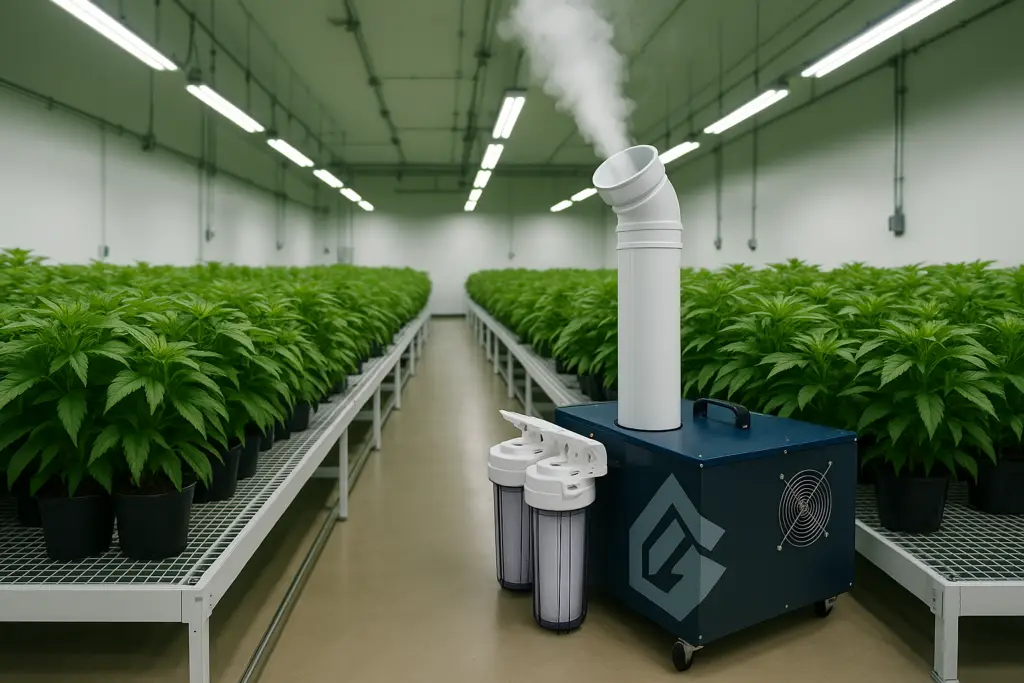
At Hydrobuilder, everything starts with your grow. Our job is to make the seed-to-harvest journey simpler, smarter, and more rewarding—so you can make confident decisions and keep plants thriving.
This guide shows you when a humidifier helps, how to size it correctly in under a minute, and the best picks for tents, rooms, and commercial spaces—curated by growers, for growers.
Quick Start (What to do first)
- Measure, don’t guess. Log RH during lights-on and lights-off with a reliable sensor.
- Use the calculator. Our Humidifier Sizing Calculator turns your room size, temperature, and airflow into exact L/h and PPD requirements. (Advanced mode factors plant transpiration and dehu removal.)
- Pick with headroom. Choose a unit with capacity at or above your net load so it isn’t pinned at 100% all day.
PPD ↔ L/h quick math: 1 L/h ≈ 2.113 PPD. PPD = L/h × 24 × 2.113.
What Is a Grow Room Humidifier Used For?
A grow room humidifier adds moisture to the air so you can maintain plant-friendly humidity—especially indoors where you control the environment. Horticulture units are designed for continuous duty, with mist output and airflow patterns that hold setpoints across active canopies.
Why it matters: When air is too dry, plants lose water faster than roots can replace it. They respond by closing stomata to conserve moisture—which also reduces CO₂ intake and slows growth. Keeping RH in range supports steady transpiration, nutrient movement, and photosynthesis.
Typical RH targets by stage
- Seedlings / Early Veg: ~70–75% RH
- Veg: ~50–70% RH
- Flower: ~40–50% RH (often lower late flower to reduce pathogen pressure)
(For precision, pair these with your VPD chart at target canopy temp.)
Do You Really Need a Humidifier?
Not every space needs one all the time. Start by monitoring your RH against the targets above.
- If you’re consistently below target → a humidifier helps.
- If you’re in range or high → skip humidification and focus on airflow and dehumidification.
- If RH swings day/night → a controller with day/night setpoints can stabilize things.
When Humidity Is Too Low (Symptoms & Risks)
- Canoeing or edge curl, leaves feel papery/dry
- Slowed growth, tight internodes without vigor
- Over-transpiration → plants close stomata → lower CO₂ uptake
- Media dries faster; frequent irrigations with little gain
Quick Fixes Before You Buy
- Place a shallow tray of water with a gentle fan moving over it (micro tents).
- Reduce unnecessary ACH (air changes) or leaks that dump moisture.
Raise canopy temperature slightly to nudge RH/VPD into range.
If RH still won’t hold, use the calculator to size a unit with proper headroom.
The Humidifier Sizing Calculator
Size your humidifier in 60 seconds
Enter your tent/room dimensions, temp, and ACH—get your exact L/h and PPD requirement, plus a suggested class. Advanced options account for plants and any running dehumidifier.
Open Calculator → Humidifier Sizing Calculator
How it works
- Enter L × W × H, grow temperature, and ACH (air changes/hour).
- Set ambient RH and your target RH.
- (Optional) Add plant count/irrigation, transpiration fraction, and dehumidifier removal.
- The calculator returns L/h & PPD and a suggested capacity class.
- Choose a model with ≥ your net load and room to grow.
Worked example
A 4×4×6.5 ft tent at 77°F, 6 ACH, ambient 30% RH, target 65% RH → typical need ≈ 28–35 PPD. Select a unit rated at or above this (the 75–150 PPD class leaves healthy headroom).
Built for growers, backed by experts—if the numbers look odd, our cultivation advisors will sanity-check your setup and recommend the right class.
Best Humidifiers by Grow Size
Actual needs vary with ACH, ambient RH, plant count, and temperature. Use the calculator for precise sizing.
Grow Size
|
Typical Net Need (PPD)
|
Recommended Class
|
Why It Works
|
|
2×2–3×3 tents
|
5–30
|
Compact ultrasonic (4–6 L, top-fill)
|
Quiet, fine mist, easy daily top-offs.
|
|
4×4 tents / small rooms
|
25–50
|
75–150 PPD ultrasonic
|
Fast RH response, directional fog heads.
|
|
4×8 / 5×10 rooms
|
50–120
|
~200 PPD ultrasonic
|
Enough headroom for late-veg spikes.
|
|
10×10 rooms
|
120–200+
|
~300 PPD ultrasonic
|
Even coverage with fewer swings.
|
|
Commercial bays
|
300–600+
|
Pro ultrasonic 600 PPD
|
High capacity, caster-mounted, controller-ready.
|
Reminder: If humidity runs high, skip humidification and see our dehumidifier guide. We carry everything under one roof with expert support so you get the right tool the first time.
Product Picks
We handpick proven solutions—not passing fads—so growers can decide with confidence. If you’re outfitting multiple rooms or buying in volume, our team can bundle and quote everything you need.
Ultrasonic vs. Evaporative vs. Steam
Ultrasonic (most popular with growers)
Pros: Ultra-fine mist, quick RH response, efficient, quiet
Cons: Needs clean water or you’ll see mineral “white dust”
Best for: Most tents/rooms; commercial when sized and controlled
Evaporative (wick/drum)
Pros: Less dust risk; naturally self-limiting (harder to overshoot)
Cons: Slower response; wicks/filters to replace
Best for: Simpler maintenance priorities
Steam/Fogging systems
Pros: Very high capacity; great with central controls
Cons: Higher power draw; more complex install and safety considerations
Best for: Commercial facilities with high ACH and building-level control
Placement, Water Quality & Maintenance
Placement
Aim the outlet above or lateral to canopy and into moving air (near an intake or oscillating fan). Don’t blast leaves or light lenses.
Water Quality
Use RO or distilled to prevent mineral scale and “white dust.” If you must use tap, add pre-filters and clean more often.
Sanitation
- Daily/Every other day: Top off; quick check for pooling.
- Weekly: Drain, rinse tank; wipe internal surfaces; inspect nozzles.
- Biweekly–Monthly: Disinfect with a mild, manufacturer-approved solution (e.g., diluted H₂O₂); rinse thoroughly.
- Quarterly: Replace wicks/filters (evap) or inspect ultrasonic transducers (pro units).
Control & Integration
Use an environmental controller with a quality RH sensor at canopy height, out of the fog stream. Coordinate with any dehumidifier to avoid tug-of-war; a 2–3% RH deadband keeps things stable. Designing a larger space? Our specialists can help with airflow mapping, irrigation/fertigation integration, and HVAC considerations—end-to-end.
Growing at Scale?
If you’re upgrading rooms or building out new space, we’ll tailor a Custom Quote (volume pricing + product mix + timelines) and act like an extension of your team from planning to delivery.