

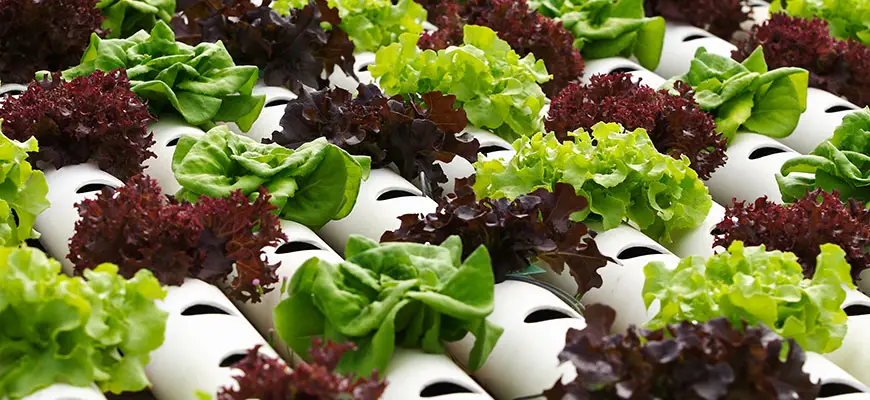
Lettuce is the most forgiving crop you can put in a hydroponic system. It tolerates a wide pH range, thrives at low EC levels, produces harvestable leaves in as few as three to four weeks, and bounces back quickly after a cut-and-come-again harvest. Whether you’re running a single bucket on a countertop or managing channels across a commercial floor, hydroponic lettuce is an ideal starting point — and a surprisingly profitable finishing point.
This guide covers everything you need: system selection, germination, lighting, nutrients, pH and EC management, tipburn prevention, and harvest timing. If you’re just getting started with hydroponics, lettuce will teach you the fundamentals faster than any other crop.
Whether you’re growing a few heads for your kitchen or scaling up to feed a wholesale account, the core principles are the same. The equipment and throughput targets just look different.
Which Hydroponic System Works Best for Lettuce?
Lettuce is compatible with nearly every hydroponic system design, but your choice should match your scale, budget, and goals — not just what’s easy to find.
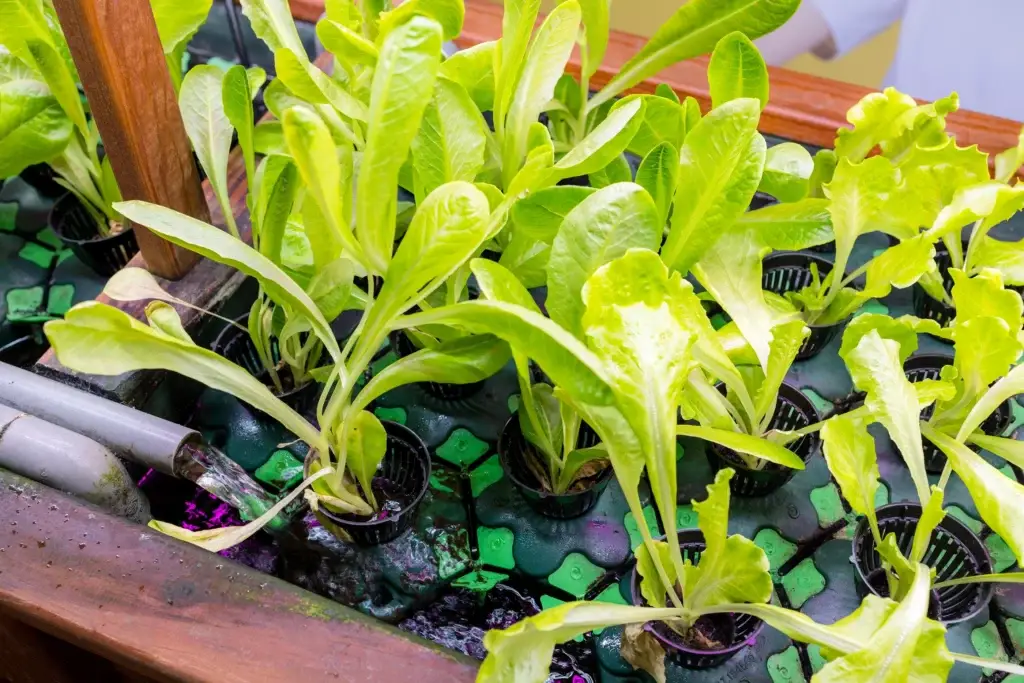
Deep Water Culture (DWC)
DWC suspends plant roots in aerated, nutrient-rich solution. It’s one of the most popular systems for lettuce because it produces consistently large, tender heads and is straightforward to maintain. Dissolved oxygen is critical: keep it above 7 ppm for optimal growth, and expect problems below 4 ppm. Water temperature should stay between 65–72°F to support oxygen saturation and root health.
The Active Aqua Root Spa 5-Gallon 4-Bucket System is a practical DWC entry point for smaller grows. Learn more about how dissolved oxygen affects root zone performance in our guide on dissolved oxygen in hydroponics.
Ebb and Flow (Flood and Drain)
Ebb and flow systems flood a grow tray with nutrient solution at timed intervals, then drain back to a reservoir. They’re highly adaptable — you can run them with rockwool, clay pebbles, or loose growing media — and they scale well from a single tray to a multi-table setup.
The Active Aqua Grow Flow 12-Site Ebb & Flow System offers a solid mid-range option with 12 individual growth modules. For a larger pre-built ebb and flow setup, the Super Closet Super Flow System supports up to 32 sites and automates feeding cycles. Browse the full ebb and flow collection to find the right fit for your space.
Nutrient Film Technique (NFT)
NFT runs a thin, continuous film of nutrient solution along the bottom of sloped channels, exposing the upper root mass to air. It’s the dominant system in commercial lettuce production because of its scalability, space efficiency, and predictable cycle times. NFT requires tight EC and pH management — the low water volume means fluctuations happen quickly. It’s not the best starting point if you’re new to hydroponics.
What System Should You Start With?
If you’re new to hydroponics, DWC or ebb and flow offer more buffer for beginner mistakes. DWC is especially forgiving on nutrients and timing. If you want to understand what the different system types look like in practice before committing, our guide to types of hydroponic systems covers each one in depth.


How to Start Hydroponic Lettuce from Seed
Choosing a Propagation Medium
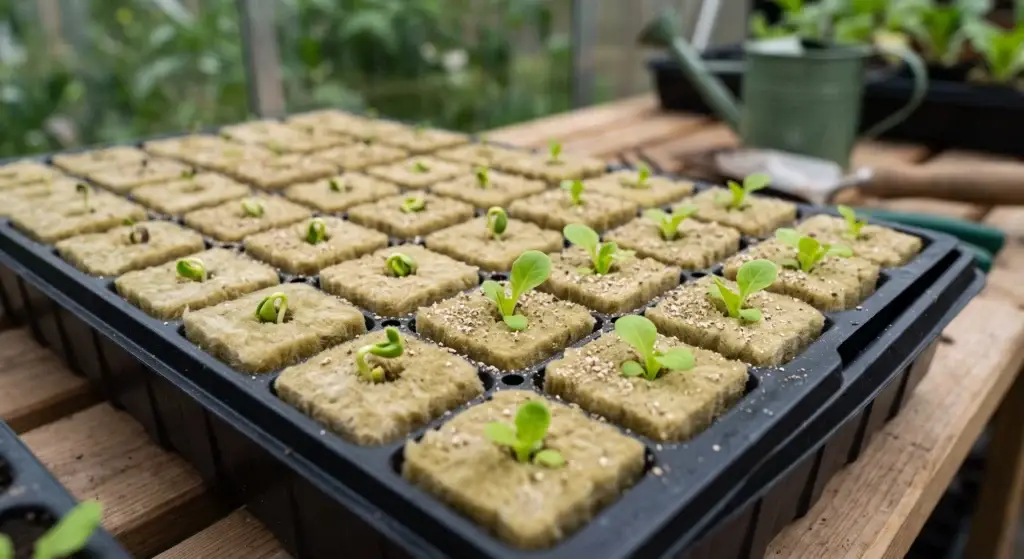
Germinate lettuce in a pre-formed plug or cube — not loose media. The most common options are rockwool starter plugs and foam plugs.
VidaWool 1.5″ Rockwool Propagation Plugs are a reliable choice. Pre-soak them in pH-adjusted water (5.5–6.0) for at least one hour before use to lower their naturally alkaline pH. Rinse thoroughly before seeding.
For a plug-and-play option without the pre-soak step, the iHort Q-Plug Starter Plugs are pre-formed, made in the USA, and transfer cleanly into net pots or channel openings.
The HBX 50-Site Seedling Starter Kit with Root Plugs includes everything you need to germinate 50 plants at once — useful when you want to stagger multiple harvest cycles.
Germination Parameters
Sow 1–2 seeds per plug. Lettuce germinates best between 65–70°F; above 75°F, germination rates drop sharply and may fail entirely. Expect sprouts in 2–4 days under ideal conditions. If you see nothing in two weeks, start over. A humidity dome helps retain moisture during germination, but remove it once sprouts emerge to prevent damping off.
Once seedlings develop 3–4 true leaves and roots are visible through the bottom of the plug (typically 10–14 days), they’re ready to transplant into your system. See our complete guide to germinating seeds for more detail on the process.
Lettuce Lighting: How Much Light Do You Actually Need?
Lettuce is a low-light crop by hydroponic standards, but light intensity directly determines your cycle time. This relationship is linear: cut your daily light integral (DLI) in half and your crop takes roughly twice as long to finish.
A DLI of 14–20 mol/m²/day supports the fastest cycle times (24–35 days to harvest in DWC under controlled conditions). Below 10–12 mol/m²/day, cycle times extend significantly and yields decline.
Target 10–16 hours of light per day, adjusting based on your available light source. Fluorescent T5 fixtures have traditionally been the go-to for lettuce because they run cool and hang low without burning — browse options in the grow lights collection. Full-spectrum LED bars are increasingly popular for lettuce because of their efficiency and thin profile, which works well over low-canopy crops.
One important caveat: above 17 mol/m²/day without adequate airflow, lettuce is prone to tipburn (more on this below), especially in varieties prone to tipburn or where air circulation is limited. More light is not always better — airflow and calcium uptake have to keep pace.
After adjusting your light setup, check our guide on how to hang grow lights to set the right mounting height.
Nutrients, pH, and EC for Hydroponic Lettuce
Lettuce is a light feeder with one notable exception: calcium demand. Get the basics right and you’ll have very few problems.
pH Range
Maintain nutrient solution pH between 5.5 and 6.5. The sweet spot for lettuce is 5.8–6.2, which maximizes availability of both nitrogen (needed for leafy growth) and calcium (critical for cell wall integrity and tipburn prevention).
Use HGV Condition – pH Down to drop pH — it requires no dilution and is formulated to work directly with nutrient solutions. If you need to raise pH, HGV Condition – pH Up is potassium hydroxide-based and highly concentrated — always dilute before adding, and add it after all nutrients are fully mixed.
For more on testing and adjusting, see our guides on pH management and how to calibrate a pH pen.
EC Range
Lettuce prefers a low EC: 0.8–1.8 mS/cm across most of the growth cycle. Seedlings and young transplants should start at the low end (0.8–1.0). As heads size up, you can push toward 1.5–1.8. Above 2.0 mS/cm, some varieties may develop bitterness or marginal tip burn — monitor closely.
Check solution strength daily with a reliable meter. The Bluelab Combo Meter measures pH, EC, and temperature simultaneously and is a workhorse piece of kit for any hydroponic operation.
What Nutrients to Feed Hydroponic Lettuce
Lettuce is in a vegetative state its entire life — it never flowers. That means you want a nutrient profile emphasizing nitrogen, calcium, and potassium, with moderate phosphorus.
HGV Dry Grow (3-6-22) provides a strong vegetative macro profile and pairs with HGV Base (14.5-0-0) to deliver the calcium and nitrogen lettuce needs throughout the crop cycle. This two-part system is formulated for commercial hydroponic environments but scales down cleanly to smaller operations. HGV Base is the constant — run it alongside Grow for the full cycle. See our complete guide to nutrients and pH for more on how to build a feeding program.
Replace your reservoir solution every 7–14 days in recirculating systems to prevent salt accumulation and biofilm formation. In commercial recirculating systems, monitor EC drift daily and drain-and-refill when EC rises more than 20% above target, rather than on a fixed interval. Between reservoir changes, top off with plain pH-adjusted water — plants take up water faster than nutrients, which gradually increases EC if you top off with full-strength solution.


Tipburn: The Most Common Lettuce Problem in Hydroponics
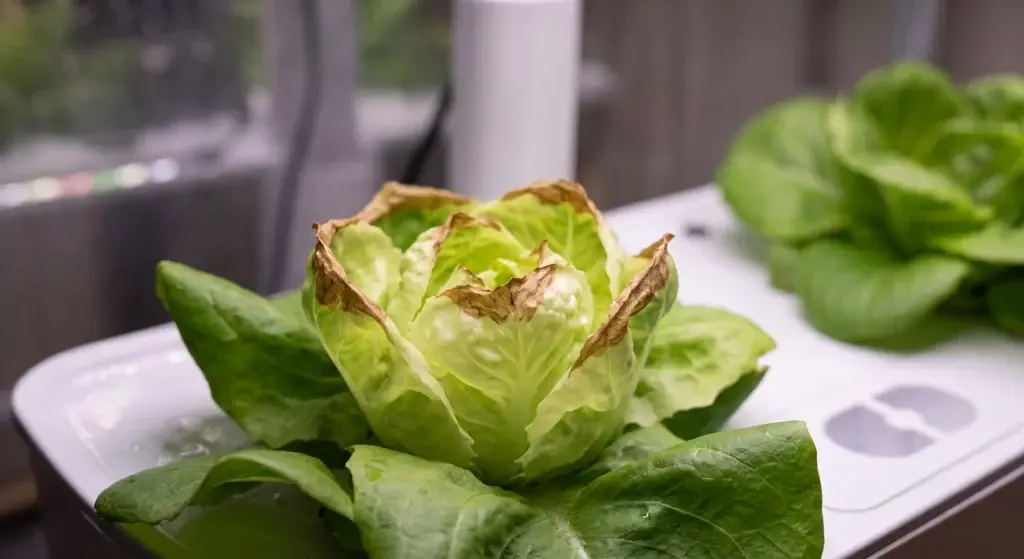
Tipburn is the browning and die-off of leaf edges, most visible on inner leaves of heading varieties. It’s not a pathogen — it’s a calcium deficiency localized to the leaf tips, caused by insufficient calcium transport rather than a lack of calcium in the solution.
The mechanism: calcium moves through plants via transpiration-driven water flow. If airflow across the canopy is insufficient, the inner leaves of a forming head don’t transpire enough to pull calcium into developing tissue. High light intensity accelerates leaf growth faster than calcium can keep up, which is why tipburn risk increases above 17 mol/m²/day, especially in varieties prone to tipburn or where air circulation is limited.
How to prevent tipburn:
- Run a gentle oscillating fan directed above the canopy — not at the plants directly — to maintain consistent air movement across developing heads
- Keep lettuce temperature below 72°F; warmer canopies transpire faster and outpace calcium delivery
- Keep nutrient solution pH between 5.8–6.2 where calcium is most available
- Avoid sudden DLI spikes — bring intensity up gradually
- For heading varieties, consider DWC over NFT; research shows DWC produces lower tipburn incidence in high-temperature or summer conditions
For more on calcium’s role in plant health, see our guide on calcium deficiency in plants.
Temperature, Humidity, and Airflow
Lettuce is a cool-season crop. The ideal temperature range is 60–70°F — below the 75°F upper limit cited in some guides, especially for heading varieties. Above 72–75°F, growth accelerates in ways that outpace calcium transport and trigger bolting in warm-sensitive varieties. Bolting produces bitter, inedible leaves, and there’s no recovery once it starts.
Night temperatures in the 55–65°F range support compact, sweet heads. If you’re growing in a warm climate or summer indoors, water temperature management matters almost as much as air temperature. Keep reservoir solution between 65–72°F. Our article on why hydroponic water temperature matters explains the dissolved oxygen and root pathogen implications of running warm water.
Maintain airflow without pointing fans directly at plants. Indirect circulation across the canopy keeps humidity from stratifying around developing heads and delivers the transpiration-driven calcium movement that prevents tipburn.
Harvesting Hydroponic Lettuce
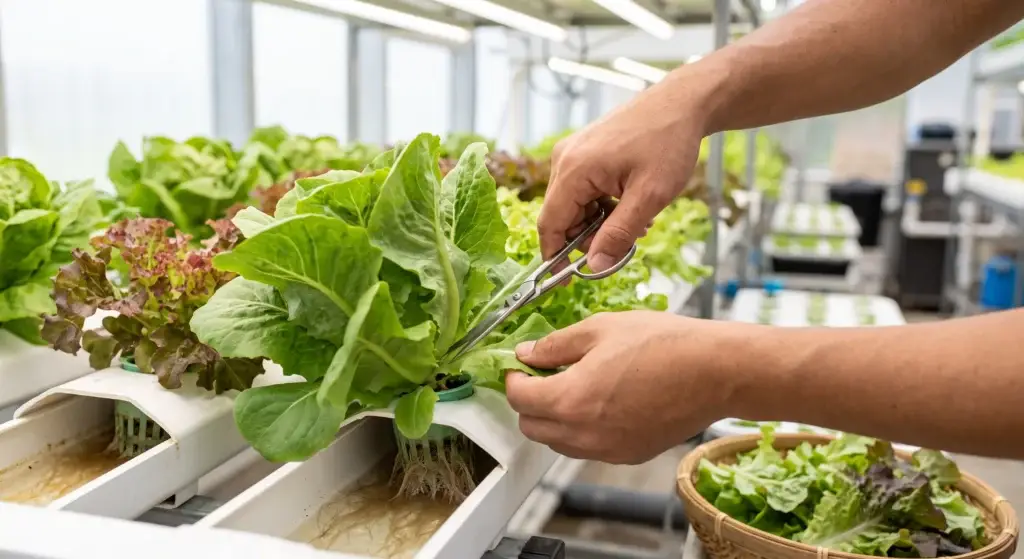
Leaf varieties (loose-leaf, oak leaf, Red Sails): Begin harvesting outer leaves once plants are 4–6 weeks old. Harvest from the outside in, leaving the central growing point intact. This is the cut-and-come-again method — a single plant can yield multiple harvests over 6–8 weeks before quality declines.
Heading varieties (butterhead, romaine, iceberg): Wait for the head to firm up before harvesting the whole plant, typically 35–60 days depending on variety and DLI. Harvest before the central bud begins to elongate — that’s the early signal of bolting.
In both cases, bitter leaves usually mean one of three things: too much heat, EC that’s too high, or a plant that’s bolting. Flushing the system with plain pH-adjusted water for 24–48 hours sometimes recovers mildly bitter plants, but if it’s bolting, harvest immediately and start fresh.
Best Lettuce Varieties for Hydroponics
Any lettuce variety grows hydroponically, but some are better suited than others:
Butterhead (Boston, Bibb, Buttercrunch): Tender, mildly sweet leaves; forms compact heads. Relatively tipburn-resistant compared to iceberg types. Matures in 30–45 days under good DLI.
Loose-leaf (Red Sails, Green Oakleaf, Black Seeded Simpson): Fastest to harvest; cut-and-come-again friendly. Lower tipburn risk because inner head formation is minimal. Best for short cycle times and continuous production.
Romaine: More upright growth habit; slightly more light-demanding than butterhead. Crisp texture holds well after harvest. Takes 40–60 days.
Iceberg: Most tipburn-prone of the common types — the dense heading structure limits inner-leaf airflow and calcium delivery. Viable in DWC with strong air circulation; challenging in NFT.
Why Shop at Hydrobuilder for Your Hydroponic Lettuce Setup
Hydrobuilder carries the full stack for hydroponic lettuce — from seed starting supplies and grow media to nutrients, meters, and complete systems. The product catalog spans hobby-scale countertop setups to multi-site commercial configurations, and the team includes growers with real hands-on experience across crop types and system designs.
If you’re not sure where to start or want to verify your setup choices before purchasing, use the
Grow Diagnostics tool or reach out directly.
Commercial accounts are available for operations with volume purchasing needs.
For Commercial Lettuce Operations
At commercial scale, hydroponic lettuce production becomes a throughput optimization problem. The variables are DLI, cycle time, spacing density, and turns per year — and every decision compounds.
System selection: NFT dominates commercial lettuce production because it supports high planting density, eliminates the need for individual growing media per site, and allows plant spacing to be tightened during early growth then expanded as canopies develop. DWC raft systems (also called pond or raceway systems) are the other dominant format — they require more water volume and pumping infrastructure but produce consistently larger heads with lower tipburn incidence.
Cycle targets: At a DLI of 17 mol/m²/day in DWC, 5–6 oz. heads can be ready 24 days after transplanting. Most commercial operations target 28–35 days from transplant to harvest, with a 10–14 day propagation phase preceding transplant. That supports 6–8 crop turns per year on a well-managed floor.
Nutrition at scale: HGV Dry Grow and Base are available in 25 lb. formats (HGV Dry Grow 25 lbs. / HGV Dry Base 25 lbs.) designed for concentrate mixing in commercial reservoir systems. The dry format delivers a lower cost per feed at scale and an extended shelf life compared to liquid concentrates.
Fertigation at scale: For operations running nutrient injection into irrigation systems,
Dosatron proportional dosers deliver nutrients directly into the water line at a consistent ratio, eliminating manual mixing. Visit the fertigation collection to see the full range of Dosatron units and accessories.
Monitoring: At commercial throughput, pH and EC drift that goes unnoticed for a day can affect an entire batch. The Bluelab Combo Meter is a reliable handheld option for daily spot checks. For continuous monitoring across reservoirs, TrolMaster’s Aqua-X controllers integrate pH and EC sensing with automated alerts.
Propagation: Most commercial operations propagate in dedicated germination areas before transplanting to grow-out systems.
iHort 98-Cell Prefilled Excel Plug Trays — pre-filled with iHort’s proprietary growing medium — reduce labor and deliver consistent plug geometry for uniform transplanting. For commercial accounts, visit Hydrobuilder Commercial.
FAQ for Hydroponic Lettuce
Q: What pH should hydroponic lettuce be grown at?
A: Maintain pH between 5.5 and 6.5, with 5.8–6.2 as the optimal range. This window supports nitrogen uptake for leafy growth and maximizes calcium availability, which is essential for preventing tipburn. Check pH daily in recirculating systems, as plants and evaporation shift it constantly.
Q: How long does lettuce take to grow hydroponically?
A: It depends on variety, DLI, and system. Loose-leaf types can be harvested in 3–4 weeks; heading varieties typically take 5–8 weeks from seed under home-scale conditions. In optimized commercial DWC with DLI at 17 mol/m²/day, 5–6 oz. heads can reach harvest 24 days after transplanting. Lower light levels extend the cycle proportionally.
Q: Why is my hydroponic lettuce bitter?
A: The most common causes are excess heat (above 72–75°F triggers stress and bolting) and high EC (above 2.0 mS/cm may concentrate compounds that produce bitterness in some varieties). If temperatures and EC are within range and bitterness is still present, check whether the plant is beginning to bolt — the central stem elongating is the visual cue. Harvest immediately if bolting has started.
Q: What is the best nutrient solution for hydroponic lettuce?
A: Lettuce needs a vegetative-focused profile — emphasizing nitrogen, calcium, and potassium — at low overall concentration (EC 0.8–1.8). A two-part system like HGV Dry Grow plus HGV Base covers the full spectrum without additives. The key element to watch is calcium: insufficient calcium relative to other nutrients is the primary driver of tipburn.
Q: Can you grow lettuce in any hydroponic system?
A: Yes, but performance varies. DWC and ebb and flow are most forgiving for beginners. NFT is most common at commercial scale for its density and efficiency. The Kratky method (passive DWC, no pump) works for small countertop grows but doesn’t scale. Aeroponics produces fast growth but is the most technically demanding to maintain.
Q: What EC should I use for hydroponic lettuce?
A: Start seedlings and young transplants at 0.8–1.0 mS/cm. Move to 1.2–1.6 as plants develop. Heading varieties near harvest can handle 1.6–1.8. Above 2.0 mS/cm, some varieties may develop bitterness or marginal tip burn — monitor closely. Lettuce is sensitive to high salt concentration — less is more with this crop.
Q: Does hydroponic lettuce taste different from soil-grown lettuce?
A: Hydroponic lettuce tends to be milder and more consistent than field-grown, partly because of reduced environmental stress and partly because you control the full nutrient profile. Some growers find hydroponic butterhead and loose-leaf varieties to be more tender. The flavor outcome depends heavily on variety selection and how close to harvest you manage temperature — cool finish temperatures produce sweeter heads.
Q: How do I prevent algae in my hydroponic lettuce system?
A: Algae needs light and nutrients to grow. Block light from reaching the reservoir and any exposed solution surfaces — use light-blocking covers, dark tubing, and opaque reservoir lids. Don’t let net pot openings be exposed to direct light. In recirculating systems, replacing the reservoir solution every 7–14 days disrupts algae establishment before it becomes established. For persistent algae in irrigation lines, HGV Condition – Clear (hypochlorous acid) maintains clean lines without harming plants.
Q: How do I harvest hydroponic lettuce using the cut-and-come-again method?
A: For loose-leaf varieties, harvest outer leaves once they reach usable size — typically when they’re 4–6 inches long. Cut or snap leaves from the outside of the plant, leaving the central crown intact. The plant will continue producing new leaves from the center. You can harvest this way for 6–8 weeks before plant quality declines. Heading types aren’t suited to cut-and-come-again — harvest the entire head when it firms up.