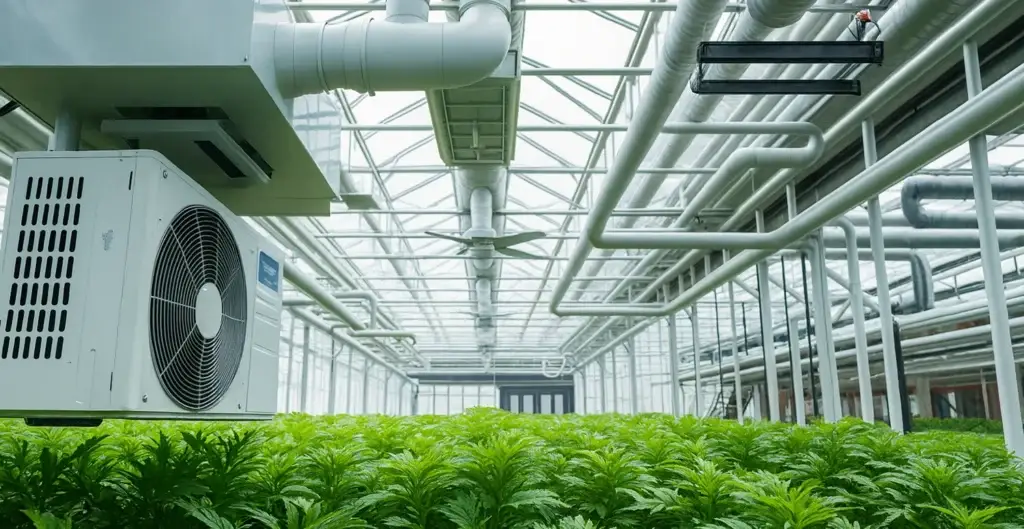
Every watt of power you bring into a grow room eventually becomes heat — and your air conditioner is the only thing standing between that heat and your plants. Choosing the right grow room air conditioner isn’t just about staying comfortable; it’s about maintaining the temperature stability that keeps photosynthesis running at full efficiency, VPD in range, and pest pressure down.
Whether you’re cooling a 4×4 tent with a single 600W LED or managing climate across multiple rooms in a licensed facility, this guide walks you through exactly how to size your AC, which type of system fits your setup, and which units Hydrobuilder recommends for hobby and commercial growers alike.
If you’re here because your grow space is already running hot, start with the Grow Room BTU Calculator — it handles the math for you. Then come back here to understand what the numbers mean and how to apply them.
Commercial growers: The sizing principles here apply at any scale, but jump to the Commercial Climate Control section for guidance on multi-zone systems, building management integration, and high-load heat management in continuous production facilities.
Why Grow Room Cooling Is Different From Home Air Conditioning
Residential AC sizing assumes roughly 20 BTU per square foot with modest internal heat gains. Grow rooms are completely different — a well-lit 10×10 room running 4,000W of LEDs generates more heat per square foot than most commercial kitchens.
The reason: every watt of electricity flowing into your space eventually becomes heat. Grow lights are the dominant source, but they’re not the only one. Dehumidifiers, ballasts, pumps, CO₂ burners, and even the people working in the room all add to the heat load. The key insight most growers miss is that your dehumidifier is also a heater — a 700W dehumidifier running continuously adds roughly 2,400 BTU/hr to your cooling load, almost as much as a 600W LED.
This is also why grow room AC and humidity control are inseparable decisions. When you size your air conditioner, you need to know what dehumidifier you’re running alongside it. Undersized cooling paired with an active dehumidifier creates a thermal arms race your plants pay for.
For a deeper look at the relationship between temperature and humidity in your canopy, see our VPD guide.
How to Calculate Your Grow Room BTU Requirement
The short answer: multiply your total equipment wattage by 3.41 to get BTU/hr, then add a 20–30% safety buffer. For a sealed room, use 30%.
The detailed version:
Your total heat load comes from five sources:
- Grow lights — Every watt of actual draw (check your driver label, not the marketing spec) generates approximately 3.41 BTU/hr. LEDs convert 30–40% of their wattage to heat inside the room; HPS fixtures convert 60–70%.
- Other equipment — Fans, pumps, controllers, CO₂ generators, and related gear. Typically 5–15% of total light wattage.
- Dehumidifier — Nearly 100% of its wattage converts to heat. A 700W dehumidifier adds ~2,400 BTU/hr.
- Ventilation infiltration — If you’re pulling in warm outdoor air, calculate sensible heat gain based on air volume and temperature differential.
- People — Each person working in the space adds approximately 400 BTU/hr.
Once you have a total BTU/hr figure, add your safety buffer and convert to tonnage if needed (1 ton = 12,000 BTU/hr). Use the calculator to run this math automatically with all variables included.
Note: These figures assume LED-only lighting in well-insulated spaces. HPS grows generate significantly higher heat loads — add 15–25% to baseline BTU for equivalent wattage HPS.
How Your Grow Equipment Affects Cooling Needs
Grow Lights
Lighting is typically the largest heat source in any indoor grow — usually 70–80% of total heat load. HPS fixtures generate more radiant heat than equivalent-wattage LED, which matters when sizing down after a light conversion. If you recently switched from HPS to LED, your existing AC may be oversized for your new setup, and your dehumidifier may be undersized (since LED grows tend to run higher relative humidity under lower ambient temps).
For guidance on modern LED options, see our LED grow light buying guide.
CO₂ Burners
If you’re running a sealed room with a CO₂ burner, you have a combustion appliance inside your grow space generating significant heat. A standard burner running at medium output can add 3,000–5,000 BTU/hr or more. This is a sealed-room-only consideration — open-loop ventilated setups don’t benefit from CO₂ supplementation. See our CO₂ calculator for supplementation context.
Dehumidifiers
Dehumidifiers are frequently overlooked in BTU calculations, but they matter. A 700W unit running continuously adds roughly 2,400 BTU/hr — and in peak humidity periods (dense canopy, late flower), your dehumidifier may run near-constantly. Budget this heat load in at 100% of dehumidifier wattage rather than a partial estimate. For sizing your dehumidifier alongside your AC, see our grow room dehumidifier sizing guide.
Ventilation
Open-loop ventilation (air exchange with the outside or adjacent unconditioned space) introduces a variable heat load that depends on outdoor temperature. In a hot climate running 3 ACH, this contribution can rival your secondary equipment heat. Sealed room designs with CO₂ supplementation eliminate this entirely — but require more precise humidity management.
For a full primer on air exchange, circulation, and exhaust, see our ventilation setup guide.
Types of Grow Room Air Conditioners
Portable Air Conditioners
Portable units are the right choice for grow tents, small rooms under 150–200 sq ft, and temporary or rental setups where permanent installation isn’t an option. They’re plug-and-play: roll in, route the exhaust hose out a window or through a tent port, and you’re running. Practical range is up to about 14,000 BTU/hr.
The trade-offs: lower energy efficiency than mini-splits (EER ratings typically 8–11 vs. 15–22+ for inverter mini-splits), more noise in the grow space, and the need to manage an exhaust hose. Single-hose portables recirculate some negative pressure — dual-hose designs are preferred for sealed rooms.
Mini-Split (Ductless) Systems
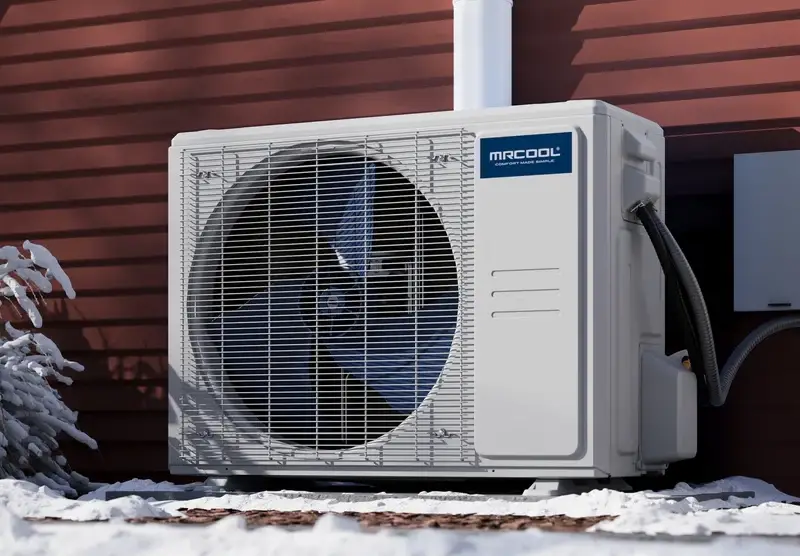
Mini-splits are the standard solution for serious hobby grows and commercial operations. An outdoor compressor connects to one or more indoor wall-mounted air handlers via refrigerant lines — no ducting required, significantly higher efficiency than portables, and much quieter operation in the grow space.
Key advantages for growers: precise temperature control (many inverter-driven units hold setpoint within ±0.5°F), heat pump capability for year-round climate control, and compatibility with environmental controllers like TrolMaster.
DIY installation options like the MRCOOL DIY Gen 5 have made mini-split installation practical without HVAC technician involvement for single-zone systems. Multi-zone systems and larger capacity installs generally require professional refrigerant work.
Multi-Zone Mini-Split Systems
For multi-room grows, a multi-zone system runs multiple indoor air handlers from a single outdoor compressor. This reduces outdoor unit footprint and can simplify installation relative to multiple single-zone systems. The MRCOOL DIY GEN 5 line offers 2-zone through 6-zone configurations. Zone-level temperature independence is a major advantage in facilities where veg and flower rooms run different target temps.
Packaged HVAC / Commercial Rooftop
For warehouse-scale operations above 10,000 sq ft, packaged rooftop HVAC units or custom-engineered systems with VFDs and BMS integration replace the mini-split approach. At this scale, thermal load calculations require professional Manual J calculations and refrigerant system engineering. Hydrobuilder’s commercial accounts team can help connect large-scale operators with appropriate resources.
Recommended Grow Room Air Conditioners
Best for Grow Tents & Small Rooms: AC Infinity TERRAFORM All-In-One Air Conditioner
AC Infinity TERRAFORM All-In-One Air Conditioner — Available in 12,000 BTU and 16,000 BTU — is purpose-built for indoor growing in a way that standard portable ACs are not. The TERRAFORM integrates cooling, heating, dehumidification, air circulation, and VPD-based environmental control in a single unit. It mounts directly to grow tent frame connectors or sits on the floor, with no window exhaust hose required for the AC function (it uses a sealed refrigerant loop). Its built-in VPD controller monitors temperature and humidity simultaneously and adjusts output to maintain target conditions — not just raw temperature.
This matters because in a flowering room, you’re not just managing temperature; you’re managing the temperature-humidity relationship that governs transpiration and terpene production. The TERRAFORM closes that loop in a way that a standalone portable AC cannot without a separate controller.
Available in 12,000 BTU (for 4×8 through roughly 10×10 ft grows at mid-wattage) and 16,000 BTU for larger or higher-load setups.
Best DIY Mini-Split: MRCOOL DIY GEN 5
The MRCOOL DIY GEN 5 Ductless Mini-Split is the most practical no-HVAC-license mini-split solution for dedicated grow rooms. The pre-charged line set and push-and-click connections eliminate the need for refrigerant charging equipment, making it genuinely DIY-installable with basic tools and careful attention to the instructions.
Available in 9,000, 12,000, 18,000, 24,000, and 36,000 BTU — all currently in stock — with integrated WiFi control via the MRCOOL SmartHVAC app. The inverter-driven compressor varies speed to maintain setpoint precisely, which is both more efficient and better for temperature stability than single-stage systems. For a 10×10 to 12×12 room under moderate LED load, the 18,000–24,000 BTU configuration is typically the right starting point.
Best Value Mini-Split: AirGrean 24,000 BTU Mini-Split
The AirGrean Mini Split Air Conditioner and Heat Pump offers competitive 22 SEER efficiency at a price point below MRCOOL. Available in 24,000 BTU, it’s a strong choice for a mid-size dedicated room (10×12 to 12×12 at moderate light loads) where budget is a consideration and DIY installation is not required. Requires professional installation for refrigerant connection.
For Commercial Operations: Add TrolMaster Control
Efficiency, Operating Cost, and SEER
Energy efficiency in an AC unit is measured by SEER (Seasonal Energy Efficiency Ratio) or EER (Energy Efficiency Ratio at a fixed condition). Higher numbers mean lower operating costs at equivalent cooling output:
- Portable ACs: Typically EER 8–11
- Standard mini-splits: SEER 15–18
- Inverter mini-splits (MRCOOL, AirGrean): SEER 20–22+
Estimating daily operating cost: (BTU/hr ÷ EER) = watts → (watts ÷ 1,000) × $/kWh × hours/day = $/day.
Example: 24,000 BTU mini-split with EER 12 running 18 hours/day at $0.13/kWh = approximately $4.20/day. A comparable portable with EER 9 running the same load costs roughly $5.60/day — a $500+/year difference at sustained running times.
Inverter-driven compressors modulate speed to maintain setpoint, running more continuously at lower output rather than cycling hard on and off. This is more efficient and produces more stable temperatures — both are meaningful advantages in a grow room.
Building for Efficiency: Design and Control
Beyond unit selection, how you design and control the space determines whether your AC stays ahead of the heat load:
Insulation matters. A well-insulated room requires significantly less cooling capacity than an uninsulated space in a hot climate. For wall-adjacent spaces or attached garages, R-13 minimum in walls is worth doing before sizing up to a larger AC unit.
Sealed vs. open loop. Sealed rooms with CO₂ supplementation eliminate ventilation heat load entirely and allow more precise VPD management. They require more careful humidity management (your dehumidifier works harder) but give your AC the most predictable load to work against.
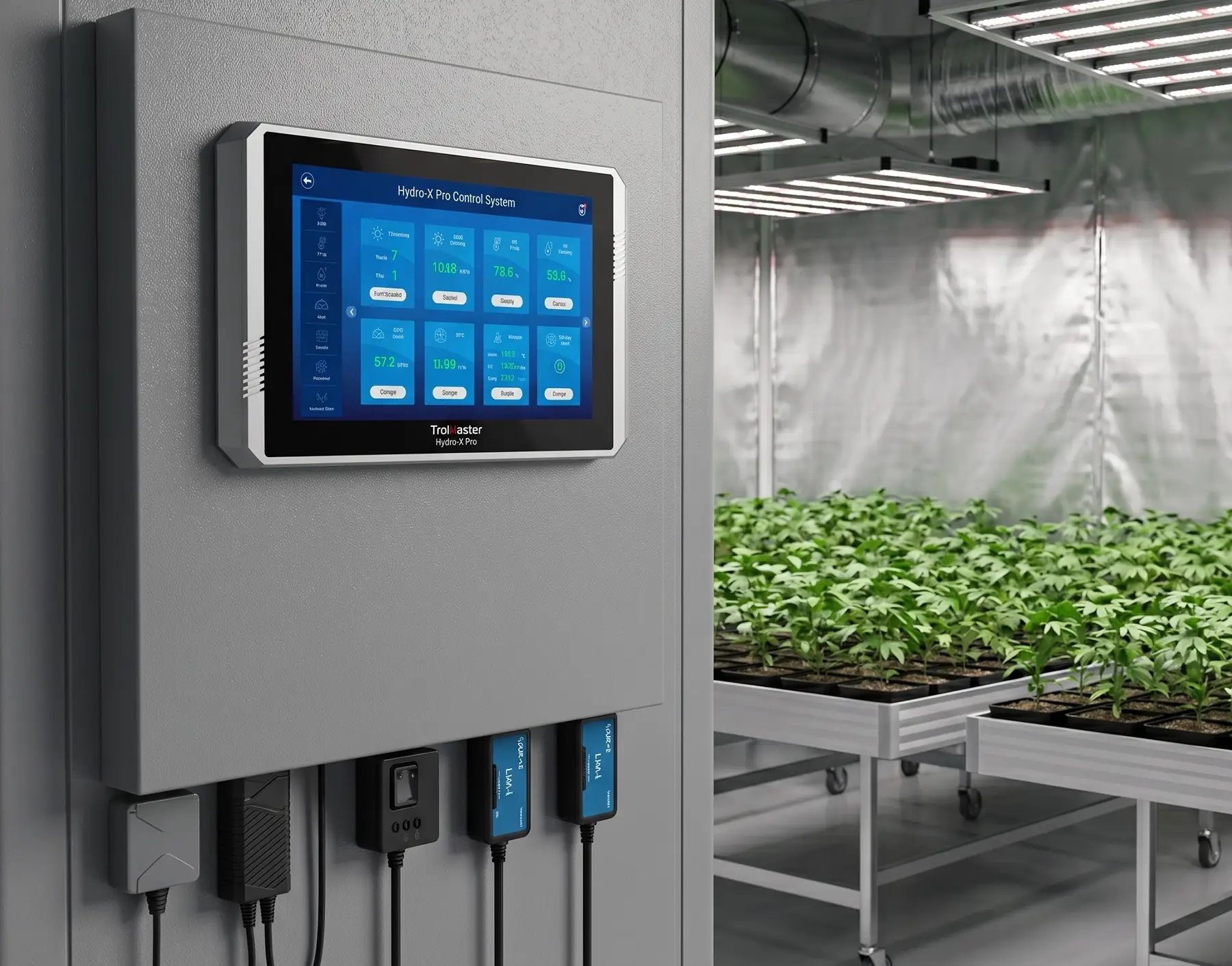
Pair AC with an environmental controller. A thermostat turns the AC on when it’s too hot. An environmental controller like the TrolMaster Hydro-X PRO turns the AC on in coordination with your dehumidifier, lighting schedule, and CO₂ supplementation to maintain a target VPD at the canopy — a meaningfully different (and better) outcome.
Don’t neglect air circulation. Even a correctly sized AC unit creates cold spots and dead zones if air isn’t being circulated effectively. Horizontal airflow fans and vertical circulation fans distribute conditioned air evenly through the canopy and prevent microclimates.
For Commercial Operations: Multi-Room Climate Control
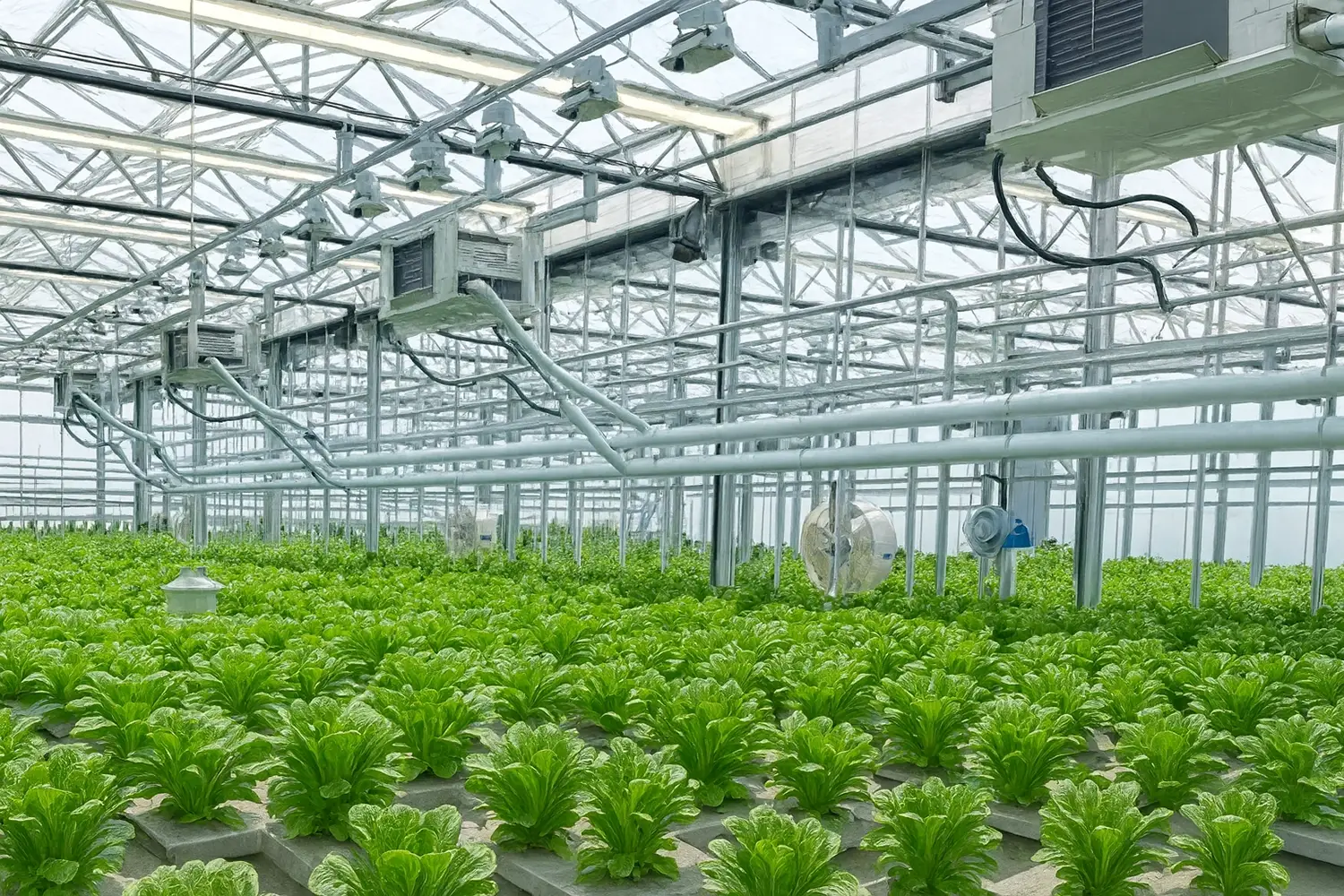
Facilities running multiple flower rooms, a dedicated veg room, and dry/trim areas are managing multiple distinct thermal environments under one roof. A few key principles that change at this scale:
Size each zone independently. The thermal load in a flower room at Week 7 with dense canopy is different from a veg room running the same square footage. Don’t average — calculate each room individually based on actual light load and dehumidifier configuration.
Plan for load diversity. Not all rooms are at peak load simultaneously. A multi-zone mini-split system or chilled water system with a central chiller can take advantage of this — the aggregate capacity needed is typically less than the sum of all room peak loads.
Dedicate environmental control per room. Multi-room operations benefit from a TrolMaster Hydro-X or Hydro-X PRO per room, each running independent crop-stage VPD programs. This lets you dial different temperature and humidity setpoints for veg, early flower, and late flower simultaneously without manual intervention.
Account for harvest room transitions. Room turnover generates significant thermal events — cleaning, drying down, restarting equipment. Build 25–30% additional headroom into rooms that cycle frequently.
For large-scale facility design support, contact the Hydrobuilder Commercial Accounts team.
Why Shop Grow Room ACs at Hydrobuilder
At Hydrobuilder, we carry the full range of grow room cooling solutions — from compact tent units to multi-zone commercial mini-splits — with expert support from people who understand indoor cultivation, not just HVAC specs. Every unit we stock has been evaluated against real grow room performance, not just manufacturer datasheets. If you’re unsure what size or type is right for your setup, our grow specialists are available to work through your heat load with you before you buy.