

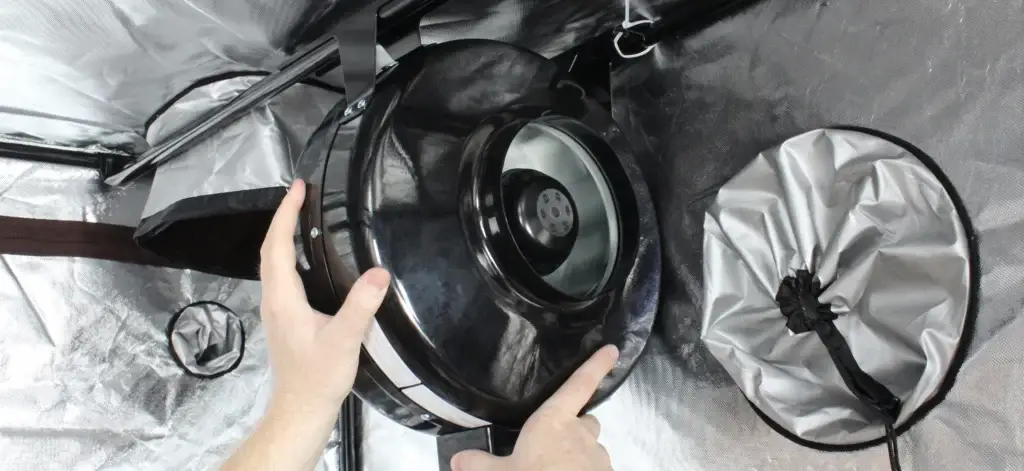
Choosing the best inline fan for your grow room is one of the highest-impact decisions you’ll make for your environment — and one of the easiest to get wrong. The right inline fan moves the right volume of air, operates quietly enough to live with long-term, and works with your controllers and carbon filters without killing efficiency. The wrong one costs you in heat stress, mold pressure, or a controller that can’t talk to it.
This guide covers everything you need to pick correctly: how inline fans actually work, what CFM you need, why motor type matters more than most growers realize, and which fans earn their place in a real grow — from a 2×4 tent to a multi-zone commercial facility.
Whether you’re a hobbyist dialing in a 4×4 tent or a commercial operator managing climate across multiple rooms, this guide has a path for you. Jump to For Commercial Operations if you’re running large-scale.
What an Inline Fan Actually Does (and What It Doesn't)
An inline fan is an exhaust and air exchange tool — its job is to pull stale, humid, heat-laden air out of your grow space and replace it with fresh air from outside. It does this continuously or on a cycle, helping keep CO₂ levels from depleting, temperature from climbing, and humidity from reaching disease-promoting levels when correctly sized and ducted.
What an inline fan is not: a circulation fan. A circulation fan (oscillating or horizontal airflow) moves air within your canopy to strengthen stems and prevent microclimates. Both are essential, but they do fundamentally different jobs. Your inline fan handles air exchange; your circulation fans distribute that conditioned air evenly.
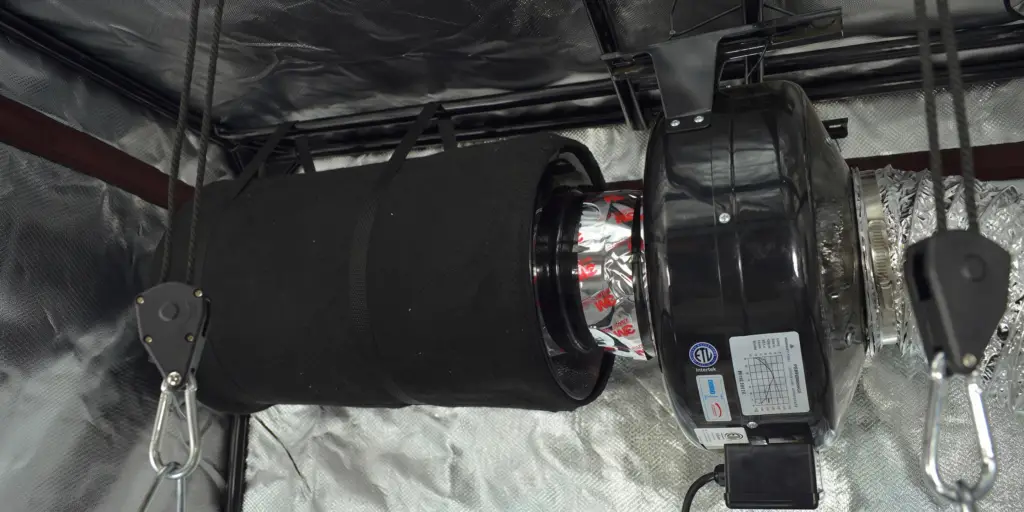
Inline fans are typically paired with a carbon filter on the intake or exhaust side to control odor, and connected with flexible ducting to direct airflow in and out of the space.
How to Size an Inline Fan: CFM Explained Simply
The short answer: for most small and mid-size hobby grow rooms, a good starting point is sizing your fan so it can replace all the air in your grow space about once per minute, then adjusting upward for real-world losses. That CFM target — adjusted upward for carbon filters, ducting, and heat load — is your practical minimum for many tent and room applications.
Here’s how to calculate it:
Step 1: Calculate room volume Length × Width × Height = cubic feet. A 4×4×8 tent = 128 cubic feet.
Step 2: Add a 25% buffer for carbon filter resistance Carbon filters typically reduce your fan’s effective airflow by roughly 20–25% at common operating pressures. Size up accordingly. That 4×4×8 tent needs a fan rated for at least about 160 CFM, not 128 CFM, when a carbon filter and ducting are included.
Step 3: Add heat load factor if running HID lighting High-intensity discharge lights (HPS, CMH) generate significantly more heat than most LED systems at similar wattage, often requiring additional exhaust capacity or duct size. If you’re running HID, adding another 25% to your CFM target — or stepping up a duct size entirely — is a common design adjustment.
Step 4: Match flange size to your carbon filter If you already have a 6″ carbon filter, you need a 6″ fan (or reducers designed for that combination). Flange mismatch is one of the most common (and avoidable) setup mistakes because reducers add turbulence and static pressure.
| Grow Space | Volume | Recommended Fan (with carbon filter buffer) |
|---|---|---|
| 2×2 tent | 32 cu ft | 4" fan, roughly 150–200 CFM |
| 4×4 tent | 128 cu ft | 6" fan, roughly 200–350 CFM |
| 5×5 tent | 200 cu ft | 6–8" fan, roughly 300–450 CFM |
| 4×8 tent | 256 cu ft | 8" fan, roughly 400–600 CFM |
| 10×10 room | 800 cu ft | 10" fan, roughly 700–1,000 CFM |
| Commercial room (20×20) | 3,200 cu ft | 12"+ or multiple units, 2,000+ CFM depending on load |
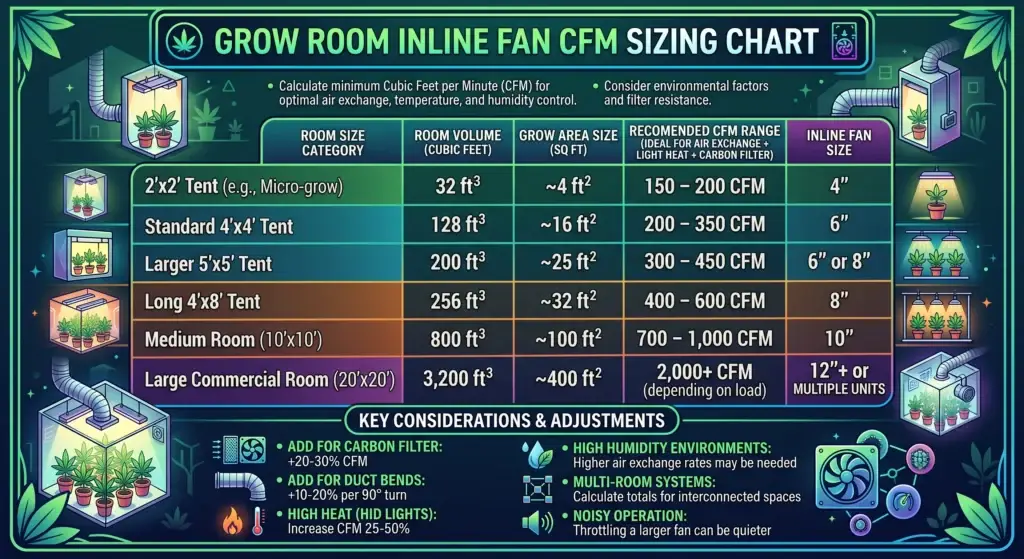
These recommendations assume one air change per minute as a baseline and include a buffer for filter and duct losses; higher-heat or high-density commercial rooms may require higher ACH targets and additional capacity.
AC Motor vs EC Motor: The Decision That Actually Matters
Most growers shop by brand and price. The decision that actually determines long-term performance, controllability, and operating cost is motor type.
AC (alternating current) motors are the traditional standard — reliable, affordable, and simple to replace. They pair well with basic fan speed controllers and are forgiving of simple infrastructure. The trade-off: they’re generally louder than comparable EC alternatives at equivalent airflow, typically less efficient at partial speeds, and can generate harmonic buzz with certain triac-style controllers.
EC (electronically commutated) motors are brushless, variable-speed, and significantly more energy-efficient — especially at reduced speeds, which is where most inline fans run most of the time. They’re often quieter at equivalent CFM, and many EC models are compatible with 0–10V speed control signals from environmental controllers when the fan and controller are designed to work together (for example, TrolMaster-compatible fans and building management systems that output 0–10V). They usually cost more upfront and require compatible controllers — an EC fan that expects a 0–10V or digital control signal should not be paired with a basic triac speed controller.
The practical rule: If you’re running a single tent and a basic speed dial, an AC motor fan with a compatible controller is often fine. If you’re automating with environmental controllers or running multiple zones with variable demand, EC is typically worth the investment due to energy savings, better low-speed performance, and integration options.
Our Picks: Best Inline Fans for Every Grow
Budget Pick for Hobby Tents: Covert Smart Inline Fan
For hobbyists setting up their first tent — or anyone who wants solid, no-frills performance without the premium price tag — the Covert Smart Inline Fan delivers strong value for typical tent builds. Available in 4″, 6″, and 8″ configurations, it includes a built-in temperature and humidity sensor with an integrated controller, so you’re not buying the fan and a separate controller as two line items.
It’s not the quietest fan on the market, and it won’t integrate with external environmental controllers. But for a 4×4 or smaller tent where you want automated response without complexity, it handles the job at a price that leaves room in the budget for things that move the needle more — like better lights or a quality dehumidifier.
The Covert Carbon Air & Odor Filter is sized to match Covert fans and makes a clean pairing for odor control according to the product line design. If you’d rather bundle everything at once, the Covert Smart Ventilation and Odor Control Kit includes the fan, filter, and ducting — one SKU, one purchase.
Sizes & CFM: 4″ (around 205 CFM), 6″ (around 350 CFM), 8″ (around 500 CFM), with exact ratings depending on the specific model revision as listed on the product page.
Best for: Hobby tents up to roughly 5×5, growers who want built-in environmental control without a separate controller.
Best AC Motor Fan for Tent Growers: AC Infinity
Cloudline A Series
If you want a clean, quiet inline fan with a reliable included controller and don’t need integration with a broader environmental control system, the AC Infinity Cloudline A Series is a proven choice in the tent category. Available in 4″, 6″, and 8″, these fans use mixed-flow impellers and acoustic insulation to run quieter than many comparably priced inline fans at similar airflow levels.
The included controller provides 10 preset speeds and can automate based on temperature and humidity thresholds when paired with AC Infinity’s probes, giving you automatic adjustments without requiring a separate environmental controller. For most tent setups, this self-contained system is sufficient.
Best for: Hobbyists and intermediate growers who want hands-off automation in a self-contained package and prefer an inline fan with an included controller over a separate control system.
Best EC Fan with Environmental Control Integration: AC Infinity Cloudline PRO T Series
The AC Infinity Cloudline PRO T Series is the step-up for growers who want EC motor efficiency combined with AC Infinity’s UIS (Unified Intelligence System) environmental control ecosystem. Available from 4″ through 12″, the PRO T Series uses EC motors and pairs with UIS controllers for scheduling, trigger logic, and data viewing.
The EC motor provides meaningful energy savings when run at partial speed — which is how many fans operate most of the time — and the noise profile is noticeably lower than typical AC motor alternatives at equivalent airflow. For most tent growers and many small to mid-sized room operators who are already invested in the AC Infinity ecosystem, this is one of the primary fans to evaluate.
Sizes & CFM: 4″ models are commonly rated around 205 CFM, with larger models up to the 12″ range providing much higher CFM outputs; exact airflow varies by model and should be confirmed on the specific product listing.
Best for: Grow rooms up to roughly 10×10 (depending on heat load and design) and growers automating with AC Infinity’s controller ecosystem.
Best High-Volume Fan for Serious Growers: Can-Fan Max-Fan
For larger grow rooms, transitions into commercial scale, or anyone running 8″+ ducting with heavy light loads, the Can-Fan Max-Fan is one of the most trusted high-volume inline fans on the market. Available in sizes like 6″, 8″, 10″, and larger, the Max-Fan uses a mixed-flow design that moves high CFM at lower noise levels than many traditional centrifugal fans.
These fans are manufactured in Germany with fiberglass-reinforced or composite housings, carry commercial-grade safety listings such as ETL/UL/CSA depending on the model, and are backed by a 5-year warranty according to manufacturer and distributor documentation. They are not the cheapest option, but they are built for continuous-duty workloads in real grow environments, rather than being tuned solely for tent review specs.
The Max-Fan line runs on AC motors; if you need EC motor technology and 0–10V control integration for a high-volume application, stepping up to the Max-Fan Pro Series is recommended.
Sizes & CFM: Representative airflow ratings range from around 420 CFM for 6″ Max-Fan Pro units to roughly 2,343 CFM for larger formats like 14–16″, with exact CFM depending on the specific model and static pressure.
Best for: Rooms around 10×10 and up, HID-heavy or high-heat setups needing substantial heat extraction, growers who want proven durability and commercial-grade construction.
Best EC Fan for Commercial-Scale: Can-Fan Max-Fan Pro Series
The Can-Fan Max-Fan Pro Series takes the Max-Fan platform and adds EC motor technology in select models — providing variable speed via integrated controllers or external 0–10V signals (where supported) and significantly higher efficiency at partial speed. These fans are designed for commercial rooms where fans run for long hours and energy costs accumulate over time.
Best for: Commercial grow rooms, controller-integrated multi-zone setups, and operations where long-term energy efficiency and noise control are important financial and operational considerations.
Best EC Fan for TrolMaster Integration: TrolMaster Aero-Fan
For grows already running TrolMaster environmental control, the TrolMaster Aero-Fan Inline Duct Ventilation Fan is one of the cleanest paths to fully automated ventilation. Available in 6″ through 12″ (with Pro Metal variants typically offered in 10″ and 12″), the Aero-Fan communicates directly with TrolMaster’s Hydro-X and Aero-X systems via its 0–10V interface on compatible models — eliminating the need for extra adapters in many setups.
Speed adjustments can respond to VPD targets, temperature triggers, light schedule transitions, or CO₂ levels when configured properly, all managed from a single TrolMaster interface. If you’re already invested in the TrolMaster ecosystem, this fan line helps close the loop on automated climate management.
Sizes & CFM: Representative airflow capacities range from around 388 CFM for 6″ models to roughly 1,080–1,180 CFM for 12″ Pro Metal models, with exact CFM depending on the specific SKU and static pressure rating; always check the product listing or datasheet for precise specs.
Best for: TrolMaster-controlled grow rooms and commercial operations prioritizing integrated automation and fine-grained 0–10V fan control.


What to Look for Beyond CFM: Features That Matter
Speed control type. A basic analog dial (triac controller) works fine with AC motor fans that are designed for it, but will cause harmonic buzz or incorrect operation with many EC fans that expect 0–10V or digital control. Know your motor and controller type before buying a controller.
Noise level. Decibel ratings are rarely standardized across brands — 45 dB on one fan may sound different than 45 dB on another depending on frequency profile and test distance. Double-insulated housings, vibration-dampened mounts, and flexible duct connections make a real difference for in-room grows.
Warranty. Inline fans are mechanical devices under continuous stress. A 5-year warranty (as offered on many Can-Fan Max-Fan and Max-Fan Pro units) versus a 1-year warranty on some budget options reflects real engineering confidence and expected service life. Budget fans often fail at the bearing seal or electronics within a few years of continuous operation.
Certifications. ETL, UL, and CSA listings matter if your electrical inspector is paying attention, or if you’re in a licensed facility that requires listed equipment. Choosing fans with appropriate third-party safety certifications supports compliance and reduces risk for commercial operations.
Pairing Your Fan: Carbon Filters and Ducting
An inline fan running without a carbon filter is an incomplete exhaust system in most grow situations where odor control matters. Carbon filters work by passing air through activated carbon media, trapping volatile organic compounds before they exit your space. Sizing rule: your carbon filter CFM rating should match or exceed your fan’s rated CFM, and the flange size must match.
For odor control guidance and carbon filter selection, see our full guide on grow room odor control.
For a broader look at how your inline fan fits into the complete ventilation picture — negative pressure, passive vs active intake, duct routing, and CO₂ replenishment — see our grow room ventilation setup guide.
For Commercial Operations: Multi-Zone Ventilation Architecture
Single-fan residential thinking doesn’t scale to commercial growing. In a commercial facility — whether a licensed cannabis cultivation operation, a vertical farm, or a large-scale greenhouse supplemental ventilation setup — inline fans are one component in a larger climate architecture, not a standalone solution.
Zone-based approach. Commercial rooms typically require multiple exhaust points to avoid stagnant zones, particularly in canopy-dense configurations. A single 12″ fan rated at around 1,700+ CFM may theoretically cover a 20×20×10 room (approximately 4,000 cubic feet), but in practice a single exhaust point can create uneven airflow distribution. Two or more appropriately sized fans at opposing exhaust points will provide more uniform air exchange at the same total CFM.
Redundancy and serviceability. Commercial ventilation layouts often include N+1 redundancy — enough capacity that a single fan failure doesn’t compromise environmental control — and allow for fan replacement without taking a room offline. This is critical for facilities where crop value and compliance requirements are high.
EC fans as best practice at commercial scale. The energy difference between AC and EC motor fans is manageable at hobby scale. At commercial scale — fans running near-continuously across multiple rooms — the efficiency gap, improved controllability, and reduced noise of EC fans typically compound into meaningful operating cost savings and better climate stability. Can-Fan Max-Fan Pro Series and TrolMaster Aero-Fan families are widely used examples in commercial EC applications.
VFD (variable frequency drive) control. For very high-volume applications — 12″+ fans on large rooms — pairing appropriate fans with TrolMaster’s Hydro-X VFD Station or similar hardware enables precise speed modulation tied to environmental parameters. This helps maintain target VPD ranges across growth stages without manual adjustment.
Pressurization management. Commercial rooms are often maintained at slight negative pressure (commonly targeted in the −0.02 to −0.05 inches water column range) to help prevent uncontrolled air leakage and odor. This typically requires slightly higher exhaust capacity than intake — often on the order of a 10–15% exhaust-to-intake imbalance — but exact setpoints and airflow ratios should be confirmed with mechanical design professionals and local codes.
Automation integration. For TrolMaster-based rooms, the TrolMaster Aero-Fan with Hydro-X integration allows VPD-triggered fan speed curves, day/night speed differentials, CO₂-correlated ventilation adjustments, and remote monitoring when configured properly. For rooms running separate environmental control systems with standard 0–10V outputs, Can-Fan Max-Fan Pro Series and similar EC fans that accept 0–10V signals can integrate into those systems.
For more on commercial grow room design, including lighting layouts, dehumidification sizing, and zone planning, see our grow room example designs and grow room air conditioner sizing guide.
Why Buy Inline Fans at HydroBuilder
HydroBuilder carries the full spectrum of inline fan options — from entry-level tent fans to commercial EC units — alongside the carbon filters, ducting, controllers, and environmental monitoring equipment needed to build a complete ventilation system. Our team has hands-on experience with the products we carry, and our support staff can help you size and specify a ventilation setup for a wide range of grow configurations.
Browse our full inline fan selection, or contact us if you need help sizing for a specific application.
💨 Grow Room Ventilation FAQ: Everything You Need to Know About Inline Fans
Q: What size inline fan do I need for a 4×4 grow tent?
A: A 4×4×8 grow tent holds approximately 128 cubic feet of air. With a 25% buffer for carbon filter resistance and basic ducting, target a fan rated for about 160–200 CFM minimum. A 6″ fan in the roughly 200–350 CFM range is the standard choice for this space, giving you headroom for hotter summer conditions or heavier odor control setups.
Q: Do I need an inline fan for a grow tent?
A: Yes — an inline fan is essentially required for any enclosed grow if you are not using a fully sealed, mechanically conditioned, CO₂-enriched design. Without active air exchange, CO₂ can deplete within a few hours of lights-on, heat from grow lights accumulates, and humidity can rise to levels that encourage botrytis and powdery mildew. Even a small, budget-priced fan running the correct CFM for your space goes a long way toward preventing all three of these problems.
Q: What is the difference between an inline fan and a circulation fan?
A: An inline fan handles air exchange — it pulls stale, humid, heat-laden air out of your space and draws fresh air in. A circulation fan (oscillating, horizontal airflow, or vertical flow) distributes that fresh air within your canopy, helping prevent microclimates and strengthening plant stems. Both are essential; they are not interchangeable. Your inline fan should be sized to your room volume and heat load; your circulation fans should be positioned based on your canopy layout.
Q: How do I calculate CFM for my grow room?
A: Multiply your room’s length × width × height to get cubic footage, then divide by 1 to get a baseline CFM target of one air exchange per minute for many hobby applications. Add around 25% for carbon filter and duct resistance. Add another 25% if running HID (HPS or CMH) lighting due to additional heat load. That total is your minimum fan CFM rating; for a 4×8×8 room: 256 cu ft × 1.25 (carbon filter) ≈ 320 CFM minimum, and higher targets may be appropriate for hotter environments or commercial densities.
Q: What is an EC inline fan and is it worth the cost?
A: EC (electronically commutated) motors are brushless and variable-speed, maintaining high efficiency across their full speed range compared to many AC motor fans. Unlike AC motor fans that often lose efficiency significantly when throttled back with simple triac controllers, EC fans are designed to stay efficient at partial speeds — which is where most fans run most of the time. Many EC fans are compatible with 0–10V environmental controller outputs and are substantially quieter at equivalent CFM. For a single hobby tent, the premium may or may not pencil out depending on priorities; for commercial grows or controller-integrated setups where fans run continuously, EC efficiency compounding over 12 months usually makes the cost difference straightforward.
Q: Can I connect an inline fan to a carbon filter?
A: Yes — and in most grow situations that require odor control, you should. The carbon filter typically sits on the fan’s intake side (pulling air through the carbon media before exhausting), or on the exhaust side depending on your duct routing and space constraints. The filter’s CFM rating should match or slightly exceed the fan’s CFM, and the flange diameter must match; using reducers introduces extra static pressure and turbulence.
Q: How loud is a typical inline fan?
A: This varies significantly by motor type, housing design, size, and speed. Budget AC motor fans in the 6″ category often measure somewhere in the 45–55 dB range at full speed under common test conditions, which is noticeable in a quiet room. Many premium inline fans with acoustic housings and EC motor fans (such as AC Infinity Cloudline and TrolMaster Aero-Fan models) are typically rated around the mid-30s to mid-40s dB at moderate speeds, with EC fans often dropping below 35 dB when running at reduced speed; exact noise ratings depend on the specific model and test method.
Q: How often should I run my inline fan?
A: Most growers run inline fans continuously during lights-on and at reduced speed during lights-off, allowing some CO₂ to accumulate slightly overnight when plants are not photosynthesizing. In high-humidity environments or during vegetative stages with heavy transpiration, 24/7 operation is common. Fans with environmental controllers (temperature and humidity triggers) can automate this without manual scheduling — the fan ramps up when RH or temp exceeds targets, then returns to a minimum speed when conditions normalize.
Q: What's better for a grow tent — an inline fan with a built-in controller or a separate speed controller?
A: Built-in controllers (like those included with the Covert Smart Inline Fan and AC Infinity Cloudline A Series) consolidate equipment and are the cleaner choice for most tent growers who want simple automation. Separate controllers give you flexibility to upgrade either component independently and, with EC fans that accept external control, enable integration with environmental control systems like TrolMaster or other 0–10V-based controllers. If you’re running a single tent and not planning to automate further, a fan with a built-in controller is simpler; if you’re scaling or integrating with a broader control system, a separate EC fan and controller is more future-proof.
Q: How do commercial growers manage inline fan ventilation across multiple rooms?
A: Commercial operations commonly use zone-based ventilation with multiple fans per room (often two or more exhaust points per zone for uniform air exchange), EC motors for energy efficiency at continuous runtime, and integration with 0–10V environmental controllers for automated speed adjustment tied to VPD, temperature, and CO₂ targets. Slight negative pressure (typically targeted in the −0.02 to −0.05 inches water column range) is maintained in many facilities to help prevent odor migration between zones and uncontrolled infiltration, though final values should align with mechanical design and code requirements. Systems like TrolMaster Hydro-X and Aero-X are widely used for this level of automation in controlled environment agriculture.